Private Label Cosmetic Bags: From Your Own Label to First Shipment
Executive Summary
Private label cosmetic bags are bags built to a specification the brand owner controls and sold under that brand's own name, and the question behind most first enquiries is what that actually buys compared with putting a logo on a design that already exists. The answer is specification ownership. White label applies brand elements to a design that is already tooled and already proven; private label develops the product to a written brief the buyer supplies, covering pattern, materials, hardware, interior layout and construction. On programmes coordinated through QUANZHOU JUNYUAN BAGS the commercial frame is the same either way: minimum order quantity 500 pieces per style and colourway, sampling in 6-10 working days, bulk production 35-50 days after sample approval, and inspection at AQL 2.5 under ISO 2859-1 before release.
The cost of the two routes diverges rather than the brand layer. A white label order spends its budget on units, brand elements and packaging; a private label order also buys development, pattern work and hardware sourcing, and that fixed content has to be amortised across the first run. Brand owners who skip that arithmetic are the ones surprised by a first-order unit price.
Two responsibilities sit with the brand owner and cannot be delegated: trademark clearance for the mark being applied, and written rights to any artwork or licensed design reproduced on the bag or the hangtag. This guide covers what a programme includes, the commercial mechanics of each route, the timeline to first shipment, unit-cost drivers and the documentation an importing brand must hold.
What a Private Label Cosmetic Bag Programme Actually Covers
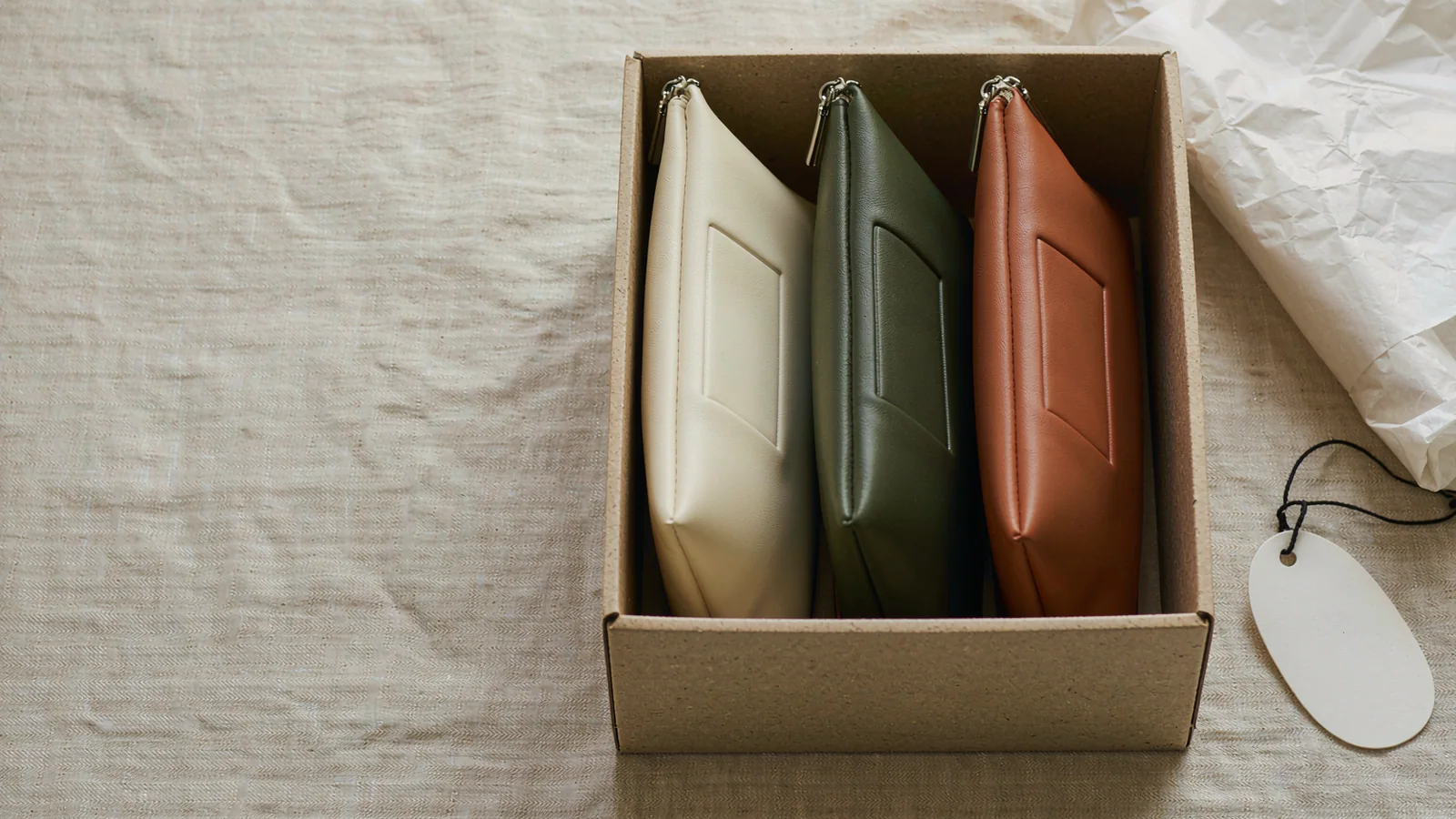
A private label cosmetic bag is a bag built to a specification the brand owner controls and sold under that brand's own name, with the brand's own woven label, hangtag, care label and retail packaging applied before it reaches the shelf. The phrase is used loosely in the trade, so it is worth separating what it covers from what it does not. It covers specification ownership: the shell fabric, the dimensions, the interior layout, the closure hardware and the construction method are chosen and documented by the buying brand. It covers applied brand elements: the identity layer that turns a generic pouch into a branded product. What it does not automatically cover is design work. A brand can run a private label programme on a design that already exists, and a large share of first orders do precisely that.
The distinction matters because the two things buyers usually mean by private label carry very different obligations. Where the product specification already exists and is already tooled, the brand owner's decisions sit in a narrow band: which base design, which colourway, which brand elements, which retail pack. Where the specification is developed to the brand's own brief, the decision set widens to include pattern geometry, material selection from the mill upwards, hardware sourcing, structural testing and, in most programmes, a written agreement about who holds the pattern. Both are private label in the commercial sense, because the bag carries the buyer's brand rather than any production-side name, but only one involves product development.
| Programme element | Who decides it | Input the brand owner must supply | Effect on the sampling window | Evidence to keep on file |
|---|---|---|---|---|
| Shell fabric and coating | Brand owner, on technical advice | Stated material, weight in g/m², denier, coating type and colour reference | 0 days if a stock material; 2-4 days if a mill colour must be matched | Mill specification sheet and colour reference number |
| Pattern and outer dimensions | Brand owner | Width x height x depth in cm with a stated tolerance | 0 days for a stock pattern; 3-5 days for a new pattern | Approved sample and signed dimension sheet |
| Lining and interior layout | Brand owner | Lining material, pocket count, elastic loop width, brush slot positions | 1-2 days for revisions to an existing layout | Interior photographs of the approved sample |
| Closure hardware | Brand owner | Zipper type and gauge, puller style, metal finish, tape colour | 1-3 days if a non-stock puller or finish is specified | Hardware specification with finish code and gauge |
| Applied brand elements | Brand owner | Vector artwork, Pantone references, label height in mm, hangtag copy | 2-4 days for the first label and print proof | Approved label proof and artwork release note |
| Retail packaging | Brand owner | Pack format, board weight in gsm, print method, barcode and copy | 3-6 days, runs partly in parallel with bulk | Approved dieline and barcode registration record |
| Compliance documentation | Shared, buyer sets the destination | Destination market, fibre content claim, any age grading | 0 days on sampling; affects test booking before shipment | Test reports and conformity declarations |
Reading the table as a contract rather than a checklist is the most useful shift a first-time buyer can make. Every row is a decision the brand owner makes and then evidences, not a service that arrives by default. A programme coordinator can propose a 600D polyester with a PU coating and quote it, but if the buyer never states what the coating must withstand, the quotation rests on an assumption and the sample passes by luck or fails on a criterion nobody wrote down. Where a specification cites a standard, cite it completely: coated fabric behaviour is commonly checked under methods such as ASTM D751 for coated fabrics, and naming the method removes an argument later.
- Specification ownership: the written spec belongs to the brand owner and is the reference against which bulk is judged.
- Applied brand elements: woven label, printed label, hangtag, swing ticket, care label, outer pack, and any exterior logo application.
- Development content: pattern making, material sourcing, hardware sourcing and proofing, where the design does not already exist.
- Compliance content: test booking, fibre and care copy, country-of-origin marking and any destination-market declaration.
- Excluded by default: trademark clearance, artwork licensing, marketplace listing, and import clearance in the destination country.
The last bullet is where most first programmes go wrong, because it is the least visible. A sourcing partner can produce a bag that carries a mark, but it cannot verify that the mark is available in the destination market, and it cannot grant rights to artwork the brand owner does not hold. Those are legal positions held by the importing brand. A brand owner who treats them as a paperwork footnote tends to discover the problem at customs or on a marketplace takedown, which is the most expensive possible moment. Putting trademark clearance and artwork rights at the front of the programme, before artwork is even drawn, costs nothing and removes the largest single category of launch risk.
White Label vs Private Label: What Each Route Actually Buys
White label and private label are used interchangeably in supplier conversations, which costs brand owners money because the two routes buy different things. A white label makeup bag is an existing, already tooled design to which the buyer applies brand elements: a woven label, a hangtag, a printed pouch, a branded carton. The product specification is fixed before the buyer arrives, so the buyer is selecting rather than developing. A private label bag in the stricter sense is built to a written brief the buyer supplies, with pattern, materials, hardware and construction decided by the buying brand. The identity layer applied at the end is identical in both cases. What differs is who holds the product specification and how much of the first invoice is development rather than units.
Demand context explains why both routes are busy at once. Search demand measured by ASINSIGHT in July 2026 put toiletry bag at roughly 74,810 weekly Amazon searches, with custom makeup bag in a 5,400-6,600 monthly band. Those are search volumes, not revenue, and they say nothing about margin, but they describe a market where generic product is heavily contested. A white label base buys speed into that demand; a developed specification buys a product harder to copy at the same price.
The commercial mechanics follow directly from the ownership split. White label compresses the decision set, so the sampling window is spent almost entirely on brand-element proofing rather than structural work, and the cash committed at first order is smaller because no pattern or hardware development is being funded. Private label widens the decision set and adds fixed costs that do not scale with quantity: a pattern has to be drafted and graded, a hardware finish has to be sourced, a first article has to be built and corrected. Those costs are real and they sit on the first order unless the programme spreads them across a larger run or across a written reorder commitment.
| Decision axis | White label route | Private label route | Where the difference appears commercially | Buyer who usually selects it |
|---|---|---|---|---|
| Design origin | Existing tooled design selected from a catalogue of held patterns | Pattern, dimensions and materials written by the brand owner and developed to order | Development time and the number of sampling rounds before approval | Launching brands testing a category before committing capital |
| Specification ownership | Shared: base spec fixed by the programme, brand layer owned by the buyer | Held by the brand owner and documented in a written specification | Whether a later design change requires re-patterning and new tooling | Brands building a repeatable range over several seasons |
| Minimum quantity | 500 pcs per style and colourway, with fewer internal decisions | 500 pcs per style and colourway, with more decisions inside each | Working capital committed before any unit is sold | Both routes; the difference is what sits inside the 500 |
| Sampling window | 6-10 working days, mostly brand-element proofs | 6-10 working days, extending to 12-15 for complex constructions | Calendar risk against a fixed launch or campaign date | Brands with a launch date already announced |
| Unit cost structure | Lower development content; cost driven by quantity and brand elements | Higher development content amortised across volume; cost driven by construction | The break-even volume at which the two routes converge | Brands planning a reorder within the same season |
| Exclusivity | The base design may be offered to other brands in the programme | The specification can be held for the brand owner under written agreement | Shelf differentiation and price protection over time | Brands selling through retail partners who require distinctiveness |
| Speed to first shipment | Shortest route to a sellable branded unit | Longer, because the specification is proven before bulk is booked | Whether the brand can meet a seasonal window at all | Brands filling a gap in an existing assortment |
A worked example makes the amortisation arithmetic concrete, and it should be read as an illustrative planning range derived from stated assumptions rather than a measured result. Assume a private label vanity case carries US$900 of development and setup content: pattern drafting, a custom woven label loom setup, a branded metal puller sourced in a specific finish, and a printed carton setup. Spread across 500 pieces that content adds US$1.80 to each unit. Spread across 5,000 pieces it adds US$0.18. The same bag, ordered white label with a stock puller and a header card instead of a printed carton, might carry under US$300 of setup, adding US$0.60 per unit at 500 pieces and US$0.06 at 5,000. The gap between the routes is therefore not a fixed number; it is a function of how many units the brand plans to buy before the design changes.
- Break-even thinking — the developed route only wins on unit cost once the volume is large enough to absorb fixed development content; the brand owner should state expected reorder volume before choosing.
- Exclusivity is negotiated, not implied — a held design is only held if a written agreement says so, and the term, territory and product scope should all be stated.
- Sampling rounds are a budget line — each additional revision round consumes calendar time and, on complex constructions, additional material.
- The brand layer is identical — woven label, hangtag, care label and pack can be specified to the same standard on either route, so route choice should be made on product grounds, not on branding ambition.
Applied Brand Elements: Woven Labels, Hangtags, Swing Tickets and Retail Packaging
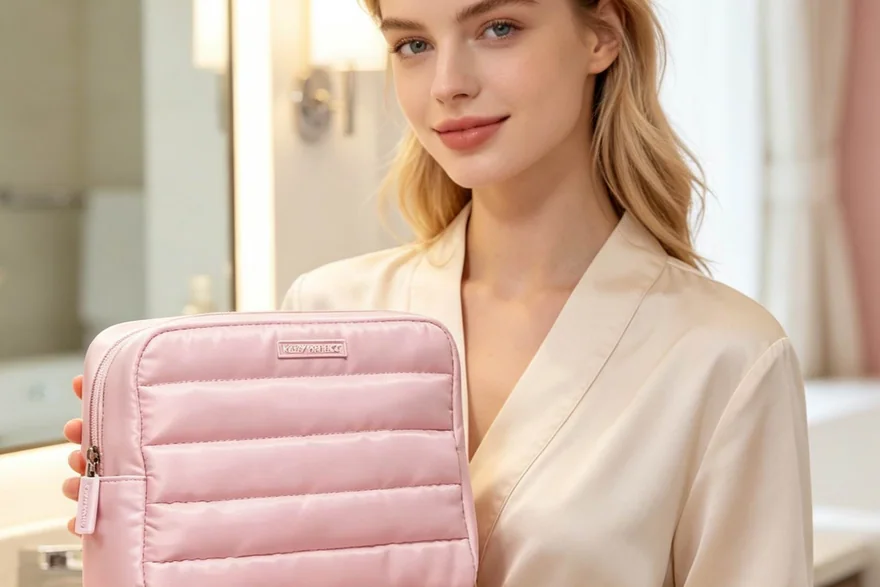
The brand layer is where most of a first programme's visible value sits, and it is also where most specification errors are made because the elements look simple. Six elements recur on a cosmetic bag programme: the woven label, the printed or heat-transfer label, the hangtag, the swing ticket, the care and content label, and the retail pack. A seventh, exterior logo application, is optional and method-dependent. Each has its own artwork format, its own dimension convention, its own minimum run set by the print or label shop, and its own proof that the brand owner must approve before bulk. Treating them as one line item called branding on a quotation is how buyers end up with a label that is the wrong height for the seam it was specified for.
Artwork format drives the proof cycle more than anything else. A woven label needs vector artwork with lettering converted to outlines and the colour count stated, because a damask loom carries a limited number of weft colours; a 72 dpi raster file either comes back wrong or triggers a redraw costing four to six working days. A printed label needs the same discipline plus a stated wash expectation, because a heat transfer on polyester lining behaves differently from a screen print on a coated shell. Colour fastness is normally checked against families of methods such as the ISO 105 colour fastness series and the AATCC test methods, and naming the method at specification stage prevents a dispute about a faded label.
| Applied brand element | Where it sits | Typical specification a buyer writes | Effect on MOQ and unit cost | Record it creates |
|---|---|---|---|---|
| Woven label | Inside back seam, or centred on the front panel | Damask or satin weave, 12-25 mm height, up to 4 weft colours, end-fold or mitred fold | No change to the 500 pc minimum; one loom setup per design plus a small per-unit addition | Approved label proof and Pantone reference list |
| Printed or heat-transfer label | Inside lining, or on an interior pocket face | Screen print or heat transfer, 1-4 colours, 40-60 mm wide, stated wash expectation | No change to the minimum; the lowest per-unit cost of the sewn brand options | Print proof and wash-test request record |
| Hangtag | Loop-attached to the zipper puller or carry handle | 300-400 gsm card, 50 x 90 mm typical, single or double sided, matte or gloss lamination | Print shop minimum often 500-1,000 pcs; per-unit cost falls sharply above that | Artwork file, print proof and copy approval |
| Swing ticket | Attached alongside the hangtag on the same loop | 70 x 120 mm typical, carries product story, ingredient or material claim, barcode and price field | Slight per-unit increase plus a small packing-time increment | Barcode registration and claim substantiation file |
| Care and content label | Inside side seam, or under the lining edge | Polyester satin or coated paper; fibre content, care symbols, country of origin, RN or equivalent identifier | No change to the minimum; copy must match the actual bill of materials | Compliance copy sign-off and fibre declaration |
| Retail packaging | Carton, printed sleeve, or polybag with a printed header | 250-350 gsm carton board or a 40-60 micron polybag; stated print method and dieline | Print minimum plus carton tooling; a visible per-unit effect at 500 pcs | Approved dieline and carton specification sheet |
| Exterior logo application | Front panel, or a debossed patch on the base | Embroidery, screen print, debossed PU patch, or a metal plate with a stated finish | Method-dependent setup; embroidery adds a digitising setup and a per-unit run cost | Logo proof and a stated placement tolerance in mm |
Two conventions save a great deal of rework. The first is to specify label height rather than label area, because a woven label is sold on loom width and the seam it is sewn into has a fixed allowance; a 20 mm label in a 10 mm seam allowance cannot be fitted after the fact. The second is to state a placement tolerance in millimetres on the exterior logo, because print and embroidery placement on a soft, unpadded panel will drift, and a brand owner who has not stated whether 2 mm or 5 mm is acceptable has no basis for rejecting a bulk lot that is visually fine. Where the closure itself is part of the brand story, the terminology in ASTM D2053 on zipper terminology gives buyer and programme a shared vocabulary for gauge, tape and puller type.
- Supply vector artwork with fonts converted to outlines and a separate Pantone list for every applied element.
- State label height in mm and the seam it will be sewn into, not just the logo file.
- State a placement tolerance in mm for any exterior print, embroidery or plate.
- Decide whether the hangtag and swing ticket are one print run or two, because this changes the print minimum.
- Confirm that care copy matches the actual bill of materials before the care label goes to print.
The hangtag and swing ticket deserve a specific warning. They carry claims the brand owner has not substantiated and artwork the brand owner may not own. A tag stating a recycled content percentage needs a chain-of-custody document; a tag carrying a licensed character needs a written licence naming the category, territory and term; a tag reproducing a protected mark is an infringement regardless of who printed it. Proofing checks that the artwork matches the file supplied, not that the brand owner had the right to supply it.
Trademark clearance for the mark applied to a bag, and written permission for any licensed character, collaboration mark or third-party artwork reproduced on a label, hangtag or pack, are the responsibility of the brand owner. A protected mark may not be reproduced without written permission from its owner, and a programme cannot grant that permission on the owner's behalf.
Timeline to First Shipment, Built From the 6-10 Day and 35-50 Day Windows
The two published windows, 6-10 working days for sampling and 35-50 days for bulk, describe only the middle of a programme. A first shipment is gated by everything before and after them: writing the specification, sourcing materials, proofing brand elements, approving the sample, booking inspection and loading the container. Brand owners who plan a launch by adding 10 and 50 together consistently miss their window by three to five weeks. The realistic method is to treat the programme as a sequence of stages, each with a trigger to start, a deliverable that closes it, and a known set of causes that extend it, then to add the buyer's own decision time on top rather than assuming decisions are instantaneous.
| Programme stage | Illustrative working days | Runs in parallel? | Buyer action that closes the stage | What extends it |
|---|---|---|---|---|
| Brief and specification writing | 2-5 | No | Return a written spec covering dimensions, materials, hardware and brand elements | Missing dimensions, no stated tolerance, undecided closure type |
| Material and hardware sourcing | 3-8 | Yes, alongside pattern work | Approve the material submission and the colour reference | Specifying a mill colour with no physical reference or Pantone code |
| Brand-element proofing | 2-4 | Yes, alongside pattern work | Approve label, hangtag, print and packaging proofs | Artwork supplied as raster, or a colour count above the loom limit |
| Sample build | 6-10, or 12-15 for complex constructions | No | Approve or annotate the physical sample in writing | Undecided reviewers, or approving without a written record |
| Sample revision, if required | 4-8 per round | No | Approve the revised sample and restate the bulk reference | Changing material or hardware midway through a revision round |
| Bulk production | 35-50 after sample approval | No | Confirm the approved sample as the bulk reference standard | Any specification change after approval; late artwork changes |
| Inspection at AQL 2.5 | 1-3 | At the end of bulk | Accept the report, or agree a rework and re-inspect plan | Booking inspection after the vessel cut-off has passed |
| Consolidation and FOB Xiamen loading | 3-7 | Partly alongside inspection | Release the 70 balance against the bill of lading | Late balance payment, incomplete packing list or carton markings |
Running those numbers produces two very different calendars, and the difference is almost entirely in the front end. A white label programme on a stock material with a stock puller and a header card might read: 2 days brief, 6 days sampling, one 5-day revision round, 35 days bulk, 2 days inspection, 4 days consolidation, for roughly 54 working days or about 11 calendar weeks. A private label programme with a new pattern, a custom woven label and a printed carton might read: 5 days brief, 12 days sampling on a complex construction, one 8-day revision round, 45 days bulk, 3 days inspection, 5 days consolidation, for roughly 78 working days or about 16 calendar weeks. Both are inside the published windows; the variance comes from decisions the buyer makes in the first fortnight.
- Freeze the specification before sampling starts, including tolerance on every dimension and placement.
- Supply vector artwork and Pantone references at the same time as the brief, not after the first sample.
- Name one approver with authority to sign off the sample, and a deputy for absences.
- Book inspection against the production finish date, not against the vessel date.
- Hold a calendar buffer for the destination market's own clearance and inland freight before the on-sale date.
Seasonality is the other variable a first-time buyer underestimates. Bulk capacity on a floor with a stated monthly output of 200,000 pieces is finite, and first-quarter public-holiday shutdowns, peak-season container availability and destination-market customs congestion all sit outside the production window. A brand owner planning a launch should work backwards from the on-sale date, subtract inland freight and clearance, subtract the shipping leg, subtract inspection and consolidation, and only then see whether 35 or 50 days of bulk fits. If it does not, the options are to simplify the construction to pull the sampling window back toward 6 days, to accept a stock material, or to move the launch.
Inspection closes the programme and is the point at which the specification earns its keep. AQL 2.5 under ISO 2859-1 sampling procedures sets the sample size and the accept and reject numbers for a given lot size; on a 500-piece order it does not mean 2.5 per cent of units may be defective in the abstract, it means the lot is accepted or rejected according to the switching procedure and the defect classification agreed in writing. A private label order adds a wrinkle: with three brand elements on the bag, each element becomes a defect class of its own. A misplaced woven label, a care label with the wrong fibre content and a scuffed carton are three separate findings, and the brand owner should say in advance which of them is critical and which is minor.
Unit-Cost Drivers and the Commercial Mechanics of Each Route
Unit price on a cosmetic bag programme is not a single number pulled from a list; it is the sum of a material conversion, a labour content, brand-element costs and a share of fixed setup, divided by the order quantity. Brand owners who understand which of those four is moving get better outcomes from a quotation than those who ask for a cheaper price. The levers that matter most on a first order are quantity, because fixed content is spread, and complexity, because labour minutes are counted per unit. The ones that matter most on a reorder are material consolidation and hardware standardisation, because both reduce setup repetition across a range.
Material is usually the largest variable line. A 300D polyester at a stock colour and a 600D recycled polyester at a mill-matched colour can differ by a meaningful amount per metre, and the difference is multiplied by marker efficiency and by whether the coating is specified. Recycled content adds a documentation obligation as well as a cost: a claim on a swing ticket or a care label normally has to be traceable through a chain-of-custody standard such as the Global Recycled Standard, and the paperwork has a cost in time if not in money. Buyers who want the marketing claim should budget for the audit trail that supports it.
| Unit-cost driver | How it is priced | Illustrative planning range of effect | Fixed or variable | Lever available to the buyer |
|---|---|---|---|---|
| Order quantity | Development and setup content spread across more units | At a stated US$900 of development content: US$1.80 per unit at 500 pcs, US$0.18 at 5,000 pcs | Fixed in total, variable per unit | Consolidate colourways into one order to clear the 500 pc minimum once |
| Shell material and coating | Per metre, converted through the cutting marker | Stock 300D polyester against a mill-matched 600D recycled polyester: a difference measured in tens of US cents per unit | Variable | Choose a stock colour from the held shade card rather than a mill match |
| Construction complexity | Labour minutes per unit, priced at a stated line rate | Adding a structured base and four interior pockets can add several minutes of sewing time per unit | Variable | Simplify the interior architecture on the first run and add features at reorder |
| Closure and hardware | Per piece, plus any finish or tooling setup | A stock puller against a custom-finished metal puller: from a few US cents to over one US dollar per unit | Variable, plus a fixed setup | Standardise one puller and finish across the whole range |
| Applied brand elements | Per piece plus a per-design setup | A woven label loom setup plus 500 labels; a hangtag print setup plus the print run | Mixed | Use one label design across several styles so the setup is amortised further |
| Retail packaging | Per carton or header plus print setup and tooling | A printed carton at 500 units carries far more setup per unit than at 5,000 | Mixed | Start on a printed header card, move to a carton once reorder volume is proven |
| Testing and compliance | Per test, per style and per colourway submitted | Testing three colourways of one style costs roughly three times testing one colourway | Fixed per programme | Test the highest-risk colourway and document the rationale in writing |
| Freight and shipment terms | Per shipment, quoted FOB Xiamen | Consolidating two styles into one shipment shares handling cost across both | Fixed per shipment | Ship styles together rather than booking separate lots |
Every figure in the table is an illustrative planning range derived from the stated assumption given in the same row, not a measured result, not a quotation and not a forecast of achievable margin. Brand owners should use it to structure a budget conversation and then replace each illustrative number with a written figure from an actual quotation.
Payment structure interacts with cost in a way first-time buyers rarely model. T/T 30 deposit and 70 against bill of lading means 30 per cent of the order value leaves before bulk starts and the remaining 70 per cent before documents are released, so the cash cycle is front-loaded against the revenue cycle. A 500-piece first order with a printed carton and custom puller funds development, packaging and then the balance before a single unit sells. That is an argument for stating expected reorder volume early, so fixed content is quoted against a realistic total.
- Ask for the quotation split by material, labour, brand elements and setup rather than as one unit price.
- Ask which cost lines are fixed per programme and which scale with quantity; this is the whole basis of reorder pricing.
- Ask what changes at 1,000, 2,000 and 5,000 pieces, and get those three numbers in writing before ordering 500.
- Ask which brand elements carry their own print or loom minimum, because those minima can exceed the bag MOQ.
- Ask whether testing cost is per style or per colourway, and budget accordingly before the test is booked.
The commercial judgement, stated plainly, is this: white label is the cheaper route to a first 500 units and the faster route to market, and private label is the better route when the brand expects to reorder the same specification and needs a product a competitor cannot buy from the same catalogue. Neither is universally correct, and the deciding inputs are reorder expectation, launch urgency and how much of the brand's differentiation is product rather than marketing. A brand whose differentiation is entirely in its logo, its photography and its channel should not pay for pattern development. A brand whose differentiation is a specific interior layout, a specific closure or a specific material behaviour should, because that is exactly what the developed route protects.
Compliance Documentation and the Brand Owner's Own Responsibilities
The importing brand, not the programme, is the party that answers to the regulator and to the marketplace. That is the single organising principle of this section. Documentation can be coordinated, test reports can be booked and collected, and declarations can be drafted, but the legal position at import belongs to the brand whose name is on the bag. A brand owner who has never imported before should assume that three sets of obligations apply at once: product-safety obligations in the destination market, labelling obligations about fibre content and origin, and claim-substantiation obligations about anything printed on a hangtag.
- Destination-market product safety: for the US market the applicable framework for regulated products includes the Consumer Product Safety Improvement Act, and any age grading the brand assigns drives which specific requirements attach.
- Chemical restrictions: placing goods on the EU market engages REACH, and restricting substances is the importer's obligation to evidence.
- Voluntary but commercially expected certifications: OEKO-TEX Standard 100 for tested textiles, and GOTS where an organic fibre claim is made.
- Fibre and care labelling: content must match the actual bill of materials, and care instructions must be defensible for the material specified.
- Country-of-origin marking: the marking rules of the destination market apply to the finished bag and, in many markets, to the retail pack.
- Test reports: held per style and per colourway where colour affects the result, dated, and traceable to the production lot.
- Commercial documents: commercial invoice, packing list, bill of lading and any declaration of conformity the destination requires.
- Trademark clearance — the brand owner must confirm the mark is available and registered, or registrable, in every market where the bag will be sold, before artwork is released to print.
- Artwork licensing — written permission is required for any licensed character, collaboration mark, artist work or third-party logo reproduced on a bag, label, hangtag or pack; a protected mark may not be reproduced without written permission from its owner.
- Claim substantiation — recycled, organic, vegan, water-resistant and similar claims need a document behind them, and the document should be held before the claim is printed.
- Labelling accuracy — fibre content, care symbols and origin marking must match the actual product; a mismatch is a compliance failure regardless of how the error arose.
- Age grading — if the bag is marketed to children, additional requirements attach, and the grading decision belongs to the brand owner.
Labelling rules are where private label programmes most often fail an audit, because the failure is boring rather than dramatic. A care label printed with a fibre content copied from a previous style, an origin marking that does not match the pack, or a swing ticket carrying a recycled percentage with no certificate number behind it are all findings that a customs authority or a retail compliance team will raise. The fix is procedural: build one copy deck per style, have it checked against the final bill of materials, and treat any change to materials as a trigger to recheck the copy. A bag whose lining changed from polyester to nylon cannot keep the old care label, and no amount of goodwill at the border changes that.
Travel-related claims deserve a note because they are common on cosmetic and toiletry bags and are frequently stated imprecisely. A bag described as carry-on compliant or airport friendly is making a claim about a rule the brand owner does not administer. Where the claim relates to carrying liquids through a checkpoint, the relevant rule is the TSA 3-1-1 liquids rule, and the honest way to write the copy is to state the bag's dimensions and its clear-panel construction and let the customer apply the rule, rather than asserting a certification that does not exist. The same discipline applies to any standards mark: a certification mark may only be used when the product is actually certified and the licence is current.
A sourcing and programme-management company cannot clear a trademark on the brand owner's behalf, and it cannot grant rights to artwork or marks belonging to a third party. Proofing confirms that the printed element matches the file supplied. Ownership of that file, and the legal right to reproduce it on a product, remain entirely with the brand owner.
Practically, the brand owner should hold one compliance folder per style before the first shipment sails, treated as a living document. Suggested contents: the final specification with revision history, the approved sample reference and photographs, the bill of materials with mill and hardware references, test reports with dates and lot references, certification certificates and validity dates, the approved copy deck for every label and tag, and the shipment document set. When a reorder is placed a year later, that folder is what makes it fast and answers a marketplace or regulator enquiry without a scramble.
The B2B Customisation View
Launch calendars are unforgiving, so cosmetic pouches, vanity cases and beauty organisers programmes are planned backwards from the on-shelf date rather than forwards from the first sketch.
Fixed commercial parameters: 500 pieces per style and colourway minimum, first sample in 6–10 working days (12–15 for complex or hardware-intensive constructions), bulk 35–50 days after approval, AQL 2.5 inspection under ISO 2859-1, FOB Xiamen, T/T 30/70.
A sourcing and programme-management company is answerable for the whole file, not just the sewing, which is why inspection reports and compliance documents are issued with every shipment.
Which Brand Types This Guide Serves
This guide is written for brand owners deciding whether to launch a cosmetic bag under their own name, and the decision set differs sharply by brand type. What is common to all of them is that the brand layer, the specification and the compliance file are three separate workstreams that happen to converge on the same physical object, and the programmes that run smoothly are the ones where the brand owner has named an owner for each.
- Start-up beauty brands: usually best served by the white label route on a first run, because the 500-piece minimum per style and colourway is already a meaningful inventory commitment and adding pattern development to it doubles the fixed content. The priority is a clean brand layer, a defensible care label and a reorder plan that justifies development on the second run.
- Established beauty and skincare brands: usually already hold a registered mark and a house artwork standard, so the private label route fits. The priority is specification ownership and a written agreement about who holds the pattern, plus consistency of brand elements across a range rather than per style.
- Retailers and own-label programmes: buy on both routes at once, white label for seasonal fill-in and private label for the core assortment. The priority is packaging that satisfies retail compliance, barcodes registered before the print run, and one care-copy deck reused across the range.
- E-commerce and marketplace sellers: need the shortest route to a listed, reviewable product, which favours white label with a strong hangtag and pack. The priority is that the listing copy, the care label and the swing ticket claims all match the actual product, because mismatch drives returns and takedowns.
- Gift, hospitality and promotional buyers: usually work to a fixed event date, which makes the 6-10 day sampling window and the 35-50 day bulk window the controlling constraint rather than unit cost. The priority is freezing artwork early and booking inspection against the production finish date.
One pattern recurs across every category: the brands that hit their launch date are the ones that treated specification writing as real work in the first week and trademark clearance as a prerequisite rather than a formality, and the brands that missed it are the ones that started sampling before either was finished. Sampling a bag whose brand name has not been cleared, or whose label artwork is still in draft, produces a sample that cannot be approved on time.
Frequently Asked Questions
What does private label mean for a cosmetic bag when the design already exists?
It means the bag carries the brand owner's name and brand elements while the underlying product specification belongs to the programme rather than to the buyer. The buyer selects a base design, a colourway and a set of applied elements, and the bag is then produced with those choices applied. The commercial effect is that the buyer owns the brand layer but not the pattern, so a later request to change the structure may require a different base design rather than a modification. This is the route most first orders take, and it is legitimate private label in the retail sense.
How does a white label makeup bag differ from a private label one in what the buyer owns?
On a white label bag the buyer owns the brand elements and the retail presentation; the product specification stays with the programme and may be offered to other brands. On a developed private label bag the buyer owns the written specification and, where a written agreement says so, the pattern developed from it. The practical test is what happens when the buyer wants to change the bag: a white label change is a re-selection, while a private label change is a specification revision. Buyers should get the position on pattern ownership in writing before paying for development.
Which brand elements can be applied to a cosmetic bag at a 500-piece minimum?
All of the standard elements can be applied at 500 pieces per style and colourway: woven label, printed or heat-transfer label, hangtag, swing ticket, care and content label, retail pack, and an exterior logo application by print, embroidery, patch or plate. The point to watch is that some elements carry their own minimum set by the print or label shop, and those minima can exceed the bag minimum. A hangtag print run with a 1,000-piece minimum leaves the buyer holding 500 spare tags, which is either a reorder asset or dead stock.
Who owns the tooling and pattern when a brand pays for a developed design?
Whatever the written agreement says, which is why the agreement matters more than the assumption. Tooling for a custom puller, a debossing plate or a carton die is usually paid for by the brand and held for the brand's use, while pattern ownership is negotiated. Without a written clause, a buyer may find the developed pattern available to other brands in the programme. The clause should state scope, territory, product category and term, and it should be agreed before development is invoiced rather than after.
What artwork files does a brand owner need to supply before label proofing starts?
Vector artwork with fonts converted to outlines, a separate Pantone reference list for every colour, and the label dimensions stated in millimetres. For a woven label the colour count matters because a damask loom has a limited weft colour capacity, so a four-colour design and a six-colour design are different quotations. Supplying a raster file at low resolution is the single most common cause of a delayed proof, because the artwork has to be redrawn and that redraw sits inside the sampling window.
Can a buyer reproduce a designer collaboration mark or a licensed character on a bag?
Only with written permission from the rights holder, and the permission must name the product category, the territory and the term. A protected mark may not be reproduced without written permission, and this applies to the woven label, the hangtag, the swing ticket and the retail pack equally. Trademark clearance and artwork licensing are the brand owner's responsibility, not something a programme can verify or grant. Reproducing a mark without permission exposes the importing brand to takedowns, seizure at the border and infringement claims.
How is a woven label specified so the first proof is correct?
State the weave type, the label height in millimetres, the fold style, the weft colour count and the Pantone references, and state which seam the label will be sewn into. Height matters more than area because the seam allowance is fixed; a label specified as 20 mm tall cannot be fitted into a 10 mm allowance after the fact. Also state whether the label is damask or satin, because the two have different minimum line weights and a fine logo that works on satin may close up on damask.
What does the 6-10 working day sampling window actually include?
It covers building the physical sample once materials, hardware and artwork proofs are available, not the brief, the sourcing or the proof approval that precede it. Complex constructions such as moulded EVA cases, structured vanity cases with internal frames, or bags requiring a new pattern take 12-15 working days instead. The window also excludes the buyer's own decision time, which is frequently the longest single component of a first programme. Two revision rounds inside the window are common on a developed design and should be planned for.
Why does bulk production take 35-50 days after sample approval?
Bulk starts only after the approved sample becomes the reference standard, and the window covers material procurement at production volume, cutting, printing or embroidering the brand elements, sewing, assembly, packing and consolidation. The spread between 35 and 50 days reflects construction complexity, whether materials are stock or mill-ordered, and where the order sits in the production schedule. A change requested after approval restarts part of the sequence, which is the most common cause of a bulk window extending beyond 50 days.
How does AQL 2.5 apply to a private label order with three brand elements?
AQL 2.5 sets the sampling plan and the accept and reject numbers for the lot, and each brand element becomes its own defect class within that plan. A misplaced woven label, an incorrect care label and a scuffed retail carton are three separate findings with potentially three different classifications. The buyer should agree in writing, before inspection, which findings are critical, which are major and which are minor, because that classification determines whether the lot passes. Booking inspection after the vessel cut-off removes the option to rework.
Which compliance documents must the importing brand hold before goods are released?
The commercial set, being invoice, packing list and bill of lading, plus the product compliance set: test reports traceable to the production lot, any certification certificates with valid dates, a declaration of conformity where the destination requires one, and the approved copy deck for every label and tag. Where the destination is the EU, chemical restriction obligations apply to the importer. Where the destination is the US, applicable product-safety requirements attach and any age grading the brand assigns drives which ones.
What labelling information does a cosmetic bag sold in the EU or US need to carry?
Fibre content matching the actual bill of materials, care instructions defensible for the material specified, country-of-origin marking per the destination's rules, and an identifier for the responsible brand. Claims such as recycled or organic content need supporting documentation before they are printed. The recurring failure is a care label copied from a previous style after a material change, which is a compliance finding regardless of intent. One copy deck per style, checked against the final bill of materials, prevents it.
How should a brand owner budget unit cost on a first 500-piece private label run?
Ask for the quotation split into material, labour, brand elements and setup, then ask which lines are fixed per programme and which scale with quantity. As an illustrative planning range derived from a stated assumption: if development and setup total US$900, that adds US$1.80 per unit across 500 pieces and US$0.18 across 5,000. That is arithmetic, not a measured result or a margin forecast. Then ask for unit prices at 1,000, 2,000 and 5,000 pieces before committing, so the reorder economics are visible.
When does moving from a white label start to a developed design make commercial sense?
When three conditions are met together: the brand expects to reorder the same specification, the differentiation that matters to the customer is in the product rather than only in the logo and photography, and the cash cycle can absorb development content being funded on the first run under T/T 30 deposit and 70 against bill of lading. If differentiation sits entirely in marketing, development spend buys nothing the customer perceives. If reorder volume is unknown, development content cannot be amortised and the first-order unit price will look uncompetitive.
People Also Ask
What is the difference between white label and private label makeup bags?
White label applies the buyer's brand elements to a design that already exists and is already tooled, so the buyer is selecting. Private label develops the bag to the buyer's written specification, so the buyer owns the pattern, materials and construction decisions. Both carry the buyer's brand, and both can use the same woven label, hangtag and pack. The difference shows up in development cost, sampling rounds, exclusivity and how a later change is handled: a white label change is a re-selection, a private label change is a specification revision.
How much does it cost to start a private label cosmetic bag line?
There is no single figure, because the total is a material cost, a labour cost, brand-element costs and a share of fixed setup, divided by quantity. As an illustrative planning range derived from a stated assumption, US$900 of development content adds US$1.80 per unit at 500 pieces and US$0.18 at 5,000. Those are planning figures, not measured results or margin forecasts, and a written quotation should replace them.
Can I put my own brand name on a makeup bag?
Yes, provided the mark is cleared for use in every market where the bag will be sold. The brand layer can include a woven label, a printed label, a hangtag, a swing ticket, a care label and a branded retail pack, all at the 500-piece minimum per style and colourway. What the brand owner cannot do is reproduce a protected mark belonging to someone else, or licensed artwork or a character, without written permission from the rights holder.
How long does a private label cosmetic bag order take?
Sampling runs 6-10 working days, or 12-15 for complex constructions, and bulk runs 35-50 days after sample approval. Those windows sit inside a longer programme that also includes brief writing, material sourcing, artwork proofing, inspection at AQL 2.5 and consolidation before FOB Xiamen loading. A realistic first shipment is roughly 11 to 16 calendar weeks, depending on how much of the design is developed rather than selected and on how quickly the buyer approves each stage.
Do I need a trademark before ordering private label cosmetic bags?
Not necessarily a registration, but the mark should be cleared and preferably filed before artwork is released to print. Trademark clearance is the brand owner's responsibility and cannot be delegated to a sourcing partner. Printing a mark that turns out to be unavailable, or that belongs to another party, wastes the label loom setup, delays the launch and can trigger marketplace takedowns or seizure at the border. Clear the mark first, then draw the artwork.
References & Standards
- ISO 2859-1 sampling procedures for inspection by attributes
- ASTM D2053 standard terminology relating to zippers
- AATCC TM61 colour fastness to laundering
- IEC 62321 determination of certain substances in electrotechnical products
- OEKO-TEX Standard 100 testing for harmful substances
- Textile Exchange Global Recycled Standard
- US CPSC CPSIA consumer product safety improvement act
- ECHA REACH regulation on chemicals
- TSA 3-1-1 liquids rule for carry-on baggage
- ASTM D751 standard test methods for coated fabrics
- ISO 105 textiles tests for colour fastness
- Global Organic Textile Standard GOTS
In-Depth Articles in This Category
23 dedicated articles sit under this pillar guide.
Related Pillar Guides
Request a Sample or a Written Quotation
Send the silhouette, dimensions, material preference and logo artwork, and the programme team will return a written quotation with MOQ, sampling window, bulk lead time and inspection standard.
Email: [email protected] · WhatsApp: +86 177 5002 0688