Travel Cosmetic Bags: Complete Guide to Travel-Ready Toiletry Design
Executive Summary
What is the right travel cosmetic bag to specify? It is a packable, leak-managed container sized so a filled toiletry payload fits inside a cabin bag without displacing clothing, with a clear liquids pouch that can be lifted out at screening. Travel programmes start at 500 pieces per style and colourway, sampling runs 6-10 working days, bulk production takes 35-50 days after sample approval, and inspection is set at AQL 2.5.
That answer is driven by two external constraints rather than by taste. The first is the cabin-bag allowance: dimensions and weight limits published by individual airlines for individual routes and fare classes. The second is the liquids regime: in the United States the transport security authority publishes a 3-1-1 rule for carry-on liquids, and other jurisdictions publish their own versions. Both change, so a brief should state a target envelope and a target weight, not a permanent number.
Everything else follows from those two constraints. Pack-flat and compressible builds buy back cabin space; hanging layouts solve bathrooms with no counter; welded seams and cap-torque clauses contain the leaks that cabin pressure change provokes; and hospitality and airline amenity buyers add their own specification lines around service life, fill state and documentation. This guide walks each of those decisions in the order a buyer meets them.
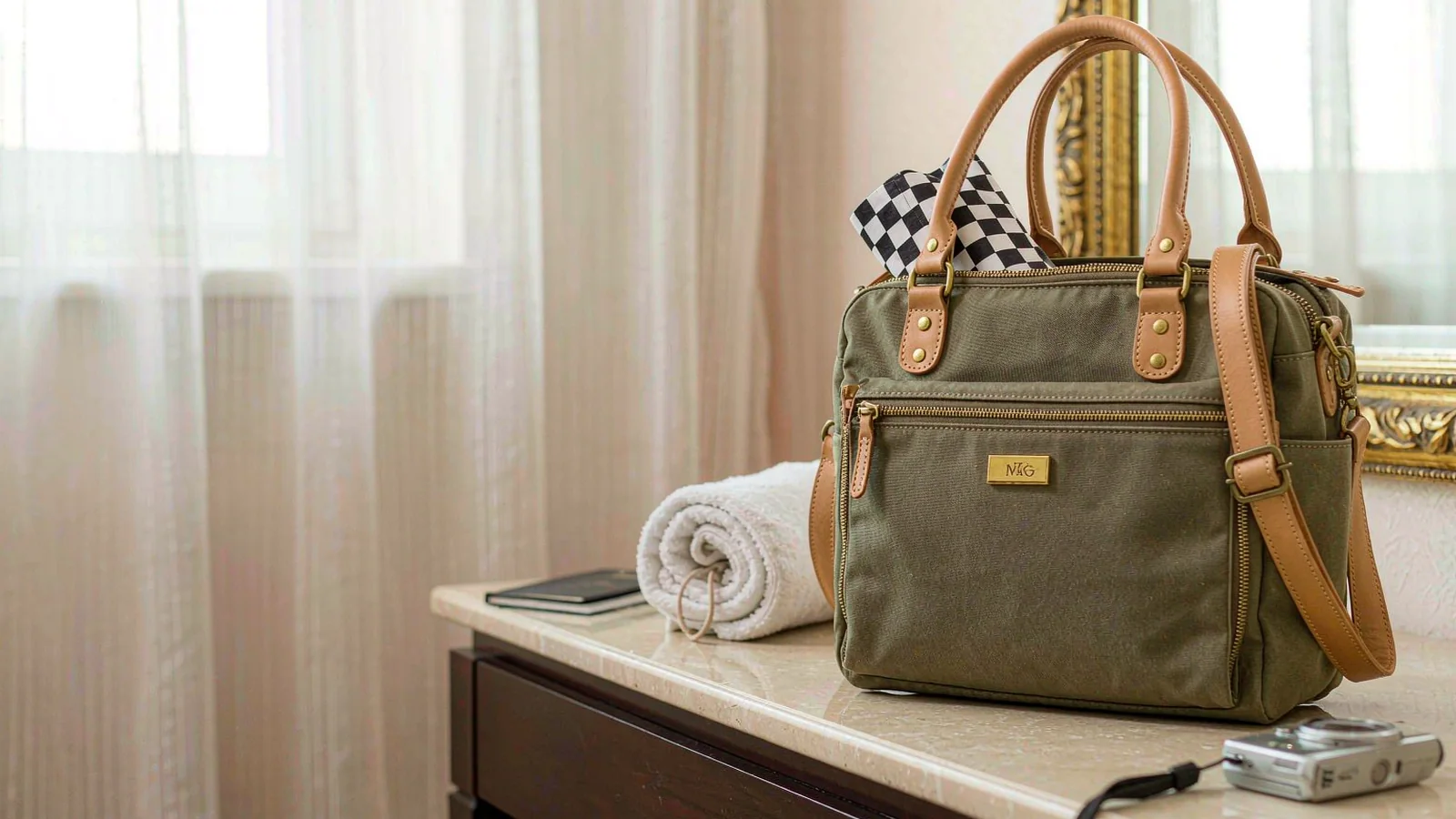
How Cabin-Bag Dimensions Shape Travel Cosmetic Bag Size
A travel cosmetic bag is sized backwards. The buyer does not start from a shape that photographs well and hope it fits; the buyer starts from the cabin bag the customer will carry, subtracts what that customer must also pack, and specifies what is left. That remaining envelope is the brief, and it is almost always smaller than a first sample. Travel formats are the corner of the cosmetic bag category where prototypes most often come back too deep, too heavy or too rigid, and every one of those three faults traces back to a sizing decision made before the tech pack was written.
The allowances themselves are not universal and should never be treated as such. Each airline publishes its own cabin-bag dimensions, weight limits and personal-item rules; those figures differ by carrier, by fare class, by aircraft type and by route, and they are revised. A brand that prints one dimension on a hangtag as though it were an industry standard is making a claim it cannot defend if a customer is charged at the gate. The defensible method is to collect the published allowances for the routes and carriers the brand's own customers actually fly, take the tightest, and specify against that, measuring the packed state of the bag rather than assuming it.
| Size tier | External W x H x D (cm) | Packed depth (cm) | Volume (L) | What else fits beside it | Programme fit |
|---|---|---|---|---|---|
| Flat pack-flat pouch | 24 x 16 x 5 | 7 | 1.8 | Slips into a jacket pocket or laptop sleeve | Amenity kits, gift-with-purchase |
| Compact travel pouch | 22 x 14 x 9 | 11 | 2.5 | Two rolled garments beside it | Entry retail travel range |
| Mid hanging travel bag | 25 x 20 x 10 | 12 | 4.5 | One folded outfit and a pair of flats | Core travel range |
| Large hanging travel bag | 28 x 24 x 12 | 14 | 7.0 | A jacket or a shoe pair | Family and long-haul ranges |
| Modular three-pouch set | 3 x (20 x 13 x 7) | 8 each | 1.4 each | Distributed into gaps around clothing | E-commerce bundles and sets |
The cabin-bag allowances, weight limits and liquids rules referred to throughout this guide are rules published by individual airlines and national authorities. They differ by carrier, fare class, aircraft and country, and they change over time. Buyers should confirm current official guidance for their own routes before committing any dimension, weight or capacity claim to a specification, a hangtag or a marketplace listing.
Packed depth, not width or height, is usually the binding constraint. Width and height are dictated by the payload: a toothbrush, a hairbrush, a razor and upright bottles set a floor under both. Depth is the one dimension a buyer can genuinely trade away, and it decides whether a travel bag disappears into a cabin case or fights it for space. A bag that reads as 8 cm deep on a spec sheet often measures 11 cm or 12 cm once it is filled and the zip has closed over a bulge, which is why depth should be specified as a packed figure with a stated tolerance.
A worked sizing method
Take a concrete case. Suppose the tightest published allowance the buyer has confirmed for the core route is a cabin case of the order of 55 x 40 x 20 cm, giving a nominal 44 litres of internal space. Allocate 60 percent of that to clothing, which absorbs 26 litres. Shoes, electronics, documents and a water bottle consume most of the remainder. What is realistically left for a wash kit is somewhere between 4 and 6 litres, which points at a mid hanging travel bag or a modular set rather than a framed vanity case. Those numbers appear here as arithmetic showing a method, not as a rule; the buyer substitutes their own confirmed allowance and their own allocation.
The same method runs in reverse for amenity programmes, where the number that matters is how many kits fit in a housekeeping trolley drawer or an overhead locker rather than a cabin case. There the useful dimension becomes the height of a kit lying flat in a drawer, typically 4 cm to 7 cm for a soft pack and 9 cm to 12 cm for a boxed presentation.
- Measure depth on a filled bag, closed, laid on a flat surface under its own weight — not on an empty sample
- State a tolerance, commonly plus or minus 5 mm on soft constructions and plus or minus 2 mm on moulded shells
- Test the bag inside the actual target cabin case alongside a stated clothing load, not inside an empty case
- Record the empty weight and the filled weight separately; the second is the one a traveller feels at the gate
- Re-measure after wash or wipe-down if the programme claims laundering, since coatings and foams change dimension
- Packed depth — depth measured on a filled, closed bag; the dimension that actually decides cabin fit
- Fill factor — the share of internal volume a real payload occupies, typically 0.6 to 0.7 for a mixed toiletry load
- Nesting test — the check that a filled travel bag sits inside the target cabin case alongside a stated clothing load
- Declared dimension — external measurement on a filled bag laid flat, stated with tolerance in the brief and reproduced on the spec sheet
- Weight ceiling — the maximum empty weight the buyer accepts, verified on a production sample rather than a proto sample
Demand for the format is visible in search behaviour, which buyers can use as a sizing signal: "travel bag for toiletries" shows roughly 110,000 monthly searches in ASINSIGHT data for 2026.07, and "toiletry bag" around 74,810 weekly searches. That is search demand, not revenue, but it confirms that shoppers search by travel use rather than by material. A range offering one compact packable size and one mid hanging size covers the two intents those queries express.
Liquid Rules and Why They Created the Clear-Quart Category
The second external constraint is the liquids regime, and it is the reason a whole product category exists. In the United States the transport security authority publishes a 3-1-1 rule for carry-on liquids: containers up to a stated volume, gathered into one clear bag of a stated capacity, one bag per passenger, presented separately at screening. Buyers should read the published wording directly at the TSA liquids rule page rather than from a summary, because the rule is specific to that authority, other jurisdictions publish different regimes, and both the container limit and the bag capacity have been revised over time. Travellers must confirm current official guidance before flying.
The commercial consequence is not that every travel bag must be transparent. It is that a travel bag either contains a transparent liquids pouch that can be lifted out, or it does not participate in the screening step at all. That single requirement created the clear-quart category: a small, transparent, resealable pouch sold separately, bundled with a larger opaque bag, or built into a travel bag as a detachable component. Before that rule, a wash bag was one volume with pockets. After it, a travel system became two volumes with a defined relationship between them.
| Liquids-pouch format | Material and wall | Closure | Volume (L) plan | Where it travels in use | Buyer note |
|---|---|---|---|---|---|
| Integrated clear front pocket | 0.4 mm PVC or TPU window | Zip across the top | 0.8 | Inside the bag; not lifted out | Cheapest option; fails where screening requires removal |
| Detachable clear pouch | 0.5 mm TPU, welded seams | Slider zip with garage | 1.0 | Lifted out at the tray | Adds a component and a second tooling item |
| Clear pouch with hanger loop | 0.5 mm TPU | Slider zip with garage | 1.0 | Hung on a hook or shower rail | Suits hostel, cruise and gym bathrooms |
| Roll-top clear pouch | 0.4 mm TPU | Roll and side-release clip | 1.2 | Compresses when half empty | Bulky corner when full; no flat stack |
| Bottle set with no pouch | Bottles only, no bag | Screw caps | n/a | Placed loose in the tray | Lowest cost; highest loss and spill rate |
Two design decisions decide whether a clear pouch works in practice. The first is whether it is genuinely removable. A pouch that clips out with one hand, at a tray table, under time pressure, is a different product from one that is zip-attached or stitched in. If the brand's customers fly, removability is not a premium feature; it is the feature. The second is whether a full set of travel bottles fits without bulging the seam. Six upright 100 ml bottles need a base footprint of roughly 20 x 12 cm at minimum, and the pouch needs headroom above them so the closure can close without pressing on the caps.
Writing the compliance wording without making a claim the brand cannot defend
"TSA approved toiletry bag" is a phrase shoppers type and a phrase brands want to print, but the published rule concerns containers and how they are presented, not a certification programme for bags. Printing an unqualified approval claim on a product that no authority has certified invites a misleading-advertising complaint and, on marketplaces, a listing takedown. The defensible wording describes the design against the published rule rather than claiming endorsement: sized to hold a set of travel-size containers in one clear bag, presented separately at screening, subject to the traveller checking current guidance. The claim is then about the product's geometry, which the brand controls.
- 3-1-1 — the published United States carry-on liquids rule: containers up to a stated volume, in one clear bag of stated capacity, one per passenger
- Clear-quart category — the product category created by that rule: a small transparent resealable pouch that travels as a distinct unit
- Removability — whether the pouch can be lifted out one-handed at the screening tray; the feature that separates a travel system from a bag with a window
- Screening-side compliance — a property of the containers and how they are presented, which the authority governs
- Bag-side compliance — a property of the bag's geometry and claims, which the brand governs and can defend
Material choice inside the clear pouch carries its own sourcing consequences. PVC gives clarity and low cost but raises plasticiser questions in some markets and stiffens in cold; TPU costs more, welds cleanly and stays flexible; EVA sits between them and is usually extruded rather than cast. Whichever is chosen, the buyer should name the thickness, the weld method and the haze limit in the brief, because clarity is the property being sold and it is easy to lose by over-specifying a cheap film. Where a pouch will hold oils or alcohol-based product, the buyer should also ask for compatibility observation over a stated period rather than assuming any film survives any fill.
No liquid volume, container size or bag capacity in this guide should be read as a current universal rule. Those figures are published by individual national authorities, they differ between jurisdictions, and they have changed. Buyers should size a clear pouch against the published guidance of the markets they sell into and print a reminder on the product or packaging that travellers must confirm current rules before flying.
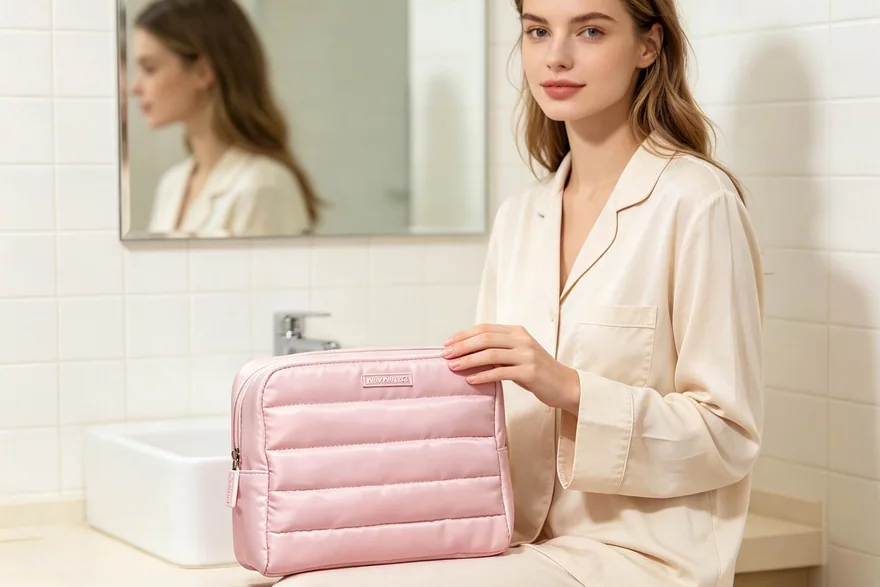
Pack-Flat, Compressible and Lightweight Builds
Pack-flat, compressible and lightweight are three different promises and buyers lose money by treating them as one. Pack-flat means the empty bag reaches a low height so it can be laid in a case or a drawer. Compressible means the bag yields under pressure and then recovers. Lightweight means low empty mass. A welded TPU pouch is pack-flat and light but barely compressible because it is already thin; a foam-padded hanging bag is compressible but not pack-flat; a moulded EVA case is none of the three. The brief should say which promise the range makes.
Three levers produce those behaviours. The first is material thickness, measured in denier for woven shells and in millimetres for films and foams. The second is structure: every frame, baseboard, mirror, stiffener and foam laminate that holds a shape also resists compression, and each one has to earn its place. The third is closure geometry, because a zip running around three sides lets a bag open and flatten while a zip across the top of a box keeps it boxed. Coated and laminated shell fabrics are governed by their own test vocabulary, and buyers specifying a coated nylon or polyester shell will find the relevant methods under ASTM D751 for coated fabrics.
| Build | Shell fabric | Empty weight (g) planning range | Compressed height (cm) | Recovery behaviour | Cost effect (illustrative range) |
|---|---|---|---|---|---|
| Unlined flat pouch | 210D polyester, PU coated | 45 to 70 | 2.0 | Creases; recovers when filled | Base |
| Lightly padded pack-flat | 420D nylon, 2 mm foam | 110 to 150 | 3.5 | Foam springs back slowly | +15 to 25 percent |
| Frameless hanging bag | 600D polyester, no frame | 220 to 290 | 5.0 | Holds shape when hung | +45 to 70 percent |
| Moulded vanity travel case | EVA shell, 3 mm | 380 to 520 | Not compressible | Rigid | +90 to 140 percent |
| Welded TPU modular pouch | 0.4 mm TPU, RF welded | 35 to 55 | 1.2 | Springs back immediately | -10 to +10 percent |
The weight and cost columns are illustrative planning ranges for comparing builds during design, not quotations and not measured results from any particular programme. Actual figures move with fabric yield, hardware count, print method and order quantity. Their purpose is to make the trade visible early: the difference between a welded pouch and a moulded case is roughly ten times the empty weight and a large multiple of the unit cost, and that difference has to be justified by what the customer does with the bag, not by what looks premium on a shelf.
Weight budgeting against cabin allowances
Empty weight deserves its own line in the brief because it is the number a traveller meets at a check-in scale. Cabin weight allowances are published per carrier and per fare class and are as variable as dimensions, so a buyer budgets rather than cites. A workable approach is to set an empty-weight ceiling per style: around 250 g for a packable retail piece meant to be forgotten in a case, around 400 g for a hanging piece with a hook and mirror, and a hard review point for anything above 500 g unless the product is explicitly a vanity case. Then weigh the bag as it ships, including hook, mirror, removable pouch and any insert.
- Set an empty-weight ceiling per style and verify it on the first production sample, not on the prototype
- Weigh with all hardware, the mirror if fitted and any removable insert or pouch included
- Budget the filled payload separately: a 100 ml bottle with packaging adds roughly 100 to 130 g, so a six-bottle load is around 0.7 to 0.9 kg
- Separate retail packaging weight from cabin weight: a printed box adds 60 to 120 g to the parcel and nothing to the traveller's allowance
- Record weight in grams on the spec sheet with a tolerance, and re-check after any fabric or hardware substitution
- Pack-flat — a build that reaches a compressed height of roughly 2 to 4 cm empty so it can be laid flat or stored in a drawer
- Compressible — a build that yields under strap or hand pressure and returns to shape once released
- Recovery — how quickly a compressed build returns to its stated height; slow recovery reads as damage to a customer
- Empty-weight ceiling — the maximum mass the buyer accepts for the bag as shipped, verified on production
- Structure audit — removing every frame, board and stiffener that does not carry a defined job
Sampling timing follows the build. Simple flat and standing constructions normally sample in 6-10 working days, while constructions that add a hook assembly, a moulded shell, welded seams or a mirror move into the 12-15 working day range. A buyer who wants both a packable pouch and a framed case in one range should plan two sampling tracks rather than one, because the two builds do not share a pattern or a tooling set and pushing them through together usually delays both.
Hanging Layouts for Shared and Small Bathrooms
A hanging travel bag solves a problem that has nothing to do with the bag: there is no counter. In a hostel bathroom, a shared shower block, a cruise cabin, a gym changing room or a small European hotel bath, the available surfaces are wet, narrow or absent, and the only reliable fixture is a door top, a rail or a single hook. The bag therefore has to become its own shelf. That single fact drives the whole layout: pocket heights, load path, drop height and wet-dry separation are all consequences of hanging off whatever the room provides.
The hook is the component buyers over-specify and under-engineer. A swivel metal hook feels premium and rotates to sit flat against a door; a webbing loop with a snap is lighter, packs flatter and costs less; a carabiner clip suits wet-room rails and backpack straps; a suction hook is cheap and fails on tiles that are not perfectly smooth. Whatever the type, the hook is only as good as the load path behind it: hook to webbing loop, loop to reinforcement patch, patch to panel, panel to seam. Most hanging bag returns are not hook failures, they are bar-tack failures at the point where the loop meets the panel. Buyers specifying pocket zips and slider hardware will find the shared vocabulary in ASTM D2053 on zipper terminology, and metal components on programmes shipping to the United States should be reviewed against the requirements set out under the Consumer Product Safety Improvement Act.
- Open height — the drop from hook to base when hung; the dimension buyers forget to specify and the one that decides whether a bag fits above a basin
- Load path — hook, then webbing loop, then reinforcement patch, then panel, then seam; the chain fails at its weakest stitch
- Wet-dry split — a lined lower compartment or a detachable wet pouch that isolates damp items from dry ones
- Centre well — the undivided middle volume that lets tall bottles stand upright instead of lying down and leaking
- Counter-free footprint — the wall area a bag occupies when open, checked against the smallest bathroom the brand expects its customer to meet
Layout choices that decide whether the bag gets used
Three-tier and four-tier pocket layouts compete with a centre-well layout, and the right answer depends on payload. Tiered pockets suit flat items: palettes, razors, dental items, cotton pads, small tubes. They are useless for a 200 ml shampoo bottle, which is why the centre well exists. A well-proportioned hanging travel bag keeps roughly a third of its volume undivided so upright bottles have somewhere to stand, and puts elastic loops at the sides for brushes and razors. Elastic loops beat mesh pockets for tall slim items and lose to zip pockets for small loose items that would otherwise fall out when the bag is rolled.
- Specify open height, not just closed height; a bag that hangs 55 to 65 cm open needs that much clear wall
- Put the heaviest items low, near the base seam, so the load path carries weight in tension rather than in peel
- Use a lined or welded lower compartment for wet items, with a drain route that does not soak the outer shell
- Decide on the mirror explicitly: a removable mirror saves weight and breakage risk, a fixed one adds a stiffener and a hazard in transit
- Check that the hook stows; a hook that cannot be tucked away snags clothing inside a cabin bag
Hanging bags also behave differently in retail photography and in transit. They are the only travel format that should be shot hung and open, because a hanging bag photographed closed looks like an overpriced pouch. That means the sample used for photography has to be filled with the intended payload, which in turn means the payload has to be specified early enough to be bought. In transit, hanging bags cannot be flat-packed as tightly as pouches, so carton planning changes: a hanging bag that occupies 5 cm compressed will ship roughly 60 to 70 units per export carton against 150 to 200 for a welded pouch, and freight per unit moves accordingly.
A hanging bag is opened, hung, unhooked and rolled far more often than any other travel format. Buyers should specify a hook and loop cycle test with a stated load in kilograms and a stated number of operations, with the end point defined as no stitch breakage or visible deformation, rather than accepting a sample that simply feels strong in the hand.
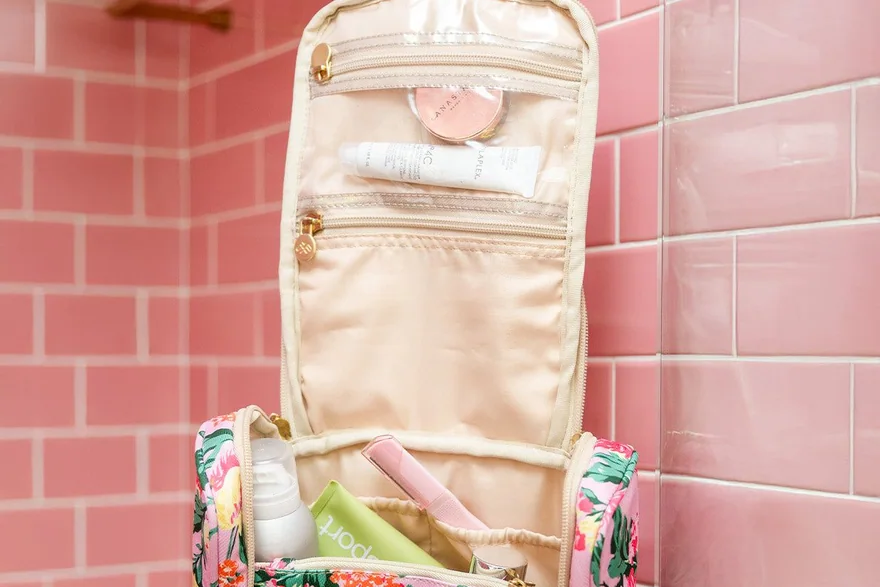
Leak Containment, Cabin Pressure Change and Daily-Carry Durability
Leaks in a travel bag are not the same problem as leaks in a bathroom cabinet, because the cabin introduces a pressure change. As an aircraft climbs and the cabin pressure falls, the air in a bottle's headspace expands and pushes product past the cap, the thread and any seal. A bottle that behaved perfectly on a bathroom shelf can weep at altitude. That is why leak containment for travel formats is specified as a method with stated conditions rather than as an adjective, and why the buyer's brief should describe fill volume, cap torque, orientation, duration and inspection criteria rather than asking for a bag that is "leakproof".
This guide deliberately states no leak-test outcomes, pass rates or ratings. What follows is a set of methods a buyer can write into a specification, with the acceptance criteria left to the buyer to set. Two authorities define the vocabulary most often used: colour fastness methods sit under the ISO 105 committee, and the broader textile test-method library is catalogued by AATCC. Naming the method, the cycle count and the end point is what turns a wish into a clause that can be inspected.
| Failure mode | Mechanism in travel use | Method a buyer specifies | Where it appears first | Brief clause |
|---|---|---|---|---|
| Cap creep under pressure change | Headspace air expands in flight and pushes product past the closure | Fill bottles to a stated volume, cap to a stated torque, hold inverted for a stated duration at ambient and at a reduced-pressure condition, then inspect | Bottle threads and the lining directly beneath the bottle | State fill volume, cap torque and hold duration |
| Seam wicking | Liquid travels along stitch holes rather than through the fabric | Water-column or wicking assessment carried out on the seam, not on the flat fabric | Bottom corner seams | Require welded seams or seam sealing, tested at the seam |
| Zip weep | Product escapes through the coil and past the slider | Inverted hold with the zip track at the lowest point of the bag | Zip garage and slider end | Specify chain type, garage and slider, with the zip at the low point |
| Hook and loop fatigue | Daily hang and unhang cycles load the loop root | Cycle test to a stated number of operations under a stated load in kilograms | Bar-tack at the webbing root | State load, cycle count and end point |
| Abrasion from daily carry | Bag rubs against cabin-bag lining, footwear and other zips | Abrasion method run to a stated cycle count with the end point defined as no thread break | Base corners and printed panels | Name the method, the cycle count and the end point |
| Colour transfer onto clothing | A damp lining rubs against packed garments | Colour-fastness to rubbing and to water, with a minimum grade stated | Dark linings and printed panels | State the fastness method and the minimum acceptable grade |
Durability against being carried daily
A travel cosmetic bag is not stored, it is carried, and carried more often than most bags in a brand's range. A commuter wash bag is opened twice a day, hung, unhooked, shoved into a backpack, sat on and wiped down. That usage profile produces a different failure order from a bag that lives on a dressing table: closures first, then load points, then corners, then print. Specifying durability therefore means specifying operation counts, not feelings, and it means testing the parts a user touches rather than the panel a user looks at.
- Zip operation: specify an open-and-close cycle count, commonly in the range of 500 to 1,000 cycles for a daily-carry piece, with the end point defined
- Hook and loop: specify a load in kilograms and a cycle count, with the end point defined as no stitch breakage or deformation
- Abrasion: specify the method and cycle count for the base and corner panels, which meet the inside of a cabin bag
- Wipe-down: specify how many cleaning cycles with a stated agent the printed panel survives before visible degradation
- Handle and grab loop: specify a static load and a duration if the bag is designed to be carried by hand rather than packed
Construction is where containment is won or lost, and the decision is usually between sewn-and-sealed and welded. A sewn bag with a coated lining leaks through stitch holes unless the seams are sealed or taped, and taping adds a process step and a cost line. A welded TPU or TPU-laminated build has no stitch holes at all, contains liquid by construction, and cannot be repaired or easily re-patterned once tooling is cut. Buyers often split the difference: welded lower compartment for the wet and liquid zone, sewn upper panels for structure and pocketing. That hybrid needs a transition detail between the two, and the transition is where a sample should be inspected first.
Every test in this guide is offered as a method a buyer can specify, with the conditions and acceptance criteria set by the buyer. No pass rate, leak rate, drop height outcome or rating is claimed here, because those depend on the construction, components and fill chosen for a specific programme and cannot be generalised across a category.
How Hospitality and Airline Amenity Buyers Specify Travel Formats
A hospitality or airline amenity buyer is not buying a product to sell. They are buying a container that will be filled, issued, used once or twice, taken home, and then judged as a memory of the stay or the flight. That changes almost every line of the specification. Where a retail buyer asks what the customer will pay, an amenity buyer asks what a unit costs delivered into a store room, how many fit in a trolley drawer, whether it survives being filled weeks before issue, and whether the branding still looks deliberate after a guest has carried it home and used it for a year.
| Specification line | Retail travel range | Hotel amenity kit | Airline amenity kit | Why it differs |
|---|---|---|---|---|
| Service life | Years of repeat use | One stay, then taken home | One flight, sometimes reissued | Sets fabric weight, seam method and hardware grade |
| Fill state at issue | Sold empty | Issued filled, often with liquids | Issued filled with miniature product | Drives leak containment and cap compatibility |
| Closure | Premium zip with branded puller | Lightweight zip or press-seal | Press-seal or single zip | Cost per unit against perceived value at issue |
| Branding depth | Woven label, debossed patch, print | Single-colour print or woven label | One-colour print, low profile | Guest-facing versus retail-facing presentation |
| Documentation | Spec sheet, barcode, listing copy | Substance declarations, refill cycle note, laundering instruction | Cabin-safety review, dimension and weight record | Determines who audits the file and when |
| Volume pattern | 500 pcs per colourway, seasonal repeats | One large drop per refurbishment cycle | Contracted volumes per route and cabin class | Sets reorder cadence and storage requirements |
Service life is the line that moves the most money. A kit issued filled and kept by the guest does not need a 600D shell, bar-tacked loops or a two-year zip; it needs to look considered at the moment of issue and survive one journey home. A kit that housekeeping collects, launders and reissues is a completely different object: it needs a lining that survives repeated laundering, a closure that survives being opened by somebody in a hurry, and a construction that can be identified and counted quickly in a linen room. Buyers should state the cycle explicitly, because a supplier reading "amenity bag" will otherwise quote the cheapest possible thing.
Documentation, compliance and the file the buyer keeps
Amenity programmes are audited in a way retail programmes usually are not. A hotel group will ask for substance declarations against the EU REACH regulation for European properties and, increasingly, for a textile declaration such as OEKO-TEX Standard 100 for anything that touches skin or holds personal-care product. Where the brief calls for recycled content, the chain-of-custody claim should be tied to a recognised scheme such as the Global Recycled Standard rather than left as a percentage on a line sheet. None of these are optional extras in an airline tender; they are the entry ticket.
Programme logistics stay constant across channels. The minimum is 500 pieces per style and colourway, sampling runs 6-10 working days for straightforward constructions and 12-15 working days where a hook assembly, welding or a moulded component is involved, bulk production runs 35-50 days after sample approval, shipment is FOB Xiamen, payment is T/T 30 deposit with 70 against bill of lading, and inspection is set at AQL 2.5 under the sampling procedures published for ISO 2859-1. Amenity buyers should plan the sampling window around the filling line rather than the launch date: the bag has to be approved before product is decanted into it, and decanting is often the longest lead item in the whole programme.
Travel formats of this kind are normally coordinated rather than bought off a shelf. A sourcing and programme-management partner such as QUANZHOU JUNYUAN BAGS, coordinating bag programmes since 2014, will typically hold the specification, the component approvals, the inspection regime and the shipment schedule on the buyer's behalf, so that a hotel refurbishment cycle or an airline route launch is not delayed by a single missing hook or a lining substitution nobody approved. For the buyer the value of that arrangement is a single written specification that survives staff changes on both sides.
Whatever the channel, the buyer should hold one written specification covering dimensions measured on a filled bag, empty weight, materials with denier and coating, closure components, hook load path, leak and abrasion methods with acceptance criteria, branding placement, packing and carton count, and the inspection level. Every later dispute resolves faster against a document than against an email thread.
The B2B Customisation View
Programmes for cosmetic pouches, vanity cases and beauty organisers move fastest when the artwork is supplied as vector files and the Pantone references are confirmed before sampling starts.
Budgeting and scheduling inputs: MOQ 500 per style and colourway; sampling 6–10 working days, extended to 12–15 for lined, moulded or hardware-heavy builds; bulk 35–50 days; pre-shipment inspection at AQL 2.5 per ISO 2859-1; FOB Xiamen; T/T 30/70.
QUANZHOU JUNYUAN BAGS is structured as a sourcing and programme-management company, which lets a buyer compare materials across several SGS-verified production lines inside one quotation.
Which Brand Types This Guide Serves
This guide is written for buyers who specify travel formats rather than for shoppers who use them, and the five buyer types below meet the same product with different questions. Travel is the segment of the cosmetic bag category where external rules shape the design, so the value of a specification lies in how well it anticipates a cabin allowance, a screening tray and a bathroom with no counter.
- Start-up brands: a single packable pouch with a detachable clear liquids pouch is the cheapest way to enter travel, because it needs no tooling, samples in 6-10 working days and can be launched in one colourway at 500 pieces while the brand tests which size its customers actually buy.
- Established beauty brands: the travel format works as an extension of an existing range rather than a separate one, so the priority is matching shell fabric, hardware finish and print method to the core line, and setting an open height and empty weight that stay consistent across seasonal drops.
- Retailers and private-label programmes: the decision is usually a good-better-best ladder of one compact packable pouch, one mid hanging bag and one modular set, with a shared colour story and one clear pouch repeated across all three so the screening message is identical on shelf.
- E-commerce sellers: bundled sets convert well because search demand is expressed by travel use, and the operational priority is a carton plan that keeps the parcel under the shipping weight break, which favours welded pouches over framed cases.
- Hospitality and airline amenity buyers: the brief is governed by service life, fill state at issue and documentation, not by shelf appeal, and the specification should state whether the kit is single-issue, laundered and reissued, or refilled in place, because that single line sets lining, seam method and closure grade.
All five share the same discipline: state dimensions as packed figures, state empty weight as a ceiling, state leak and abrasion requirements as methods with acceptance criteria, and state compliance wording as a description of the design rather than as an approval claim. Buyers who do that before sampling spend fewer rounds correcting samples, and the 35-50 day bulk window starts on time.
Frequently Asked Questions
What dimensions should a travel cosmetic bag be specified at to fit inside a cabin bag?
Specify packed dimensions, not empty ones, and derive them from the tightest published allowance your customers actually fly. A practical retail ladder is a flat pouch around 24 x 16 x 5 cm, a compact travel pouch around 22 x 14 x 9 cm, and a mid hanging bag around 25 x 20 x 10 cm. Depth is the binding dimension because width and height are set by the payload. Measure depth on a filled, closed bag with a stated tolerance, and test the bag inside the actual target cabin case alongside a stated clothing load.
Why did the TSA 3-1-1 liquids rule create a separate clear-quart bag category?
Because the published United States rule requires carry-on liquids in containers up to a stated volume, gathered into one clear bag of a stated capacity, one per passenger, presented separately at screening. That turned a wash bag from one volume into two: an opaque bag for dry items and a transparent pouch for liquids that must be lifted out at the tray. Other jurisdictions publish their own regimes and the figures have changed, so buyers should confirm current official guidance before sizing or labelling a pouch.
Can a brand print "TSA approved" on a travel makeup bag?
The published rule governs containers and how they are presented, not a certification programme for bags, so an unqualified approval claim is difficult to defend and risks a marketplace takedown for misleading advertising. The safer wording describes the geometry: sized to hold travel-size containers in one clear bag, presented separately at screening, subject to the traveller checking current guidance. That claim is about a dimension the brand controls rather than an endorsement no authority has issued.
How much should an empty travel toiletry bag weigh?
Set a ceiling rather than a target. Around 250 g suits a packable retail piece meant to be forgotten in a case, around 400 g suits a hanging piece with hook and mirror, and anything above 500 g should trigger a review unless it is explicitly a vanity case. Weigh the bag as shipped, including hook, mirror and removable pouch, and record grams with a tolerance on the spec sheet. Verify on a production sample, because prototypes are usually lighter than the repeatable build.
What makes a travel cosmetic bag pack flat without crushing its contents?
Three levers: material thickness, structure and closure geometry. Removing frames, baseboards and foam laminates frees compression, but each one has to earn its place, so run a structure audit and delete anything without a defined job. A zip running around three sides lets a bag open and flatten; a zip across the top keeps it boxed. Keep a third of the volume undivided so tall bottles stand upright instead of being pressed sideways when the case is closed.
When is a hanging travel bag a better brief than a standing one?
When the expected bathroom has no usable counter: hostels, shared shower blocks, cruise cabins, gym changing rooms and small hotel baths. Hanging turns the bag into its own shelf, which drives pocket layout, open height and load path rather than base stability. It costs more, weighs more and ships fewer units per carton, so a standing bag remains the better choice where the customer has a vanity surface and wants the cheapest packable option.
How should a buyer specify leak resistance for a bag carried in an aircraft cabin?
Specify a method with stated conditions, not an adjective. Cabin pressure falls in flight, headspace air in a bottle expands and pushes product past the cap, so the clause should state fill volume, cap torque, orientation, hold duration and whether a reduced-pressure condition is included, plus the inspection criteria. Add a separate seam assessment, because leaks travel along stitch holes rather than through fabric, and name the end point so an inspector can judge a result.
Which closure works best on a travel makeup bag that is carried daily?
A coil or reverse-coil zip with a garage, a stated slider type and a moulded puller is the default for daily carry, because the garage protects the slider end where weeping starts and the coil tolerates grit better than metal. Name chain type, size, tape colour and slider in the bill of materials rather than writing "zip". Roll-top closures suit compressible pouches that are half empty much of the time but create a bulky corner when full.
How do hotel amenity buyers specify travel kits differently from retail travel ranges?
They buy a container to be filled and issued rather than a product to be sold. Service life drops from years to one stay, so shell weight, hardware grade and closure cost fall accordingly, while the filling line, trolley drawer dimensions and the number of kits per store room rise in importance. Branding becomes a single-colour guest-facing mark rather than a retail identity, and the specification must state whether the kit is single-issue, laundered and reissued, or refilled in place.
What should an airline amenity buyer require in the documentation file?
A dimension and weight record per kit, a cabin-safety review of any metal or rigid component, substance declarations for European properties and a textile declaration for anything touching skin or holding personal-care product, plus a recycled-content claim tied to a recognised chain-of-custody scheme if one is being made. Add the inspection level, the packing and carton count, and the refill or reissue cycle. Airlines audit this file; a missing declaration can hold a route launch.
Does a travel cosmetic bag need welded seams, or is a coated lining enough?
It depends on whether the liquid zone is sewn. A coated lining stops liquid passing through fabric but not through stitch holes, so a sewn bag needs taped or sealed seams, which adds a process step and a cost line. A welded build has no stitch holes and contains by construction, but cannot be repaired or easily re-patterned once tooling is cut. A common compromise is a welded lower compartment for the wet zone and sewn upper panels for structure, with the transition inspected first.
How many bottles should a mid-size travel toiletry bag be designed around?
Derive capacity from the bottle count rather than from a size chart. A mid-size travel bag sized for six 100 ml bottles needs a base footprint of roughly 20 x 12 cm and pocket heights of 12 to 16 cm, then a fill factor of 0.6 to 0.7 for air, padding, brushes and hand access, which lands around 4 to 5 litres of body volume. Keep roughly a third undivided so bottles stand upright instead of lying down.
Which fabric weights and deniers suit a lightweight travel cosmetic bag?
A PU-coated 210D polyester gives an unlined flat pouch in the 45 to 70 g range and packs to about 2 cm. A 420D nylon with 2 mm foam suits a lightly padded pack-flat piece at 110 to 150 g. A 600D polyester frameless hanging bag typically runs 220 to 290 g. For welded builds, 0.4 to 0.5 mm TPU film gives the lowest empty weight. Treat all of these as planning ranges for comparison, not as quotations or measured results.
How long does sampling take for a travel cosmetic bag with a hook and a clear pouch?
Straightforward flat and standing constructions normally sample in 6-10 working days. Adding a hook assembly, welded seams, a moulded component or an integrated mirror moves the programme into the 12-15 working day range, because each of those needs its own component approval or tooling. Bulk production then runs 35-50 days after sample approval, with the minimum at 500 pieces per style and colourway and inspection set at AQL 2.5.
People Also Ask
Is a hanging toiletry bag allowed as a carry-on?
A hanging bag is luggage like any other, so what matters is whether it fits the cabin allowance published by the airline for that route, fare class and aircraft, and whether any liquids inside follow the screening rule published by the relevant authority. Those allowances and rules differ and change, so travellers should confirm current official guidance rather than rely on a hangtag. For buyers, the practical move is to size the packed bag against the tightest allowance in the target market and print dimensions as packed figures.
What size clear bag do airports require for liquids?
There is no single global size. The United States transport security authority publishes a 3-1-1 rule with a stated bag capacity, and other jurisdictions publish their own regimes that differ and have been revised. Travellers must check current official guidance for their departure airport and any transfer point. Buyers should therefore design the clear pouch against the markets they sell into, keep headroom above six upright 100 ml bottles so the closure closes without pressing on caps, and avoid printing a capacity as if it were universal.
Do travel cosmetic bags need to be transparent?
The whole bag usually does not; the liquids pouch does. Screening requires liquids to be presented in a transparent bag that can be lifted out, so a travel system works as an opaque bag for dry items plus a transparent, resealable pouch for liquids. Brands that make the whole bag transparent gain instant visibility of contents and lose any sense of privacy or premium finish, which is why the detachable clear pouch is the more common retail answer.
How do you stop toiletries leaking on a plane?
Three things work together: leave headspace in each bottle because cabin pressure change expands the air inside it and pushes product past the cap, tighten caps to a consistent torque, and store bottles upright in an undivided centre well. Then specify containment in the bag itself: welded or sealed seams in the liquid zone and a zip with a garage at the lowest point. Buyers should turn each of these into a stated method and acceptance criterion in the brief.
Are travel makeup bags worth buying in bulk for a hotel?
They are worth buying when the kit does a second job after the stay, because a guest who carries it home extends the brand impression. The economics depend on service life: a single-issue kit justifies a light shell and a simple closure, while a laundered and reissued kit needs a lining and seam method built for repeated cleaning. Buyers should state that cycle in the brief, since a supplier reading amenity bag will otherwise quote the cheapest possible construction.
References & Standards
- ISO 2859-1 sampling procedures for inspection by attributes
- ASTM D2053 standard terminology relating to zippers
- AATCC TM61 colour fastness to laundering
- IEC 62321 determination of certain substances in electrotechnical products
- OEKO-TEX Standard 100 testing for harmful substances
- Textile Exchange Global Recycled Standard
- US CPSC CPSIA consumer product safety improvement act
- ECHA REACH regulation on chemicals
- TSA 3-1-1 liquids rule for carry-on baggage
- ASTM D751 standard test methods for coated fabrics
- ISO 105 textiles tests for colour fastness
- Global Organic Textile Standard GOTS
In-Depth Articles in This Category
23 dedicated articles sit under this pillar guide.
Related Pillar Guides
Request a Sample or a Written Quotation
Send the silhouette, dimensions, material preference and logo artwork, and the programme team will return a written quotation with MOQ, sampling window, bulk lead time and inspection standard.
Email: [email protected] · WhatsApp: +86 177 5002 0688