Cosmetic Bags for Athletes: Locker Room & Competition
Executive Summary
Cosmetic bags for athletes are specified by the environment rather than by the user. A locker room is humid, shared and short of flat space, and a competition venue adds a timing constraint. Those conditions produce requirements a general wash bag does not meet: a sealed wet compartment, ventilation so a closed bag dries, a wipe-clean lining, and a hanging method for a locker door or a rail. Capacity runs 5 to 8 litres for a competition pouch and 20 to 28 litres for a full kit bag.
Odour and personalisation are the two issues underestimated. Odour is a construction problem before it is a finish problem, so mesh panels, a drain path and a removable washable liner do more than an antimicrobial treatment, and any such claim should be tied to a named test method. Personalisation is a commercial constraint, because a minimum of 500 pieces per style and colourway means names are best applied downstream. Programmes sample in 6 to 10 working days and 12 to 15 for welded wet compartments, then ship 35 to 50 days after approval under AQL 2.5 to ISO 2859-1, FOB Xiamen, T/T 30 deposit and 70 against bill of lading.
What a locker room kit carries and why the environment sets the specification
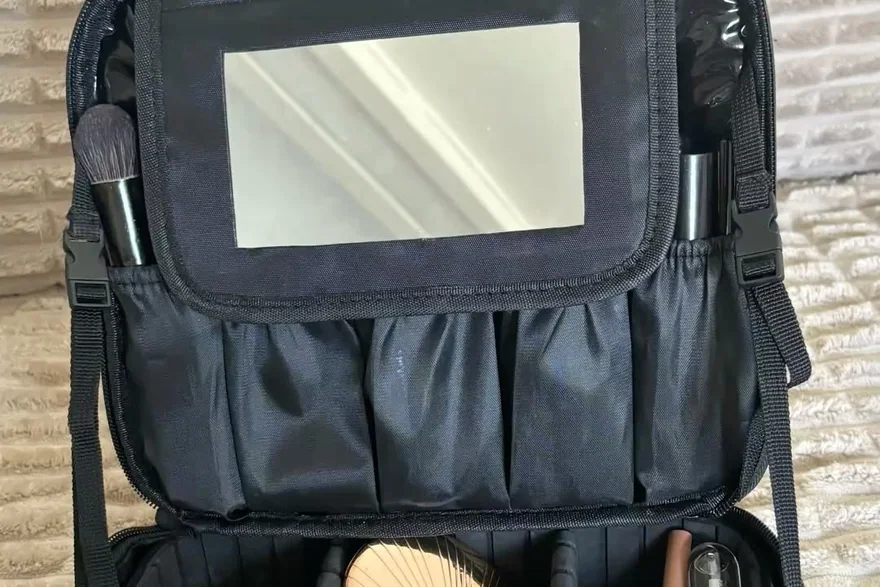
A locker room kit is not a scaled-down vanity case. The contents reflect a sport rather than a beauty routine: hair gel and a strong-hold spray, grip or chalk, a sweatband, sunscreen stick, lip balm, blister plasters and zinc oxide tape, a small first-aid item, deodorant, a comb or brush, hair ties and pins, and for some disciplines a compact mirror and a minimal cosmetics set for competition presentation. Several of those items are wet or tacky on contact, several leave residue that does not wash out of a woven lining, and all of them get used in a room where the air is warm and damp and where the bag is usually on a bench or a hook rather than on a shelf.
That environment dictates three properties before aesthetics enter the conversation. The first is humidity: a bag closed while damp will smell within a day or two unless it has either ventilation or a wet compartment that is genuinely sealed from the rest of the interior. The second is the shared surface: a bench or a locker shelf is not clean, so the base fabric needs to be coated and wipeable, and the bag benefits from studs or a coated base panel that keeps the fabric off a wet surface. The third is movement: the bag is carried by a handle or a clip far more often than it is set down carefully, so the handle attachment and the hanging loop carry real load.
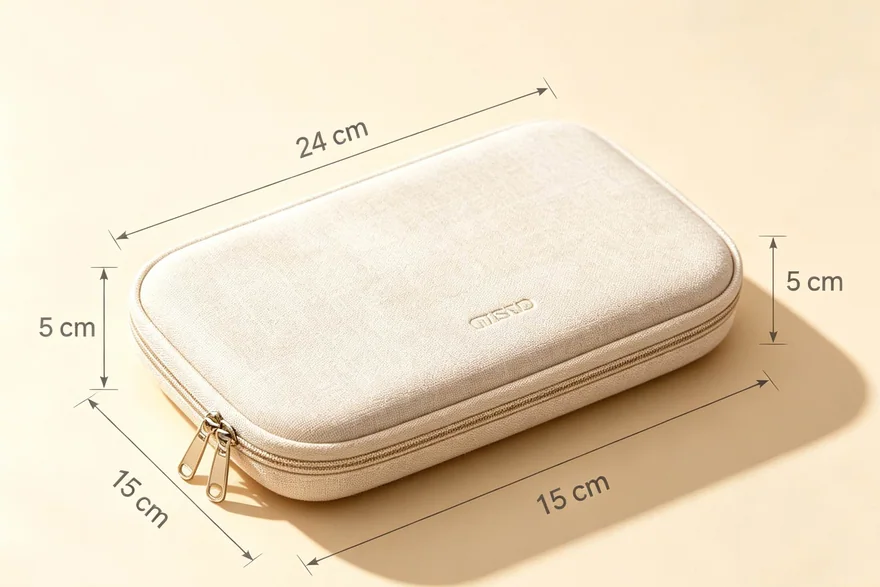
Volume expectations split cleanly by use. A competition-day pouch holds what is needed between a warm-up and a performance, which is typically 5 to 8 litres in a bag around 30 by 20 by 15 cm, small enough to sit in a kit bag or on a bench corner. A full locker room kit bag holds training-day items as well and runs 20 to 28 litres at roughly 40 by 28 by 22 cm, which is a locker-shelf size rather than a handbag size. Buyers who try to cover both with one product usually end up with a bag that is too large for competition day and too small for the training kit, so two sizes with shared branding is normally the better assortment.
Wet-dry separation, drainage and controlling odour in a closed bag
Wet-dry separation is the single feature that separates a sports cosmetic bag from a general one, and it is frequently specified badly. A pocket made of the same fabric as the rest of the bag is not a wet compartment; it is a pocket that will get damp and stay damp. A genuine wet compartment needs a laminated or welded construction: a TPU or PU face of 0.18 to 0.25 mm bonded to a 210D or 300D base, seams that are welded or bound rather than turned and stitched, and a closure that seals along its full length. Where the compartment is at the bottom of the bag, an 8 to 10 mm drain grommet at the lowest corner lets water out without opening the bag, which is the difference between a compartment that dries and one that does not.
Ventilation handles the rest. A mesh panel of 210D polyester, roughly 10 by 15 cm, on the back or the gusset allows air exchange while the bag is closed and costs almost nothing to add. A removable liner is the more thorough answer: a pouch that lifts out of the bag, goes in a domestic wash at 30 degrees, and goes back in dry solves the odour problem at its source. Buyers specifying a washable liner should also specify a corrosion-resistant zip and bound internal seams, because a liner that shrinks or a zip that corrodes turns a good feature into a return reason.
Antimicrobial finishes are the third lever and should be treated with more caution than they usually are. A finish can be useful on a lining, but it degrades with washing and wiping, and a claim of odour control without a named test behind it is a substantiation risk. Where a buyer wants the claim, the requirement should reference a specific method from the AATCC test methods library and state how many wash cycles the finish is expected to survive. Colour behaviour is tested separately: sweat is mildly acidic and slightly saline, and a lining or shell that crocks under those conditions will mark a light competition kit, so the relevant assessment sits within the ISO 105 colour fastness family.
| Construction | Typical build | Added unit cost | Maintenance | Common failure mode |
|---|---|---|---|---|
| Laminated wet compartment | 0.18-0.25 mm TPU on 210D, welded seams | $0.35-$0.70 | Wipe and air dry | Seam peel if the film is too thin |
| Removable washable liner | 210D polyester pouch, bound seams | $0.45-$0.90 | Machine wash at 30 degrees | Shrinkage if the fabric is not pre-shrunk |
| Drain grommet | 8-10 mm eyelet at the lowest corner | $0.05-$0.12 | None | Placement too high to drain |
| Mesh vent panel | 210D mesh, 10 x 15 cm, bound edge | $0.10-$0.20 | None | Snagging if the mesh is too open |
| Antimicrobial lining finish | Applied finish, named test method | $0.15-$0.40 | Degrades with washing | Claim outlives the finish |
The outer shell follows the same logic as the wet compartment but for a different reason. A coated fabric resists bench grime and wipes clean, and the coating is best specified against ASTM D751 coated fabrics so that two quotes can be compared on coating adhesion and abrasion rather than on the word waterproof. A 600D polyester at 280 to 320 g/m² is the standard choice for a kit bag; a 420D nylon ripstop at 180 to 210 g/m² suits a competition-day pouch where weight matters and the bag is rarely dragged.
Competition day: sizing a kit that travels from locker to venue
Competition day compresses the working sequence. A performer arrives, warms up, needs a mirror and a few items in a specific order, then needs everything back in the bag and moved. The pouch therefore has to open to a usable tray, stay open, and be closable in one motion. A wide-mouth U-zip that runs down both gussets and stops short of the base gives an opening of roughly 140 to 170 degrees and lets the lid lie back rather than flop; a straight zip across the top gives about 90 degrees and forces the user to hold the lid. A small frame wire or a 2 mm EVA panel in the lid is enough to keep the mouth open without the weight of a full moulded case.
Weight matters more on competition day than in training because the pouch is carried alongside competition kit. An empty target of 250 to 400 g for a 6 litre pouch is realistic with a 420D ripstop shell, a bound base and a lid panel rather than a full frame. Structure should be concentrated where it pays: a coated base panel with four stud feet keeps the bag off a wet bench, and a lid panel protects a mirror. Structure distributed evenly across all six panels adds weight without protecting anything, because the crushable items in a sports kit are few. Where a glass item is carried, such as a small bottle, a divided sleeve with 3 mm foam is cheaper than thickening the shell.
Hanging and carrying decide whether the pouch is actually used. A 20 to 25 mm webbing loop with a clip, rated to take the loaded bag, lets the kit hang from a locker door, a bench hook or a rail, and it is the feature athletes notice first because a hook is often the only available surface. A short wrist strap of 12 to 15 mm adds a second option. Where the bag is carried by hand, a padded wrap of 8 to 12 mm foam on the handle spreads the load; where it goes inside a team kit bag, a flat external slip pocket is more useful than a handle. Aerosol items in the kit should be checked against carry-on limits where the team travels by air, and the general framework is the TSA 3-1-1 liquids rule.
- Opening: U-zip down both gussets for a 140-170 degree mouth; a straight top zip caps access at about 90 degrees.
- Structure where it pays: lid panel of 2 mm EVA for a mirror, coated base with four stud feet, 3 mm foam sleeve for any glass.
- Weight target: 250-400 g empty for a 6 litre competition pouch; above 600 g it stops being carried.
- Carry: 20-25 mm webbing loop with a clip for locker doors and rails, plus a 12-15 mm wrist strap as a second option.
- Interior: light lining so dark items read in a dark venue corridor, elastic strip for uprights, one sealed pocket for liquids.
- Air travel: check aerosol and liquid sizes against the carry-on rule before assembling a competition kit.
Interior layout should be derived from the sequence rather than from the item count. A competition pouch works with three zones: a flat zip pocket for tape, plasters and ties; an elastic strip holding up to eight upright items such as gel, spray and sunscreen; and a sealed laminated pocket for anything that could leak under compression. A light lining is worth insisting on, because competition venues are often dim backstage and a black interior hides exactly the small dark items that are needed quickly. A 15 by 10 cm acrylic mirror in a sleeve completes the kit without adding the weight of glass.
Team kits, personalisation and planning a repeatable reorder
Team kits are the commercial core of this category, and they introduce a constraint that retail programmes do not have: every athlete wants their own name. A programme runs at 500 pieces per style and colourway, and per-athlete embroidery effectively turns each name into a separate variation, which is unworkable inside that structure. The usual resolution is to run the base bag as one style in one colourway and apply names downstream, either through a local embroidery service or through a removable name tag that transfers between seasons. Where names must be applied in the same shipment, the buyer should supply the name list as a data file with the order and agree the digitising charge per name separately.
Team identity is easier than individual identity. A club or school crest can be woven, embroidered or printed at production because it does not vary between units, and a colourway per squad or per age group is a legitimate way to use the minimum: each colourway is a programme of 500, so two squads means two programmes rather than one split order. Buyers should be deliberate about how many colourways they open, because this category rewards depth over breadth. One colourway ordered in depth for a season is cheaper per unit and easier to reorder than three colourways ordered thin, and athletes notice when a replacement bag does not match the rest of the team's kit.
Reorder consistency is the other half of the problem and it is mostly about colour. A team bag is replaced individually as bags wear out, so a reorder has to match bags already in service. The practical controls are a retained physical reference sample from the approved run, an approved shade tolerance, and a stated light source for comparison, because a navy viewed under retail lighting and the same navy viewed in daylight are different problems. Where a custom-dyed trim or elastic is used, keeping a dye-lot reference is essential. Consolidating the hardware specification across sizes also helps: one zip gauge and one hook type across the range means one set of spare parts and one inspection checklist.
| Personalisation method | Minimum practical | Durability through washing | Reorder complexity | Best for |
|---|---|---|---|---|
| Name embroidery | One digitised file per name | Excellent | High; needs a name list per order | Downstream application after the base run |
| Number print | From 40 mm height | Good; check after 20 washes | Low; numbers repeat | Squad numbering within one colourway |
| Woven team label | 10 x 45 mm flat | Unaffected by washing | Low; reordered with the bag | Side seam or zip garage |
| Removable name tag | Tag plus a 15 mm loop | Depends on the tag material | None; tag reordered separately | Teams whose roster changes each season |
| Colourway per squad | 500 pcs per colourway | N/A | Medium; shade matching needed | Two or three squads under one brand |
Decide the personalisation route before the artwork is finalised. Running the base bag in one colourway at 500 pieces and adding names downstream keeps the minimum intact, lets unsold stock be reused next season, and avoids a production schedule built around a roster that changes.
The B2B Customisation View
The brief for makeup bags and toiletry bags should state the tolerances that matter: acceptable shade drift, stitch density, and the defect threshold at final inspection.
Programme data for this category: minimum order quantity 500 pieces per style and colourway, sampling in 6–10 working days (12–15 working days for complex constructions), bulk production 35–50 days after sample approval, final random inspection at AQL 2.5 under ISO 2859-1, FOB Xiamen, T/T 30/70.
This is the model that lets a small brand launch makeup bags and toiletry bags with the same inspection discipline a large retailer would demand.
Which Brand Types Benefit Most
Sports kit formats suit buyers who can plan around a season rather than around a trend. Start-up brands use the category to enter a channel with built-in repeat demand: a club or a school reorders every season, and a bag that survives a year of training generates the kind of referral that a consumer listing cannot buy. Established brands treat it as a line extension that puts the mark in front of a captive audience at low unit cost, particularly where the brand already sells into the same sport. Retailers and specialist sports dealers value the category for its predictability: sizes and colourways change slowly, so stock risk is lower than in fashion accessories, and the selling conversation is about features rather than about novelty. E-commerce sellers benefit from disciplined listings that state litre capacity, wet-compartment construction and wash instructions, because those are the three facts that drive the buying decision and their absence drives returns. Gift and hospitality buyers use team-format pouches for event and tournament kits, where a personalised bag is useful, durable, and free of the sizing risk that apparel carries. The category also rewards planning around the calendar: club and school business is booked months ahead of a season, so a buyer who wants the bag inside the kit bag at the start of the season places the order while the previous one is still running. That lead time is the practical argument for standardising on one approved article that reorders in 35 to 50 days rather than commissioning a new design each season.
- Start-up brands: seasonal repeat demand and referral inside a closed community.
- Established brands: low-cost line extension in front of a captive audience.
- Retailers and dealers: slow-changing sizes and colourways mean lower stock risk.
- E-commerce sellers: feature-led listings convert better and reduce return rates.
- Gift and event buyers: personalised pouches carry no apparel sizing risk.
Frequently Asked Questions
What size cosmetic bag fits a standard gym locker shelf?
Most locker shelves take a bag with a footprint of about 30 by 20 cm and a height of 15 cm, which is roughly 6 litres. A full kit bag at 40 by 28 by 22 cm and 20 to 28 litres fits the floor of a locker rather than the shelf. Buyers should confirm the locker opening width, since a bag that fits the shelf but not the door aperture is a common complaint.
How does a wet compartment differ from a waterproof lining?
A waterproof lining protects the bag from its contents; a wet compartment protects the rest of the bag from one damp item. The compartment needs a laminated face of 0.18 to 0.25 mm, welded or bound seams, a full-length sealed closure, and ideally a drain grommet at the lowest corner. A pocket made from the shell fabric alone is neither.
Can an athlete's cosmetic bag go through a washing machine?
Only if it was built for it. A washable bag needs bound rather than raw internal seams, a corrosion-resistant zip, a coated shell that tolerates agitation, and a care label stating temperature and drying method. Most kit bags are designed to be wiped and aired, and a removable washable liner is the cheaper way to get the same result without redesigning the bag.
What fabric resists odour build-up in a locker room bag?
Construction matters more than fabric. A laminated wet compartment, a mesh vent panel of about 10 by 15 cm, and a removable liner washed at 30 degrees address the cause; an antimicrobial finish only slows it and degrades with washing. Where a finish is specified, tie the claim to a named AATCC test method and state how many wash cycles it must survive.
How do buyers test colour fastness against sweat?
By specifying the test rather than the adjective. Sweat is mildly acidic and slightly saline, and both the shell and the lining should be assessed for colour change and transfer under those conditions. The relevant methods sit within the ISO 105 colour fastness family, and the requirement should state the grade expected so two quotes can be compared on the same basis.
Should a competition-day pouch be clear?
Usually not. Clear PVC is heavier per litre, scuffs visibly, stiffens in cold conditions and shows every mark inside. A clear internal panel over the tape and tie pocket gives the retrieval benefit without the maintenance problem. Clear exteriors make sense only where a venue or a security checkpoint requires the contents to be visible without opening the bag.
What minimum applies to a team kit bag with embroidered names?
The base bag runs at 500 pieces per style and colourway. Per-athlete names are not a separate style but they are a separate operation, so the usual route is to run the base bag in one colourway and apply names downstream or with a removable tag. Where names are applied in the same shipment, supply the roster as a data file and agree the digitising charge per name in advance.
How long does sampling take for a bag with a welded wet compartment?
12 to 15 working days, because the welding fixture and the parameter trials have to be completed before a representative sample exists. A comparable bag with a sewn and bound wet compartment samples in 6 to 10 working days. Bulk production runs 35 to 50 days after sample approval on either route, so the choice affects the start of the schedule rather than the delivery date.
How is a reorder colour matched to the first run?
With a retained physical reference sample from the approved run, an agreed shade tolerance, and a stated light source for comparison. Those three controls prevent the usual argument about whether a navy matches. Where a custom-dyed trim or elastic is used, a dye-lot reference is essential, because trim shades drift more than shell shades between runs.
What hanging method works on a locker door?
A 20 to 25 mm webbing loop with a clip, bar-tacked into the back panel and rated for the loaded bag. The clip lets the bag move between a door, a bench hook and a rail, which covers the three surfaces actually available in a locker room. A metal hook is stronger but can mark a painted door; a moulded clip is lighter and kinder to the surface.
Can a kit bag hold aerosol hairspray under travel rules?
Only within the carry-on limit, which the TSA 3-1-1 liquids rule sets at containers of 100 ml or less in a single clear bag. Teams travelling by air should check the equivalent rule for each carrier and origin, since limits are set nationally. A 75 ml aerosol is a common compromise for competition kits that fly.
What inspection standard applies to a 500-piece team kit run?
AQL 2.5 under ISO 2859-1, which defines the sample size and the accept and reject numbers for the lot. For team kits the defect list should prioritise functional failures over cosmetic ones: wet-compartment seam integrity, clip and loop attachment strength, zip alignment at the gusset curve, and print or embroidery adhesion on branded panels. Samples should be assessed loaded as well as empty, because a wet compartment that holds water empty can leak under compression.
How do teams handle name personalisation without breaking the minimum?
Separate the base run from the name. Run the bag in one colourway at 500 pieces and add names downstream, or specify a removable tag that transfers between seasons. This keeps the minimum intact, lets unsold base stock be reused, and avoids building a production schedule around a roster that changes every year. Club crests and squad numbers can still be applied during production, because they do not vary between individual units.
What closure survives repeated opening with wet hands?
A #8 coil zip with a large puller, because a small slider is hard to grip when hands are wet or chalked. Two sliders on a U-zip help where the bag hangs, since one side may be unreachable. A sewn stop and a reinforced end box at both ends of the run prevent the usual failure, which is the tape splitting at the end rather than the teeth failing.
How much empty weight should a competition-day pouch carry?
Aim for 250 to 400 g on a 6 litre pouch. That is achievable with a 420D nylon ripstop shell at 180 to 210 g/m², a bound base and a lid panel rather than a full frame. Above about 600 g the pouch stops being carried alongside competition kit, which is the practical definition of too heavy in this category.
Should a locker room bag have a reflective detail?
It helps where athletes walk between a venue and a car park in low light, and a reflective piping or a reflective puller costs very little. It also helps the bag be identified among similar team bags in a shared space. The detail should be on the exterior and should not replace a light interior, which is what actually speeds retrieval in a dim corridor.
People Also Ask
What should an athlete keep in a locker room kit bag?
Hair gel and a strong-hold spray, grip or chalk, a sweatband, sunscreen stick, lip balm, blister plasters and zinc oxide tape, deodorant, a comb or brush, hair ties and pins, and a small acrylic mirror. Competition kits add a minimal presentation set. Most of these are tacky or damp on contact, which is why the wet compartment matters more than the pocket count.
How do you stop a gym bag from smelling?
Separate damp items into a genuinely sealed laminated compartment, add a mesh vent panel so the closed bag can dry, and use a removable liner that can be washed at 30 degrees. Airing the bag open after use does more than any finish. An antimicrobial treatment can help but degrades with washing, so a claim should be tied to a named test method.
What size makeup bag is best for competition day?
Around 30 by 20 by 15 cm and 5 to 8 litres, which holds what is needed between a warm-up and a performance and still fits in a kit bag or on a bench corner. Look for a wide U-zip mouth, a lid panel for a mirror, a coated base with stud feet, and a hanging loop with a clip. Empty weight should stay under 400 g.
Can you put a team logo on a cosmetic bag?
Yes. A woven label or embroidery is the most durable under washing, a printed number works for squad numbering, and a debossed patch reads well on a matte shell. Names vary per unit, so they are best applied downstream or as a removable tag, keeping the base run at 500 pieces in one colourway and letting the same bag serve a roster that changes each season.
Request a Sample or a Written Quotation
Send the silhouette, dimensions, material preference and logo artwork, and the programme team will return a written quotation with MOQ, sampling window, bulk lead time and inspection standard.
Email: [email protected] · WhatsApp: +86 177 5002 0688