Leather Makeup Bags: Material Grades, Construction and Specification
Executive Summary
Which material should a leather makeup bag programme specify - genuine hide, PU-coated split, PVC leatherette, microfibre suede or a partially bio-based composite? None of them wins outright. Genuine leather wins on repairability, burnished edges and how it ages; PU wins on consistency, colour repeatability and unit cost; plant-part composites carry the strongest retail story and by far the widest performance spread. The answer comes from matching substance and finish to the shape being built, not from chasing a label. The commercial envelope does not move with the material choice: 500 pieces minimum per style and colourway, sampling in 6-10 working days, bulk production in 35-50 days after sample approval and inspection at AQL 2.5.
This guide takes that material family whole. It sets out the hide preparations that realistically reach a bag cutting table, what the tanning route changes about hand and achievable colour range, how PU, PVC and microfibre constructions differ underneath one retail word, and where partially bio-based composites stand - including the fact that most still depend on a synthetic binder, so the bio-based share and coating chemistry must be requested as documented figures.
The rest covers what decides whether the bag survives two years of daily use: substance selection for a soft pouch against a structured case, edge finishing, hardware, decoration, lining choice and the specific ways coated leather fails. Restricted-substance documentation runs throughout, and animal-origin material carries extra import paperwork in some markets - confirm with a customs broker early. Programmes sourced through QUANZHOU JUNYUAN BAGS run on the commercial terms above.
What Counts as Leather: Hide, Grain, Split and Where the Substitutes Sit
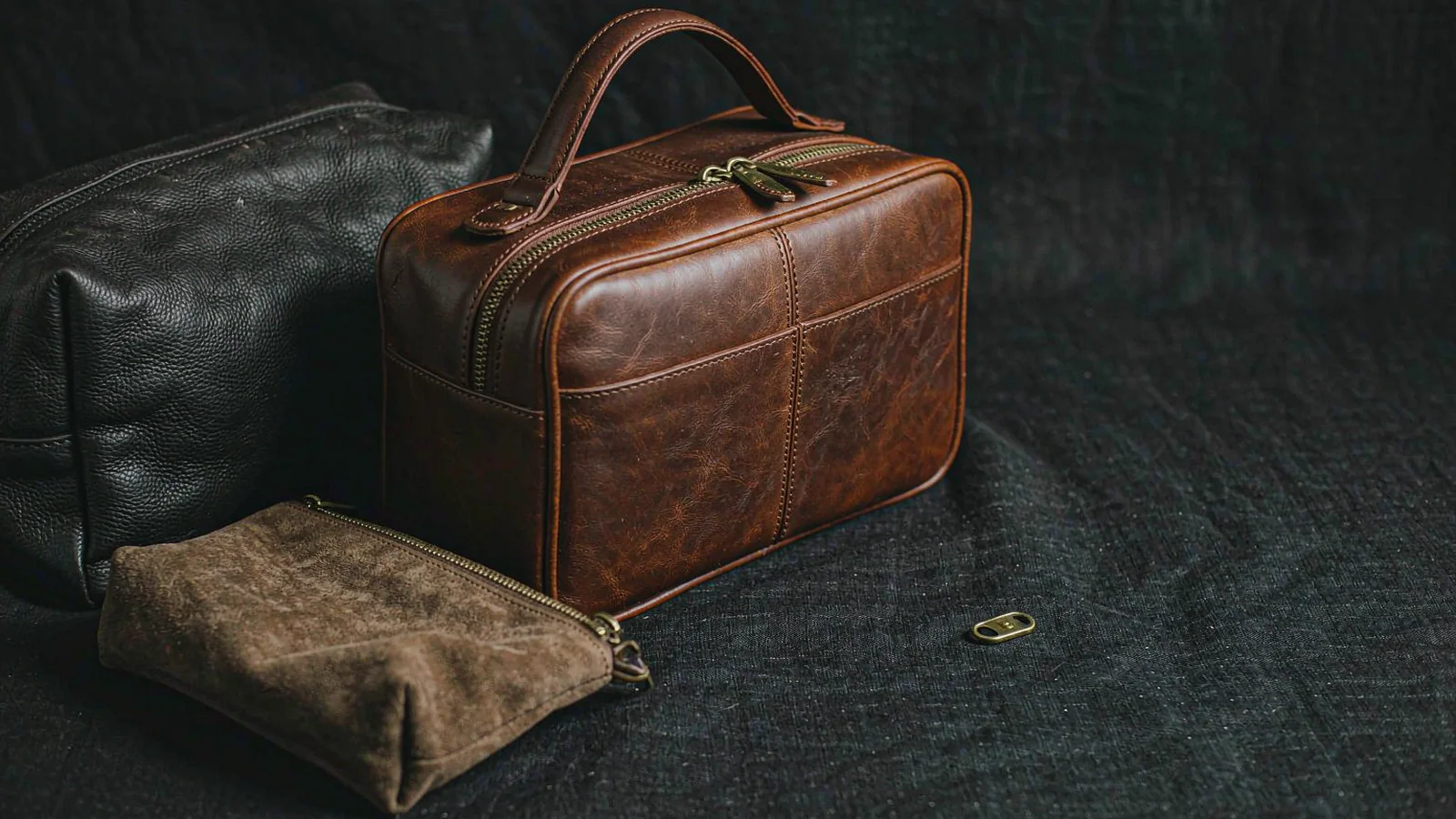
One word on a hangtag covers materials that differ more widely from each other than either does from polyester. A full-grain tanned panel at 1.4 mm and a PVC-coated knit at 0.9 mm are both sold as a leather makeup bag, and they will not survive the same two years. Specifying this category starts with vocabulary: what each grade is, where it sits in the hide, and what that position implies for strength, thickness ceiling, consistency and cost per square decimetre. Once those are clear, the conversation becomes concrete.
A hide is not homogeneous through its depth. The outer grain layer carries the pore structure, the follicle pattern and most of the tensile strength, and is also where scars, insect bites and growth marks live. Below it sits the corium, a looser fibre network that is weaker, cheaper and far more uniform. Every leather grade is a decision about how much of that top layer survives: full grain keeps it almost untouched, top grain removes only the very surface by light buffing, corrected grain takes the grain off and prints a new one back on, and split discards it entirely. Moving down that list buys uniformity and yield while costing strength, character and finish durability. It is a trade rather than a downgrade, because some designs need what the lower grades offer.
| Leather type | Where it sits in the hide | Usable substance for bags | Hand and surface character | Best-fitting construction | What to watch in specification |
|---|---|---|---|---|---|
| Full grain | Outermost grain, defects and follicle pattern visible | 1.0-1.4 mm, sometimes 1.6 mm for a firm case | Tight grain, firm break softening over months, sheen at wear points | Premium flat pouches, small structured cases 18-22 cm, burnished edges | Defects raise cutting waste; shade varies panel to panel |
| Top grain | Grain layer after light buffing and refinishing | 0.9-1.2 mm | Even fine grain, softer break, widest pigment range | Debossed logo panels, zip pouches 20-24 cm, even embossing | Buffing depth varies by hide; check finish adhesion after folding |
| Corrected grain (pigmented) | Grain buffed away, then pigment film and embossed grain applied | 1.0-1.6 mm | Uniform printed grain, fuller stiffer hand, minimal hide-to-hide variation | Large vanity cases with board inserts, luggage-style trainers, repeat orders | Surface is a film; excessive pigment dries and cracks at folds |
| Split (finished) | Lower corium layer only, no natural grain | 0.8-1.2 mm finished; 0.6-1.0 mm before PU coating | Fuzzy break, matte, no grain, consistent roll to roll | PU-coated split for mid-tier pouches, gussets, binding, reinforcements | Low tear strength alone; most strength comes from the coating |
| Suede (nap finish) | Flesh side or split buffed to a nap | 0.8-1.4 mm | Dry nap, matte depth of colour, marks and polishes unevenly with handling | Soft unstructured pouches, piped or fringed detailing, contrast panels | High crocking and water-staining risk; needs a tested protector finish |
| Nappa-type soft full grain | Full grain heavily milled to soften | 0.7-1.0 mm | Glove-like drape, softest hand in the family, shows every scuff | Slouchy pouches, roll-top cases at 25-30 cm open width, linings | Needs backing to hold shape; scuffing is the usual complaint |
Three numbers make this practical. A bovine hide yields roughly 4.0-5.5 m2 in total, but usable panel area after defects are marked out is often only 55-70% of that, so full grain carries a cost penalty unrelated to the tannery price per square decimetre. Thickness is specified in millimetres or in the ounce system, where 1 oz is 0.4 mm, making 1.0 mm roughly 2.5 oz and garment weights too light for most cases. Finally, a tolerance of plus or minus 0.1 mm on substance is normal and belongs in the materials clause, because it changes how a folded edge sits.
- Substance - thickness in millimetres, always specified with a tolerance rather than one figure
- Break - how the surface creases when folded tightly; a dry break whitens or cracks, a good break recovers
- Temper - how stiff or floppy the finished leather is, set by milling time and by fatliquor and resin levels
- Fatliquor - oils worked into the fibre during tanning; too little cracks later, too much stretches
- Finish - the pigmented or clear film on top of the leather, which takes most of the abrasion in service
- Yield - usable panel area after defects are cut around; hidden driver of cost between adjacent grades
The substitutes enter the same matrix from the other direction. PU-coated split is literally one of the grades above with a film added, making it a leather-based material rather than a synthetic one, and it is routinely mistaken for the entirely different construction of a polyurethane film cast onto a polyester knit base. PVC leatherette, microfibre PU suede and partially bio-based composites are separate families again. Because all five share one retail vocabulary, the reliable comparison is to ask what the base is, what is coated onto it and at what substance. Colour behaviour is where those differences reach the customer first, which is why rub and light fastness are set through standard methods such as the ISO 105 colour fastness series rather than opinion.
Ask for substance as a range with tolerance, for example 1.0-1.1 mm, and require that one pattern be cut from a single hide delivery. Mixing deliveries in one colourway is the most common cause of visible shade banding across panels approved from the same swatch.
Tanning Route and Finish: What Chrome, Vegetable and Chrome-Free Change
Tanning converts a perishable protein structure into a stable material, and the route chosen determines five things a bag developer will feel later: how soft the leather can be made, how well it holds a pale colour, how it reacts to water and heat, how much it stretches under a zip line, and how much documentation sits in the shipment file. Three routes dominate commercial use, and the quick way to hold them in mind is that chrome gives the widest processing window, vegetable gives the firmest body and the narrowest palette, and chrome-free options exist mainly to answer restricted-substance questions.
Chrome tanning uses basic chromium salts and completes in roughly one to two days of drum time before retanning, dyeing and fatliquoring, producing a soft, supple, thermally stable leather that tolerates wide finishing and accepts nearly any colour including pastels and deep blacks. Vegetable tanning relies on plant polyphenols over several weeks in pits or slow drums, giving a dense firm leather that darkens under light, moves slightly with humidity and has a handle customers read as substantial, but in practice delivers naturals, tans, browns and muted tones. Chrome-free or wet-white routes use synthetic syntans, aldehydes or zeolites and sit between the two in hand and cost, which is why they appear in light linings and where a metal-free claim has been requested.
| Variable | Chrome-tanned | Vegetable-tanned | Chrome-free (wet-white or aldehyde) |
|---|---|---|---|
| Process signature | Chromium salts, one to two days of tanning plus retan and dye | Plant polyphenols, several weeks in pits or slow drums | Synthetic syntans, aldehydes or zeolites, metal-free on request |
| Hand and temper | Soft, supple, high stretch recovery, mills easily | Firm, dense, slowly broken in by the owner | Soft to medium, closest simulation of chrome |
| Colour range | Very wide: pastels, neons, pale neutrals, deep level blacks | Narrow: naturals, tans, browns, muted earth tones | Wide, especially clean whites and pale shades |
| Dimensional behaviour | Stable, tolerates brief pressing heat, low humidity movement | Absorbs and releases moisture, darkens under light over months | Good stability; white grades need a yellowing check |
| Best bag application | Everyday zip pouches, structured cases, rolled and painted edges | Rigid or moulded-look cases, unlined burnished-edge pouches | Light-coloured cases, linings, metal-free enquiries |
| Documentation load | Restricted-substance declaration plus questions on tanning salts | Lower metal scrutiny, but source traceability often requested | Residual formaldehyde must be shown in a test report, not a claim |
| Indicative cost | Baseline reference for quoting | Higher per square decimetre with more cutting waste | Premium alternative; quote-driven and supply-dependent |
Finish decides most of the visible quality, sometimes more than the tanning does. Aniline finishes use only soluble dye, so the natural grain shows completely and every defect shows too; semi-aniline adds a very thin pigment layer that balances appearance against uniformity; pigmented finishes lay down a film thick enough to hide defects and carry an embossed grain. Each step up improves uniformity and stain resistance while reducing repairability. A customer who spills foundation on a pigmented corrected-grain panel can usually wipe it off; the same spill on aniline suede is permanent. That difference, more than any heritage narrative, is why most cosmetic programmes land on semi-aniline even when the budget permits better hides.
Colour performance needs pointing at a method rather than an adjective. Rub fastness, dry or against a wet cloth, is assessed using methods such as the AATCC test methods library, and buyers should set their own numeric targets, for example a minimum grade for dark linings against pale outer fabric, rather than accept the phrase colour fast in a quotation. Light fastness matters less for a bag kept in a drawer than for one sitting on a hotel bathroom counter, and perspiration fastness matters for a case handled daily. Setting targets before sampling costs nothing and prevents the complaint that cannot be traced to an agreed number.
- Aniline - dye only, no pigment film; maximum natural character, minimum stain resistance, defect-prone
- Semi-aniline - light pigment layer plus dye; the practical default for everyday leather pouches
- Pigmented - opaque film carrying an embossed grain; uniform, wipeable, repairable only by refinishing
- Pull-up or waxy - oil-rich finish that lightens where folded; develops character, shows every scratch
- Metallic or pearlescent - fine effect pigments in the finish layer; spectacular under lights, poor abrasion resistance at edges
- Matte or soft-touch - matting agents in the topcoat; fingerprints less visible, but scuffs can polish up permanently
Compliance joins tanning here, because tanning and finish chemistry together determine what must be declared. Azo-colourants that can cleave into listed aromatic amines, chromium VI in leather, formaldehyde in finishes, alkylphenol ethoxylates in wetting agents and intentionally added PFAS in some water-repellent treatments are all restricted or under scrutiny, most visibly under the EU REACH regulation. None of this is a reason to avoid leather; it is a reason to require a current restricted-substance test report and a signed declaration from whoever supplies the material, date-stamped so it can be renewed before a retail compliance portal expires it.
A sentence saying the material is REACH compliant is not documentation. Ask for a third-party test report less than twelve months old, a declaration covering the specific article rather than a generic family, and confirmation of whether any SVHC above the declaration threshold is present.
PU, PVC and Microfibre: Reading the Construction Behind the Label
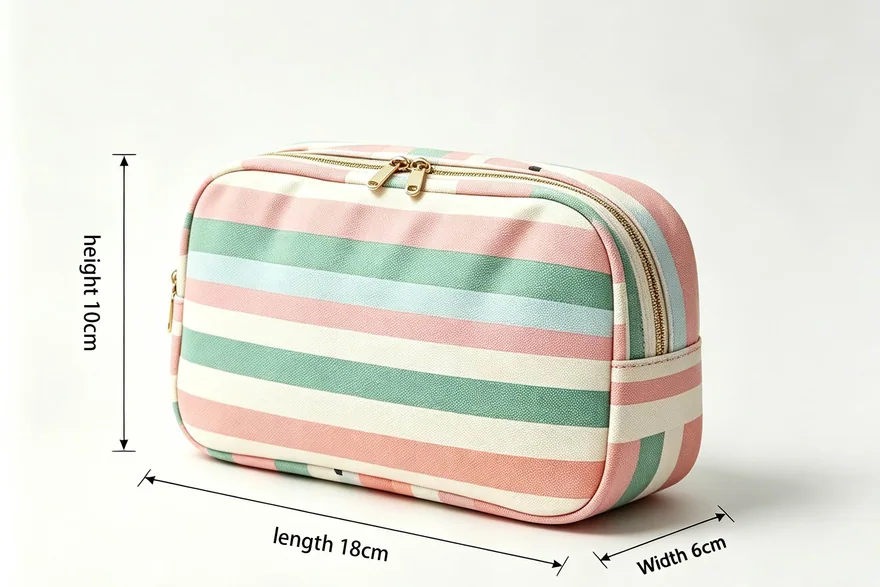
The most useful question a buyer can ask about a vegan leather toiletry bag is deceptively simple: what is underneath the coating. Two products both called PU will behave completely differently if one is a polyurethane film on a leather split and the other a polyurethane film on a polyester knit, because the substrate controls tear strength, behaviour at a raw or painted edge, how much it stretches under a zip, and what happens when the film eventually lets go. The coating itself also varies by backbone chemistry, and that choice decides whether the bag peels in year two or year six. Asking both questions at quotation stage separates a specification from a marketing claim.
| Construction | Base substrate | Coating or film | Typical substance | Dominant failure mode | Where it is used in a cosmetic bag |
|---|---|---|---|---|---|
| PU-coated split leather | Finished or unfinished corium split from a hide | Polyurethane film roughly 0.05-0.15 mm thick | 0.8-1.2 mm total | Film hydrolysis then flaking, especially in humid storage followed by use | Mid-tier zip pouches, structured cases, the default PU cosmetic bag option |
| PU film on polyester knit base | Circular-knitted polyester fabric | Polyurethane film with a compacted foam layer | 0.6-0.9 mm | Delamination after repeated tight flexing; seam slippage at stitch holes | Soft slouchy pouches, lining-free stays, roll-top cases |
| PU film on nonwoven base | Needle-punched polyester or blended nonwoven | Polyurethane film over a foam interlayer | 0.7-1.1 mm | Visible edge fray where panels are raw-cut; lower tear propagation resistance | Light trainers, gift-with-purchase cases, wide colour and print programmes |
| PVC leatherette | Polyester knit or woven scrim | PVC plastisol with liquid plasticiser | 0.8-1.5 mm | Plasticiser migration causing stiffening, odour and clouding of adjacent films | Price-led cases, wipe-clean inner walls, structured panel inserts |
| Microfibre PU suede | Nonwoven polyester or polyamide microfibre | Polyurethane binder with a suedeed face | 0.6-1.0 mm | Nap pilling and water spotting; claims not matching actual fibre construction | Premium vegan cases, piped trims, embossed logo patches |
| Silicone or hybrid coated textile | Textile base, often recycled polyester | Silicone elastomer topcoat | 0.6-1.0 mm | Narrower compatibility with standard inks and contact adhesives for logos | Hygiene-led wipe-clean pouches with minimal hardware |
Coated-fabric constructions are characterised by standard methods covering peel adhesion, coating mass, hydrostatic behaviour, cold crack and blocking resistance, and quoting against that framework rather than a photograph is what makes comparisons defensible. A buyer weighing two PU cosmetic bag quotations can request adhesion figures aligned with ASTM D751 for coated fabrics, plus rub fastness figures from the AATCC crocking methods, with targets set before samples are cut. Nobody should expect a laboratory result inside a quotation; the realistic ask is an existing third-party report and a commitment to retest at the buyer's cost on the first bulk lot.
- Hydrolysis - moisture-driven breakdown of polyester-based polyurethane chains, giving a tacky surface then flaking; polyether types resist it but abrade sooner
- Peeling - film separating from its base when adhesion was poor or the surface contaminated; starts at folds and zip ends
- Crocking - surface colour transfer onto a contacting material, dry or wet; the standard objection to dark suede and unfixed reds and blacks
- Blocking - two coated faces sticking in hot container shipment, sometimes removing finish; test hot before bulk packing
- Plasticiser migration - movement of softener out of PVC into adjacent materials, which is why PVC can fog a clear TPU window in the same case
- Cold crack - stiffening and cracking below freezing in transit or winter retail storage
None of these modes is inevitable, and all are specifiable against. Hydrolysis resistance improves materially when the coating uses a polycarbonate or polyether backbone rather than a polyester one, so a buyer targeting two years of shelf plus two years of use should ask which backbone is used rather than accepting the word polyurethane. Peel strength is largely a function of surface preparation and of whether a tie coat was applied, so a cheap material that peels in six months usually failed at the primer stage rather than at the film. Crocking is controlled by fixation and by a final anti-crock topcoat, both visible in processing cost, which is why two identical specifications quote differently.
Edge behaviour deserves particular attention in a cosmetic pouch because small formats mean sharp turns. A PU film on knit stretches slightly and turns cleanly with a narrow allowance; PU-coated split behaves more like leather and needs a fold-under, binding or flexible edge paint; microfibre suede can often be cut nearly raw if the nap is dense, which is one reason it appears in designs without visible surplus. Whichever route applies, the same construction should be folded and pressed on the actual pattern during sampling, because failure almost always appears at the tightest radius of the gusset.
Request the polyurethane backbone type in writing - polyester, polyether or polycarbonate - alongside coating mass in grams per square metre. On a hanging toiletry bag that lives permanently in a bathroom, that one line matters more than the base fabric.
Partially Bio-Based and Next-Generation Materials: What to Verify
Every material in this family is interesting and every one of them is partially bio-based, which is not the same as bio-based. A sheet built from cactus fibre, pineapple leaf waste, apple pomace, mycelium network or cork granules still needs something holding it together and protecting its face, and in commercial practice that almost always means a polyurethane binder, a polyurethane topcoat or a resin impregnation. Honest specification starts by asking for two numbers rather than one: the tested bio-based share of the finished article, and the identity of the binder making up the remainder. A brand repeating someone else's plant-based claim without checking those numbers carries the compliance risk for the launch.
There is also a difference between renewable input and renewable content. Bio-attributed polyurethane made with plant-derived polyol belongs to the same chemical family as its fossil equivalent, typically reports a bio-carbon fraction in the 20-40% range of polyol mass depending on formulation, and performs identically, which makes it the lowest-risk route for a programme wanting a measurable claim without changing pattern, tooling or tolerances. Recycled polyester with a polyurethane coating is another bridge option, and because recycled content is verifiable through chain-of-custody frameworks such as the Global Recycled Standard, its claims are easier to substantiate on a retail portal than a vague plant-based statement. Plant-part composites and mycelium sheets suit capsule launches better than core repeat programmes.
| Material family | Bio-based share to request | Binder or coating reality | Substance and hand today | Programme risk | Honest retail positioning |
|---|---|---|---|---|---|
| Plant-part composite on textile base | Commonly 20-50% by weight; insist on the test method used | PU binder or PU/PVC topcoat over a textile carrier | 0.8-1.4 mm, firmer than expected, limited drape | Higher minimums, longer lead times, small colour lots with shade drift | Sustainability story; still a coated composite, not a pure leaf material |
| Mycelium-part sheet | Varies widely by producer; request the standard applied | Usually resin-impregnated or PU-finished | 1.0-2.0 mm, dense and matte, distinct tactile identity | Limited widths and colourways, slow sampling, quote-dependent cost | Capsule launches where novelty carries value |
| Recycled polyester with PU coating | Zero bio-based; recycled content verifiable instead | Standard polyurethane on rPET knit or nonwoven | 0.6-1.0 mm, soft, performs like standard PU | Claim depends entirely on chain-of-custody documentation being ready | Strong bridge option for programmes needing auditable claims |
| Bio-attributed polyurethane | Bio-carbon often 20-40% of polyol mass depending on grade | Polyurethane chemistry with renewable feedstock | Matches standard PU across the range | Allocation method must be confirmed: mass balance or direct | Direct substitute needing no retooling or tolerance change |
| Cork fabric on textile backing | High natural content in the visible face layer | Textile backing plus a thin protective finish | 0.5-1.0 mm, light, cracks rather than folds at tight radii | Needs a generous pattern radius and careful seam handling | Panels, trims and brand-detail accents rather than full bodies |
Verification language needs precision, because it separates a defensible line from a substantiation problem. Bio-based content measured as organic carbon, expressed as a percentage of total organic carbon, gives one number; measured as a percentage of total mass it gives a different and usually lower one for the same sheet. A 40% bio-carbon claim and a 25% bio-mass claim can describe the identical material, and neither is false, so the quotation should name the basis used and cite the test report rather than the brochure. Article-level certification such as OEKO-TEX Standard 100 covers harmful substances but says nothing about renewable content, so it complements rather than replaces those figures.
- Bio-based content - ask whether measured on total organic carbon or on total mass; one sheet gives two numbers
- Allocation method - mass balance allows a claim on a pathway that also carries fossil input; direct attribution is stricter and usually costlier
- Binder identity - the polyurethane or resin doing the structural work drives hydrolysis behaviour, cold crack and edge performance
- End of life - recyclability and biodegradability differ; a coated composite usually qualifies cleanly for neither
- Supply continuity - plant-part materials are agricultural: harvest variation changes shade and hand between deliveries
- Claim scope - what applies to the shell may not apply to lining, interlining, thread or hardware
Two planning notes make these materials workable. The first is quantity: many producers quote a material minimum well above the 500-piece programme minimum, or apply a whole roll to one order, so a first run may carry a surcharge that disappears at reorder. The second is lead time, because these sheets are often imported to the cutting floor on their own schedule, and expecting the standard sampling window on a material that must first be shipped in is unrealistic. Programmes wanting the sustainability story inside a normal calendar should plan it as a long-pole item and approve body panels before hardware and print decisions are finalised.
Decide first whether the launch will say bio-based, plant-part, recycled-content or metal-free, because each word drives a different material and documentation package. Promising more than the test report supports creates an exposure no amount of good construction will offset.

Substance, Edge Finish, Hardware, Decoration and Lining
Material and construction meet at one decision: how thick, how heavy, and how much structure the design needs. A soft pouch relies entirely on the drape of its shell, so anything above roughly 1.0 mm fights the shape and produces creases that never recover; a structured case relies on the shell resisting compression, so anything below about 1.0 mm needs interlining, board inserts or foam lamination to stop it collapsing in a suitcase. Getting this number wrong produces the most common failure in the category, which is not a torn bag but one that photographs flat and disappoints in three dimensions.
Weight follows from substance and base density, with a hard practical limit. Light leathers and substitutes sit around 300-600 g per square metre at bag-relevant thicknesses, while dense corrected-grain or heavy full-grain panels can approach 700-900 g/m2 at similar area, so doubling up on interlining quietly adds 150-250 g to a 25 cm case. Hardware has to match that load: a #3 coil zip and a light aluminium puller suit a soft 0.8 mm pouch, whereas a 1.4 mm structured case generally wants a #5 metal or moulded zip, a stiffer tape and a bound or covered rail so the teeth cannot saw through the shell. Terminology is not interchangeable between sources, so names should be pinned against a reference such as ASTM D2053 for zipper terminology rather than a catalogue description.
| Design intent | Recommended substance range | Edge treatment | Decoration that survives | Lining suggestion |
|---|---|---|---|---|
| Flat soft pouch, unstructured, about 20 x 13 cm | 0.6-0.9 mm nappa-type or split suede | Turned and topstitched; no paint needed | Blind deboss, deep emboss or woven label only | 190T polyester or brushed tricot at 55-70 g/m2 |
| Medium zip pouch, light structure, about 23 x 15 x 7 cm | 0.9-1.2 mm top grain or PU film plus interlining | Fold-and-paint edge or 6-8 mm self binding | Hot foil on a flat panel; screen print on PU only | 210D polyester, wipe-clean, no coating transfer |
| Structured vanity case, about 25 x 18 x 12 cm | 1.2-1.6 mm corrected grain or PU on board | 12 mm binding tape with reinforced corners | Deboss plus metal logo plate; avoid large-area print | 150D twill polyester laminated to 2 mm foam |
| Roll-top or fold-over case, 30 cm open width | 0.8-1.1 mm soft-milled, low-temper finish | Turned seam, no paint at the fold line | Blind emboss; sewn label; no rigid hardware on folds | Cotton-polyester brushed sheeting 90-110 g/m2 |
| Hanging toiletry case with hook, 24 cm folded | 1.0-1.2 mm PU-coated split, flexible topcoat | Edge paint with flexible resin, fold-tested after cure | Screen print on flat face; heat transfer on textile panels | Coated 210D polyester with mesh slip pockets |
Edge finishing is the clearest cost signal and quality signal in a leather makeup bag, and people notice it before almost anything else. Folded-and-stitched edges are cheapest and most forgiving, read informal, and suit soft pouches and nappa-type builds. Painted edges are clean and unforgiving: the resin must be compatible with the finish underneath, applied in two or three passes with inter-pass drying, and fold-tested after full cure, because a stiff resin over a soft body cracks along the fold line within weeks. Binding with tape or self-fabric costs most in labour and adds 3-5 mm to every dimension, but it survives the structural builds where paint fails.
Decoration should be chosen against the finish rather than against a logo file. Debossing presses into the grain and suits vegetable-tanned or full-grain material with enough substance to take a shallow relief, and it lasts longest because nothing is added to the surface. Hot foil looks sharp on flat matte panels but bridges poorly across heavy embossed grain. Screen print and heat transfer adhere best to PU or PVC and least well to oil-rich aniline leather, where ink sits on wax rather than fibre. Embossed suede or microfibre can partially recover as the nap lifts. Where the shell resists every method, a metal plate, a woven label or a smooth inset panel solves it.
- Deboss and blind emboss - longest lasting, nothing added to the surface, best on firm grain above 1.0 mm
- Hot foil - sharp on flat panels, patchy on deep embossed grain, poor adhesion on silicone topcoats
- Screen print - reliable on PU and PVC, needs compatible ink and cure, vulnerable to plasticisers
- Heat transfer - strong colour on textile-backed panels, weakest at folds and corners
- Metal logo plate - works on any substrate, needs a suitable rivet or stitch pattern, adds weight
- Woven or embossed label - the safe fallback where a structural shell resists direct marking
Lining deserves more attention than it gets, because in a cosmetic bag it takes almost all of the abuse. The balance is between a soft hand that protects glass bottles and a coated face that can be wiped after a spill: 190T to 210D polyester, brushed tricot at 55-70 g/m2, or a 150D twill laminated to 2 mm foam are the common answers at different price levels. The two checks that matter are crocking from a dark lining onto a pale shell, and shrinkage, since slightly different shrinkage makes panels pucker after cleaning. Approving both from one dyer removes that risk cheaply, and PU linings should be sold as wipe-clean rather than washable, since machine washing breaks the bond between film and base.
- Lock substance with tolerance, then interlining thickness, before approving samples; changing either alters external dimensions
- Approve the edge finish at the production radius, not on a flat swatch; cracking starts at the gusset end
- Match zip size to shell weight: #3 coil below 0.9 mm, #5 above 1.2 mm or wherever board is carried
- Require a hardware pull test and a cycle target on every structuring or plating change
- Specify lining weight in g/m2 alongside denier; one denier can be woven to very different weights
- Require any edge paint to be identified by resin type so reorders match
Failure in Service, Care Instructions, Compliance and Where Each Material Sits on Shelf
What actually kills a leather makeup bag is rarely structural; it is usually chemistry. Solvent-based cleansers and alcohol-rich removers carried alongside the makeup, foundation transferring during a spill, sunscreen migrating into stitch holes, and humidity cycling in a bathroom that never fully dries are the real agents. Genuine leather tolerates a damp cloth but loses oils to every solvent. PU tolerates water-based spills well and also fails against solvents, but in a different place: damage there is permanent loss of the topcoat rather than a stain that might be conditioned out. Suede and microfibre respond worst of all to anything wet, drying unevenly so a mark remains even without staining. Which of these is likely shapes both the care instruction and the shell decision.
- Genuine leather - wipe with a barely damp cloth, dry away from direct heat, condition twice a year, never machine wash, expect marks to become patina
- PU-coated split - wipe with mild soap solution, no solvents or alcohol, avoid tumble drying and long-term tight folding
- PVC leatherette - wipe clean only, keep away from heat; gradual stiffening begins rather than reverses
- Microfibre PU suede - brush dry with a suede brush; dampen the whole panel rather than the spot; retest protector sprays for shade change
- Partially bio-based sheets - follow the coating, not the filler; a dominant PU topcoat means PU care wording
- Any construction - empty and air dry after a spill before resealing; trapped solvent does more damage in a closed pouch
Care instructions sit inside a compliance package that has to be built alongside the product. For most cosmetic and toiletry bags entering major markets, that package includes a restricted-substance test report against the buyer's list, a chemical declaration from each material source, labelling showing composition and country of origin, and any general-product-safety declaration that applies. OEKO-TEX Standard 100 covers the finished article against a list of harmful substances, and in the United States, lead and phthalate limits under the Consumer Product Safety Improvement Act apply to regulated categories, so the destination market determines which documents belong in the file. Obligations under REACH apply to articles placed on the EU market regardless of size.
Leather carries one extra administrative step that no substitute does. Because it is material of animal origin, some destination markets apply additional import documentation controls relating to species declaration, processing method and sanitary certification, and those requirements vary by country, by species and sometimes by which authority inspects a given shipment. This is not a reason to avoid hide, but it is a reason to bring a licensed customs broker in before the first booking rather than after it: the paperwork is routine when arranged in advance and expensive when discovered at the port. Buyers running parallel programmes often find that substituting one trim component changes how an entire style documents, so trims, glues and any small leather tab should be listed before a shipment is classified.
Material choice also carries meaning on shelf, and it must be honest about price. At the lowest illustrative planning band, around USD 2.00-4.00 landed per unit, the realistic shells are PVC leatherette and thin PU on nonwoven base, with one to two years of casual use before edge or surface wear begins. From roughly USD 4.00-8.00, PU-coated split and PU on knit come into range, offering better tear strength and a credible two to three year life with proper edge finishing. Above about USD 8.00-15.00, corrected-grain and top-grain hide become viable for smaller formats; above that, full grain, vegetable-tanned builds and better microfibre are realistic. These are internal budgeting figures that need requoting, and their purpose is stopping a brief that asks for full grain at a USD 3.00 cost target.
Reading those bands against the customer is the last piece. A gift-with-purchase programme wants the material to look expensive for one photographed moment, which is where a matte PU with a good emboss outperforms its own cost. An everyday retail pouch is judged at two years, favouring a repairable construction over a rich one, and a better zip over a better shell. A premium case sold on permanence has to offer real substance, real edge finishing and replaceable hardware, written into the specification so reorders can match it. With sampling at 6-10 working days and bulk at 35-50 days after approval, there is time to get the decision right before committing to 500 pieces.
Restricted-substance reports, material declarations, care wording and customs classification belong in the sampling stage, when changes are cheap. The costliest compliance problem in this category surfaces after the container ships, when the only options are re-labelling at destination or discounting the purchase.
The B2B Customisation View
A realistic cosmetic bags schedule assumes one round of sample revision; planning for a perfect first sample is the most common cause of a slipped launch.
Fixed commercial parameters: 500 pieces per style and colourway minimum, first sample in 6–10 working days (12–15 for complex or hardware-intensive constructions), bulk 35–50 days after approval, AQL 2.5 inspection under ISO 2859-1, FOB Xiamen, T/T 30/70.
A sourcing-partner structure also protects the buyer when volumes grow, because capacity for cosmetic bags can be spread across SGS-verified production lines without changing the specification.
Which Brand Types This Guide Serves
This guide serves several kinds of buyer, and each one uses the same material information for a different decision. What they share is that material selection happens once and then constrains everything downstream: the pattern, the tolerances, the hardware specification, the decoration method, the compliance file and ultimately the price band the product can honestly occupy. Getting it right early is cheaper than any amount of negotiation later, because almost every expensive problem in this category traces back to a line in the original material specification rather than to anything done on the assembly floor.
- Start-up beauty brands building a first launch, typically choosing between a PU cosmetic bag at 0.8-1.0 mm with debossed branding and a genuine top-grain pouch where the unit cost supports it, needing clear guidance on which trade-offs customers actually notice
- Established brands extending into storage cases who need test reports dated within twelve months and terminology matching their retail portals rather than a generic material name
- Retailers and private-label teams who should lock the material six weeks ahead of the 35-50 day bulk window, since leather and coated constructions are made to order
- E-commerce sellers optimising reviews and returns, where specifying a properly fixed dark lining removes the most common negative review topic in this category
- Hospitality and gift buyers wanting the appearance of hide at a volume price, best served by a matte PU with a credible emboss and a wipe-clean lining
- Promotional and gifting programmes working inside a fixed unit ceiling, where careful grade selection between PVC leatherette and PU-coated split matters far more than any surface finish upgrade
Whichever of these describes the programme, the workflow that produces a reliable result is the same: set the material family and substance first, then the edge treatment and lining, then approve against written targets rather than impressions. ISO 2859-1 sampling procedures underpin the AQL 2.5 inspection applied at shipment, and every preference agreed beforehand should be written into the specification so it survives contact with a second delivery nine months later. Questions about result-specific details, with terms held at 500 pieces per style and colourway and a T/T 30/70 structure on FOB Xiamen, go to [email protected].
Frequently Asked Questions
Should a leather makeup bag programme specify genuine hide or a PU construction?
It depends on what the customer will do with the bag and on the unit cost target. Genuine hide offers repairability, edges that can be burnished rather than merely covered, a distinctive ageing pattern and higher tear strength at equal substance, though it costs more and varies between hides. PU constructions offer colour repeatability across deliveries, defect-free surfaces, easier cleaning after cosmetic spills and lower unit cost at 500 pieces per style and colourway. Buyers building something intended to last years generally prefer hide; those building a promotional or trend-led item generally prefer PU.
What thickness should be specified for a soft leather pouch compared with a structured case?
A soft pouch relying on drape works best between 0.6 and 0.9 mm; anything thicker fights the shape and creases permanently at the fold. A structured case must resist compression, so start at 1.0-1.6 mm, with anything below 1.0 mm needing interlining or board to avoid collapsing. The practical step is to lock substance with a tolerance of about plus or minus 0.1 mm, then interlining thickness, since together they set external dimensions, how the folded edge sits and whether a #5 zip can be sewn through cleanly.
How long does PU-coated split leather last before it starts peeling?
Service life is governed by the polyurethane backbone rather than the split underneath. Polyester-based films, common because they are soft and cheap, break down under humidity and can become tacky then flake within two to five years, sooner in a permanently damp bathroom. Polyether and polycarbonate formulations resist that mechanism much better and cost more per metre. Peeling usually begins at zip ends and tight gusset folds, so asking which backbone is used, requesting adhesion figures aligned with coated fabric test methods and setting an internal target before sampling beats relying on any generic durability claim.
What is the difference between full grain and top grain leather in a bag specification?
Full grain keeps the outer surface of the hide essentially intact, retaining the pore structure and tensile strength of the grain layer while displaying every scar and growth mark, which raises cutting waste to 30-45% in some programmes. Top grain has that outer surface lightly buffed away, then refinished, giving an even appearance, a softer break, better acceptance of pigment and better yield per hide, at some cost in strength and character. For a small debossed cosmetic bag, top grain is usually more economical; for a burnished-edge premium pouch, full grain is usually worth the penalty.
Why does PVC leatherette smell, and does the odour disappear?
The odour comes from residual solvent and migrating plasticiser in the PVC layer, and its intensity reflects both formulation quality and how long the roll has been held. It does diminish with airing, but it never fully disappears because the plasticiser continues to migrate slowly throughout service life, and that same migration is what eventually causes stiffening and can cloud an adjacent clear window in the same case. Buyers sensitive to odour should ask for low-migration or low-odour grades, request that rolls be aired before cutting, specify ventilation holes in the polybag, or move to a PU construction, which is measurably less odorous at comparable cost in many grades.
Which decoration methods work on leather compared with PU?
Debossing and blind embossing suit leather best, particularly firm full grain or vegetable-tanned material above 1.0 mm, because the relief is pressed into the fibre and nothing wearable is added. Hot foil works on flat matte leather panels but bridges poorly over deep embossed grain. Screen print and heat transfer adhere reliably to PU and PVC and unreliably to wax-rich aniline leather, where ink sits on the finish. Suede and microfibre embossing can partially recover as the nap lifts. Where no direct method suits, a metal plate, woven label or smooth inset panel is the reliable fallback.
Should genuine leather cosmetic bags be lined, and which lining works best?
Yes in almost every commercial case, because the lining takes nearly all of the cosmetic contact while the outer shell takes almost none. A 190T to 210D polyester or brushed tricot at 55-70 g/m2 protects bottles and keeps unit cost reasonable; a 150D twill laminated to 2 mm foam adds body for a structured case. The two specifications worth locking are crocking, since a dark lining can transfer onto a pale shell, and shrinkage, which causes puckering after cleaning. Approving both from one dyer at the same time prevents both cheaply.
How can a buyer verify a vegan leather toiletry bag claim?
Verify it structurally rather than by assertion. Ask for the base and the coating separately: a PU-coated split contains real hide fibre, while a polyurethane film on polyester knit or nonwoven contains none. Confirm the claim covers the whole article: lining, interlining, thread, binding tape, glue, any leather zip pull tab and any suede label. A vegan claim does not automatically improve compliance behaviour, so restricted-substance documentation still applies exactly as for hide. Record the composition on the specification sheet so reorders cannot substitute a different construction.
Is vegetable-tanned leather better than chrome-tanned for a toiletry bag?
Not categorically; the two suit different designs. Vegetable tanning produces a dense firm leather with a recognisable handle that darkens attractively under light, but the achievable palette is largely limited to naturals, tans and browns, it moves with humidity, and it costs more per square decimetre with higher cutting waste. Chrome tanning gives a softer, more stable, more thermally tolerant leather that accepts virtually any colour including pale pastels and true blacks, which matters enormously when every colourway in a range has to match a swatch. Where a pale or white colourway is essential, chrome-tanned or chrome-free options are the realistic choices.
How heavy is a leather vanity case compared with a PU one at the same size?
At bag-relevant thicknesses, light leathers and their substitutes run roughly 300-600 grams per square metre, while dense corrected-grain or heavy full-grain panels approach 700-900 grams per square metre at similar substance. On a 25 by 18 by 12 cm case with lining, interlining and hardware, choosing a heavy hide instead of a PU film on knit can add 200-400 grams to the finished item, which is noticeable to someone packing a cabin bag and expensive across air freight. Buyers targeting a lightweight product should specify maximum grammage alongside thickness rather than thickness alone, since the two together determine weight.
What restricted-substance documentation should accompany a leather or PU cosmetic bag?
Ask for a third-party test report less than twelve months old covering the specific article rather than a generic material family, plus a signed restricted-substance declaration from each material source. Items commonly checked include azo colourants that can cleave into listed aromatic amines, chromium VI in leather, formaldehyde in finishes, alkylphenol ethoxylates, intentionally added PFAS in water-repellent treatments, and phthalates and heavy metals in PVC layers and hardware. Article-level certification against a harmful substances list complements this but does not replace it. Date-stamp everything and renew proactively, since retailers increasingly check substantiation after listing.
Does using animal-origin material create extra import paperwork?
It can. Because leather is material of animal origin, some destination markets apply extra import documentation controls on species declaration, processing method and sanitary certification, and the detail varies by country, by species and by inspecting authority. Buyers should raise this with a licensed customs broker before the first booking rather than at the port, because the paperwork is routine in advance and expensive when discovered late. It is also worth listing every incidental component, including trims, glues and any small leather tab, since one substitution can change how the whole style documents.
How should a leather makeup bag be cleaned, and can care wording go on the product?
Care wording belongs on a sewn-in label or printed panel, and should describe the coating rather than the marketing story. Genuine leather: wipe with a barely damp cloth, dry away from direct heat, condition twice a year, never machine wash, expect wear to become patina. PU: wipe with mild soap, no alcohol or solvents, no tumble drying, no long-term tight folding. PVC: wipe clean only, keep away from heat. Suede and microfibre: brush dry, dampen the whole panel rather than the spot. Always tell the user to air the bag open after a spill before resealing.
At what price does genuine leather stop making sense for a cosmetic bag?
As an illustrative internal planning guide rather than a quotation: below roughly USD 4.00 landed per unit, only PVC leatherette and thin PU on nonwoven base are realistic, giving one to two years of casual use. Between about USD 4.00 and 8.00, PU-coated split and PU on knit come into range with better tear strength and a credible two to three year life. From roughly USD 8.00 to 15.00, corrected-grain and top-grain hide become viable for smaller formats; above that, full grain and vegetable-tanned builds are realistic. Every figure needs requoting; the point is stopping a brief asking for full grain at a USD 3.00 target.
People Also Ask
What is a leather makeup bag actually made of?
It can be one of several quite different materials. Genuine options include full grain, top grain, corrected grain, finished split, suede and soft nappa-type finishes, each defined by how much of the outer grain layer survives. Man-made options include polyurethane-coated split, polyurethane film on a polyester knit or nonwoven base, PVC leatherette and microfibre PU suede. Partially bio-based sheets containing plant fibre or mycelium exist too, though most still rely on a synthetic binder. Asking what the base is and what is coated onto it identifies what is actually being bought.
Is PU leather vegan?
Not necessarily. A PU-coated split is real hide split with a polyurethane film applied, so it contains animal fibre and is not vegan even though it is accurately described as PU. A polyurethane film cast onto polyester knit or nonwoven contains no animal input. To make a defensible claim, buyers must check the whole article: outer shell, lining, interlining, thread, binding, adhesive, zip pull tab and any suede label, because a single leather trim component invalidates the claim. Ask for written composition on the specification sheet so reorders cannot quietly substitute another construction.
How can you tell whether a cosmetic bag is real leather?
Look at the edge first: real leather has a fibrous, slightly fuzzy break, whereas a coated fabric shows a textile weave or a nonwoven base. Real leather also smells characteristic, feels warm, shows irregular pore structure under magnification and absorbs a drop of water slowly. PU and PVC surfaces show a repeating embossed grain, feel cooler, and resist water entirely. Labels help but are not proof, since PU-coated split is legitimately described as leather in some markets. For purchasing purposes, the reliable route is a written substrate declaration rather than a visual test.
Are vegan leather toiletry bags durable?
Durability depends far more on the polyurethane backbone and the base than on whether the material contains hide. Polyester-based PU is soft and inexpensive but vulnerable to humidity-driven hydrolysis, becoming tacky then flaking after roughly two to five years, especially in a bathroom. Polyether-based and polycarbonate-based films resist that mechanism and last considerably longer at higher cost. Base also matters: knit and nonwoven bases tear differently, behave differently at raw edges and take strain differently at zip lines. Setting written targets for peel adhesion and rub fastness before sampling is the reliable way to compare two quotations.
Does leather resist makeup spills better than PU?
Each fails differently. A cosmetic spill on a pigmented leather panel tends to sit in the finish and can often be wiped or conditioned out, whereas on PU it can attack the topcoat and leave permanent dulling. Against alcohol-based removers and solvent cleansers, both are vulnerable: leather loses oils and dries, while PU suffers coating damage. Suede and microfibre perform worst, since uneven drying leaves a mark even without staining. In practice the more protective decision is often the lining specification and the wipe-clean instruction rather than the choice of shell material itself.
References & Standards
- ISO 2859-1 sampling procedures for inspection by attributes
- ASTM D2053 standard terminology relating to zippers
- AATCC TM61 colour fastness to laundering
- IEC 62321 determination of certain substances in electrotechnical products
- OEKO-TEX Standard 100 testing for harmful substances
- Textile Exchange Global Recycled Standard
- US CPSC CPSIA consumer product safety improvement act
- ECHA REACH regulation on chemicals
- TSA 3-1-1 liquids rule for carry-on baggage
- ASTM D751 standard test methods for coated fabrics
- ISO 105 textiles tests for colour fastness
- Global Organic Textile Standard GOTS
In-Depth Articles in This Category
14 dedicated articles sit under this pillar guide.
Related Pillar Guides
Request a Sample or a Written Quotation
Send the silhouette, dimensions, material preference and logo artwork, and the programme team will return a written quotation with MOQ, sampling window, bulk lead time and inspection standard.
Email: [email protected] · WhatsApp: +86 177 5002 0688