Cosmetic Bags for Fitness Enthusiasts: Gym & Yoga Use
Executive Summary
Cosmetic bags for fitness enthusiasts need to manage a rapid transition between training, showering, commuting and the rest of the day. The most useful design separates damp items from dry cosmetics, stands securely on a locker shelf and opens wide enough for fast retrieval without spilling contents. A compact 22 × 14 × 9 cm pouch suits a yoga-class refresh kit, while a 26 × 17 × 11 cm case accommodates shower bottles, deodorant, skincare and a small towel. Breathable zones help damp accessories dry, but leak-prone liquids still need a coated or removable compartment rather than open mesh.
Gym and yoga users do not form one uniform profile. Some travel with a mat and small tote; others carry a large duffel, cycle to a studio or move directly into a workplace. Product architecture should follow those routes. Rounded corners prevent snagging, a stable grab loop supports quick locker handling, and visible interior contrast reduces forgotten items. Washability claims must identify what can be washed and how. Materials, coatings, foam and decoration react differently, so a wipe-clean liner or removable washable pod is often more credible than declaring the entire structured bag machine washable.
The workout route defines the cosmetic bag better than the sport label
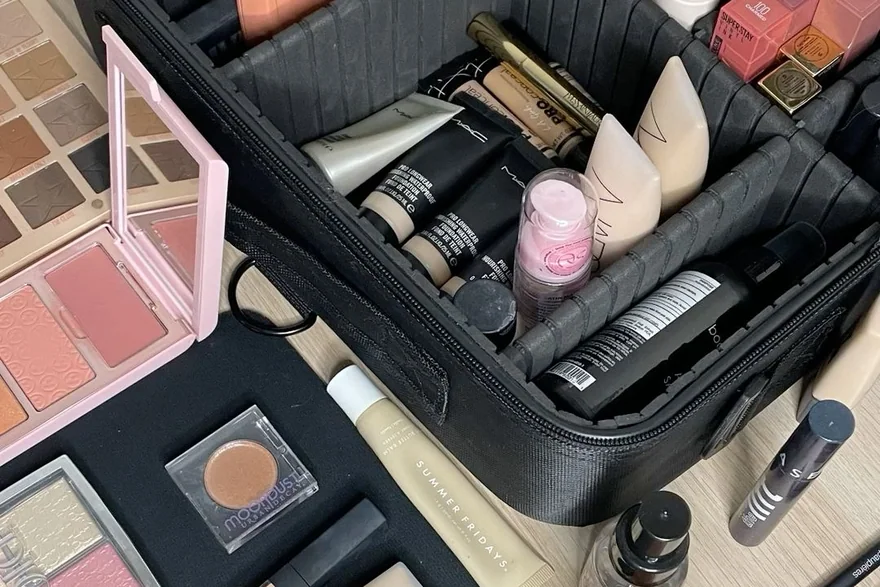
A fitness cosmetic bag serves moments rather than a single activity: pre-class preparation, shower access, post-workout skincare, a change of venue and eventual drying at home. The useful product brief maps those moments. A yoga commuter may carry face mist, deodorant, hair ties, sunscreen and a small cleansing cloth in a tote beside a mat. A gym user with shower access may add shampoo, body wash, moisturiser, shower footwear and a damp cap or wristband. A runner travelling light may need only anti-chafe balm, wipes and a key. Treating all three as the same large wash bag adds bulk and hides the items that should remain immediately available.
Locker geometry introduces hard limits. Many users place a pouch on a narrow shelf, stand it at the base of a locker or hang it from a hook. A bag that is excessively deep steals shoe space, while a tall soft pouch falls forward as bottles are removed. A base around 9 to 11 cm deep, reinforced with thin PE board, keeps an everyday kit upright. A vertical height below about 18 cm fits more shelf positions than a tall hanging organiser. Rounded top corners and a recessed handle prevent snagging when the pouch is pulled from a crowded duffel.
The category also carries a hygiene expectation that should be expressed with construction, not vague wellness language. Smooth lining, accessible corners and removable parts make residue easier to remove. Ventilation helps a damp textile item release moisture once the bag leaves the locker, but it cannot correct a sealed wet bag forgotten for days. The design should make unpacking obvious: a contrasting wet pod, a loop that hangs it to dry and a wide mouth that can be turned outward for wiping. Those choices support realistic care without implying health or medical outcomes.
Packing position adds another constraint. A pouch under shoes and a towel sees compression from several directions, while one in a side tote pocket sees repeated abrasion and possible rain. The brief should show where the bag rides and which objects sit around it. That context decides whether pump guards, a reinforced base or a smooth low-profile shell adds value. It also prevents unnecessary padding from consuming space in a light yoga tote.
Wet and dry zoning must control both water and airflow
Wet-zone design begins by separating three conditions. A sealed liquids pocket contains a leaking bottle. A water-resistant compartment delays moisture transfer from a damp cloth. A ventilated pocket lets residual moisture escape. These functions conflict: the membrane that contains a leak also restricts airflow. The most adaptable solution is a coated main pouch for liquids plus a removable mesh or perforated pod for damp accessories. Users can keep the pod attached during the journey, then remove and hang it at home.
For a compact yoga kit, a 20 × 12 cm TPU-lined envelope can hold facial mist, sunscreen and cleansing products while a 16 × 10 cm mesh sleeve carries hair ties or a dry cloth. A shower-oriented case may reserve one third of its volume for a welded clear pod and two thirds for dry skincare and cosmetics. The wet boundary should not share an unsealed seam with an absorbent foam panel. If stitching is necessary, the specification should show the seam path and define a modest containment check rather than call the construction waterproof.
Airflow is driven by exposed area. Two small eyelets contribute little when a damp cloth is compressed behind a coating. A mesh panel covering part of the removable pod, with a solid lower tray to catch droplets, gives a more useful route. Mesh opening size should keep small items inside and resist snagging from hooks or jewellery. The pod should also open widely enough that users can remove every item; a narrow zipper on a deep pocket creates the damp, inaccessible corner the feature was meant to avoid.
Care labels need to match the construction. A simple unstructured polyester pouch may tolerate gentle hand washing, while a foam-backed or PE-board case may deform if immersed. Heat-welded TPU can crease under high heat, metal trims may discolour and printed logos may respond differently from the base cloth. Buyers can use AATCC test methods as a recognised reference when defining colourfastness or laundering evaluations, then state the approved consumer care method plainly.
Pocket colour can reinforce the moisture boundary. A translucent blue pod and pale dry lining communicate different functions without text-heavy labelling, while textured and smooth pulls preserve the distinction by touch. The cue should remain consistent throughout the range. When two modules appear identical after removal, users can return a damp component to the wrong position, so orientation marks and attachment geometry should make the correct placement apparent.
| Moisture condition | Suitable zone | Air exchange | Cleaning route | Design limit |
|---|---|---|---|---|
| Leaking travel bottle | Welded TPU removable pouch | Low | Remove and wipe | Closure is still a potential path |
| Damp face cloth | Mesh pod with coated lower tray | High above tray | Remove, rinse and hang dry | Not for free liquid |
| Dry cosmetics | Lined structured cavity | Moderate | Wipe interior | Keep isolated from wet seams |
| Shower accessories | Perforated coated pocket | Medium | Open fully and air dry | Small perforations can retain residue |
| Used hair ties or bands | Small external mesh sleeve | High | Empty after every session | Open mesh may snag |
- Do not ask one material to provide full containment and high ventilation at the same time.
- Make the damp component removable so the drying action is visible and convenient.
- Keep stitched seams above the lowest point of a liquid tray where possible.
- Write care instructions for the complete laminated construction, decoration and hardware—not only the face fabric.
Locker, tote and mat-carry formats require different attachment logic
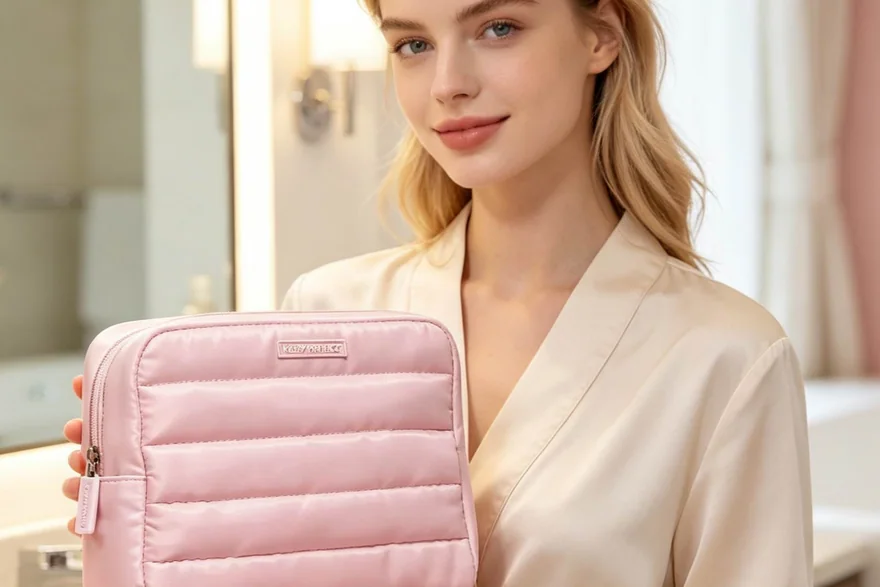
A cosmetic pouch that rides inside a duffel needs smooth edges and enough structure to protect pumps from side pressure. A pouch clipped to a yoga tote needs a secure, low-profile attachment that does not swing into the user or interfere with the mat. A case that stays in a locker needs a stable base and an opening that works in a narrow vertical slot. These routes should not be combined automatically. External clips and long straps add weight and snag points when most users will carry the item internally.
For tote integration, a short 15 to 20 cm webbing loop with a low-profile gate hook can secure the pouch to an internal D-ring. The loop should detach so the product remains clean in hand-carry mode. An external snap loop can wrap around a mat strap, but it should not be positioned as a load-bearing mat carrier. Test the attachment with the filled pouch during walking and stair movement; a connector that seems secure on a table can rotate and release when the pouch swings.
Locker access favours a U-shaped lid or a top zipper with twin sliders. A full book-style opening gives visibility but can spill objects if the bag is opened vertically. A gusset limiting the lid to about 100 to 120 degrees creates a small shelf and keeps items in place. Elastic loops should vary in width: 25 mm for slim tubes, 40 mm for deodorant or travel bottles and a broad sleeve for a comb. One open zone should remain for irregular items rather than filling every wall with prescribed loops.
Fitness use also rewards a clear external cue for orientation. A contrasting top pull identifies the opening inside a dark duffel, while a different texture on the wet-pod pull prevents confusion. The cue can be subtle and brand-consistent: ribbed versus smooth moulded pulls, two close tonal colours or a short knotted cord. Reflective piping may suit cycling-oriented collections, but it should be positioned as visibility detailing rather than safety equipment. A loop for a locker key can sit inside the dry section, where it cannot scratch cosmetic containers.
Strap and hook storage matters when the feature is not in use. A detachable tether can park in a shallow external sleeve, while a hanging tab can fold flat beneath a keeper. Exposed hardware that swings freely can strike a locker, catch a knitted garment or abrade another bag. The storage detail should be operable with damp hands and should not occupy the dry pocket intended for cosmetics. This keeps the carry route flexible without leaving an uncontrolled projection.
| Carry route | Recommended silhouette | Attachment detail | Access priority | Avoid |
|---|---|---|---|---|
| Inside gym duffel | Rounded rectangular case | Short grab loop | U-shaped lid | Protruding metal hooks |
| Inside yoga tote | Slim vertical pouch | Detachable internal tether | Top twin-slider opening | Heavy rigid base |
| Beside rolled mat | Narrow barrel pouch | Short wrap loop to existing strap | End or top access | Claiming it supports the mat |
| Permanent locker kit | Stable box case | Optional hanging tab | Restricted clamshell gusset | Loose detachable pieces |
| Cycle commute | Low-profile semi-rigid pouch | Internal D-ring tether | High-contrast top pull | Long swinging strap |
Specify the pouch connector and the matching tote or duffel anchor together. A hook without a defined attachment point is decorative hardware, not useful integration.
Repeat cleaning demands honest material and trim choices
Foundation, sunscreen, hair product and deodorant residue behave differently from water. Oils can soften some printed surfaces, pigments settle into coarse weaves and alcohol-based products can dull coatings. The inside of a fitness cosmetic bag therefore benefits from a smooth, light-coloured lining with minimal seam ledges. Coated 210D polyester is a common value choice; TPU film gives a cleaner surface for a removable pod; fine nylon can reduce weight but needs a suitable backing. Dark lining hides marks in photographs yet also hides residue during actual cleaning.
Outer materials need to survive contact with floors and damp towels. A 600D polyester base panel resists routine abrasion, while a lighter 300D or 420D body keeps the case flexible. A separate base panel is easier to replace or recolour in development than a full heavy shell. If recycled content is part of the positioning, the Global Recycled Standard and Recycled Claim Standard explain recognised chain-of-custody frameworks. Marketing language should follow verified documentation for the actual order rather than a generic material description.
Trim selection can simplify cleaning. Reverse-coil zippers present a flatter exterior, but coated zipper tape can be stiff around tight curves. Moulded pulls are easier to wipe than braided cords, though cords are easier to replace and can provide tactile distinction. Hook-and-loop collects lint in locker environments; snaps are cleaner but require force and accurate alignment; short zipper attachments fully contain a pod but add seams. The correct connector depends on whether the module is removed every day or only for occasional care.
An approval protocol should mimic the intended routine. Load the bag with the stated bottle shapes, place it on a lightly damp surface, operate every closure with damp hands, wipe the interior with the proposed care method and dry it open. Inspect coating whitening, trapped water, colour transfer, pull slippage and base curling. Colour fastness can be framed through ISO 105 test methods, while specific cosmetic-residue checks should list the representative products and contact time used. This approach creates evidence without inventing a universal washability claim.
Drying configuration belongs in the sample review. The opened case should remain stable, the wet pod should hang without folding over itself and pockets should not trap a hidden lower corner. A removable base insert can make wiping easier if its edges stay sealed and it can be replaced in the correct orientation. Instructions can show the drying position in one clear diagram, reducing the chance that a user closes the bag while surfaces remain damp.
| Component | Practical material | Residue risk | Care design | Approval focus |
|---|---|---|---|---|
| Dry cavity lining | Coated 210D polyester | Pigment at seam ledges | Wide opening, bound seams | Wipe result and colour transfer |
| Removable wet pod | Clear or translucent TPU | Oil film remains visible | Turnable shape, rounded base | Weld integrity and crease response |
| Outer body | 300D or 420D textile | Sunscreen darkening | Low-texture face | Spot-clean appearance |
| Base panel | 600D polyester with backing | Floor dirt and standing moisture | Separate raised panel | Abrasion and curling |
| Pull and connector | Moulded pull plus gate hook | Residue around small recesses | Simple geometry | Wet-hand operation |
- Approve a care method against the complete bag, including foam, board, ink and hardware.
- Use smooth light-to-mid-tone lining so residue can be found and removed.
- Reserve open mesh for damp accessories, not loose liquids or small unprotected cosmetics.
- Describe recycled content only when order-level chain-of-custody evidence supports the claim.
The B2B Customisation View
The route from concept to shelf for makeup bags and toiletry bags is short when the specification is tight at the start, and painfully long when it is not.
Fixed commercial parameters: 500 pieces per style and colourway minimum, first sample in 6–10 working days (12–15 for complex or hardware-intensive constructions), bulk 35–50 days after approval, AQL 2.5 inspection under ISO 2859-1, FOB Xiamen, T/T 30/70.
The role played here is programme coordinator: QUANZHOU JUNYUAN BAGS translates a retail brief into a factory-ready technical pack and then audits the output against it before goods leave the floor.
Which Brand Types Benefit Most
Start-up fitness brands can launch one compact refresh pouch with a removable wet pod rather than splitting volume across sport-specific graphics. Established activewear brands can repeat colours, reflective details and pull shapes from apparel while keeping claims appropriate to a bag. Retailers benefit from grouping products by route—quick refresh, full shower or locker storage—because those missions explain capacity. E-commerce sellers should show the pouch beside common bottles, demonstrate removal and drying of the wet pod, and distinguish wipe-clean components from any part approved for washing. Gift buyers for studios, wellness events and hotels can pair a restrained logo with a reusable accessory such as a refillable-container label set; messaging should stay inclusive and avoid promising health outcomes.
The minimum order is 500 pieces per style and colourway, so colour planning should follow the intended channel rather than a large speculative palette. Sampling takes 6-10 working days for standard soft pouches and 12-15 working days for complex multi-material constructions. Bulk production follows in 35-50 days after sample approval. Final inspection is AQL 2.5 under ISO 2859-1; shipment is FOB Xiamen with T/T 30 deposit and 70 against bill of lading. Freeze the wet-zone seam map, care label, attachment hardware and packed-object list before approval. For repeat orders, retain an approved sample and colour references because coating, mesh and webbing can present the same nominal colour differently.
Channel feedback should be coded by routine rather than reduced to a generic quality comment. A studio customer struggling to dry the pod, a commuter finding the tether too long and a shower user losing small items through mesh describe separate design problems. Recording the packed context, component and care behaviour lets a later range revision change the correct feature. It also protects successful details from being altered merely to refresh the appearance.
Frequently Asked Questions
What capacity suits a yoga-class cosmetic refresh kit?
A 2 to 3 litre pouch around 22 × 14 × 9 cm is usually enough for sunscreen, facial mist, cleansing product, deodorant, hair ties and a small cloth. The exact capacity should be verified with the intended retail planogram. A slim shape fits beside a rolled mat or inside a tote, while a 9 cm base gives enough stability to stand on a locker shelf without consuming excessive space.
How should a gym cosmetic bag separate damp and dry items?
Use a coated or welded removable pod for damp items and a separate lined cavity for dry cosmetics. Add mesh only where airflow is useful, ideally above a solid lower tray. Do not rely on a single coated divider joined by an unsealed bottom seam. The removable part should open widely, hang to dry and carry a clear care instruction so users know that unpacking remains necessary.
Which materials are easiest to wipe after a workout?
Smooth coated polyester works well for a dry cavity, while TPU is practical for a removable liquid or damp pod. A coarse woven interior traps pigment and residue at yarn intersections. Rounded corners, limited seam ledges and a broad opening can matter as much as material choice. Buyers should test the approved wiping method on lining, print, binding and zipper tape, because each component may react differently.
Why is mesh not enough for a wet compartment?
Mesh provides airflow but does not contain droplets or a leaking bottle. It works for a damp cloth, bands or shower accessories after free water has been removed. A coated lower tray beneath a mesh panel can capture small droplets during transit. Liquids belong in a separate contained zone. This distinction prevents an airflow feature from being marketed as waterproof protection it cannot provide.
How can a cosmetic pouch attach to a yoga tote safely?
A short detachable tether can connect the pouch to an internal D-ring, keeping it from falling to the bottom while avoiding a long swinging strap. The connector and anchor should be developed together and tested with the pouch filled. An external loop may wrap around an existing mat strap, but the pouch should not be presented as supporting the mat's weight unless that complete carry system has been designed and evaluated for the purpose.
What opening works best in a narrow gym locker?
A top zipper with twin sliders or a U-shaped lid limited by side gussets works well. The gussets stop contents falling when the bag opens vertically, while the broad top still shows bottle caps and tools. A full clamshell may need more shelf width than the locker offers. Test the sample in the intended orientation, because an opening that looks convenient on a table can behave differently when space is vertical.
When can a fitness cosmetic bag be called washable?
Only when the approved care method has been evaluated on the complete construction. An unstructured polyester pouch may support gentle hand washing, but foam, PE board, welded film, metal trim and decoration can restrict immersion or heat. If only the removable pod is washable, state exactly that and provide separate care instructions for the outer case. A wipe-clean claim is often clearer for a structured style.
Which interior colour helps users find small gym items?
A light or mid-tone contrasting lining reveals dark caps, black hair ties and residue more clearly than a black interior. The choice can still fit the brand palette; stone, pale teal or warm grey work inside many darker shells. Use a distinct pull texture or close tonal accent for the wet pod. Visibility features should remain legible under locker lighting, not only under studio photography.
How should buyers test a wet-pod zipper and seam?
Fill the pod with the specified objects and a defined small volume of test liquid, close it, orient it as carried and observe for the agreed dwell time. Record any seepage at the zipper, welded seam or attachment point. Then wipe and dry the component according to its care label. The protocol should define acceptable performance and should not be used to imply that a zippered pouch is suitable for submersion.
What minimum applies to one gym-pouch colourway?
The minimum is 500 pieces per style and colourway. If the same gym pouch launches in slate, coral and olive, each colourway needs its own 500-piece quantity. A focused first palette reduces leftover trim and approval complexity. Shared zipper gauge or lining construction can simplify development, but each colour presentation should still have an approved sample because coated cloth, mesh and webbing reflect colour differently.
How long does a detachable wet-dry design take to sample?
A standard soft style typically samples in 6-10 working days. A more complex construction with welded compartments, several materials or custom attachment hardware should be planned at 12-15 working days. Bulk production is 35-50 days after sample approval. The approval review should include wet-hand operation, loaded carry, removal of the pod and the stated cleaning method rather than colour and logo alone.
Why should reflective trim be described carefully on a fitness bag?
Reflective piping can improve visual distinction in certain lighting and can connect a pouch to an activewear range, but it is not automatically safety equipment. Product copy should call it reflective detailing unless a specific performance claim is supported by relevant evaluation. Position the trim away from high-fold areas and inspect its appearance after repeated flexing, especially on a rounded pouch that is compressed inside a duffel.
What inspection defects matter for a locker-friendly cosmetic case?
Major functional concerns include a blocked or separating zipper, detached tether, leaking wet-zone seam, unusable pocket width, unstable base or an exposed sharp component. Appearance checks include piping alignment, clean lining, consistent mesh tension and correct logo position. Final inspection is AQL 2.5 under ISO 2859-1, with defect classes agreed before inspection so functional faults are not treated like minor cosmetic variations.
How can a fitness range avoid stereotypes in colours and features?
Organise the range around routines and capacity rather than assigning colours or grooming behaviours to genders. Offer coherent neutrals and accents that connect to the wider brand, then show varied packing lists in photography. Adjustable loops and one open cavity support different products better than a rigid layout based on assumed users. Inclusive merchandising describes shower, refresh, commute and locker functions without prescribing who should choose each style.
People Also Ask
What should go in a gym cosmetic bag?
A gym cosmetic bag can hold the items needed for the user's actual transition: deodorant, cleansing product, moisturiser, sunscreen, hair accessories, travel-size shower products and a small cloth. Keep liquids in a contained removable pouch and dry cosmetics in a separate cavity. The list should match the session and onward journey; carrying every possible product creates a bulky bag and makes retrieval slower.
How do you keep a gym toiletry bag from smelling damp?
Empty damp items promptly, open the bag fully, remove any ventilated pod and let components dry according to the care instructions. Design can make that routine easier through mesh area, a hang loop, broad openings and wipeable surfaces, but it cannot replace unpacking. Avoid unsupported antimicrobial or health claims. A bag with visible wet and dry zones gives users a clearer cue to separate and dry contents.
Is a hanging cosmetic bag useful for yoga studios?
It can be useful where changing areas provide a secure hook and little counter space, but many yoga users carry a lighter tote and only a short refresh kit. A compact upright pouch may fit that route better. If a hanging format is chosen, test the hook seam under the intended packed load and ensure the folded depth does not compete with a mat, clothing and water bottle.
Can a cosmetic bag be machine washed?
That depends on the complete construction, not only the outer fabric. Foam, stiffening board, welded TPU, metal hardware, coatings and decoration may make machine washing unsuitable. Follow the approved care label. A removable pod may be washable even when the outer case is wipe-clean only. Buyers should evaluate the proposed cleaning cycle on a production-intent sample before making a consumer claim.
Request a Sample or a Written Quotation
Send the silhouette, dimensions, material preference and logo artwork, and the programme team will return a written quotation with MOQ, sampling window, bulk lead time and inspection standard.
Email: [email protected] · WhatsApp: +86 177 5002 0688