Cosmetic Pouches: The Small-Format Guide for Brand Programmes
Executive Summary
Is a cosmetic pouch the right first format for a brand programme? In most cases yes: the flat or lightly gusseted pouch is the cheapest unit in the category, the fastest to sample, the easiest to ship flat, and the only format that works equally well as a retail bag, a gift-with-purchase and a subscription-box insert. This guide explains how to specify one properly. Programmes of this type are run at MOQ 500 pcs per style and colourway, with sampling in 6-10 working days (12-15 working days where the construction is complex), bulk production in 35-50 days after sample approval, and inspection at AQL 2.5 under ISO 2859-1. Shipment is quoted FOB Xiamen and payment follows T/T 30 deposit, 70 against bill of lading.
The page walks the format in the order a specification is written: the size ladder from card-holder sleeve to A5-ish and deep boxed and what genuinely fits at each step, the five construction routes from fold-and-sew to zip-around, and how closure and print behave when the canvas is only 12-20 cm wide.
The later sections cover the channel economics behind gift-with-purchase and subscription use, retail presentation and peg-display options, packing and carton arithmetic, and why small-format goods fail inspection for reasons a larger bag never would. Such programmes are coordinated by QUANZHOU JUNYUAN BAGS, a sourcing and programme-management company working with SGS-verified floor space of 4,950 m2 across 7 production lines and 149 machines and 200,000 pieces of monthly capacity. Enquiries: [email protected].
What Defines a Cosmetic Pouch: Boundaries of the Small-Format Category
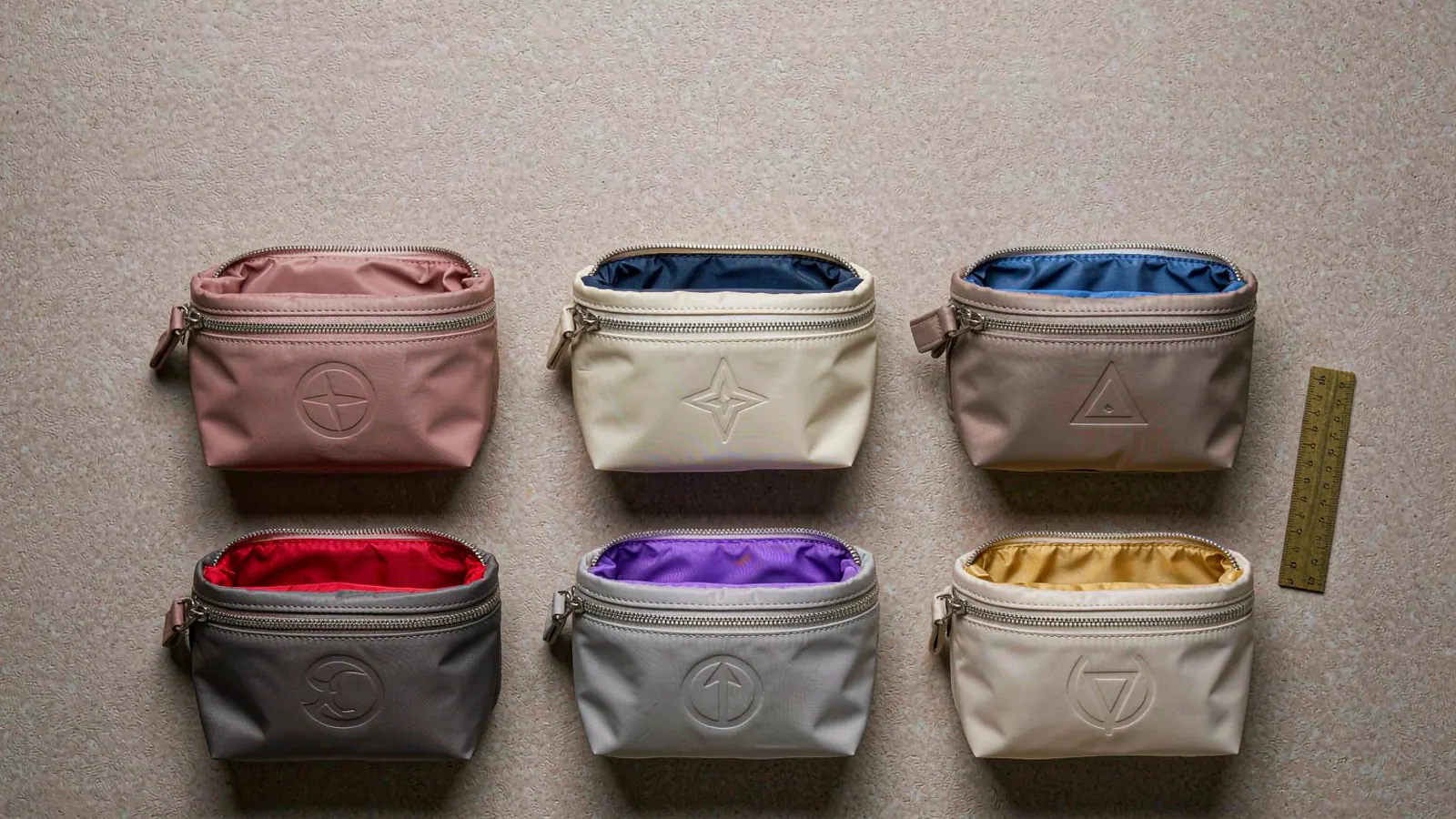
A cosmetic pouch is a soft-sided, frameless container whose largest closed dimension normally sits between 12 cm and 26 cm and whose unfilled depth stays at or below roughly 8 cm. It closes along a single edge or a short run of edges, carries no internal frame, no mirror, no hanging hook and no base board, and is designed to lie flat when empty. That combination - soft, shallow, flat-lie - separates the pouch from its neighbours. A vanity case carries a frame or moulded shell, a hanging toiletry bag carries a suspension system, and a dopp kit is simply a pouch deep enough to stand a bottle upright. The pouch is the shallow end of that continuum, and most of its commercial behaviour follows from that one property.
The distinction matters commercially because the pouch is the cheapest unit a brand can put a logo on and still call a bag. Fewer panels, fewer seams, less zip tape and no hardware beyond a pull keep the bill of materials short, and the flat-lie geometry means finished goods nest rather than stack, which compresses both warehousing space and freight chargeable weight. Marketplace listings for this class of goods quote a unit price band of roughly $0.45 to $12.00 depending on fabric, hardware and print method (Alibaba, October 2026), with the flat pouch occupying the bottom of that band and the structured, framed case the top. A buyer moving from a case to a pouch is not simply buying a smaller bag; the buyer is buying a different cost structure.
Demand-side signals point the same way, though they measure search interest rather than revenue. The phrase "make up bags for women" is credited with roughly 80,000 monthly searches and "custom makeup bag" with 5,400-6,600 monthly searches, while the toiletry-bag cluster carries about 74,810 weekly Amazon searches (ASINSIGHT, July 2026). For a brand owner that reads as broad, steady pull at the small end of the category and thinner, more technical pull at the structured end - one reason the pouch is usually the first format a programme specifies and the last it drops.
Material choice at pouch scale is governed by hand feel, printability and seam behaviour rather than by strength. A pouch carries 200 g to 1 kg of contents at most, so what fails is the corner, the zip tape or the print. Common bases are 210D-600D polyester, 210D-420D nylon, 8-12 oz cotton canvas, PU-coated polyester, TPU laminate, RPET polyester and, where clarity is wanted, PVC. Recycled content claims need a chain-of-custody route: buyers specifying RPET usually ask for the Recycled Claim Standard or Global Recycled Standard, and organic cotton canvas is tied to the Global Organic Textile Standard. Article-level chemical limits are commonly evidenced through OEKO-TEX Standard 100.
- Flat pouch - front and back panels joined directly with no depth panel; lies almost flat when empty and packs to a few millimetres.
- Gusseted pouch - a separate strip or a folded-in panel at the side or base that creates 2-6 cm of usable depth.
- Boxed-corner pouch - corners folded and stitched into a seam so the pouch stands without a separate gusset piece.
- Zip-around pouch - the zip runs around two or three sides, so the shell opens like a clamshell rather than a slot.
- Envelope pouch - a fold-over flap closing with a snap, magnet or button instead of a zip; the cheapest closure route.
- Card sleeve - the smallest step in the ladder, around 12 x 8 cm, sized for cards, lip balm and sample sachets.
- Beauty pouch - the same object under trade language, used when the pouch is sold filled or as part of a gift set.
The pouch also has clear limits, and knowing them prevents a bad first sample. Without a frame or stiffener, contents are crushed by whatever sits on top, so anything fragile needs a boxed corner and a firm base insert or a different format. A pouch cannot hold a bottle upright unless it clears the bottle's height plus a closure allowance, which is why 200 ml bottles usually push a programme out of pouch territory. Access is another limit: a zip across the top of a 21 cm face opens a slot about 18 cm wide, so corner contents are reachable but not visible. A zip-around solves that.
Those limits are acceptable where the pouch dominates, because there the pouch is not being asked to organise a full wash routine. It is being asked to carry a curated set of three to eight items, look like a real product, print cleanly at small scale and arrive flat. Every section that follows is written against that brief. The next step decides everything else: choosing the size.
The Pouch Size Ladder: What Actually Fits at Each Step
Choosing a pouch size is a measurement exercise, not a taste exercise. The failure mode is always the same: a brand owner approves a size that looks right on a screen, the sample arrives, and the hero product does not close inside it. The reason is that published dimensions describe the shell, while usable space is the shell minus three deductions - seam allowance, zip tape, and fabric thickness at every fold. A pouch specified at 20 x 14 cm does not hold 20 x 14 cm of product; it holds roughly 17 x 11 cm, and that is before the fill ratio is applied.
The practical method is to work outward from the contents. Brand owners should measure the three bulkiest items the pouch must hold, add 1.5-2 cm of clearance around the largest face, add 1 cm at the opening for the zip tape and slider body, and only then write the dimension into the specification. Depth is fixed last, and should be set by the thickest single item laid flat rather than by the total volume, because soft pouches bulge rather than stack.
| Format step | Closed footprint (cm) | Usable depth (cm) | What genuinely fits | Typical programme use |
|---|---|---|---|---|
| Card-holder sleeve | 12 x 8 | 0.4-0.8 | Lip balm, a single slim compact, two cards, three to five sample sachets | Gift-with-purchase, subscription-box insert, advent and calendar fill |
| Mini flat | 15 x 10 | 1.0-1.5 | Three lipsticks laid side by side, one mascara, a slim mirror | Promotional giveaway, sample-set carrier, beauty-tool sleeve |
| Slim pencil | 19 x 8 | 2.0-3.0 | Brushes up to 18 cm, eyeliner, brow pencil, tweezers, a lash curler | Brush pouch, tool kit, narrow subscription insert |
| Small gusseted | 18 x 12 | 3.0-4.0 | Travel-size tubes 50-100 ml, a pressed-powder compact, a sponge | Travel-size sets, hotel amenity kits, sample programmes |
| Medium | 21 x 14 | 4.0-5.0 | Full-size mascara, a 15 x 10 cm palette, a 100 ml bottle upright | Main retail SKU, mid-tier gift-with-purchase, e-commerce hero |
| A5-ish | 24 x 17 | 5.0-6.0 | An A5 notebook with cover, a full-size palette, a 200 ml bottle laid flat | Premium gift-with-purchase, gift-set outer, influencer kit |
| Deep boxed | 26 x 18 | 7.0-8.0 | Full-size bottles standing, a brush set, a sponge trio, a small mirror | Travel kit core, premium e-commerce bundle, vanity-case substitute |
The paper-size reference points are worth fixing, because they are the fastest shorthand between a brand team and a programme coordinator. A6 is 10.5 x 14.8 cm, A5 is 21.0 x 14.8 cm and A4 is 29.7 x 21.0 cm. A pouch described as "A5-ish" needs a closed footprint near 23 x 17 cm to accept a covered A5 notebook; one cut at exactly 21 x 14.8 cm will not. The same caution applies to any pouch described by the product it holds rather than by its own measurements.
Three deductions shrink usable space on every step of the ladder. Seam allowance consumes 1.0-1.2 cm at each seamed edge, so a pouch with two side seams loses 2.0-2.4 cm of width before anything goes inside. Zip tape consumes roughly 1 cm of the opening on a #3 coil and 1.2-1.4 cm on a #5, plus about 1.2 cm of slider travel beyond the tape ends. Fabric thickness consumes space at every fold: 600D polyester with PU backing is 0.5-0.7 mm per layer, so a doubled gusset fold takes about 1.5 mm of depth at each corner.
The fill ratio is the fourth reducer and the one most often ignored. A pouch specified to the exact dimensions of its contents will bulge, strain the zip and look cheap in photography. The working rule is to size for 60-70% fill, leaving slack for the shell to sit against the product rather than drum-tight around it. Brand owners wanting the packed look in photography should specify contents and pouch together.
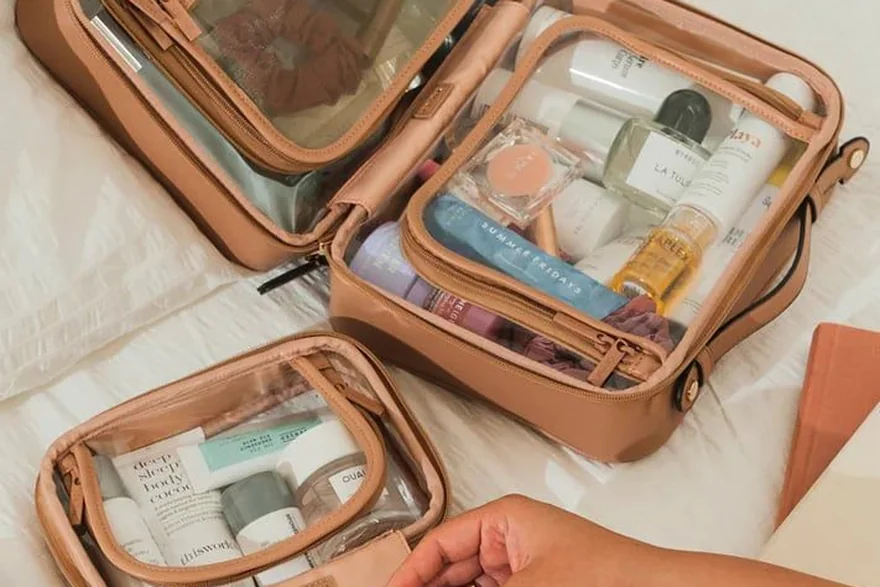
One size step has a regulatory driver rather than a marketing one. A pouch intended as the liquids bag for air travel has to work with the TSA 3-1-1 liquids rule, which limits containers to 100 ml (3.4 oz) inside a single quart-sized transparent bag. In practice that means a footprint near 20 x 15 cm, enough depth for four to six 100 ml bottles, and a transparent face so screeners can see the contents. Clear TPU and PVC are the usual answers; branding then has to be a woven label or a narrow border print, because heavy ink coverage destroys the transparency that made the format usable.
Tolerances close the specification. Buyers should state +/- 0.5 cm on the closed footprint and +/- 0.3 cm on the gusset depth, measured flat, seam to seam, unfilled. Soft goods relax: a pouch cut from 300D polyester with a light interlining can grow 1-3% across the width after its first week of use. Stating the measurement method on the spec sheet prevents an argument later about whether goods are out of tolerance or were simply measured differently.
- Measure three ways - flat and closed, gusseted and open, and standing on its base. Any one of the three can be the binding constraint.
- Subtract 1.0-1.2 cm per seamed edge before comparing a pouch size against a product dimension.
- Subtract the zip tape and slider travel from the opening: about 2.2-2.6 cm of lost length in total on a #5.
- Size for 60-70% fill, not 100%, or the shell will drum and the zip will strain.
- Fix depth from the thickest single item laid flat, not from the total volume of the set.
- State the tolerance and the measurement method on the spec sheet at the same time as the dimension.
Pouch Construction Variants: Five Ways to Build the Same Rectangle
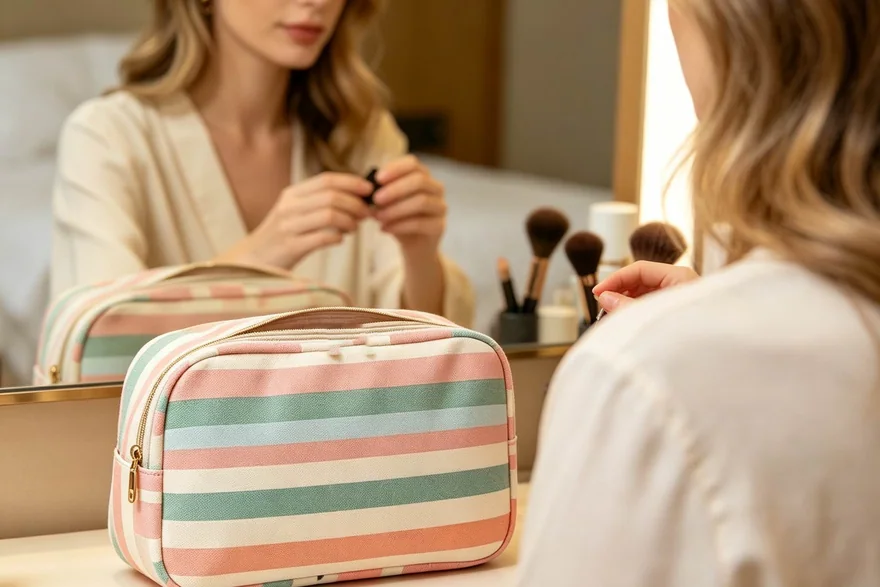
Two pouches can share identical dimensions, fabric and print and still differ by a factor of two in unit cost. The difference is construction: how many panels are cut, how many seams are sewn, and whether depth comes from added material or from folding material already there. Choosing the cheapest construction that still delivers the required look is the largest lever on unit cost after fabric.
The first route is the single-panel fold-and-sew: one rectangular panel is folded, two side seams are sewn, and the zip goes into the fold or across the top. It is the cheapest pouch that exists - one panel, two seams, minimal cutting waste. The drawbacks are equally clear: no depth, so corners dog-ear under load; a fold line through the middle of the print face, ruling out full-bleed artwork.
The second route is the two-panel bound pouch. Front and back panels are cut separately, joined along three edges, and the fourth closed with the zip, with 18-22 mm binding tape around the perimeter to cover raw edges. It costs more than a fold-and-sew, but gives a defined edge that reads as better-made at close range and allows different front and back materials. The trade-off: binding interrupts the print on every edge, so artwork must be inset by the binding width plus 2 mm.
| Construction route | Panels and seams | Depth without an added piece | Machine and operator load | Illustrative unit-cost band, USD ex-works |
|---|---|---|---|---|
| Single-panel fold-and-sew | 1 panel, 2 side seams, fold at base | None, 0.5-1.0 cm of natural bulge | Lowest: cut, fold, two seams, top zip | $0.45-$0.95 |
| Two-panel bound | 2 panels, 3 seams, binding on the perimeter | None unless the binding is cut wide | Low: adds a binding operation | $0.75-$1.40 |
| Gusseted, separate strip | 2 faces plus 1 gusset strip, 4-5 seams | 2-6 cm, set by strip width | Medium: gusset eased around corners | $0.95-$1.90 |
| Boxed corner | 1-2 panels, side seams plus 2 corner seams | 3-8 cm, set by the corner leg length | Medium: alignment is operator-dependent | $1.10-$2.20 |
| Zip-around | 2 panels, zip inserted around 2-3 sides | 2-5 cm, needs a gusset for more | Highest: long zip insertion, lining | $1.60-$3.40 |
| Envelope with snap | 1 panel with an integral flap, 2-3 seams | 1-3 cm from the flap fold | Low: snap setting adds a press step | $0.85-$1.70 |
Illustrative planning ranges, not quotes. Assumptions: 500-2,000 pieces per style and colourway, 300D polyester or 10 oz canvas, a standard nylon coil zip with a plain pull and a one- or two-colour print, quoted FOB Xiamen and excluding tooling, testing and freight. A lining, metal pull, woven label or process print moves a band upward; higher volume moves it down. Use the bands to rank constructions, then confirm the figure against a specification sheet.
The third route is the gusseted pouch, the default when a programme needs real capacity at a modest price. A strip of fabric, typically 3-6 cm wide, is sewn between the two faces, running down one side, around the base and up the other. The strip can be one continuous piece eased around the corners - stronger, since it leaves only two junctions - or separate pieces, which waste less fabric but put four junctions in the load path. The base seam is where such a pouch fails under overload, so heavy contents call for a one-piece gusset and a taped base seam.
The fourth route is the boxed corner, which creates depth from material already present. The rule of thumb: mark a leg of the required depth along the side seam and an equal leg along the base fold, stitch between the two marks, and the pouch gains roughly that depth of standing base while losing about twice that length from the flat base width. A pouch cut 24 x 17 cm with 5 cm corner legs stands on a base roughly 14 cm wide. The fabric must be stiff enough to hold the shape - boxed corners in 210D nylon collapse while the same construction in 600D polyester holds. Confirm corner depth on the first sample rather than trusting the calculation.
The fifth route is the zip-around, where the closure runs around two or three sides instead of across one edge. It is the most expensive route and the most useful for premium programmes, because it opens the pouch into two flat halves with contents fully visible. Cost comes from zip length and from turning the tape around corners without puckering: a zip-around on a 21 x 14 cm face uses roughly 55-60 cm of tape against about 20 cm for a straight top zip.
The sixth variant, the envelope with a snap, is the cheapest way to avoid zip costs altogether. A single panel is extended into a fold-over flap closing with a plastic or metal snap, a magnetic tab or a button and elastic loop. There is no tape to pucker and no slider to derail. What the buyer gives up is security: an envelope does not seal against dust or leakage, and a snap pulling through the face fabric destroys the pouch. Any snap specification should include a reinforcement patch behind the socket.
Coated fabrics add a further branch. Where a pouch must be wipe-clean, the face carries a PU, PVC or TPU coating, which changes seam behaviour and the test regime: coated fabrics are assessed against ASTM D751, and what matters at pouch scale is coating adhesion and blocking resistance. A coating that is too stiff cracks at a boxed corner and resists the needle, leaving visible perforations along the seam.
- Cheapest route - fold-and-sew, best for flat promotional pouches with centred artwork.
- Best edge definition - two-panel bound, at the cost of an inset print area.
- Best capacity per dollar - gusseted with a one-piece strip and a taped base seam.
- Best shelf presence - boxed corner, if the fabric is heavy enough to hold shape.
- Best unpacking - zip-around, at roughly three times the zip length of a top zip.
- Cheapest closure - envelope with snap, always with a patch behind the socket.
Closures and Print Area When the Canvas Is Small
Closure choices at pouch scale
The closure is the most-specified component on a pouch after the fabric, and the governing constraint is not strength but proportion. A #5 metal zip looks like handbag hardware on a 12 cm face; on a 24 cm face it looks correct. Every closure has a minimum face width below which it stops reading as a design choice and starts reading as a mistake.
| Closure type | Minimum sensible face width | Cycle life to specify | Dominant failure mode at small scale | Specification notes |
|---|---|---|---|---|
| Nylon coil zip #3 | 9 cm | 500-1,000 open-close cycles | Slider derailment at the bottom stop; tape puckering on short runs | Cheapest option; specify an auto-lock slider and a top stop on both ends |
| Nylon coil zip #5 | 12 cm | 1,000+ open-close cycles | Tape twist at the corners; teeth show through lightweight fabric | Reads as better-made; needs wider binding and a heavier face fabric |
| Concealed or invisible zip | 12 cm | 300-500 open-close cycles | Slider catching on the lining; tape curl after washing | Cleanest print face of any zip; hardest to repair and slowest to insert |
| Metal teeth zip #3 or #5 | 12 cm | 1,000+ open-close cycles | Tooth loss under point load; coating rub on the teeth | Weight and noise read as premium; check metal content rules for the destination market |
| Plastic or metal snap | Any width | Specify by pull-force range, not cycles | Socket pulling through the face fabric | Always add a 20-25 mm reinforcement patch behind the socket |
| Magnetic tab | 6 cm | Not cycle-rated | Magnet shifting inside the flap; lining puncture | Must be fully encapsulated and stitch-isolated; check retailer magnet policies |
| Drawstring with cord lock | 10 cm | Not cycle-rated | Cord pulling out of the channel; uneven gather | Good for brush pouches; does not seal against dust or leakage |
| Hook-and-loop tape | Any width | Specify peel cycles | Lint pick-up; scratch damage to the lining and to cosmetics | Cheapest and quietest to fit; poor perceived quality at close range |
| Fold-over with button and loop | 8 cm | Not cycle-rated | Button loss in transit | Strong craft signal; slowest to assemble and hard to automate |
Two details separate a good closure specification from a mediocre one. The first is the slider: specify auto-lock or non-lock, a stated finish, a pull at least 20 mm long, and a defined parked position - a slider left mid-face reads as broken even on an empty pouch. The second is the tape and stop arrangement: on pouches below 15 cm a slider running off the tape end is the most common field complaint, so both ends need stops. Terminology should follow ASTM D2053 on zipper terminology so that buyer and programme coordinator mean the same part by "top stop" or "slider".
Print area when the canvas is small
Print area is where pouch programmes most often go wrong, because the arithmetic is unforgiving on a small face. Take a medium pouch with a closed footprint of 21 x 14 cm and a #5 zip across the top. Seam allowance removes 1.0 cm from each of the four edges, taking the face to 19 x 12 cm; the zip tape removes a further 1.4 cm along the opening; binding of 18 mm on the two side edges removes another 3.6 cm of width. The safe print area is about 15.4 x 10.6 cm on a pouch nominally 21 x 14 cm - 163 cm2 against 294 cm2 of shell, a 45% loss that is entirely normal.
- Seam allowance - deduct 1.0-1.2 cm at every seamed edge before placing artwork.
- Zip tape - deduct 1.0 cm for a #3 and 1.2-1.4 cm for a #5 along the opening edge.
- Binding - deduct the full binding width plus 2 mm on every bound edge.
- Corner radius - artwork inside a 5-8 mm radius loses usable corner area.
- Fold line - no printed element may cross the fold; keep 5 mm clear either side.
- Registration - allow +/- 1 mm for screen print, +/- 0.5 mm for heat transfer.
Minimum legible sizes follow from the process: about 1.5 mm cap height for screen print, 1.2 mm for heat transfer, 2 mm for a woven label, and at least 5 mm satin-stitch height for embroidery - so a monogram on a 12 x 8 cm card sleeve can be no more than about 30 mm wide. Brand teams routinely supply a lock-up designed for a web page and are then surprised it cannot be produced at 40 mm. Fix the process and the safe area first, then adapt the lock-up.
Registration tolerance matters more on a pouch than on any larger bag because the viewing distance is short: a +/- 1 mm drift on a 10 cm panel is 1% of its width and visible to a shopper holding the pouch, while the same drift on a 50 cm holdall is 0.2% and is not. Buyers should state a registration tolerance and a print-position tolerance measured from a stated datum - usually the bottom-left seam - and sign off the pre-production sample against that datum.
Colour count is the other economic decision. Each spot colour in a screen print adds a screen, a set-up and a registration step, and at 500 pieces those costs are spread over a very small run. A four-colour image is therefore often cheaper as a single heat-transfer or sublimation print than as four spot screens, so buyers should ask for both routes to be priced. Sublimation needs a polyester face and gives an all-over print with no hand feel - the only way to get edge-to-edge coverage on a fold-and-sew pouch.
Colour fastness closes the print specification, and it matters here because a pouch is handled, rubbed against bag linings and wiped. Print and fabric should carry a rub-fastness requirement assessed under the ISO 105 series on colour fastness, with dry and wet crocking grades stated separately, and the reference swatch signed off under a defined light source before bulk begins. Without that, the brand owner discovers the problem at the distribution centre.
Why the Pouch Is the Default Gift-with-Purchase, Subscription and Peg-Display Format
The pouch dominates promotional channels for a reason that has nothing to do with fashion: it is the cheapest object a shopper will still describe as a bag. That perceived value is the entire mechanism of a gift-with-purchase. A printed envelope, sachet or card is read as packaging and discarded; a pouch with a zip, a pull and a logo is read as a product, kept and reused. That second life is what brand owners are buying, and why the pouch beats every cheaper alternative in the same budget band.
The economics are simple to model and should be modelled before the format is chosen. Suppose a retailer runs a threshold gift on baskets of $60 at a 55% gross margin, so contribution on a qualifying basket is about $33. A medium pouch at an illustrative ex-works band of $0.95-$1.90, plus freight, duty and handling at an illustrative 45-60% on-land uplift, lands at roughly $1.40-$3.00 delivered, or 4-9% of that contribution. This is an illustrative planning range built on the stated assumptions, not a quote - but the shape holds: the gift must fit inside the margin of the basket that triggers it.
Subscription boxes create a second, slightly different case. There the pouch can serve as both container and gift, removing an outer printed box from the bill of materials. A flat pouch of around 19 x 8 cm or 21 x 14 cm holds four to eight sample and travel-size items and arrives as a finished object rather than a packed carton. The saving is not only the box but the packing labour, since items are laid into an open pouch rather than wrapped and void-filled. Programmes making this switch usually need a slightly higher specification - heavier face fabric, better pull - because the pouch is now the outer presentation.
| Presentation option | What the pouch itself must carry | Typical retail context | Trade-off to plan for |
|---|---|---|---|
| Loose in an open tray or bin | Nothing extra; a hangtag or belly band carries the branding | Discount, gift shops, checkout zones | Lowest prep cost, highest shrinkage and no theft deterrent |
| Hangtag on a string or plastic tie | A reinforced welt, webbing loop or eyelet - not a cut hole | Any fixture with a peg or bar | A cut hole in the face fabric tears under the weight of the pouch |
| Euro slot or sombrero hanger tab | An 8 x 3 cm heat-sealed or stitched tab with a slot about 6 x 1.2 cm | Drugstore and supermarket peg walls | Needs a weldable or stitchable face fabric; adds a seam and a print inset |
| Self-hanging from the zip pull or loop | A pull or webbing loop with at least 25 mm of clear opening | Peg walls where a tab is not wanted | The pull carries the full weight; specify a pull-strength test |
| Printed belly band or paper sleeve | Nothing on the pouch; a 250-300 gsm wrap around it | Gifting aisles and premium shelves | Hides part of the pouch print and adds one packing step per unit |
| PDQ or counter display unit | Nothing on the pouch; flat-packed units standing in a printed tray | Checkout counters and endcaps | Display ships flat and is assembled in store; adds a unit cost per display |
| Header card with polybag | Nothing on the pouch; a card stapled or taped over the bag top | Value channels and e-commerce multipacks | Raises plastic use at a time when retailers are cutting it |
| Rigid gift box or sleeve set | Nothing on the pouch; a box two to three times the pouch volume | Premium gift sets and seasonal programmes | Raises chargeable volumetric weight three to five times |
Any hanging option should be treated as a structural element rather than a packaging afterthought. A hangtag threaded through a cut hole in 300D polyester will tear out; the correct detail is a folded welt, a 10 mm webbing loop caught in the top seam, or a metal eyelet set through a reinforcement patch. A euro slot heat-sealed to a PU-coated face works well because the weld spreads the load; the same slot stitched to a woven face needs a bar-tack at each end. Buyers should ask for a pull test on the hanging feature - a stated load held for a stated time - rather than accept a visual check, because a display that fails in store fails across a whole fixture at once.
Labelling is the last piece of channel readiness and is easiest to get wrong on small goods, because there is so little space. A retail barcode needs a flat area and a quiet zone of at least 2 mm each side, so on a pouch it usually sits on a hangtag or printed patch rather than the shell, which curves when filled. Fibre content, origin and care instructions go on a sewn-in label. Programmes selling into the US should check CPSIA requirements, including tracking labels for children's items; those selling into the EU should check obligations under EU REACH.
- Set the gift budget from the qualifying basket margin before choosing the pouch size, not after.
- Raise the face fabric and pull specification when the pouch itself is the outer presentation.
- Specify a welt, loop or eyelet for hanging - never a cut hole in the face fabric.
- Ask for a stated pull test on any hanging feature rather than a visual inspection.
- Put the barcode on a hangtag or patch; the shell curves when filled and will not scan reliably.
- Confirm CPSIA or REACH obligations for the destination market at the sampling stage, not at booking.
Packing, Carton Economics and Why Small-Format QC Behaves Differently
Freight is where the flat-lie geometry pays. Air freight is charged on the greater of actual and volumetric weight, the latter calculated as length x width x height in centimetres divided by 6,000. A carton of flat pouches is dense - it fills with fabric rather than air - so actual weight usually exceeds volumetric weight. A carton of structured cases is the reverse, mostly air, so the buyer pays for volume. On a long-haul air shipment that difference alone can exceed the unit cost of the pouch, which is why pouch programmes move by air while case programmes go by sea.
| Format step | Folded thickness per unit (cm) | Illustrative units per export carton, 60 x 40 x 40 cm | Illustrative carton gross weight (kg) | Illustrative units per 40 ft high-cube container |
|---|---|---|---|---|
| Card-holder sleeve | 0.4 | 700-900 | 12-16 | 410,000-555,000 |
| Mini flat | 1.0 | 350-450 | 11-15 | 200,000-280,000 |
| Slim pencil | 2.0 | 200-260 | 9-12 | 115,000-160,000 |
| Small gusseted | 3.0 | 130-170 | 9-12 | 75,000-105,000 |
| Medium | 3.5 | 85-110 | 7-10 | 49,000-68,000 |
| A5-ish | 4.0 | 55-70 | 7-9 | 32,000-43,000 |
| Deep boxed | 5.0 | 40-52 | 7-10 | 23,000-32,000 |
These figures are illustrative planning ranges for freight-quote purposes, not a packing guarantee. They assume a 60 x 40 x 40 cm export carton (96 litres), units nested flat, 25-50 units per inner polybag, packing efficiency of 60-75% depending on how slippery the face fabric is, no hangtags or inner boxes, and a 40 ft high-cube loaded to about 58 m3 at 580-620 cartons. Adding a hangtag, gift box or display unit changes every column. Confirm the packing list from the pre-production sample, then re-quote freight.
A worked example shows why the arithmetic is worth doing before the format is frozen. Take the medium pouch: 85-110 units per carton at 7-10 kg gross, against a volumetric weight of 16 kg for a 96-litre carton. By sea, freight per unit is small; by air at an illustrative planning rate the carton is billed on 16 kg and landed freight per unit becomes a noticeable share of a $1.40-$3.00 delivered cost. Folding flatter or shipping hangtags separately are legitimate responses.
Inner packing deserves a line on the specification too: 25-50 units per polybag, the lower end for coated goods that could block or scuff. State polybag thickness, recycled content and any print warning, and define the carton by construction - five-ply or a stated edge-crush rating.
How small-format goods behave differently in inspection
The defining feature of pouch quality control is viewing distance. A suitcase is assessed at arm's length or across a room; a pouch is examined at 30-40 cm, under retail lighting, beside a neighbouring pouch on the same fixture. Defect visibility scales inversely with viewing distance, so a fault unnoticed on a 60 cm duffel is a rejection on a 15 cm pouch. That is why pouch programmes draw more inspection disputes, and it should shape both specification and inspection plan.
- Print registration drift - a +/- 1 mm shift is 1% of a 10 cm face and visible at arm's length.
- Shading between panels - front and back from different dye lots read as two colours.
- Stitch skipping at corners - where the needle slows and the feed shifts.
- Zip tape puckering - a tape eased around a corner without slack ripples permanently.
- Wavy top seam - the seam carrying the zip stretches under the presser foot.
- Uneven gusset fold - an off-centre gusset makes the pouch lean when standing.
- Corner dog-ear asymmetry - the two bottom corners of a boxed pouch must mirror each other.
- Loose thread ends - found by the shopper, not by the inspector.
- Magnet or snap bulge - hardware inside a flap shows as a bump through the face.
- Coating cracking at a fold - stiff PU creases permanently at a boxed corner.
- Ink rub on the fold line - the highest-friction point on the pouch.
- Slider parked off-position - reads as broken on a shelf when the pouch is empty.
The inspection standard should be written rather than assumed. Buyers typically specify AQL 2.5 for major defects under ISO 2859-1 sampling procedures, and should state the inspection level and defect classification on the same sheet. Under general inspection level II, a lot of 501-1,200 pieces draws 80 units with an accept number of 5 and a reject number of 6 at AQL 2.5; a lot of 3,201-10,000 pieces draws 200 units with 10 and 11. That shows what a passed inspection means: a statement about a sample, not a guarantee about one carton.
Defect classification is where pouch programmes need the most detail. Critical defects - a needle fragment, a sharp point, a wrong safety label - carry zero tolerance and should trigger a needle policy and a metal-detection check. Major defects are those a shopper would reject: print misregistration beyond tolerance, a broken stitch, a zip that does not close. Minor defects show only on close examination, such as one loose thread. Colour and print should be checked against a signed reference swatch under a stated light source, and rub fastness against a named method from the AATCC test-method library.
Sample discipline closes the loop. Repeats are where pouch programmes drift, because a second run ordered months later comes from a different dye lot and possibly a different line, and only a retained physical reference will show whether it matches. Buyers reordering the same pouch should say so at quoting stage and ask for the reference to be matched.
- Write the AQL, the inspection level and the defect classification on the specification sheet.
- Treat critical defects - needle fragments, sharp points, wrong labels - as zero tolerance.
- Grade print registration against a stated datum on the pre-production sample, not by eye.
- Check front and back panels against the same signed swatch for dye-lot shading.
- Retain three sealed samples: pre-production, shipment and golden reference.
- Flag repeat orders at quoting time so dye lots can be matched to the original.
The B2B Customisation View
Every programme for cosmetic bags begins with a written brief: target retail price, filling volume, closure type, print method and the compliance market the goods will be sold in.
Commercial parameters stay fixed across the range: MOQ 500 pieces per style and colourway, prototype turnaround 6–10 working days (extended to 12–15 for multi-panel or moulded builds), bulk lead time 35–50 days from approved sample, AQL 2.5 inspection to ISO 2859-1, FOB Xiamen, T/T 30 deposit and 70 against bill of lading.
Working as a sourcing partner rather than a single-line vendor means QUANZHOU JUNYUAN BAGS can move cosmetic bags between construction types — woven, coated, leather-look — without restarting the compliance conversation.
Which Brand Types This Guide Serves
The pouch is the most widely usable format in the category, but the reason differs by brand type, and so does the specification that follows from it. Start-up beauty brands use the pouch as a first branded object because the entry quantity is low relative to almost any other product a new brand might commission, and because a pouch can be ordered in a single size with a single print and still look like a considered launch. The usual pattern is one medium pouch at 21 x 14 cm in two colourways, a two-colour print, and a hangtag that carries the brand story that the 15 cm face cannot fit. Established brands use the same format differently: as a channel tool rather than a product, ordered in four or more colourways against a seasonal palette, with the pouch specification held constant across seasons so that print plates, zip colours and carton packing can be repeated without re-engineering.
- Start-up beauty brands - one medium pouch, two colourways, two-colour print, hangtag carrying the longer brand story; sized to hold the hero product plus two companions.
- Established brands - seasonal colourways on a frozen construction, repeat orders matched to a retained golden sample, often in four to eight colours per drop.
- Retailers and private-label buyers - a size ladder of three steps sharing one fabric and one print language, barcoded on a hangtag, specified for a stated fixture and peg type.
- E-commerce sellers - the pouch as the outer presentation for a curated set, in a heavier face fabric with a better pull, sized to the box dimensions of the fulfilment network.
- Subscription-box operators - a flat 19 x 8 cm or 21 x 14 cm pouch that replaces the outer carton, with the print area planned around the contents rather than around a shelf.
- Gift, hotel and hospitality buyers - small gusseted or envelope pouches at 15-18 cm, wipe-clean coated fabric, neutral colourways, and a specification written for laundering or replacement cycles.
- Promotional and gift-with-purchase buyers - the cheapest construction that still reads as a bag, usually fold-and-sew or envelope with snap, budgeted against the qualifying basket margin.
Frequently Asked Questions
What minimum quantity applies per pouch size and colourway?
The minimum for a custom pouch programme is 500 pieces per style and colourway, and that minimum applies to the combination rather than to the total order. A buyer wanting the same pouch in three colourways is therefore committing to 1,500 pieces in total. In practice most first programmes run one size in two or three colourways to reach an efficient cutting and printing run while staying close to the entry point. Where a brand owner wants four or more colourways, it is worth asking whether the same artwork in a different ink colour counts as a separate colourway or as a print variation, because the answer changes the total commitment.
How long does a cosmetic pouch sample take, and what extends that window?
A standard pouch sample takes 6-10 working days from an approved specification. Constructions that add operations extend it: a zip-around with a lining, a pouch with a heat-welded euro slot, a moulded pull or a four-colour process print typically need 12-15 working days. The most common cause of delay is not the sewing but the artwork and the hardware - a zip in a custom-dyed colour, or a print file supplied at screen resolution rather than vector, will both stop the clock. Buyers working to a launch date should freeze artwork and hardware colour at the same time as the dimensions.
Which pouch size works best as a gift-with-purchase?
The medium step at roughly 21 x 14 cm with 4-5 cm of depth is the most common gift-with-purchase size, because it holds a full-size mascara, a compact palette and a 100 ml bottle without looking empty, and it still sits in the lower half of the cost ladder. The mini flat at 15 x 10 cm is the choice when the gift is triggered on a lower basket value or when the pouch is filled with samples rather than full-size product. The decision should be made backwards from the qualifying basket margin: fix the budget first, then find the largest size that fits inside it.
Can a small pouch carry a full-bleed print, or does the seam limit the artwork?
A true full-bleed print is possible only on constructions without a fold or binding interrupting the face - and most pouches have both. On a fold-and-sew, the fold line runs through the panel and no printed element may cross it. On a bound pouch, the binding covers every edge. The practical answers are to inset the artwork inside a stated safe area, or to use dye sublimation on a polyester face fabric, which prints edge to edge with no hand feel. Sublimation is the usual route for all-over patterns and photographic artwork at pouch scale.
What zip size should a 15 cm cosmetic pouch specify?
A #3 nylon coil zip is the correct match for a pouch around 15 cm wide. A #5 reads as oversized at that width and forces a heavier face fabric and a wider binding to carry it. The specification should state the tape size, the slider type - auto-lock is standard - the pull length at 20 mm or more, and stops at both ends of the tape. On a 15 cm pouch the most common field complaint is a slider running off the end of the tape, so the stop arrangement and the tape extension past the seam are worth writing down explicitly.
How much does a custom cosmetic pouch cost per unit?
As an illustrative planning range for 500-2,000 pieces in 300D polyester or 10 oz canvas with a standard coil zip and a one- or two-colour print, quoted FOB Xiamen and excluding tooling, testing and freight: about $0.45-$0.95 for a fold-and-sew flat pouch, $0.75-$1.40 for a two-panel bound pouch, $0.95-$1.90 for a gusseted pouch, $1.10-$2.20 for a boxed-corner pouch, $1.60-$3.40 for a zip-around and $0.85-$1.70 for an envelope with snap. Broader marketplace listings for the category run roughly $0.45-$12.00. Lining, metal hardware, woven labels and process prints all move a band upward.
Which fabric weight suits a flat pouch versus a gusseted pouch?
A flat pouch with no depth works well in 210D-300D polyester or 8 oz canvas, because there is no shape to hold and a lighter fabric drapes better and folds flatter. A gusseted or boxed-corner pouch that is expected to stand needs 420D-600D polyester or 10-12 oz canvas, or a lightweight fabric with an interlining or a base insert. The test is simple: fill the sample and stand it on a shelf. If it slumps, the fabric is too light for the construction rather than too light in absolute terms.
How many cosmetic pouches fit in one export carton?
As an illustrative planning range for a 60 x 40 x 40 cm carton with units nested flat and packed 25-50 per inner polybag: 700-900 card sleeves, 350-450 mini flats, 200-260 slim pencil pouches, 130-170 small gusseted pouches, 85-110 medium pouches, 55-70 A5-ish pouches and 40-52 deep boxed pouches. Those ranges assume no hangtags, no gift boxes and no display units. The reliable number comes from the pre-production sample: pack one carton, count it, and re-quote freight against the actual count rather than against an estimate.
Which chemical compliance documents apply to cosmetic pouches sold in the EU and US?
For the EU, obligations under REACH cover substances in articles, and buyers normally ask for a supplier declaration plus test evidence against the restricted-substance list current at the time of booking. For the US, CPSIA applies where a pouch is marketed to children, including lead limits and a tracking label. Independently of either, article-level chemical limits are commonly evidenced through OEKO-TEX Standard 100, which many retailers accept as a single umbrella document. The important point is timing: compliance should be specified at sampling, because a test report requested after bulk has shipped cannot change the goods.
Can a cosmetic pouch use recycled fabric and still carry a recognised certification?
Yes, provided the recycled content is documented through a chain of custody rather than asserted. RPET polyester is the usual base and is normally tied to the Recycled Claim Standard or the Global Recycled Standard, which require transaction certificates to travel with the material. Organic cotton canvas is tied to the Global Organic Textile Standard. Buyers should state the required certificate, the scope - fibre only or the whole article - and who holds the certificate, at the quoting stage, because certificate scope affects which production route can be used.
What is the difference between a gusseted pouch and a boxed-corner pouch?
A gusseted pouch creates depth by adding material: a strip of fabric, usually 3-6 cm wide, is sewn between the two faces. A boxed-corner pouch creates depth from material already present, by folding each bottom corner into a seam. The gusset gives more usable depth and a softer, rounder shape; the boxed corner costs less, needs one less panel, and produces a defined rectangular base that stands better on a shelf. Boxed corners need a stiffer fabric to hold their shape, while gussets work with lighter cloth.
How is a small pouch inspected under AQL 2.5?
Inspection is carried out against ISO 2859-1 on a random sample drawn from the finished lot. Under general inspection level II and AQL 2.5, a lot of 501-1,200 pieces draws 80 units with an accept number of 5 and a reject number of 6; a lot of 3,201-10,000 pieces draws 200 units with 10 and 11. Buyers should also state the defect classification, because AQL 2.5 says nothing about which faults matter. At pouch scale the classification should be written around print registration, zip function, seam integrity and hardware, with critical defects at zero tolerance.
Can a cosmetic pouch be specified to hold travel-size liquids for air travel?
Yes, and the specification is driven by the screening rule rather than by preference. Containers are limited to 100 ml (3.4 oz) inside a single quart-sized transparent bag, so a liquids pouch needs a footprint around 20 x 15 cm, enough depth for four to six 100 ml bottles, and a transparent or translucent face. Clear TPU and PVC are the usual choices. Branding then has to be applied as a small woven label, a printed patch or a narrow border print, because heavy ink coverage would remove the transparency that makes the pouch usable at security.
What artwork file and resolution does a small cosmetic pouch print require?
Vector artwork - AI, EPS or SVG with text converted to outlines - is the safe deliverable for screen print, heat transfer and embroidery alike, because it can be scaled to a 40 mm lock-up without loss. Where raster artwork is unavoidable, 300 dpi at final print size is the minimum, which on a 15 x 10 cm safe area means roughly 1,800 x 1,200 pixels. Buyers should also supply spot colour references, a stated registration tolerance and a datum for print position, usually measured from the bottom-left seam, so the pre-production sample can be graded rather than merely admired.
People Also Ask
What is a cosmetic pouch called in sourcing terms?
Cosmetic pouch, makeup pouch and beauty pouch are used interchangeably in sourcing, and the same object may be quoted as a flat pouch, a zip pouch or a small vanity pouch depending on the construction. What matters in a specification is not the name but the closed footprint, the depth and the construction route, because a flat fold-and-sew pouch and a gusseted pouch at the same nominal size hold quite different amounts.
What size cosmetic pouch holds a full-size mascara and a palette?
The medium step at roughly 21 x 14 cm with 4-5 cm of depth is the smallest pouch that reliably holds a full-size mascara alongside a 15 x 10 cm palette. Anything smaller forces the palette in at an angle or leaves the zip straining. Buyers should also allow for the seam and zip deductions, which remove about 3 cm of width and 3 cm of height from the nominal shell size before any product is placed inside.
Are cosmetic pouches cheaper to ship than structured vanity cases?
Usually yes, because flat pouches pack densely and are billed on actual weight, while structured cases are mostly air and are billed on volumetric weight. A carton of nested flat pouches typically reaches a higher actual weight than its volumetric weight, so the buyer pays for material rather than for empty space. The gap widens on air freight and narrows on sea freight, where volume rather than weight tends to set the cost.
Why do brands give away cosmetic pouches with purchase?
Because a pouch is the cheapest object a shopper still reads as a bag. A printed envelope or sachet is read as packaging and discarded; a pouch with a zip, a pull and a logo is kept and reused as a pencil case, cable organiser or travel pouch. That second life is what the brand is buying, and the cost has to fit inside the margin of the basket that triggers the gift.
How do you hang a cosmetic pouch on a peg wall?
Four options are common: a hangtag on a string through a reinforced welt or webbing loop, a heat-sealed or stitched euro-slot tab, a self-hanging zip pull or loop with at least 25 mm of clear opening, or a header card over a polybag. A cut hole in the face fabric should be avoided because it tears under the pouch's own weight. Whichever option is chosen, ask for a stated pull test rather than a visual check.
References & Standards
- ISO 2859-1 sampling procedures for inspection by attributes
- ASTM D2053 standard terminology relating to zippers
- AATCC TM61 colour fastness to laundering
- IEC 62321 determination of certain substances in electrotechnical products
- OEKO-TEX Standard 100 testing for harmful substances
- Textile Exchange Global Recycled Standard
- US CPSC CPSIA consumer product safety improvement act
- ECHA REACH regulation on chemicals
- TSA 3-1-1 liquids rule for carry-on baggage
- ASTM D751 standard test methods for coated fabrics
- ISO 105 textiles tests for colour fastness
- Global Organic Textile Standard GOTS
In-Depth Articles in This Category
19 dedicated articles sit under this pillar guide.
Related Pillar Guides
Request a Sample or a Written Quotation
Send the silhouette, dimensions, material preference and logo artwork, and the programme team will return a written quotation with MOQ, sampling window, bulk lead time and inspection standard.
Email: [email protected] · WhatsApp: +86 177 5002 0688