Hanging Toiletry Bags: Hook Design, Load Testing and Build Specification
Executive Summary
Is a hanging toiletry bag worth specifying, and what makes one survive real use? It is worth specifying when the suspension system is engineered rather than merely attached: the hook, the anchor webbing, the reinforcement patch and the top panel seam form one continuous load path, and the bag performs only as well as the weakest link in that path. That is the question this guide answers in detail. Programmes of this type are coordinated at MOQ 500 pcs per style and colourway, sampling in 6-10 working days, bulk production in 35-50 days after sample approval, and inspection at AQL 2.5 under ISO 2859-1.
The practical answer has three parts. First, specify the hook by measured clearance, not by photograph: throat opening, wire section and the fixing diameters it must clear. Second, specify the load path: a full-height spine, a box-stitched anchor and a reinforcement patch that moves stress away from the top corner. Third, specify a written load protocol with a load level, a duration, a cycle count and acceptance criteria that the brand owner sets, instead of accepting a verbal claim.
The rest of this guide follows that sequence: hook taxonomy and clearance, load transfer into the bag body, a written test protocol, pocket and closure behaviour while suspended, waterproofing, and the trade-offs between roll-up, flat and hybrid geometries. Buyers planning a programme coordinated by QUANZHOU JUNYUAN BAGS can use these spec lines in a technical pack.
What Defines a Hanging Toiletry Bag: Geometry, Load Path and Use Case
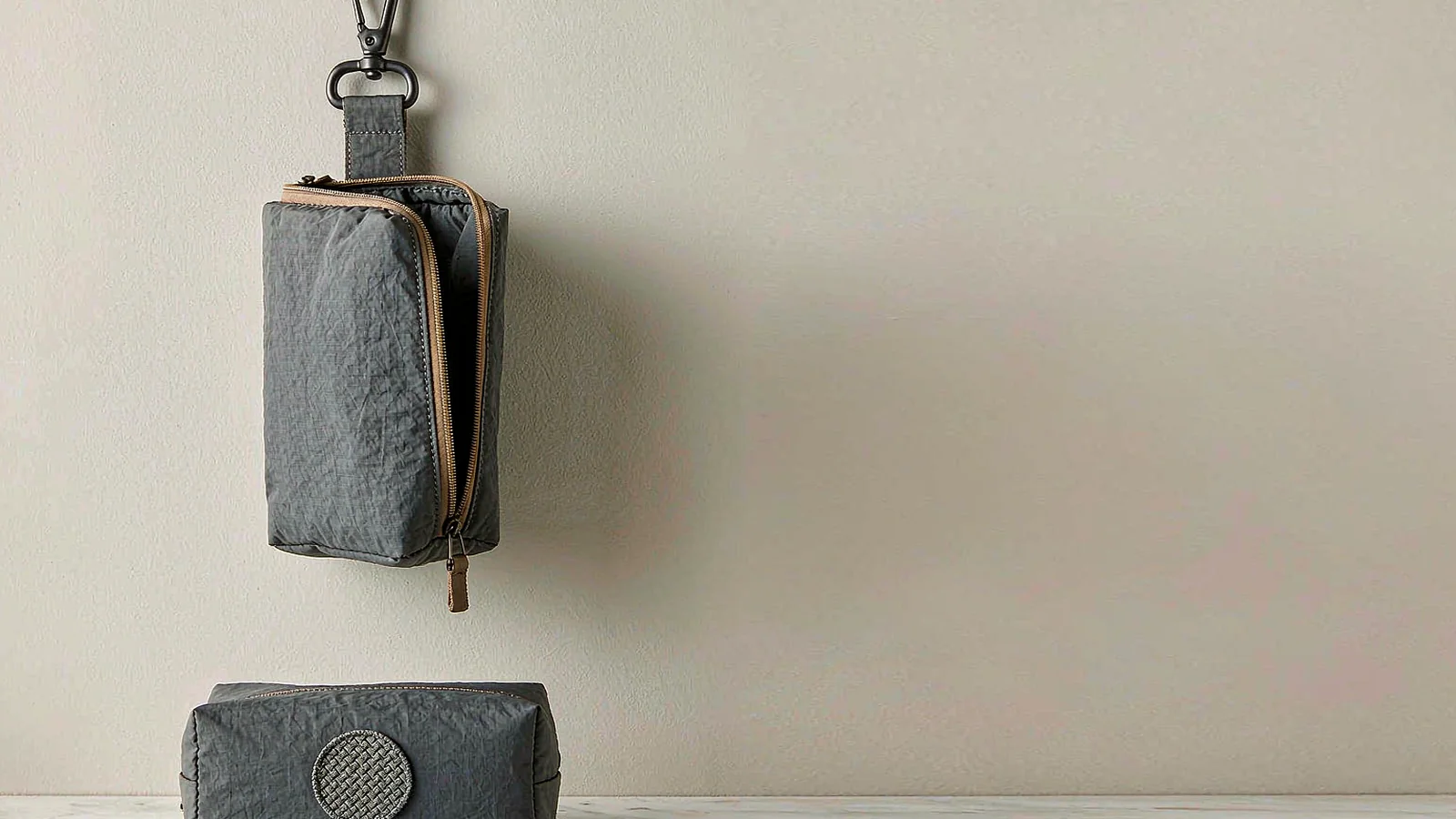
A hanging toiletry bag is defined by one structural decision: it has to carry its own filled weight from a suspension point above it, rather than resting on a surface. That decision changes everything downstream. The top of the bag becomes a structural member instead of a seam, the interior has to be planned on the vertical axis, and the closure has to behave while gravity pulls the contents away from the stitching. A flat wash bag on a hotel counter can be cut from 210D lining with a single perimeter seam; the same volume hung from a hook needs a reinforced spine, an engineered anchor and a hook whose throat clears the fixing it must grip.
Three geometries dominate the category. The flat hanging organiser folds open into three or four panels and hangs from a hook at the top of the back panel; a typical closed footprint is 24 x 18 x 8 cm opening to roughly 24 x 58 cm deployed. The roll-up wraps around its contents and secures with a strap, then hangs from a loop or clip; rolled diameters of 11-14 cm over a 24-30 cm length are typical. The hybrid carries a detachable hanging panel so the unit works rolled on a counter or suspended in a shower. Each geometry moves the load path somewhere different, which is why hook, anchor and reinforcement have to be specified together.
| Component | Function in the hanging system | Common spec options | What to check on the sample |
|---|---|---|---|
| Hook | Transfers the whole filled weight into the fixing | Wide-throat fixed, swivel, carabiner, S-hook, webbing loop | Throat opening in mm, burr-free edges, plating adhesion |
| Anchor webbing | Carries load from hook into the bag body | 15 mm, 20 mm or 25 mm polyester webbing | Whether it is stitched into the top seam only or run down the panel |
| Reinforcement patch | Spreads concentrated stress into the panel | 600D patch, PE board 0.6-0.8 mm, EVA 2 mm | Footprint in cm, and inside or outside the lining |
| Hanging spine | Turns the back panel into a tension member | Full-height 25 mm webbing under the lining | Whether it reaches the bottom seam or stops mid-panel |
| Panel articulation | Lets the bag open flat while suspended | Two, three or four panels with bound or taped hinges | Sag of the lowest panel when loaded and hung |
| Closure | Keeps contents in when the bag is open or moved | Two-way zip, magnetic snap, hook-and-loop, side-release buckle | Slider position under load; whether the lower stop takes strain |
| Mirror | Adds function at the cost of top-end mass | Acrylic or PETG 1.5-2 mm, bound edge | Edge coverage; pocket above or below the anchor |
Planning on the vertical axis is where most first briefs go wrong. Pockets that look balanced flat on a table behave differently hung at eye height: the lower pockets carry the visual weight and the upper ones sit out of comfortable reach. Work from the fixing down. With the hook at 165-180 cm on a door or shower rail and a deployed height of 58 cm, the lowest pocket lands at roughly 105-120 cm, which is comfortable; at 75 cm deployed it drops to around 90-105 cm, which feels low for anyone under 165 cm tall. Usable hanging height, not closed footprint, governs the layout.
- Hook-to-first-pocket distance: 8-14 cm is the common band, and it is dead space unless it carries a mirror or a document sleeve.
- Deployed height: 50-58 cm suits three panels; 66-75 cm suits four panels with a lower wet pocket.
- Reach envelope: contents below roughly 95 cm from the floor are awkward for shorter users.
- Rear clearance: a bag hung in a shower cubicle needs about 10 cm behind it so it does not press against wet tile.
Search demand shows why the format keeps earning shelf space. 'Travel bag for toiletries' draws roughly 110,000 monthly searches and 'toiletry bag' around 74,810 weekly Amazon searches according to ASINSIGHT data for 2026.07; those measure search interest, not revenue. The demand is fed by a specific friction: bathrooms with no usable counter. Cruise cabins, hostel shower blocks, gym changing rooms and campervan conversions all present a wet room with a rail and nowhere to put anything. In the United States the liquids regime adds a second friction, because the TSA 3-1-1 liquids rule keeps bottles grouped in one quart-size bag, so a hanging organiser is opened and re-closed at the security tray and again at the destination.
A hook is not an accessory that gets added at the end of development. It is the first link in a load path that ends in the bottom seam of the back panel. Any brief that specifies fabric, colour and pocket count but leaves the hook to a catalogue pick has left the structural decision to chance.
The guide then takes each link in turn: hook taxonomy and clearance against real fixings, how load travels from the hook into the bag body, a written test protocol, layout and closure behaviour while suspended, waterproofing of the hanging panel, and finally the choice between roll-up, flat and hybrid geometries.
Hook Types and Opening Clearance Against Real Fixings
Hooks on hanging toiletry bags fall into five families, and the differences are mechanical rather than cosmetic. A wide-throat fixed hook is a formed piece with an open mouth deep enough to pass over a door top or a towel bar; throat depths of 45-55 mm are the useful band. A swivel hook adds a rotating rivet between the hook and the webbing anchor, letting the bag orient itself to the fixing. A carabiner clip uses a spring-loaded gate with a much smaller opening, typically 12-20 mm. An S-hook is a double bend that relies on friction and balance. A webbing loop with a side-release buckle removes metal entirely and turns the suspension point into an adjustable strap.
The choice is governed by clearance arithmetic. Throat depth has to exceed fixing thickness by a working margin, and 8-12 mm is a sensible planning figure: enough to seat the hook without jamming, not so much that it swings loose. A 35-45 mm interior door top therefore needs a throat of roughly 47-55 mm. A 22 mm shower curtain rail needs only 30-34 mm, which is why hooks that feel generous on a rail can refuse a door. Wire section matters as much as throat: a 3 mm zinc-alloy wire bridges a 25 mm towel bar with a shallow contact arc, while a 4 mm wire grips a wider arc and resists rolling.
| Hook type | Throat or gate opening | Typical material | Fixings it suits | Dominant risk |
|---|---|---|---|---|
| Wide-throat fixed hook | 45-55 mm throat | Zinc alloy die-cast or stainless wire | Interior doors 35-45 mm, wardrobe rails, towel bars | Rotates out of plane if the load is off-centre, unscrews from a threaded base |
| Swivel hook | 30-45 mm throat plus rotation | Zinc alloy with steel rivet, or POM | Shower rails, shower curtain rods, pegs | The rivet is a second failure point; rotation can be stiff when new |
| Carabiner clip | 12-20 mm gate | Aluminium 6061 or zinc alloy | D-rings, wardrobe rails, towel rings, backpack loops | Gate springs open under lateral pull; small gate rejects thick door tops |
| S-hook | 20-30 mm each bend | Stainless steel wire 3-4 mm | Shower rails, exposed pipes, campsite lines | Balances rather than grips; lifts off if the bag is brushed |
| Webbing loop and buckle | Adjustable to 200 mm plus | Polyester webbing plus POM buckle | Tree branches, bunk ladders, hooks of unknown size | Buckle slip under load; more sewing to get wrong |
| Suction cup | Not applicable | PVC or TPE cup | Glazed tile and glass only | Not recommended for this category; releases without warning |
Material selection follows the environment. Zinc alloy (Zamak) die-cast hooks give crisp detail and take nickel, chrome, gunmetal or black-nickel plating, but plating is a surface layer and it is the layer that fails first in a wet room: blushing, flaking and edge wear all start at the contact point. Stainless steel wire in 304 grade costs more and takes a simpler shape, but tolerates a shower environment. Plastic hooks in POM or glass-filled PA6 remove corrosion entirely and pass a magnetic check without comment, at the cost of a lower margin before permanent deformation. For hardware terminology used consistently across a technical pack, the ASTM D2053 zipper and hardware terminology standard gives buyers and factories a shared vocabulary.
Metal hardware also carries a compliance line. Nickel release and certain surface coatings on metal components are regulated in the European Union under REACH, and a buyer selling into that market should ask for a declaration against the current restricted substance list rather than assuming a plating shop is compliant. Plating colour then becomes a specification line, not a mood board decision: matte black nickel hides wear better than bright chrome, and a bright finish shows every contact mark after a season in a gym bag.
- Towel bars: 19 mm, 22 mm and 25 mm outside diameter are the common sizes; confirm which the target market uses before fixing the throat.
- Shower rails and curtain rods: 22-25 mm, often with a decorative end cap that reduces usable entry.
- Interior doors: 35 mm in much of Europe and North America, 40-45 mm on fire and solid-core doors.
- Wardrobe rails: 25-32 mm; a carabiner gate of 12-20 mm will not pass over an end cap.
- Over-door hooks and pegs: 12-16 mm projection, which favours a swivel or carabiner over a wide throat.
- Camping and van use: guy lines, ladder rungs and branches, which favour a long adjustable webbing loop.
Two failure behaviours deserve specific clauses in a technical pack. The first is rotation dumping: a fixed hook with an off-centre load rotates until the bag tips and the contents slide out of an open pocket. A swivel hook solves orientation but adds its own rotation risk at the rivet. The second is gate spring-open: a non-locking carabiner pressed sideways against a rail can pop its gate and release. Neither is visible in a product photograph and neither is caught by visual inspection, which is why the protocol in section four asks for a loaded hang at the worst-case pocket configuration.
- Clearance rule — throat depth must exceed fixing thickness by 8-12 mm, verified against the thickest fixing in the target market.
- Contact arc — a thicker wire section grips a wider arc on a round bar; 3 mm is the practical minimum, 4 mm better on 25 mm bars.
- Rotation clause — state whether the hook must rotate, and whether rotation is at the rivet or at the throat.
- Corrosion clause — name the plating system and substrate, plus a humidity expectation if the bag will live in a wet room.
- Edge clause — every hook edge that touches webbing must be burr-free; a sharp radius at the eye cuts an anchor fast.
The Load Path: How Hanging Weight Travels Into the Bag Body
Load enters at the fixing and leaves through the bottom seam of the back panel. Between those two points it passes through the hook eye, the anchor webbing, the stitching that fixes the webbing, the reinforcement patch, the back panel fabric, and finally the hinge seams between panels. Every one of those is a candidate for being the weakest link, and the interesting part for a buyer is that the hook is rarely it. Metal hooks are almost always stronger than the textile they are sewn to, which is why a failed hanging toiletry bag usually presents as a torn webbing anchor or a split top corner rather than a bent hook.
Anchor design is therefore the highest-leverage decision in the whole build. The weakest common construction is a 15 mm webbing loop stitched into the top seam only: the entire load concentrates into two short stitch lines at the edge of the panel, and the fabric is pulled in peel rather than in shear. Better is a webbing extension running 8-10 cm down the back panel, which moves the stitch line away from the edge. Better still is a full-height spine, a 25 mm polyester webbing running from the anchor to the bottom seam under the lining, which turns the back panel into a tension member and lets the fabric share the load instead of resisting it at a point.
Stitching specification matters as much as geometry. A box or box-X bar tack at the anchor is standard practice: a rectangle roughly 20 x 25 mm with a stitch count in the low forties, sewn at 8-10 stitches per inch in a bonded polyester or nylon thread in the Tex 40-70 range. The number buyers should actually write down is the stitch count per bar, because a machine set for a light bar on a sample run will drift unless it is specified. Where the webbing wraps an internal stiffener, the stitching should pass through webbing, panel fabric and stiffener together.
| Load path element | Typical build | Spec line the buyer can write | Failure mode if omitted |
|---|---|---|---|
| Hook eye to webbing | Webbing folded through the eye and bar tacked | Webbing folded 25 mm through the eye, box-X tack, 42 stitches minimum | Webbing pulls through the eye or the fold opens |
| Anchor to panel | Webbing extended 8-10 cm down the back panel | Anchor webbing 90 mm below the top seam, sewn through all layers | Peel failure at the top seam; webbing tears away |
| Full-height spine | 25 mm polyester webbing under the lining to the bottom seam | 25 mm polyester spine, full panel height, both ends bar tacked | Panel fabric carries all load; bottom hinge sags |
| Reinforcement patch | 600D patch or PE board 0.6-0.8 mm behind the anchor | Reinforcement 120 x 150 mm behind the anchor, edges turned in | Stress concentrates at a point; panel tears from the corner |
| Panel hinge seams | Bound or taped hinge between panels | Hinge seams bound with 20 mm tape, 8-10 SPI | Hinges split where the lower panel hangs from the upper |
| Thread and needle | Bonded polyester, Tex 40-70, needle size matched to fabric | Bonded polyester Tex 70, needle size stated, no skipped stitches | Seam grins and opens progressively under load |
Reinforcement is about spreading stress, not adding bulk. A patch that is too small simply moves the tear line to its own edge; a patch with a hard, unturned edge creates a new stress concentrator a centimetre away from the old one. A useful planning figure is a footprint of at least 120 x 150 mm behind the anchor, with edges turned in or skived so the transition from reinforced to unreinforced fabric is gradual. Where a PE board of 0.6-0.8 mm or a 2 mm EVA sheet is used, it should be captive between lining and shell so it cannot shift, and radiused at the corners rather than cut square.
Creep is the failure mode that surprises people. A bag can hang for an hour and look fine, then show progressive elongation over a season: polyester webbing is preferred because it elongates less under sustained load than polypropylene, and the lining seam that carries the spine should be sewn with the same thread as the anchor. Hydrostatic and adhesion behaviour of coated fabrics, and the attachment of hardware to them, are covered by ASTM D751 for coated fabrics, a useful reference when a brief must say how a hook anchor is tested against a coated shell rather than a woven one.
On a returned hanging bag, look at the top corner first, not the hook. A clean tear running diagonally from the anchor towards the side seam means the anchor was too short. A tear along the seam line means stitch density or thread was underspecified. An intact anchor with a bent hook means the load level simply exceeded the design, which is a brief problem, not a construction problem.
- Peel loading — an anchor stitched only at the panel edge loads the fabric in peel, the weakest direction for a woven textile.
- Point loading — a narrow anchor concentrates force; widening the webbing from 15 mm to 25 mm roughly halves the stress per unit width.
- Off-centre loading — contents packed to one side rotate the hook and load one half of the anchor disproportionately.
- Wet loading — a saturated pocket adds mass and softens some coatings, so wet-state behaviour belongs in the protocol.
- Cycle loading — repeated hanging and removal fatigues stitch holes, which is why a one-hour test tells a buyer very little.
Specifying a Hanging Test Protocol Instead of Accepting a Claim
The phrase 'our hook is very strong' is not a specification and cannot be audited. What a buyer needs is a protocol: a written statement of what is loaded, how much, for how long, how many times, in what condition, and what counts as a failure. Once those five things are written down, two factories can be compared on evidence rather than on confidence, and a dispute six months later has a document to resolve against. The protocol belongs in the technical pack before sampling, because changing an anchor after sample approval costs a new sample round and pushes the bulk date.
Start with the fill. 'Loaded' is meaningless unless the fill method is described: a bag filled with 200 g of cotton wool behaves nothing like the same bag holding four 100 ml bottles. Specify the fill as uniform, mass spread evenly across the pockets, or worst case, the full payload in the lowest pocket to maximise the moment arm on the anchor. Worst case matters and should be the default. Then specify the load level in kilograms as a decision the brand owner makes. Values of 2.0 kg, 3.0 kg and 4.0 kg are all written into hanging protocols for bags of this size; the number is chosen and recorded, not discovered. It is a specification input, not a laboratory result.
| Protocol parameter | How to write it | Values a buyer may set | Pass criterion |
|---|---|---|---|
| Conditioning | State temperature, humidity and time before the test | Standard laboratory atmosphere, 24 hours | Sample tested in the stated state only |
| Load level | State a single figure in kilograms, chosen by the brand owner | 2.0 kg, 3.0 kg or 4.0 kg | No detachment and no stitch breakage |
| Fill method | State uniform or worst case, and where the mass sits | Worst case: all mass in the lowest pocket | Test repeats with the stated distribution |
| Sustained duration | State hours of continuous hanging at the load level | 24 hours, 72 hours or 168 hours | No elongation beyond the stated tolerance |
| Cycle count | Define one cycle, then state how many | 250, 500 or 1,000 hang-and-remove cycles | Anchor intact and hook functional at the end |
| Seam opening tolerance | State the maximum permitted gap in mm after the test | 2 mm, measured with a ruler at three points | No gap exceeds the stated figure |
| Hook deformation | State the permitted permanent set | Returns to within 5 degrees of the start angle | Throat still clears the stated fixing |
| Sample size | State how many units and from which stage | 3 units from pre-production, 1 per 5,000 in bulk | All units pass; a failure triggers root-cause review |
Acceptance criteria should be sorted into three tiers, because not every failure is equal. A catastrophic failure is detachment of the anchor, breakage of the hook, or a seam splitting open. A functional failure is the hook deforming so that it no longer clears the stated fixing, the throat closing up, or a zip that unzips itself under load. A cosmetic failure is plating wear at the contact point, print abrasion, or a permanent crease in the lining. Write all three into the pack with separate tolerances, because a factory can reasonably be asked to accept zero catastrophic failures and a stated small percentage of cosmetic ones.
Measurement method needs a clause too, otherwise two parties measure different things. State that seam opening is measured with a steel rule at three points along the anchor, that the hook angle is photographed against an angle template before and after, and that the throat opening is checked with a gauge pin of the stated diameter. Photographs before and after, from the same position, are cheap evidence and settle most arguments. Where hook plating contacts webbing, colour transfer can be assessed using AATCC test methods for crocking, a common omission in hardware specs.
Sampling and inspection are separate from the protocol and should not be confused with it. The protocol describes a functional test on a small number of units at defined stages. Inspection is the statistical check applied to a shipment, and for these programmes that is AQL 2.5 under ISO 2859-1, which governs how many cartons are opened and what defect classes are counted. A buyer who wants hook function covered at shipment can add a functional check on a stated number of pieces per carton, but that is an addition to the AQL plan, not a substitute for the protocol.
- Write it before sampling — a protocol added after sample approval forces a second sample round and a later bulk date.
- Name the number — the load level, duration and cycle count are decisions the brand owner records, not results a supplier reports.
- Test worst case — all payload in the lowest pocket produces the largest moment on the anchor.
- Separate defect tiers — catastrophic, functional and cosmetic failures need separate tolerances and separate consequences.
- Photograph everything — same angle, same distance, before and after, with a scale in frame.
- Retest on change — any change to hook, webbing width, thread or panel fabric invalidates the previous protocol result.
One more clause is worth adding, and it costs nothing: a change-control line stating that any substitution of hook, webbing, thread or reinforcement requires the protocol to be repeated before bulk starts. Substitutions are the most common cause of a good sample followed by a weak shipment, and they are rarely deliberate; a hook of the same drawing from a different plating shop, or webbing of the same width from a different roll, both move the result.

Pocket Layout, Closure Behaviour and Waterproofing While Suspended
A hanging toiletry bag is used in two states, closed in transit and open on a fixing, and most briefs only design the first. In the open state the pockets are vertical, gravity pulls every item downwards against its retaining seam or elastic, and the user reaches across rather than down into the bag. That reverses several instincts. Heavy items belong low, because mass at the top increases the moment arm on the anchor and makes the bag swing; elastic loops must be tight enough to hold a bottle at 90 degrees to the panel; and anything with a lid should be oriented so the lid cannot work loose in transit.
Closure behaviour while hanging is where the second category of complaints comes from. A single-slider zip on a deployed bag tends to creep: the slider walks down under the weight of the contents on the tape, and the bag slowly opens itself. A two-way zip lets the user close from both ends and park the sliders at the bottom, where the lower stop takes the strain instead of the tape. A zip garage at the top protects the slider from the hook webbing. Magnetic snaps are quiet but add mass at the closure line and can pop open if an overfilled pocket bows the panel. Hook-and-loop is light and cheap but loses grip when wet, a real problem in a shower.
| Hanging zone (top to bottom) | Recommended contents | Design note | Risk to manage |
|---|---|---|---|
| Hook webbing zone, 0-10 cm | Nothing bulky; flat document sleeve or mirror sleeve | Keep this zone light so the anchor carries less moment | A mirror here adds mass directly above the anchor |
| Upper panel, 10-25 cm | Flat items: brushes, comb, razor, dental kit | Elastic loops at 20-25 mm spacing | Brushes slip out of loose loops when the bag swings |
| Middle panel, 25-45 cm | Bottles up to 100 ml, tubes, small jars | Elastic or mesh pockets 6-8 cm deep with a retaining lip | Tall bottles lever against the seam; add a base shelf |
| Lower wet pocket, 45-60 cm | Damp items, wet razor, sponge | Welded or taped seams, drain grommet optional | Water migrates into the lining if the seam is only stitched |
| Bottom edge, 60-70 cm | Heavy items: full-size aerosol, large bottle | Reinforced base shelf sewn to the spine | Mass here maximises swing; keep the bag off the wall |
Mirrors are the detail most often specified backwards. A mirror is attractive in a hanging makeup organizer and photographs well, but glass is heavy and wrong in a wet room. Acrylic or PETG sheet at 1.5-2 mm is the practical choice: lighter, shatter-resistant, and supplied with a protective film peeled at the point of sale. The edge should be fully bound, because an exposed acrylic edge chips and then cracks. Position matters more than size: a mirror directly above the anchor adds mass where the load path is most sensitive, so a 15 x 20 cm mirror in the second panel beats a 20 x 25 cm mirror in the first.
Waterproofing the hanging panel has two jobs: keeping spray off the contents, and keeping a leak inside the bag. The first is the shell, where a TPU lamination of 0.15-0.25 mm or a PU coating on a 300D or 420D face fabric is the usual answer, with the hydrostatic head figure written into the pack as a value the buyer sets and verified against ASTM D751 for coated fabrics. The second is the seams, and this is what gets missed: a stitched seam in a wet pocket leaks through the needle holes regardless of how good the fabric is, so a wet pocket needs welded or taped seams, or a drop-in liner. Document the coating against OEKO-TEX Standard 100 if the brand sells on a skin-contact claim.
- Two-way zip — lets the sliders park at the bottom where the stop takes the load instead of the tape.
- Zip garage — a small fabric hood at the top keeps the slider off the hook webbing and out of the way when the bag is open.
- Base shelf — pockets that hang free put all bottle mass on the front seam; a shelf sewn to the spine moves it to the panel.
- Welded wet pocket — stitching leaks through needle holes; a welded or taped wet pocket is the only reliable containment.
- Bound mirror edge — exposed acrylic edges chip, then crack; bind all four sides.
- Rear standoff — 10 cm of clearance behind the bag keeps a shower-hung panel off wet tile.
The packed state still matters even for a bag that lives on a hook. A hanging bag is carried closed in a suitcase, and the folded or rolled geometry decides how much space it takes. A flat hanging organiser folded closed is roughly 24 x 18 x 8 cm and packs as a rectangular block, efficient in a suitcase corner but not compressible. A roll-up rolls to a cylinder of 11-14 cm diameter and can be squeezed, at the cost of crushing anything soft inside. Both states should be drawn in the technical pack: deployed, with pocket positions, and packed, with the maximum dimensions the brand will accept.
Roll-Up, Flat and Hybrid Variants: Which Geometry Fits Which Programme
The roll up toiletry bag and the flat hanging organiser solve the same problem with opposite assumptions. A roll-up assumes the contents are rigid and roughly cylindrical: bottles, tubes, brushes and razors that tolerate being wrapped. It packs into a tight cylinder, it is genuinely compact, and it works well on a counter where it can be unrolled flat. What it does badly is organisation while suspended: a cylinder hanging from one end presents its contents end-on, pockets open sideways, and anything loose falls out when the roll flexes. Roll-ups are at their best as brush organisers and counter-top kits, and at their weakest as shower-hung organisers for small items.
The flat hanging organiser assumes the opposite: that the contents are varied and small, and that the user wants to see all of them at once. Three or four panels hung vertically give a clear field of view, pockets open forwards, and a mirror can be integrated. The costs are packing volume and structure. A multi-panel bag needs hinge seams, a spine and a reinforcement patch, which is more sewing and more opportunity for a weak seam; and it does not compress, so it occupies a fixed block in the suitcase. The flat format carries a higher unit cost and a higher perceived value, and it is what most buyers mean by a hanging toiletry bag.
The hybrid tries to buy both. A hanging panel with two or three zip or mesh pockets is attached to the roll by snap fasteners or a short webbing and buckle, so the unit can be rolled for transit and unclipped to hang. This is attractive on paper and needs care in practice: the attachment points become a second load path, and they are usually weaker than a sewn anchor. If a hybrid is specified, the attachment should be rated to the same protocol as the main hook, the snaps backed with a reinforcement patch, and the detached panel tested hanging on its own.
- Roll-up — 11-14 cm rolled diameter, 24-30 cm length; best for rigid cylindrical contents and counter use; weakest as a hanging organiser for small items.
- Flat hanging — 24 x 18 x 8 cm closed, 24 x 58 cm deployed; best for visibility, mirrors and shower use; more sewing, fixed packed volume.
- Hybrid detachable — roll plus clip-on hanging panel; serves both counter and shower use; needs a second rated attachment.
- Four-panel — 66-75 cm deployed with a lower wet pocket; best for family kits; needs a full-height spine or the lower panel sags.
- Compact two-panel — 40-50 cm deployed; best for gym and overnight use; limited bottle capacity, lowest unit cost of the family.
Packing geometry has a direct effect on landed cost, worth calculating before the format is locked. A flat hanging organiser folded closed occupies roughly 3.5 litres of packed volume; a roll-up occupies roughly 2.4 litres as a cylinder. As a planning example only, a carton of 60 x 40 x 40 cm holds around 40 units of the folded flat format or around 55 units of the rolled format, which changes the per-unit freight figure even when the unit price is identical. Treat carton counts as an estimate to be confirmed by a packing test on the pre-production sample, because the actual count depends on how compressible the specific fabric turns out to be.
Material choice interacts with geometry in one more way. A roll-up needs a fabric that recovers from being rolled, which favours a 420D nylon or a 300D polyester with a light backing over a stiff coated shell that creases permanently. A flat hanging panel needs the opposite, enough body to hang flat, which is where a 600D polyester or a coated 420D earns its weight. Colour fastness of the panel fabric should be specified against ISO 105 colour fastness test methods, because a hanging panel spends its life facing a bathroom light. Where the brand carries a recycled content claim, face fabric and webbing can be sourced to the Global Recycled Standard and documented with transaction certificates.
- Decide whether the primary use is counter or shower. Shower use pushes hard towards the flat hanging format.
- Measure the fixings in the target market and set the hook throat from the thickest one, not the average.
- Set the load level, duration and cycle count for the protocol and write them into the technical pack before sampling.
- Choose the anchor: 15 mm loop, 90 mm extension or full-height 25 mm spine, and specify the bar tack stitch count.
- Draw both states, deployed and packed, with dimensions and carton estimate.
- Confirm fabric, coating and hardware compliance for the destination market, then approve a pre-production sample tested to the protocol.
The commercial frame sits underneath all of this and does not change with geometry. Programmes run at 500 pieces per style and colourway, sampling takes 6-10 working days and 12-15 for complex builds such as a hybrid with a moulded hook, and bulk production runs 35-50 days after sample approval. Shipment is quoted FOB Xiamen, payment at T/T 30 deposit and 70 against bill of lading, inspection at AQL 2.5. A custom metal hook is the one item that adds lead time without warning, because a new die-cast tool has to be cut; as an illustrative planning range, buyers often budget a few hundred to a couple of thousand US dollars for a bespoke hook tool plus several weeks of tooling.
The B2B Customisation View
Programme planning for cosmetic bags starts with the end market: a hotel amenity run and a beauty-retail launch ask for completely different construction and compliance evidence.
Planning figures used across the programme: MOQ 500 pieces per style and colourway, 6–10 working days sampling (12–15 when moulding or multi-layer lamination is required), 35–50 days bulk lead time, AQL 2.5 to ISO 2859-1, FOB Xiamen, T/T 30/70.
The programme-management model exists because most import problems are documentation problems, and documentation is what this office produces and holds.
Which Brand Types This Guide Serves
This guide is written for brand owners, retailers and e-commerce sellers who are specifying a hanging toiletry bag programme rather than buying a finished catalogue item. The decisions in it — hook throat, anchor length, reinforcement footprint, protocol parameters — are the ones that determine whether a product survives its first season or generates returns. Different types of buyer meet them from different directions, and the priority order changes accordingly.
- Start-up and DTC brands — usually have one shot at a first production run and no budget for a second. The priority is a protocol written before sampling, a conservative anchor specification, and a hook chosen from an existing tool rather than a bespoke die-cast, because a new tool adds both cost and weeks. A compact two-panel or a roll-up keeps the first order simple at the 500-piece minimum.
- Established beauty and skincare brands — typically use a hanging bag as a gift-with-purchase or a travel set component, where brand finish matters as much as structure. The priority is plating specification, colour matching of webbing and tape to the brand palette, mirror edge quality, and documentation for the recycled or skin-contact claims already made elsewhere in the range.
- Retailers and private-label programmes — buy across multiple tiers and need consistent specification language so that a hanging toiletry bag in one tier can be compared with the next. The priority is a written technical pack with the same protocol applied to every tier, a defined defect tier list, and carton packing confirmed by test rather than estimate.
- E-commerce and marketplace sellers — compete on reviews, and reviews are destroyed by a hook that fails in week three. The priority is worst-case fill testing, a full-height spine even if it costs slightly more, and pre-shipment photography evidence for every batch so a listing problem can be traced to a production run.
- Hospitality, gym and gift buyers — specify for a wet environment and for a user who does not own the bag. The priority is corrosion-resistant hardware, welded wet pockets, a hook that clears the rails actually installed on site, and a simpler closure that a guest can operate without instruction.
Frequently Asked Questions
What hook throat opening should a hanging toiletry bag specification require?
The throat has to be specified against the thickest fixing in the target market, with a working margin of 8-12 mm on top. An interior door at 35-45 mm thick therefore needs a throat of roughly 47-55 mm, while a 22 mm shower rail is comfortable at 30-34 mm. Write the figure in millimetres into the technical pack and add the fixing diameters the hook must clear, then verify with a gauge pin of that diameter on the pre-production sample. A hook that looks generous in a photograph can still refuse a solid-core door, and the failure only appears when the customer gets home.
Should a hanging toiletry bag use a metal hook or a plastic hook?
It depends on the environment and the compliance route. Zinc alloy gives crisp shapes and takes good plating but the plating is the first thing to fail in a wet room. Stainless wire tolerates showers and costs more. POM or glass-filled nylon removes corrosion entirely and passes magnetic checks without comment, at a lower margin before permanent deformation. For a bag sold into the European Union, metal hardware also carries a REACH declaration line, so the brief should state the destination market and the intended end user before the hook material is fixed.
How is the load level for a hanging toiletry bag chosen?
It is chosen by the brand owner, not reported by anyone else. The load level is a specification input: the buyer decides what a realistically filled bag weighs for the intended contents, writes that figure in kilograms into the protocol, and requires the bag to hold it. Figures of 2.0 kg, 3.0 kg and 4.0 kg are all values buyers set for bags of this size. What matters is that the number is recorded alongside the fill method, duration and cycle count, because a load level quoted without those three tells a buyer nothing about whether the result is comparable.
Why do hanging toiletry bags usually fail at the top corner rather than at the hook?
Because the metal hook is almost always stronger than the textile it is sewn to. Load concentrates where the anchor webbing meets the panel, and if the webbing is stitched into the top seam only, the panel fabric is loaded in peel, its weakest direction. The tear then starts at the top corner and runs diagonally towards the side seam. A webbing extension of at least 90 mm down the panel, a full-height 25 mm spine and a radiused reinforcement patch move the load into shear and spread it, which is why anchor design dominates structural outcomes.
What goes into a written hanging load test protocol?
Five things: what is loaded, how much, for how long, how many times, and what counts as a failure. The fill method should state worst-case distribution, with all mass in the lowest pocket. Duration is typically 24, 72 or 168 hours of continuous hang. Cycle counts of 250, 500 or 1,000 hang-and-remove cycles cover fatigue. Acceptance criteria should be split into catastrophic, functional and cosmetic tiers with separate tolerances, and should include seam opening in millimetres and permitted permanent set of the hook.
How many hang-and-remove cycles should a hanging toiletry bag be tested for?
The cycle count is a decision the buyer records, and 250, 500 or 1,000 are the values most commonly written in. One cycle must be defined first: hang on the stated fixing at the stated load, leave for a stated dwell time, remove, then repeat. Fatigue matters because repeated hanging and removal works the stitch holes at the anchor, and a bag that survives a one-hour static hang can still fail at cycle 300. State the dwell time per cycle as well, or two factories will run two different tests.
What is the difference between a hanging makeup organizer and a hanging toiletry bag?
In construction they are close relatives; the difference is in what the pockets are shaped for. A hanging makeup organizer is planned around brushes, palettes and compacts, so it uses narrow elastic loops, shallow mesh pockets and often an integrated mirror. A hanging toiletry bag is planned around bottles and wash items, so it uses deeper pockets with retaining lips, a welded wet compartment and more height. Both hang from the same kind of hook and both need the same anchor engineering, but the pocket geometry and the waterproofing differ enough to justify separate technical packs.
Can a roll up toiletry bag also hang, or are the two formats exclusive?
They overlap but they are not the same build. A roll-up can hang from a loop or clip at one end, and many do, but a rolled cylinder presents its contents end-on and pockets open sideways, so small items fall out when the roll flexes. A flat hanging organiser hangs as a vertical field with pockets opening forwards, which is better for visibility and for shower use. The hybrid answer is a detachable hanging panel clipped to the roll, which serves both but adds a second load path that must be rated to the same protocol.
What fabric weight suits the back panel of a hanging toiletry bag?
The back panel is structural, not decorative, so it wants more body than the front. A 600D polyester or a coated 420D is typical for the flat hanging format, with a 300D or 420D face on the front panels and a 210D ripstop or polyester taffeta lining. Roll-ups favour a 420D nylon that recovers from being rolled over a stiff coated shell that creases permanently. Where the brand carries a responsible-sourcing claim, organic cotton canvas can be used, documented to the Global Organic Textile Standard rather than asserted on a hangtag.
How tall should a hanging toiletry bag be when it is hanging open?
Work from the fixing down rather than from the closed footprint. A three-panel bag deployed at 50-58 cm puts the lowest pocket at roughly 105-120 cm when hung from a hook at 165-180 cm, which is comfortable for most users. Four-panel builds at 66-75 cm suit family kits with a wet pocket, but push the lowest contents towards 90-105 cm, which starts to feel low for shorter users. State the deployed height and the hook-to-first-pocket distance in the technical pack.
Is a mirror inside a hanging toiletry bag a structural problem?
It is a mass problem rather than a strength problem, and it is usually specified in the wrong place. A mirror positioned directly above the anchor adds weight exactly where the load path is most sensitive, so a 15 x 20 cm mirror in the second panel is a better build than a 20 x 25 cm mirror in the first. Acrylic or PETG at 1.5-2 mm is the practical material choice over glass in a wet room, and all four edges should be bound, because an exposed acrylic edge chips and then cracks.
How does a buyer stop liquids leaking out of a hanging toiletry bag?
Two separate lines. The shell needs a coating or lamination, typically TPU at 0.15-0.25 mm or a PU coating, with a hydrostatic head value the buyer sets and verifies against ASTM D751 for coated fabrics. The wet compartment needs welded or taped seams, because a stitched seam leaks through the needle holes no matter how good the fabric is. Add a cap-torque clause for any bottle filled by the brand, and consider a drop-in liner or a drain grommet in the lower wet pocket.
What should be checked on a pre-production sample of a hanging toiletry bag?
Measure the hook throat with a gauge pin of the stated diameter, then check the burr-free condition of every edge that touches webbing. Confirm the anchor webbing length and width against the drawing and count the bar tack stitches at the anchor. Open the lining if possible to verify the reinforcement footprint and whether the spine reaches the bottom seam. Hang the sample loaded to the protocol, worst-case fill, and photograph it. Finally confirm the packed dimensions and do a real carton count rather than accepting an estimate.
Does AQL 2.5 inspection cover hook function on a hanging toiletry bag?
Not by default. AQL 2.5 under ISO 2859-1 is a statistical plan for counting visual and dimensional defects across a shipment; it does not by itself load the bag and hang it. A buyer who wants hook and anchor function verified at shipment can add a functional check on a stated number of pieces per carton, defined as part of the inspection plan and priced before the order is placed. That check is an addition to the AQL plan, not a substitute for the pre-production load protocol.
People Also Ask
What is a hanging toiletry bag?
A hanging toiletry bag is a wash bag built with a suspension point at the top, usually a hook, a carabiner or a webbing loop, so the filled bag can hang from a door, towel bar or shower rail instead of resting on a counter. Opened, it presents pockets vertically rather than horizontally. The suspension point makes the top of the bag structural, so the hook, the anchor webbing and the reinforcement patch have to be specified as one load path.
How do you hang a toiletry bag without a hook?
Three options work. A long webbing loop with a side-release buckle wraps around rails, branches and ladder rungs of unknown size. A carabiner clips to any D-ring, wardrobe rail or backpack loop. Where neither is available, a strap with a snap hook threaded through the bag's own D-ring will do. Avoid suction cups for this category, because they release without warning and a hanging toiletry bag carries too much weight to trust one.
Do hanging toiletry bags work on cruise ship bathrooms?
They work well there, because cruise cabins usually offer a rail and very little counter. Choose a hook whose throat clears the rail diameter plus 8-12 mm, and prefer stainless or POM hardware over plated zinc alloy in a humid cabin. Keep the deployed height moderate so the bag does not swing into the shower area, and use a welded wet pocket so damp items do not soak the lining between port days.
What size hanging toiletry bag is best for travel?
For most travellers a three-panel build of about 24 x 18 x 8 cm closed, deploying to roughly 24 x 58 cm, is the practical middle. It takes bottles up to 100 ml, hangs at a comfortable reach from a hook at 165-180 cm, and still packs as a manageable block. Gym and overnight users can drop to a two-panel build at 40-50 cm deployed; family and long-trip kits justify four panels at 66-75 cm.
How do you clean a hanging toiletry bag?
Empty it, brush out dry residue, then wipe the lining with a mild detergent solution and a soft cloth. Coated shells respond to a damp cloth; do not machine wash a bag with a metal hook, a mirror or an internal stiffener, because the hook will abrade the drum and the board can warp. Dry the bag open and hung, never folded, and pay attention to the wet pocket seam, which is where residue collects. Check the hook plating for wear at the same time.
References & Standards
- ISO 2859-1 sampling procedures for inspection by attributes
- ASTM D2053 standard terminology relating to zippers
- AATCC TM61 colour fastness to laundering
- IEC 62321 determination of certain substances in electrotechnical products
- OEKO-TEX Standard 100 testing for harmful substances
- Textile Exchange Global Recycled Standard
- US CPSC CPSIA consumer product safety improvement act
- ECHA REACH regulation on chemicals
- TSA 3-1-1 liquids rule for carry-on baggage
- ASTM D751 standard test methods for coated fabrics
- ISO 105 textiles tests for colour fastness
- Global Organic Textile Standard GOTS
In-Depth Articles in This Category
19 dedicated articles sit under this pillar guide.
Related Pillar Guides
Request a Sample or a Written Quotation
Send the silhouette, dimensions, material preference and logo artwork, and the programme team will return a written quotation with MOQ, sampling window, bulk lead time and inspection standard.
Email: [email protected] · WhatsApp: +86 177 5002 0688