Canvas Makeup Bags: Cotton Specifications, Printing and Care
Executive Summary
Are canvas makeup bags a practical choice for a branded cosmetic pouch programme? Yes. A cotton canvas cosmetic pouch is the strongest option when a brand wants a natural-fibre hand feel, a printable surface and an accessible unit cost, provided the brief pins down area weight in g/m², pre-shrinking, lining and seam construction before sampling starts. Programmes coordinated through QUANZHOU JUNYUAN BAGS run at MOQ 500 pieces per style and colourway, with sampling in 6-10 working days, bulk production in 35-50 days after sample approval and inspection at AQL 2.5 under ISO 2859-1.
The difficulty is that canvas is a family, not a specification. Twelve-ounce canvas can mean 407 g/m² of genuine bag cloth or 244 g/m² of light shirting, depending on whether the ounces are per square yard or per running yard at a stated width, and numbered duck grades are a separate scale again. This guide sets out the weight and weave decisions, the greige, dyed and printed route economics, the shrinkage tolerances worth writing into a specification, how each decoration method behaves on cotton, and the coating, lining and seam choices that decide whether a bag still looks right after a year.
Everything below is written for buyers who must brief a factory, read a quotation and sign off a sample. Cost figures are illustrative planning ranges to be replaced by a live quote. Shrinkage and colour-fastness numbers appear as tolerances the buyer writes down and confirms by testing, not as promised results.
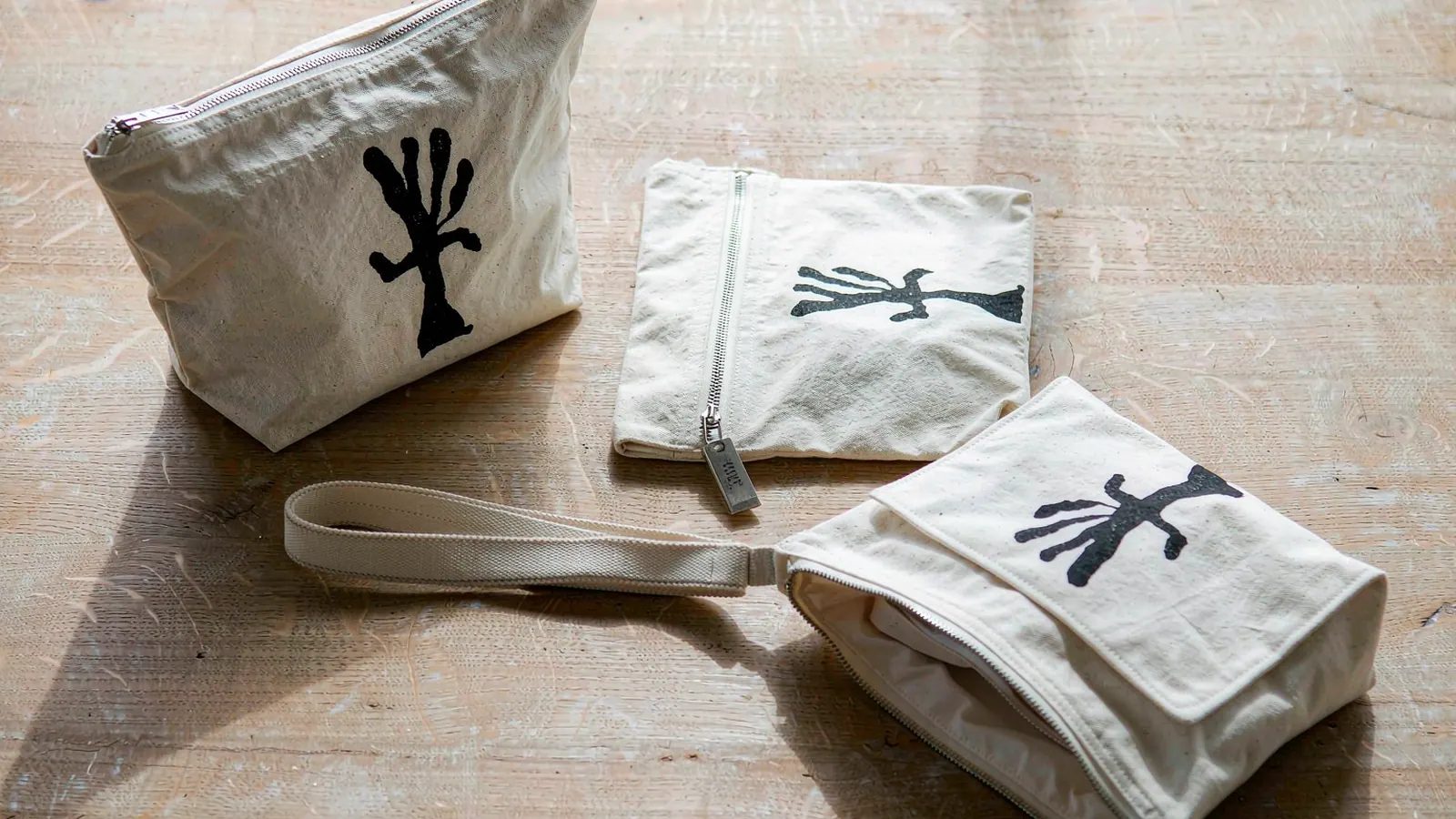
Canvas Weight Systems: What Twelve Ounces Actually Commits a Buyer To
A canvas makeup bag is, at its simplest, a cotton cosmetic pouch whose shell is a plain-woven or duck-woven cotton cloth bonded to a lining and closed with a zip. What separates a pouch that survives two years of travel from one that collapses after a month is rarely the pattern. It is the fabric specification, and the first line of that specification is area weight, which is also where most canvas bag briefs go wrong, because the number on a quotation often does not mean what the buyer reading it assumes.
Cotton cloth is weighed two ways. Outside North America, and on every serious fabric specification sheet, the unit is grams per square metre, written g/m², meaning the mass of one square metre of finished cloth. In the North American market the unit is ounces per square yard, written oz/yd². The conversion is fixed at one oz/yd² equals 33.906 g/m², so eight oz/yd² is about 271 g/m², ten about 339, twelve about 407, fourteen about 475 and sixteen about 542. A buyer who asks for twelve-ounce canvas and receives cloth at 300 g/m² has been sold something roughly a quarter lighter than requested.
Three ways the same three characters describe different cloth
The second trap is the running-yard quotation. Some suppliers quote ounces per linear yard, or per metre, at a stated width rather than per square yard. A roll 150 cm wide contains 1.667 square yards in every linear yard, so cloth at twelve ounces per linear yard at 150 cm is 7.2 oz/yd², or roughly 244 g/m². That is a light, floppy shirting weight, not a bag canvas. The identical phrase describes two cloths that differ by about forty per cent in mass, which is why a quotation must always carry the unit and the width.
The third trap is the numbered duck grade. Industrial cotton duck is also sold by grade, written as number eight, number ten or number twelve. That is an older grading scale rather than an area-weight figure, and the two scales do not map one-to-one onto oz/yd². A line on a quotation that says only number twelve duck, or only twelve-ounce canvas, is incomplete. The buyer should require three entries on the fabric specification sheet: area weight in g/m², the width, and whether the quoted weight is greige, meaning loom-state before scouring, dyeing and finishing, or finished. Finished weight is normally the higher of the two.
There is also a difference in what an apparel buyer and a bag buyer mean by the same number. In denim, twelve ounces per square yard is a mid-weight trouser cloth expected to break in and drape against the body. In bag canvas, twelve ounces is a working shell expected to hold a shape and resist abrasion against a suitcase zip. Same number, different job, and the specification should say which applies.
None of this needs a laboratory to police. Cut a ten centimetre by ten centimetre square, weigh it in grams and multiply by one hundred; a ten centimetre square of twelve oz/yd² cloth weighs about 4.07 grams. Run that check on the approval sample and repeat it on the bulk fabric.
| Quotation wording | What it literally means | Equivalent area weight | Consequence on a cosmetic pouch |
|---|---|---|---|
| 10 oz/yd², area weight | Ten ounces per square yard of finished cloth | About 339 g/m² | Light pouch that folds flat; needs interfacing to stand up |
| 12 oz/yd², area weight | Twelve ounces per square yard of finished cloth | About 407 g/m² | Mainstream printed cotton cosmetic pouch weight |
| 14 oz/yd², area weight | Fourteen ounces per square yard of finished cloth | About 475 g/m² | Stiff and durable; heavier carton, slower to soften |
| 12 oz per running yard at 150 cm | Twelve ounces per linear yard, not per square yard | About 244 g/m² | Roughly forty per cent lighter than it sounds; slumps and creases |
| Number 12 duck grade | Traditional duck grade, not an area weight | Must be weighed and restated in g/m² | Cannot be compared with an oz/yd² figure as written |
Matching weight to the shape being built
Cloth in the 240 to 300 g/m² band, roughly seven to nine oz/yd², suits a flat fold-flat pouch or a light drawstring bag but will not hold a freestanding shape without interfacing. The 300 to 400 g/m² band is the mainstream choice for a printed cotton cosmetic pouch: heavy enough to take a print without every weave irregularity telegraphing through it, light enough to fold into a suitcase. Above 450 g/m² the cloth becomes genuine bag canvas, stiff and slow to soften, and the extra mass shows up in freight and in how substantial a small item feels.
Weight also drives finished-bag weight. A toiletry bag nominally 24 by 16 by 10 centimetres, built in twelve-ounce cloth with a light polyester lining and a nylon zip, lands in the order of 130 to 170 grams empty; the same pattern in sixteen-ounce cloth with a coated lining moves closer to 200 to 230 grams. Those are planning estimates, not measured results. As an illustrative planning range, stepping the shell of a 22 centimetre pouch from 300 g/m² to 450 g/m² adds on the order of ten to thirty US cents per unit in fabric alone. Heavier cloth also consumes more metres per unit, so buyers comparing quotations should ask each to state fabric consumption per piece and the marker width.
Weave Families: Plain Canvas, Duck, Twill and Slub Compared
Weight tells a buyer how much cotton is in the cloth; weave tells that buyer how it will behave under a needle, under a squeegee and in the hand. Four families dominate the cotton cosmetic pouch category, and they are not interchangeable at equal weight. A 360 g/m² plain canvas and a 360 g/m² twill are the same mass over a very different surface, with different print fidelity, different stitch behaviour and a different story on a product page.
Plain canvas is the one-over-one-under construction most people picture: a balanced grid, firm, slightly rigid, honest and matte. It is the workhorse for printed pouches because it is widely available at many weights and takes a screen print predictably. Its limitation is texture: every warp and weft intersection is a peak, so fine detail breaks along those peaks and the weave stays visible through the ink film.
Cotton duck is a denser, flatter cousin, built with two or more yarns woven together as one at high pick density. It is the rugged end of the family: dimensionally stable, resistant to snagging, and flat enough that print registration holds across a wide panel. Duck is the usual answer when a canvas toiletry bag has to survive being jammed into a holdall week after week, and it tolerates embroidery best because the dense ground resists stitch pull.
Cotton twill runs a diagonal rib across the face. It drapes more softly than plain canvas, resists creasing better, and gives the smoothest ink lay-down of the three because the surface has fewer hard peaks per unit area. Twill is often right for a soft cosmetic pouch meant to slouch rather than stand, and for fine-line artwork that would break on a plain weave. It is less rigid, so a structured case in twill needs more internal support than the same case in duck.
Slub, sometimes sold as linen-look cotton, uses yarn of deliberately irregular thickness. It reads rustic and dry, photographs well and supports an artisan or gift positioning. The trade-off is consistency: thin places in the yarn leave gaps in a printed film, embroidery coverage varies, and shade can look uneven within one dye lot. Buyers choosing slub should treat it as a texture decision and keep the artwork bold.
Two cloths of identical g/m² can behave differently, because weight is the product of yarn thickness and thread density. A coarse yarn woven with few picks per inch gives an open cloth that absorbs ink, lets embroidery sink in and frays at a raw edge; a finer yarn woven densely resists all three. The specification should therefore request ends per inch and picks per inch alongside the weight, and the approval sample should be checked against those numbers.
| Weave family | Construction | Hand feel | Print surface | Typical weight band | Best use in a cosmetic pouch |
|---|---|---|---|---|---|
| Plain canvas | One warp over one weft, balanced sett | Firm, matte, slightly rigid | Shows weave texture; fine detail breaks | 270 to 450 g/m² | Everyday printed cotton cosmetic pouch |
| Cotton duck | Paired yarns, high pick density | Dense, flat, rugged | Smooth lay-down, holds registration | 350 to 600 g/m² | Structured toiletry bag, travel pouch |
| Cotton twill | Diagonal rib, warp or weft faced | Softer drape, crease resistant | Best ink coverage of the three | 240 to 400 g/m² | Soft pouches, premium natural positioning |
| Slub cotton | Irregular yarn thickness, plain woven | Dry, textured, rustic | Ink gaps at thin places; uneven shade | 240 to 380 g/m² | Artisan ranges, gift-led collections |
What the weave decides downstream
Weave choice cascades. An open plain weave needs a heavier lining or an interlining to stop a wipe-clean liner showing its own texture through the shell, bound or overlocked internal seams because cotton frays where a synthetic would be trimmed, and a lower embroidery stitch density with a backing chosen for a woven ground. A dense duck needs a sharper needle and more power at the machine, and its bulkier seam allowances change how a boxed corner folds.
Weave also decides how the bag photographs. Plain canvas and slub read as natural and craft-led; duck reads as utility; twill reads as soft and apparel-adjacent. For a cotton cosmetic pouch selling on a product page rather than a shelf, that difference is often worth more than a ten-gram change in fabric weight, and it should be chosen deliberately rather than inherited from whatever cloth a supplier happens to hold.
- Weight and weave are separate decisions — 360 g/m² of plain canvas and 360 g/m² of twill are not the same cloth to print on or to sew.
- Request ends per inch and picks per inch with the g/m²; an open cloth at the same weight frays, absorbs ink and puckers under embroidery.
- Plain canvas is the volume default; duck is the durability upgrade; twill is the soft-hand and fine-detail upgrade.
- Slub is a texture decision that trades print fidelity for a rustic look — keep artwork bold.
Greige, Dyed, Printed and Waxed: Where the Colour and the Cost Are Added
Once weight and weave are settled, the next decision is where colour enters the cloth. There are five realistic routes for a canvas makeup bag programme, and each moves cost, lead time and risk differently. Buyers rarely compare them explicitly, which is why two quotations for the same pouch can differ by more than the fabric alone explains.
Greige, or natural undyed, means the cloth is used after scouring with no dye at all. It avoids dyeing cost and dye-lot variation, which makes it the most repeatable route across seasons. Its weakness is that natural is not a single shade: unbleached cotton shifts with the cotton origin and with how aggressively the cloth was scoured, so a reorder six months later can arrive visibly warmer or cooler. Any brand using natural canvas should hold a reference swatch and specify a tolerance against it, as a maximum colour difference in delta E under a stated light source.
Piece dyeing colours the woven roll in a dye bath. It delivers any solid shade from a brand palette and is the standard route for a one-colour programme. Two things need managing: the dye-lot minimum set by the dyehouse, normally expressed in metres rather than pieces and worth requesting in writing before the price is agreed, and lot-to-lot drift between repeat orders. The discipline that controls both is a lab dip, approved before bulk dyeing and retained as the standard, with a fresh dip approved for every new lot.
Yarn dyeing colours the yarn before weaving. It gives the deepest, most light-stable shade and is the only route to true woven stripes and checks, because the pattern is built into the cloth rather than printed onto it. It also carries the longest lead time and the highest effective minimum, since yarn must be dyed in lots before any cloth exists. Yarn-dyed routes suit a brand with a signature stripe that will be reordered unchanged rather than a seasonal colour story.
Printing adds pigment or reactive colour to the woven surface, by rotary screen for long repeats or digitally for short ones. Cost is driven less by the cloth than by colour count, registration tolerance and set-up. Screen printing carries a one-off charge per colour for screens and set-up, which a buyer should insist on seeing quoted separately from unit price so a reorder can be compared honestly. Digital printing removes that charge and makes small complex artwork economical, at a higher running cost per metre.
Waxing or coating is a finishing pass applied after dyeing or printing. It buys water resistance and a patina, and it changes hand, shade and printability at the same time, which is why it belongs in this decision rather than as an afterthought. It is covered in the finishing section below.
| Route | Where colour is added | Consistency risk | Lead-time effect | Best for |
|---|---|---|---|---|
| Greige, natural undyed | None; cloth scoured and used as woven | Shade varies by cotton lot; needs a reference swatch | Shortest route | Natural and plastic-free positioning |
| Piece-dyed solid | Dyed in roll after weaving | Dye-lot drift between repeat orders | Adds dyeing plus lab-dip approval | Single-colour brand palettes |
| Yarn-dyed | Yarn dyed before weaving | Best shade depth; stripes must be registered | Longest; yarn lot minimums apply | Signature stripes, checks, woven patterns |
| Printed | Pigment or reactive print on woven cloth | Colour count and registration drive cost | Adds screen or digital set-up | All-over pattern, seasonal artwork |
| Waxed or coated | Finish applied after dyeing or printing | Finish depth shifts the shade slightly | Adds a separate finishing pass | Water-resistant travel pouch |
On cost the increments are small relative to fabric but real. As illustrative planning ranges at 500 pieces, moving a pouch shell from undyed natural to a matched solid dyed shade adds on the order of five to twenty US cents per unit; a yarn-dyed stripe or an all-over print can add twenty to sixty cents before any one-off screen or plate charge. Replace these with a live quotation.
GOTS-certified organic cotton: what the certificate does and does not cover
Organic cotton is an available route for a cotton cosmetic pouch, and it is frequently oversold. The Global Organic Textile Standard, documented at global-standard.org, is a chain standard covering the fibre and every processing step it passes through, from farming through ginning, spinning, weaving, dyeing and sewing. Each operator in that chain holds its own scope certificate, and the shipment is evidenced by a transaction certificate. A buyer asking for GOTS cotton should request the scope certificates for the spinning, weaving and sewing operators plus a transaction certificate for the shipment, not a logo on a quotation.
The standard also sets fibre thresholds. A product labelled organic carries at least ninety-five per cent certified organic fibre; made with organic material applies at seventy per cent. That distinction belongs on the specification and the hangtag, because it is a claim a retailer can check.
What GOTS does not do is make the fabric water-free or dye-free. Organic cotton is still an irrigated or rain-fed crop with a real water footprint, and the standard permits a restricted list of approved dyestuffs and auxiliaries rather than prohibiting colour. It requires wastewater treatment; it does not describe a cloth that consumed nothing.
Article-level substance testing is a separate instrument. OEKO-TEX Standard 100 tests the finished article against limit values for harmful substances and can be held on conventional canvas as readily as on organic. The two answer different questions: one describes the fibre and the chain, the other what is left in the article the consumer touches. Coatings and finishes carry their own chemistry and should be covered by the same documentation.
Practically, organic cloth narrows the field. Availability in a given g/m² and width is thinner than for conventional canvas, shade matching takes longer, and the cloth carries a premium. Buyers planning a GOTS route should fix the fabric specification earlier than usual and treat the paperwork as a lead-time item.
Shrinkage, Dimensional Stability and Pre-Shrinking Requirements
Cotton moves. That is the single most important thing to understand about a canvas makeup bag, and the reason a canvas programme needs a stability specification where a polyester one barely needs any. A cosmetic pouch is a shaped object made of a shell, a lining, a zip and usually a binding, and those components do not move by the same amount. When they move differently, the panel twists, the zip bows and the bag no longer sits flat.
There are two separate questions and the specification needs to answer both. The first is fabric residual shrinkage: how much the cloth itself moves if washed again after cutting. The second is finished-bag dimensional change: how much the assembled pouch moves when the consumer washes it. A mill can deliver cloth inside tolerance and the bag can still fail, because the lining, the interfacing and the zip tape each have their own behaviour and because cutting and sewing introduce tension that washing releases.
Writing shrinkage as a tolerance rather than a promise
The honest way to handle this is to write the numbers the buyer requires and then confirm them by testing, rather than to accept an assurance that the cloth is pre-shrunk. A workable specification line reads: residual shrinkage not to exceed three per cent in warp and weft after one home-laundering cycle at forty degrees Celsius, tumble or line dried as nominated, tested by the laboratory's chosen method from the AATCC test method set; and finished bag length and width not to vary by more than three per cent from the pre-wash measurement after the same cycle. Those percentages are the tolerance being set, not a result anyone has guaranteed. The buyer then commissions the test on the production fabric and on three finished bags, adjusts if the result is worse, and carries the agreed figure into the bulk order.
The lining deserves its own line, because it is the usual culprit. If the shell moves three per cent and the lining one per cent, the lining pulls the shell out of flat and the top edge ripples. The specification should require the lining's residual shrinkage to sit within about one per cent of the shell figure under the same cycle. A polyester lining is stable and low-shrinkage, which is exactly why pairing it with a cotton shell needs a pre-shrunk shell rather than a hope.
Off-grain cloth causes a second family of complaints. Bow and skew mean the weft does not run square to the warp, so a rectangular panel emerges as a parallelogram and the bag leans. The specification should cap bow and skew at around two per cent and require a grain check on the spread before cutting. That is cheap to police at the cutting table and expensive to discover at goods-in.
| Specification line | What the buyer writes into the spec | How it is confirmed | Failure mode if omitted |
|---|---|---|---|
| Fabric residual shrinkage | Not over three per cent warp and weft after one forty-degree home-laundering cycle | Laboratory report on the production fabric before cutting | Panels shrink after purchase and the bag loses its shape |
| Lining to shell match | Lining residual shrinkage within one per cent of the shell figure | Same cycle run on shell and lining together | Puckered interior and a wavy top edge |
| Finished-bag dimensional change | Length and width within three per cent of pre-wash measurement | Wash three finished bags, dry as nominated, re-measure | Zip bows and the pouch no longer sits flat |
| Bow and skew | Not more than two per cent off-grain | Grain check on the spread before cutting | Rectangular panels cut as parallelograms; the bag leans |
| Dimensional tolerance | Nominal size plus or minus five millimetres on a 22 to 24 cm pouch | Measure ten pieces at final inspection | Inconsistent retail presentation across the shipment |
Pre-shrinking routes and what each one costs
There are three ways to get stability. Sanforising, a compressive shrinkage process at the mill, relaxes the cloth mechanically so its residual movement falls inside a stated band; the mill states the band it targets and the buyer's test confirms it. Fabric washing relaxes the cloth in water and softens the hand. Specifying a tolerance without either treatment leaves the risk with the consumer, which is only acceptable if the care label forbids washing.
Each route has a price beyond money. Sanforising adds a cost per metre, in the low single-digit percentage of fabric cost as an illustrative planning range, and slightly reduces usable width, which affects the marker. Washing softens the hand, raises the area weight a little and produces the lived-in look many brands want, but consumes water and time and makes shade matching harder. A garment-washed canvas pouch also prints slightly less crisply, because the relaxed weave moves under the squeegee.
Whatever route is chosen, the dimensional checks belong in the inspection plan, not only in the laboratory. Under ISO 2859-1 sampling procedures at AQL 2.5, the inspection checklist should include measurement of length, width and gusset against the nominal size, a flat-lay check for twist, and a zip-line check for bow, with the tolerances named on the checklist so that an inspector can call a pass or a fail without judgement.
How Canvas Behaves Under Screen Print, Transfer, Embroidery and Digital
Cotton canvas is one of the friendlier surfaces in the bag world for decoration, and one of the less forgiving ones for fine detail. The fibre absorbs, which makes digital and water-based routes viable where they would fail on polyester. The weave is coarse and irregular, so every method telegraphs texture and none reproduces a hairline. Choosing a decoration method means matching it to the weave and the artwork, not picking the cheapest line on the quotation.
Screen printing
Plastisol sits on the cloth as a cured film. It is opaque on dark grounds, forgiving on absorbent cotton and the most abrasion-resistant option for a bag dragged across a suitcase. Its cost is a plastic hand and a deposit thick enough to feel, and on an open weave it bridges the gaps between yarns so the texture reads through the edges of the design. Water-based ink soaks into the fibre for the softest hand but loses opacity on dark cloth; discharge removes the ground dye and only works on reactive-dyed grounds chosen with it in mind. Whichever is used, the ink supplier's cure window must be respected and verified, because an under-cured print fails in the first wash.
Artwork also has to be built for the surface. As a working rule, lines below about half a millimetre and small reverse-out text break along the weave peaks of a plain canvas, and large solid areas show the cloth texture through the film. Twill and duck tolerate finer work than plain canvas, and much finer work than slub.
Heat transfer and film
Heat-applied film adheres to the surface rather than entering it. On a smooth synthetic that is reliable; on coarse canvas the adhesive only contacts the peaks of the weave, so the effective bond area is smaller than the design area and the texture telegraphs through the film. Transfer onto heavy canvas needs higher pressure, longer dwell and the temperature the film supplier specifies, and even then the risk is edge lift starting at the weave peaks. Transfer suits names, numbers and small marks far better than large solid panels.
Embroidery
Embroidery on canvas is a pull problem. The needle and thread compact the cloth locally, and on an open weave the stitches sink into the interstices, so the panel puckers around the motif. Three specification items control it: a backing chosen for a woven ground, an underlay that stabilises the yarns before the satin stitches go down, and pull compensation built into the digitising. Grounds above about 350 g/m² resist pull far better than light ones, which is why a lightweight slub pouch embroiders badly. Letter heights below roughly five millimetres lose legibility, and dense fill on a soft pouch stiffens that panel relative to the rest.
Digital and direct-to-film
Direct-to-garment digital printing works on cotton because the fibre absorbs the ink after a pretreatment, giving full colour with the softest hand of any method and no per-colour screen charge. The constraints are real: pretreatment and cure must be controlled, white underbase on a dark ground is harder on a coarse cloth, and absorption is uneven across a slub. Direct-to-film, which prints to a film and transfers with a powder adhesive, sidesteps absorption and handles full colour more predictably, at the cost of a thin film hand. Both suit photographic artwork that screen printing cannot reproduce economically at 500 pieces.
| Decoration method | How it sits on cotton canvas | Behaviour on an open weave | Durability item to specify | Artwork constraint |
|---|---|---|---|---|
| Screen print, plastisol | Cured film on the surface, opaque on dark grounds | Bridges the interstices; weave texture reads through | Cure window and a wash-cycle target | Avoid lines below about half a millimetre |
| Screen print, water-based | Penetrates the fibre, soft hand | Soaks in; lower opacity on dark grounds | Fixation and wash-fastness target | Best on light or natural grounds |
| Heat transfer film | Adhered film sitting on the peaks | Reduced contact area; texture telegraphs through | Peel strength after washing; edge lift | Avoid large solid areas on heavy cloth |
| Embroidery | Thread laid over a stabilising backing | Stitches sink into an open weave; puckering risk | Backing type, density, pull compensation | Letter height five millimetres minimum |
| DTG or direct-to-film | Pretreatment with ink absorbed, or adhesive film | Softest hand; uneven absorption on slub | Pretreatment control, cure and wash target | Full colour; best on smooth medium weights |
Colour fastness as a specified target
Fastness belongs in the specification as targets with named test methods, not as an adjective. The ISO 105 series provides the reference methods most buyers use: washing, rubbing or crocking, light and perspiration fastness each have their own part and grading scale. A reasonable starting frame for a cosmetic pouch is grade four for colour change and three to four for staining after the nominated wash cycle, and four dry and three to four wet for rubbing. Those are targets the buyer sets and confirms by testing the dyed cloth and the printed panel together; a supplier calling a fabric colour fast without a method and a grade has said nothing enforceable.
Crocking deserves particular attention on deeply dyed canvas. A navy or black pouch that rubs colour onto a light lining, or onto a customer's clothing, is a returns problem rather than a cosmetic one, and the wet crocking figure is usually the first to fail. It should be tested on the shell, the lining and any printed area, because a pigment print can crock independently of the cloth beneath it. Related AATCC test methods cover laundering and crocking, provided one method is named and used consistently across repeat orders.
Placement tolerances should be written down too. A logo two or three millimetres off reads as a defect near a seam or a binding, so the specification should state acceptable placement deviation, the printable area after seam allowances, and whether decoration happens before or after assembly. That last point decides whether artwork can run close to a boxed corner at all.
Coatings, Linings, Seam Strength, Stain Behaviour and Care
The last set of decisions concerns what happens to the cloth after it is chosen and what the owner is told to do with the bag afterwards. These generate returns. A canvas toiletry bag that leaks, frays at an internal seam or shrinks into a twist on its first wash failed at the specification stage, not at the machine.
Coated and waxed finishes versus uncoated natural
An uncoated natural canvas has a dry, matte, slightly rough hand that is the entire reason many brands choose cotton. Every finish trades some of that away. A clear acrylic or polyurethane coating adds water resistance and a wipe-clean surface while stiffening the cloth and deepening the shade. A wax finish delivers water repellency and the creased patina that develops with use, but brings handling constraints: wax softens with heat, so a pouch left in a hot car or tumble-dried will bloom or migrate. Coated fabrics have their own test language, and buyers specifying one should ask for physical results against recognised coated-fabric methods such as ASTM D751.
There is also an order-of-operations rule. Wax and coating both block print adhesion, so any screen print, transfer or adhesive label must be applied before the finish, or replaced by a stitched woven label, a patch or embroidery. Buyers who discover this after sampling usually end up moving the logo to a patch.
Chemical compliance should be settled at the same time as the finish. For the EU market, coatings, water-repellent treatments and pigment systems fall within the scope of EU REACH restricted-substance requirements, and the documentation request should name the finish rather than the bag in general. Fluorine-free durable water-repellent treatments are now the norm; ask which chemistry is used.
Lining choice
The lining is where a cosmetic pouch lives or dies. A cotton lawn or poplin lining keeps the all-natural story intact and shrinks in sympathy with the shell, but absorbs foundation and lipstick exactly as the shell does. A polyester taffeta lining in the 190T to 210T range is inexpensive, slippery and easy to wipe, but is fossil-based and works against a natural positioning. A recycled polyester lining with Global Recycled Standard documentation offers a middle path. A laminated PEVA or TPU lining is the practical answer for a canvas toiletry bag carrying liquids, though it is impermeable and needs venting consideration in a sealed pouch.
Two lining failure modes belong in the specification. The first is shrinkage mismatch, covered above. The second is colour bleeding: a dark lining that stains a natural shell during washing is a visible defect, so the lining's own washing fastness must be specified too. A light lining in a dark pouch shows every mark and a dark lining in a pale pouch risks transfer, which is why most programmes settle on a mid-tone or printed lining that hides soil.
Seams on a woven natural
Cotton canvas does not behave like a synthetic under a needle. It frays, so internal seams must be bound, overlocked or French-seamed rather than trimmed, a measurable cost difference against a polyester bag where a raw edge can be heat-cut. It is dense, so the machine needs a heavier point in the 90/14 to 110/18 range for cloth above roughly 400 g/m², with a stitch density around eight to ten per inch. Thread should be bonded polyester or core-spun, since cotton thread loses strength in washing.
Strength and slippage are different failure modes and both belong in the specification. A seam can be strong enough not to break and still fail by slippage, where yarns slide apart under load and open a gap along the stitch line; open-weave canvas is the more exposed case. The buyer should state a minimum seam force in newtons, name the test method and fix a seam allowance, normally around ten millimetres. Reinforcement belongs where bags actually fail: bar-tacks at the zip ends and at the roots of any handle.
Soil, stains and the care label
Natural cotton absorbs oil, and cosmetics are oily. Foundation, lip balm, sunscreen and liquid concealer all leave marks that water alone will not lift, and on an undyed pouch those marks are highly visible. Three specification choices mitigate it: a darker or printed shell that hides soil, a stain-resistant finish that buys time before absorption, and a wipe-clean lining so the marks land on a cleanable surface. The first is free, the second washes off gradually over the life of the bag.
The care label has to match what was built. An uncoated cotton pouch with a polyester lining can usually be hand-washed cold, reshaped while damp and dried flat; a pouch with a structured interfacing, a waxed finish or a laminated lining often cannot be washed at all and should be labelled sponge clean only. Waxed canvas should not be machine washed or solvent cleaned. Decide the construction first, then wash-test three finished bags and write the label from what actually happened.
Read commercially, a cotton cosmetic pouch occupies the accessible end of the natural position. It sits above a basic polyester pouch in perceived value and well below a leather vanity case in price, which makes it the usual choice for a brand that wants to talk about natural materials or an organic option without moving into leather price points. The claims still have to be true: GOTS certification covers fibre and chain rather than zero impact, an organic cotton bag is not water-free, and a laminated pouch is not plastic-free.
- Uncoated canvas keeps the natural hand that sells the category; every coating or wax trades hand for water resistance.
- Apply print, transfer or adhesive labels before waxing or coating — finishes block adhesion.
- Lining is the performance decision: wipe-clean laminate for liquids, matched-shrinkage cotton or recycled polyester for a natural story.
- Cotton frays and does not heat-cut, so internal seams must be bound or overlocked; specify needle size, stitch density and bar-tacks at zip ends.
The B2B Customisation View
A realistic cosmetic bags schedule assumes one round of sample revision; planning for a perfect first sample is the most common cause of a slipped launch.
Fixed commercial parameters: 500 pieces per style and colourway minimum, first sample in 6–10 working days (12–15 for complex or hardware-intensive constructions), bulk 35–50 days after approval, AQL 2.5 inspection under ISO 2859-1, FOB Xiamen, T/T 30/70.
A sourcing-partner structure also protects the buyer when volumes grow, because capacity for cosmetic bags can be spread across SGS-verified production lines without changing the specification.
Which Brand Types This Guide Serves
Canvas suits brand types whose positioning depends on the word natural, and it suits them at price points that leather and technical synthetics cannot reach. The pattern shapes available at 500 pieces cover the whole category, from a flat 20 by 14 centimetre cosmetic pouch to a boxed 24 by 16 by 10 centimetre toiletry bag, so the same cloth can serve a starter line and a mature one.
- Start-up beauty brands: undyed or piece-dyed canvas with a single-colour screen print gives a credible natural story at a low entry cost, and 500 pieces per colourway is small enough to test two shades in one drop.
- Established colour-cosmetics brands: yarn-dyed stripes or a signature woven label let a canvas pouch carry brand recognition without tooling, and repeat orders hold shade if a lab dip is retained as the standard.
- Retailers and wholesalers: a canvas toiletry bag reads as a giftable, accessible step above polyester, with an illustrative landed planning range that supports a mid-tier shelf price rather than a promotional one.
- E-commerce sellers: cotton photographs warmly, ships light relative to structured cases and supports search-led listings around canvas makeup bag and cotton cosmetic pouch terms, where demand is expressed as search volume rather than revenue.
- Gift, hospitality and subscription buyers: slub or waxed finishes give a distinctive hand for amenity and gift-with-purchase programmes, where the bag is judged by feel rather than by performance.
- Brands with a documented sustainability position: GOTS-certified organic cotton is available with scope and transaction certificates, provided the claim stays within what the certificate covers.
What canvas does not suit is a brand promising waterproof performance, a fully wipe-clean interior without a laminated lining, or a hairline-sharp photographic print on a coarse slub ground. Those programmes are better served by a coated synthetic or a laminated construction. For everyone else the commercial argument is straightforward: a cotton canvas pouch costs more per unit than a plain polyester one and far less than a leather case, and it can carry a natural or organic story that neither alternative supports as convincingly. Sampling at 6-10 working days and bulk at 35-50 days give a brand enough room to approve a lab dip, a print strike-off and a wash test before committing 500 pieces, and that sequence is what turns a canvas brief into a repeatable programme rather than a one-off.
Frequently Asked Questions
What fabric weight should a canvas makeup bag specification state for a 22 cm pouch?
State area weight in g/m², never ounces alone, plus the width and whether the figure is greige or finished. For a 22 cm cosmetic pouch, the 300 to 400 g/m² band is the mainstream choice: heavy enough to hold its shape and take a print, light enough to fold. Below 300 g/m² the pouch needs interfacing to stand up; above 450 g/m² it becomes stiff and adds to carton weight. Add ends per inch and picks per inch, since two cloths of identical weight can behave differently under a needle or a squeegee.
Why does twelve-ounce canvas mean something different on a cosmetic pouch than on a denim jacket?
Because the number can refer to three different things. Twelve ounces per square yard is about 407 g/m² and is a genuine bag weight. Twelve ounces per running yard at 150 cm width is only about 244 g/m², roughly forty per cent lighter. A number twelve duck grade is a separate traditional scale with no direct conversion. Apparel buyers also expect a twelve-ounce cloth to drape and soften against the body, whereas a bag must hold shape and resist abrasion. The specification must name the unit and the width.
How much shrinkage should the buyer write into a canvas cosmetic pouch specification?
Write it as a tolerance to be confirmed by testing, not as a result. A workable line is residual shrinkage not exceeding three per cent in warp and weft after one forty-degree home-laundering cycle, with the lining within one per cent of the shell figure and finished-bag length and width within three per cent of the pre-wash measurement. Then commission the test on the production fabric and on three finished bags and carry the agreed numbers into the bulk order.
Should the canvas be pre-shrunk before cutting, or is a finished-bag tolerance enough?
Both, in most programmes. Pre-shrinking through sanforising or fabric washing removes most of the movement before the cloth reaches the cutting table and is the reliable way to keep a stable polyester lining from pulling a cotton shell out of flat. A finished-bag tolerance then catches what cutting and sewing tension introduce. Relying on the finished-bag tolerance alone is only reasonable if the care label forbids washing, since otherwise the first correction happens in the customer's machine rather than in the factory.
Which decoration method gives the most durable logo on a canvas makeup bag?
For abrasion resistance on a bag that will be dragged around, a properly cured plastisol screen print is the usual answer, because the film sits proud of the cloth and wears rather than absorbs. Embroidery is more durable still in raw terms but adds pull and puckering on an open weave. Water-based prints give the softest hand and lower opacity; transfers risk edge lift at the weave peaks. Whichever is chosen, the specification should name a wash-cycle target and confirm it by testing the printed panel.
Can a full-colour photograph be printed onto a natural cotton cosmetic pouch?
Yes, but by digital route rather than by conventional screen printing. Direct-to-garment printing works on cotton because the fibre absorbs the ink after a pretreatment, giving full colour with a soft hand and no per-colour screen charge; direct-to-film transfers handle colour on coarse cloth more predictably with a thin film hand. Both suit photographic and gradient artwork at 500-piece quantities. Expect the weave texture to show through, and avoid a slub ground if image sharpness matters, because irregular yarn thickness absorbs unevenly.
Will embroidery pucker on an open-weave canvas?
It will unless the specification addresses it. The needle and thread compact the cloth locally and the stitches sink into the interstices of an open weave, so the panel pulls around the motif. Three items control it: a backing chosen for a woven ground, an underlay that stabilises the yarns before the satin stitches go down, and pull compensation built into the digitising. Grounds above about 350 g/m² resist pull better than light ones. Keep letter heights at roughly five millimetres or more for legibility.
Is a waxed canvas finish compatible with a printed or embroidered logo?
Not if the print is applied afterwards. Wax and coating both block adhesion, so screen prints, transfers and adhesive labels must go on before the finish, or be replaced by a stitched woven label, a patch or embroidery. Waxed cloth also brings handling constraints: it softens with heat, should be sponge-cleaned in cold water rather than machine washed, and should not be solvent cleaned, since that strips the finish. Build the decoration sequence into the sampling brief.
What lining works best inside a canvas toiletry bag that will carry liquids?
A laminated PEVA or TPU lining is the practical answer, because it wipes out after a leak, though it is impermeable and needs venting consideration in a sealed pouch. Where a natural story matters more, a recycled polyester lining with Global Recycled Standard documentation offers a middle path, or a cotton poplin that shrinks in sympathy with the shell but stains as readily. Whichever is chosen, the lining's residual shrinkage should sit within about one per cent of the shell and its washing fastness must be specified so it cannot bleed.
Does GOTS-certified organic cotton mean the pouch is dye-free and water-free?
No. GOTS is a chain standard covering the fibre and every processing step from farming through spinning, weaving, dyeing and sewing, with a scope certificate for each operator and a transaction certificate for the shipment. It requires wastewater treatment and restricts inputs to an approved list, but organic cotton is still a crop with a real water footprint and the standard permits approved dyestuffs. Fibre thresholds also matter: organic labelling needs at least ninety-five per cent certified organic fibre, made-with-organic seventy per cent.
How should colour fastness be written into a canvas bag specification?
As named methods with grades, not as adjectives. The ISO 105 series provides the reference methods for washing, rubbing, light and perspiration fastness, each with its own grading scale. A reasonable starting frame for a cosmetic pouch is grade four for colour change and three to four for staining after the nominated wash cycle, and four dry and three to four wet for rubbing. Test the shell, the lining and any printed area separately, because a pigment print can crock independently of the cloth.
How does a canvas pouch cope with makeup stains, and what care label should it carry?
Natural cotton absorbs oil, and foundation, lip balm and sunscreen leave marks that water will not lift, especially on an undyed ground. Mitigation comes from three specification choices: a darker or printed shell that hides soil, a stain-resistant finish that delays absorption and washes off gradually over the life of the bag, and a wipe-clean lining so marks land on a cleanable surface. The care label should follow the construction: an uncoated pouch with a polyester lining can be hand-washed cold and dried flat, while a waxed or laminated pouch should be labelled sponge clean only.
Is canvas a cheaper route than polyester for a cosmetic pouch programme?
Normally it costs more per unit, and the difference comes from more than the cloth. Cotton frays, so internal seams must be bound or overlocked instead of trimmed; the cloth moves, so pre-shrinking and shrinkage testing add steps; and dyeing carries lab-dip approval and dye-lot minimums. As an illustrative planning range, expect canvas to sit above a basic polyester pouch and well below a leather case, with print route and lining choice moving the figure more than the shell fabric. Replace planning ranges with a live quotation.
What should be on the inspection checklist for a canvas cosmetic pouch shipment?
Beyond the usual appearance checks under AQL 2.5, the checklist should carry the dimensional tolerances in writing: length, width and gusset within about five millimetres on a 22 to 24 centimetre pouch, measured on ten pieces; a flat-lay check for twist; a zip-line check for bow; and verification that cloth weight matches the approved sample by the ten-centimetre square method. Add print placement deviation, seam security at bar-tacks and lining cleanliness. Named tolerances let an inspector call a pass or fail without exercising judgement.
People Also Ask
Is canvas good for makeup bags?
Canvas is a strong choice for a makeup bag when a natural hand feel, a printable surface and an accessible price matter more than waterproof performance. Cotton absorbs ink well, so screen print and digital routes both work; it is durable against abrasion; and it reads as natural on a product page. The trade-offs are real: cotton absorbs cosmetic oils, it shrinks unless pre-shrunk, and internal seams must be bound because the cloth frays.
How do you clean a canvas makeup bag?
It depends on the construction, so read the label before anything else. An uncoated pouch with a polyester lining can usually be hand-washed in cold water, reshaped while damp and dried flat. A bag with a structured interfacing, a laminated lining or a waxed finish should be sponge-cleaned only; wax in particular is stripped by machine washing and by solvent cleaning, and softens with heat. Treat oil-based makeup marks early, since cotton absorbs them.
What is the difference between canvas and cotton duck?
Duck is a denser, flatter branch of the canvas family, woven with two or more yarns acting as one at high pick density. Plain canvas is a balanced one-over-one-under weave with visible texture; duck is smoother, more dimensionally stable and more resistant to snagging, and it tolerates embroidery and wide print registrations better. Duck is the usual upgrade when a pouch has to survive hard travel use, and it generally sits at the heavier end of the weight range.
Does canvas shrink in the wash?
Untreated cotton canvas will move, and the amount depends on the cloth, the finish and the wash conditions rather than on any universal figure. That is why the number belongs in the specification as a tolerance the buyer sets and then confirms by testing: residual shrinkage not exceeding a stated percentage in warp and weft after a nominated laundering cycle, with the lining matched to within about one per cent of the shell. Pre-shrinking through sanforising or fabric washing reduces the movement before cutting.
Can you put a canvas makeup bag in the washing machine?
Only if the construction and the care label allow it. An uncoated cotton pouch with a stable lining and no structural interfacing can usually take a gentle cold cycle, but a waxed finish, a laminated wipe-clean lining or a stiffened base should not go near a machine, and a tumble dryer will soften wax and accelerate shrinkage. The safe sequence is to decide the construction first, wash-test three finished bags, then write the label from the result.
References & Standards
- ISO 2859-1 sampling procedures for inspection by attributes
- ASTM D2053 standard terminology relating to zippers
- AATCC TM61 colour fastness to laundering
- IEC 62321 determination of certain substances in electrotechnical products
- OEKO-TEX Standard 100 testing for harmful substances
- Textile Exchange Global Recycled Standard
- US CPSC CPSIA consumer product safety improvement act
- ECHA REACH regulation on chemicals
- TSA 3-1-1 liquids rule for carry-on baggage
- ASTM D751 standard test methods for coated fabrics
- ISO 105 textiles tests for colour fastness
- Global Organic Textile Standard GOTS
In-Depth Articles in This Category
9 dedicated articles sit under this pillar guide.
Related Pillar Guides
Request a Sample or a Written Quotation
Send the silhouette, dimensions, material preference and logo artwork, and the programme team will return a written quotation with MOQ, sampling window, bulk lead time and inspection standard.
Email: [email protected] · WhatsApp: +86 177 5002 0688