Cosmetic Bag Manufacturing: Process, Quality Control and How to Specify It
Executive Summary
How does cosmetic bag manufacturing actually run, and what should a buyer require at each stage? It runs as a fixed sequence: a written specification, pattern making and marker planning, material procurement with incoming inspection, cutting, printing and embroidery applied before assembly, sub-assembly, final assembly, trimming and thread management, in-line inspection, pack-out, then pre-shipment inspection at AQL 2.5 under ISO 2859-1. On programmes of this type the minimum order quantity is 500 pieces per style and colourway, sampling takes 6-10 working days (12-15 for complex constructions), and bulk production takes 35-50 days after sample approval.
The sequence matters because nearly every defect a buyer will ever see is created at one identifiable station. Skipped stitches are created at the closing machine, shade variation at the cutting table when rolls are mixed, print registration at the screen, zipper misalignment at the setting jig, lining twist at the base-closing operation, loose threads at trimming, and dirty marks at pack-out. Knowing which station creates which defect converts a vague complaint into a corrective action that survives into the next order.
This guide walks the sequence in order, then goes deep on quality control: how AQL 2.5 sample sizes and accept and reject numbers are derived, how defects are classified as critical, major or minor, what a pre-shipment report must contain, and which lead-time and governance decisions keep a reorder as consistent as the first shipment.
Step 1: The Brief and the Written Specification - What Must Be Fixed Before Any Cutting Starts
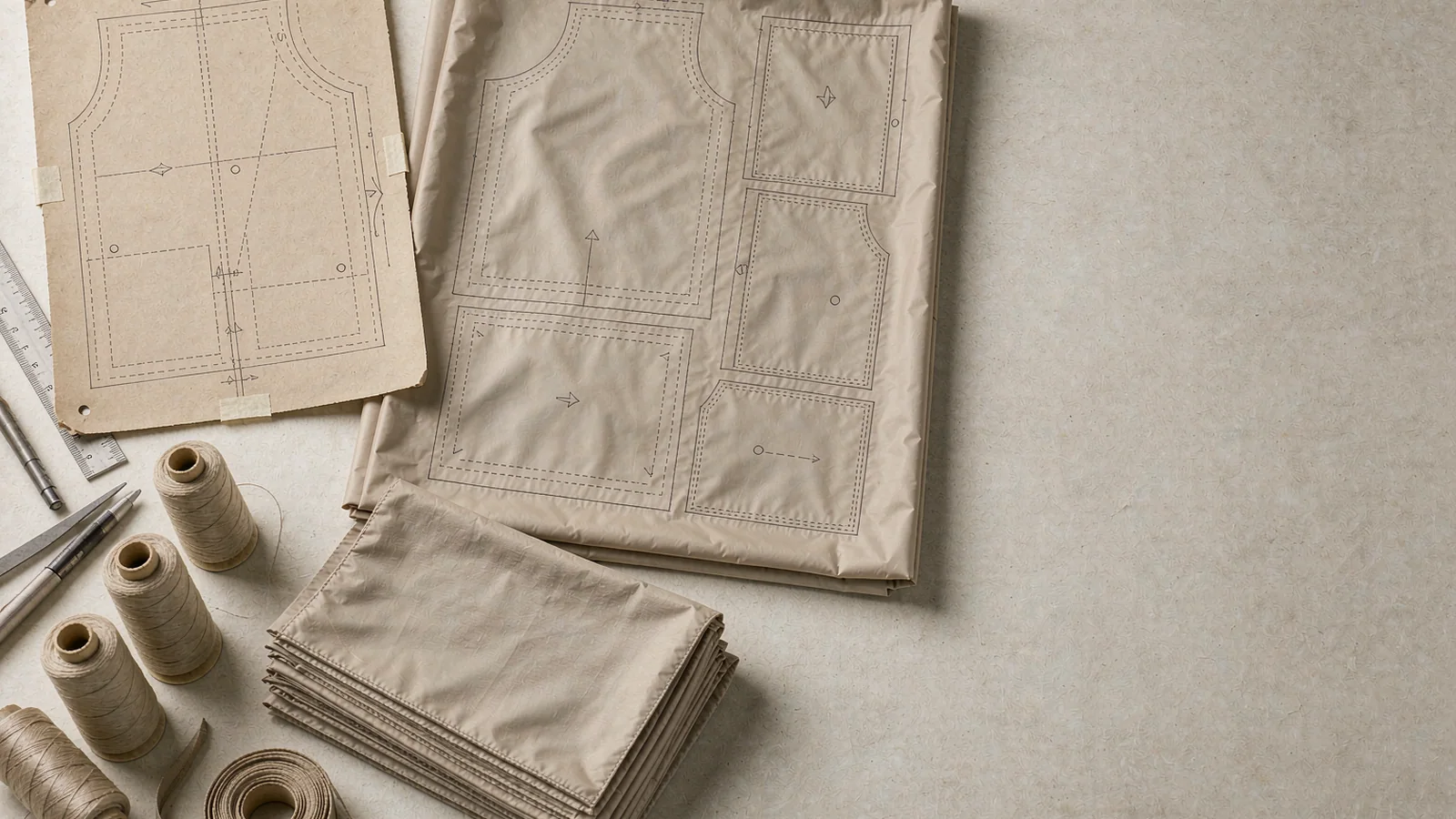
Cosmetic bag manufacturing begins long before a blade touches cloth. It begins with a written specification, usually called a tech pack, that converts a brand idea into values a production floor can be held to. A cosmetic bag, makeup pouch or vanity case is a sewn soft-goods product: shaped fabric panels, a lining, a closure that is almost always a zipper, and a set of small components - pullers, binding tape, elastic loops, labels, sometimes an interlining, a mirror panel or a hanging hook. Every one of those elements can be specified tightly or left open, and anything left open will be resolved by whoever is cutting and sewing that week, in the direction of speed and material availability rather than brand intent.
The most common failure in a first programme is not a bad production partner; it is a thin specification. A buyer who approves a physical sample without a written spec has approved one object, not a standard. The next lot is cut from the same pattern file but a different fabric roll, closed with a zipper from a different batch, and lined by an operator who folds the base differently. When the shipment lands with a 1 cm dimensional difference and a lining that twists at the base, no document exists that establishes which party was wrong. Specification writing is the cheapest quality control available to a brand owner, and it costs nothing but attention.
What the specification must fix
| Specification field | Tightly specified (recommended) | Left open (typical consequence) |
|---|---|---|
| Finished dimensions | Length, width and depth in cm with an explicit tolerance, e.g. 22 x 14 x 9 cm, +/- 0.5 cm | The nearest existing pattern is used; dimensional drift appears between reorders |
| Shell fabric | Fibre, denier, weave, coating type and fabric mass in g/m2 | Substitution to a cheaper denier changes abrasion life and print fidelity |
| Lining | Fibre, denier, colour, and whether it is loose or bonded to the shell | Lining twist and bunching at the base of the pouch |
| Zipper and hardware | Type, gauge, tape width, slider and puller style, finish, and any named brand | Zipper misalignment and puller mismatch against the approved sample |
| Thread | Fibre and ticket number, e.g. polyester T40, matched or contrast | Seam strength falls and the stitch shade reads wrong after washing |
| Decoration | Vector artwork, method, placement coordinates from a named datum, colour standard | Registration drift and logo position variance across the run |
| Labelling and packing | Label content, placement, polybag specification, carton count and carton markings | Retailer chargebacks and repacking at the destination warehouse |
| Compliance documentation | Named test standards, scope and report validity dates | Test reports that do not match the construction actually shipped |
Placement coordinates are the second most common gap. Logo centred on the front panel is not a specification; it is a hope. A usable instruction names a datum - 45 mm below the top edge, centred across the panel width, +/- 3 mm - and states the artwork size, the colour reference and the decoration method. The same discipline applies to care labels, brand labels and barcode stickers: each needs a position, an orientation and a tolerance, because each is applied by a person or a jig that will otherwise drift over a shift.
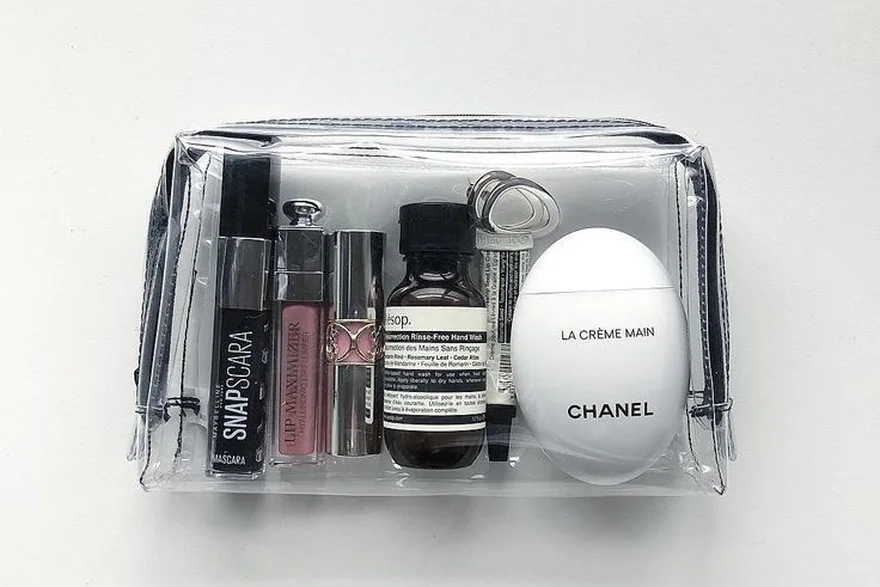
Volume and end use should be settled at the same time, because they set the pattern. A brush roll needs internal dividers before the panels are cut; a hanging toiletry case needs a load path strong enough to carry a full bag on a hook. If the programme is a clear toiletry bag intended for cabin baggage, the envelope is not a matter of taste - the TSA 3-1-1 liquids rule sets the bag at roughly one quart (about 946 ml) and containers at 100 ml, so the specification should be dimensioned around a bag that genuinely closes over a set of 100 ml bottles rather than one that only looks right empty.
- Fix dimensions with a tolerance - a size without a tolerance is unenforceable at inspection.
- Fix the fabric by construction, not by name - a trade name can be substituted; 600D polyester with a PU coating cannot.
- Fix the closure completely - zipper type, gauge, tape colour, slider finish and puller drawing.
- Fix every decoration placement from a named datum, in millimetres, with a colour standard.
- Fix the packing specification - units per polybag, pieces per carton, carton construction and markings.
- Fix the test method for each claim, so that a pass or fail can be judged objectively.
Sampling is where the specification gets tested against reality. The sample that comes back is a proposal, not a contract: it shows what the pattern file produces with one roll of fabric and one operator. Buyers should measure the returned sample against the written spec rather than against a mental image, and record the measurements, because that record becomes the reference for bulk. Once approved in writing, the sample should be sealed as a golden sample with a date and version number, and the specification frozen at the same version so that later changes trace to a decision rather than to a misunderstanding.
Step 2: Pattern Making, Grading and Marker Planning
Pattern making turns dimensions into flat shapes that can be cut and sewn. For a simple cosmetic pouch the pattern set is small - a front panel, a back panel, a gusset or base strip, lining panels, a binding strip and perhaps a pocket panel - but every piece in it carries decisions that show up in the finished bag. Seam allowance is the first: 1 cm is the usual convention on synthetic soft goods, rising to 1.5 cm on canvas and on any seam that will be turned and topstitched, while binding may consume a further 8-12 mm of edge. If the allowance is not stated, the maker chooses it, and a reorder from a rebuilt pattern will not match the first lot.
Notches, drill marks and grain lines are the second set of decisions. Notches tell the sewing operator where panels align; drill marks locate zipper ends, pocket openings and label positions; grain lines stop a panel from being cut on the bias, which would let a rectangular pouch skew into a parallelogram after filling. A cosmetic bag that looks square empty and leans when packed is usually a grain-line or notch problem, not a fabric problem. Buyers should ask which of these marks exist on the pattern, because a pattern without them produces bags that depend entirely on operator skill.
Marker planning and fabric consumption
A marker is the layout of every pattern piece across the usable fabric width, typically 150 cm for woven polyester, and it determines how much cloth each bag consumes. Nesting is the art of fitting those pieces together with minimum waste. Three constraints limit it. Grain line restricts rotation, so panels cannot simply be turned to fit. Directional prints, nap and pile force every piece to face the same way, which raises consumption sharply. Pattern repeat matching forces stripes, checks and large motifs to line up across panels, which adds a further allowance and is one of the quietest cost drivers in cosmetic bag manufacturing. A buyer who specifies a matched check should expect to pay for the extra cloth.
| Approach | Marker and yield behaviour | Reorder consistency | Where it breaks down |
|---|---|---|---|
| Hand-drafted pattern traced from a physical sample | Marker built by eye; off-cuts vary widely from one marker to the next | Rebuilt for each reorder, so finished dimensions wander over time | Any programme that must match a previous shipment |
| CAD pattern with stored grade rules | Nesting is repeatable; consumption can be quoted per piece with confidence | The same versioned file is reused, so dimensions stay stable across reorders | Up-front time to build and approve the digital file |
| Automated nesting software on a CAD marker | Highest utilisation and an optimised cutting path | File-driven; marker changes are logged and versioned | Only as good as the digitised pattern it starts from |
| Card template markers used by hand | Low utilisation on shaped panels and rounded corners | Templates wear, flex and distort with repeated use | Directional, striped or repeat-matched fabrics |
Consumption is the number a buyer should ask for, because it converts a fabric price into a unit cost. A partner quoting fabric by the metre but not stating consumption per piece has left the most important figure unpriced. Buyers should also ask what happens to off-cuts: on a 500-piece minimum they are usually too small to be useful, but on a multi-thousand-piece run the cumulative waste is real money, and the policy for it belongs in the commercial terms rather than in a conversation.
- Ask for the pattern piece list and the seam allowance used on each seam type.
- Ask for the marker consumption per piece in metres, plus the waste allowance assumed.
- Confirm the grain line and the notch positions on panels that must align, especially zipper ends.
- Confirm whether repeat or stripe matching is required, and price the extra consumption before approving.
- Require the pattern file to carry a version number that matches the approved sample version.
The final output of this stage is a cut plan: how many plies are laid, how many bundles are produced, and how each bundle is numbered and ticketed. Numbering matters more than it sounds. Panels are cut in stacks, and a bundle carries pieces from one position in the lay. If bundles from different rolls or different shade groups are mixed during assembly, the finished bags in one carton will not match each other. A disciplined floor keeps bundle numbers together through sewing and into the carton; a buyer visiting a line can test this simply by checking whether bundle tickets are still attached at the packing table.
Step 3: Material Procurement, Incoming Inspection and Cutting
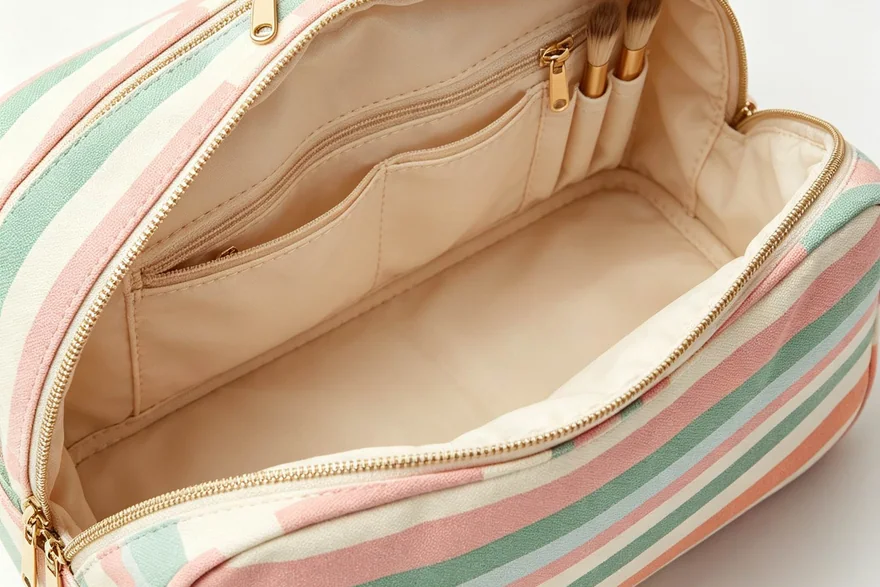
Material procurement is where most of the calendar disappears. Shell fabric, lining, interlining, binding tape, zippers, pullers, elastic, labels and polybags all have different suppliers and lead times, and the longest of them sets the start date for the whole programme. Stock colours in 420D or 600D polyester can often be drawn quickly, while a dyed-to-order shade means a laboratory dip, an approval, and a mill minimum measured in hundreds of metres per colour. A buyer working to a launch date should ask at quotation stage which components are stock and which are made to order, because that answer moves the date more than any sewing decision.
Incoming inspection is the checkpoint that protects the run before it starts. Fabric arriving at the cutting room should be checked for roll width against the marker width, fabric mass in g/m2 against the specification, roll length against the invoice, and shade against the approved standard under controlled lighting. Coated fabrics need a check of coating adhesion and hand, because a coating that cracks on the fold will not show itself until the bag is assembled. Rolls that fall outside the agreed shade band should be quarantined and, if used at all, blocked into a separate shade group so that no single carton contains two shades. Shade variation between panels of one bag is the dispute that costs the most time to resolve after shipment.
Documentation should be requested at the same time as the goods, not after. Coated and laminated fabrics are commonly assessed against methods such as ASTM D751 for coated fabrics, while chemical compliance is usually evidenced through OEKO-TEX Standard 100 certification of the fabric and through supplier declarations against EU REACH restricted-substance requirements. Where a recycled content claim is being made on the label, the chain of custody matters as much as the fabric: buyers should ask for a transaction certificate under a recognised scheme such as the Global Recycled Standard, because a recycled claim without documentation is a liability rather than a selling point.
Cutting: methods and what each does to the edge
Cutting method is not a detail. It determines what the edge looks like, whether that edge will fray, whether panels are identical to each other, and how much of the marker can actually be used. The five methods below cover almost every cosmetic bag programme, and a buyer should know which one a quotation assumes, because moving from one to another changes both price and appearance.
| Cutting method | Edge it leaves | Repeatability | Best suited to | Watch-outs |
|---|---|---|---|---|
| Clicker press with a steel die | Compressed, clean edge that resists fraying on most synthetics | High and die-controlled | Repeat panels at volume and straight-sided shapes | Die cost and die lead time, one die per size |
| Laser cutting | Heat-sealed edge on polyester, which removes the need for binding on some panels | Very high and file-driven | Intricate shapes, internal notches, sampling before a die exists | Scorch marks on light colours and fumes requiring extraction |
| Straight-knife or band-knife cutting | Raw edge that frays unless bound or overlocked | Moderate and operator-dependent | Thick lays, canvas, foam laminate and multi-ply spreads | Blade deflection causes top-to-bottom drift in tall lays |
| Rotary cutter or shears | Raw edge | Low | Single-ply sampling, repairs and one-off prototypes | Not viable for bulk consistency |
| Ultrasonic cutting | Sealed edge with a small fused bead | High | Synthetic tapes, webbing and binding cut to length | Bead thickness and a stiffer hand at the cut edge |
The edge behaviour drives downstream construction. A laser-sealed polyester edge may allow a clean, unlined interior panel with no binding, which saves an operation and reduces bulk at the seam; the same panel cut with a knife needs a bound or overlocked edge or it will fray after a few weeks of use. Conversely, a sealed edge is stiffer, so on a bag that must fold flat or squash into a suitcase, the sealed edge may be the wrong choice. A buyer who has only ever seen the sample may not realise that the sample was cut by a different method from the bulk run, which is exactly the kind of change that should be prohibited without written approval.
Lay planning completes the cutting stage. Plies are spread at controlled tension, because fabric spread too tight will relax after cutting and shrink the panel, and fabric spread too loose will pucker. Rolled fabric benefits from a relaxation period before spreading. Lays are then blocked by shade group, cut, and reassembled into numbered bundles with a cutting ticket that identifies style, colourway, size and bundle count. Panels from different rolls must not be mixed within a bundle. It sounds administrative, but bundle discipline is the difference between a carton that opens consistently and a carton that looks like a sample sale.
- Require incoming inspection records: roll width, fabric mass, roll length and shade against the approved standard.
- Require off-shade rolls to be quarantined and blocked, not blended into the run.
- Confirm in writing which cutting method was used for the approved sample and which will be used for bulk.
- Confirm ply height and spreading tension control, especially on laminated and foam-backed materials.
- Confirm that bundle tickets survive to the packing table so panels from one roll stay together.
Step 4: Printing, Embroidery and Sub-Assembly - Decoration Applied Before the Line
Decoration is applied to flat panels before assembly for three practical reasons. Registration is easier on a flat piece than on a shaped bag; a misprint costs one panel instead of a finished bag; and the inside of a pouch is inaccessible once it has been closed and turned. The consequence for the buyer is that artwork approval has to happen early, because printing cannot wait until the line is ready, and printed panels then have to be handled and stored so that uncured ink is not damaged before assembly. A programme late on artwork approval is late on everything else.
Screen printing remains the workhorse for logos on cosmetic bags. Ink is forced through a mesh screen onto the panel, with mesh count controlling deposit thickness and detail. Plastisol sits on the surface and gives strong opacity on dark grounds; water-based inks penetrate more and feel softer but behave differently on coated fabrics. Cure temperature and dwell time determine whether the print survives a wash or cracks on a fold. Heat transfer and vinyl offer small runs and photographic detail but introduce a temperature ceiling, which is a problem on TPU and thin PVC. Dye sublimation gives full-colour prints on polyester with no hand feel at all, but only on polyester and only on a light ground.
| Decoration route | Applied at which stage | Substrate constraint | Defect that dominates |
|---|---|---|---|
| Screen print, plastisol | Flat panel, before assembly | Needs a stable low-stretch face fabric; coating affects adhesion | Ink build and cracking on fold lines, off-register on multi-colour work |
| Heat transfer or vinyl | Flat panel, occasionally a finished bag | Press temperature must sit below the substrate softening point | Edge lift after washing or after cold transit |
| Dye sublimation | Flat polyester panel | Polyester only, on a white or very light ground | Colour shift and ghosting when press dwell varies |
| Embroidery | Flat panel, before assembly | Needs backing; dense fill puckers light fabrics | Puckering, thread breaks and illegible small text |
| Woven or printed label | Inserted into a seam during sub-assembly | Label edge finish affects fray and next-to-skin comfort | Wrong content, wrong placement, or a skewed label |
| Emboss or deboss | Flat panel with a heated die | Only coated materials with a suitable melt range | Shallow or double-struck impressions |
Embroidery deserves its own note because it is the most frequently mis-specified decoration on a pouch. The design has to be digitised, and digitising is not a mechanical conversion: stitch direction, underlay, density and pull compensation all have to be set for the specific fabric. Too much density on a light lining-weight polyester produces a puckered panel that will never lie flat. Small text below roughly 5 mm in height tends to close up. A buyer should approve a physical embroidery strike-off on the actual production fabric, not a digital mock-up, and should keep that strike-off with the golden sample.
Colour fastness belongs in the specification as a method reference rather than an adjective. Colour fast is unenforceable; colour fastness to rubbing at a stated grade under a named method is enforceable. Buyers typically reference the ISO 105 series or the equivalent AATCC test methods, and should state which test applies to which claim: rubbing for a dark print on a light bag, washing for anything labelled washable, light fastness for a bag displayed in a window. Stating the method and the pass grade at specification stage removes the argument that always follows a faded shipment.
Sub-assembly: the stations before the main line
Sub-assembly is the set of operations that prepare parts before they reach the main sewing line: zippers set into panel edges or into a facing, binding applied to raw edges, pockets closed and topstitched, elastic loops cut and tacked, hanging hooks or D-rings attached to a reinforced tab, interlining fused or basted to a panel, and labels inserted. The two constructions that matter most for a cosmetic bag are the bound seam, where a tape encloses the raw edge and gives a clean interior, and the turned-and-topstitched seam, which is faster and flatter but depends entirely on accurate trimming. Which one a quotation assumes should be stated, because it changes both interior appearance and durability.
- Approve decoration on the production fabric, not on a substitute or a digital mock-up.
- State the colour standard and tolerance for each printed colour, not just the name of the shade.
- State the fastness method and pass grade for every colour claim.
- Confirm which seam construction the price assumes: bound, turned and topstitched, or overlocked.
- Confirm that reinforcement is specified at every load point: puller tab, hanging hook, handle and strap ends.
Step 5: Final Assembly, Line Balancing, Trimming, In-Line Inspection and Pack-Out
Final assembly is where prepared parts become a bag. The work is divided into stations, and line balancing is the exercise of giving each station an equal share of the total work so that no operator waits and none is overwhelmed. The balancing matters because the slowest station sets the output of the whole line. On a cosmetic bag the bottlenecks are usually zipper setting and closing, turning and shaping the bag right side out, and any operation that requires the operator to handle a three-dimensional object rather than a flat panel. A line that is balanced on paper but not in practice shows up as a pile of work in progress in front of one operator.
Two flow patterns are used. In bundle flow, bundles of maybe 10-25 panels move between stations, which is efficient on simple constructions but lets a defect travel through 25 pieces before anyone notices. In single-piece flow one unit moves at a time, which surfaces defects immediately but needs tighter station design. Either way, the buyer should specify stitch construction and density rather than leaving it to the operator: a stated value such as 8-10 stitches per inch on structural seams, the seam type, a back-tack or bar-tack at every start and stop, and reinforcement at stress points. Thread and needle size should also be specified, because a needle that is too large leaves visible holes in a coated fabric and one that is too small breaks.
The closure is the component most likely to generate a return. Zipper terminology is standardised, and buyers who use it get better quotations: gauge, tape width and material, coil or metal teeth, single or double slider, and the puller style are all described precisely in ASTM D2053 on zipper terminology. Specifying the puller drawing and finish matters as much as the tape, because a puller is the part a customer touches and the part most often substituted for a cheaper look-alike between the sample and the bulk run.
- Zipper is set into the shell panel or facing, with ends secured and stops positioned per the pattern notches.
- Lining panels are closed, leaving a turning opening of a stated length at the base or a side seam.
- Shell is closed, corners are boxed or shaped to the specified depth, and allowances are trimmed.
- Bag is turned right side out, corners are pushed out fully, and the shape is set, by pressing if the substrate allows it.
- The turning opening is closed, by topstitching or by an invisible stitch depending on the specification.
- Binding or topstitching is applied at the zipper edge and at any raw interior edge.
- Labels, care labels and any hardware such as a hanging hook or wrist strap are attached and checked.
- Thread tails are trimmed, the bag is brushed or vacuumed, and it moves to in-line inspection.
Trimming, thread management and in-line inspection
Trimming is the least glamorous and most visible operation in the whole process. Loose threads are the single most cited cosmetic complaint on a sewn bag, and nearly all of them originate here rather than at the sewing machine. A good trimming station cuts thread tails close to the seam, removes the little knots left at start and stop points, turns the bag inside out to remove the threads trapped in the lining, and then brushes or air-blows the bag before it is bagged. Buyers should require this explicitly; it is a labour cost, and labour costs are the first thing trimmed when a price is squeezed.
In-line inspection happens during production rather than after it. Three checkpoints are standard: a first-off approval, where the first units off the line are measured and compared with the golden sample; a patrol inspection, where a checker samples units at intervals through the run and records what is found; and an end-of-line check on function, where every zipper is run, every puller is tugged and every snap is opened and closed. Broken needles deserve a specific policy: a documented needle-change procedure with the fragments accounted for, because a broken needle fragment inside a soft-goods product is a safety matter rather than a cosmetic one.
Pack-out is the last chance to lose the order. The specification should state whether each bag is individually polybagged, whether it is stuffed with tissue to hold shape, whether a desiccant sachet is included, whether a barcode or UPC sticker is applied and where, how many pieces go into each export carton, the carton construction, the maximum carton weight, and the carton markings and shipping marks. Assorted colourways packed in one carton should be stated as an exact ratio rather than left to the packer. Where a bag is marketed to children, labelling obligations change: buyers should check the CPSIA requirements for tracking labels and substance limits before artwork is finalised.
- Specify stitch type and density, with back-tacks or bar-tacks at every seam start and stop.
- Specify thread and needle size, matched to the substrate and the fabric mass.
- Specify the zipper fully, including slider finish and puller drawing, using standard terminology.
- Require a documented broken-needle procedure with fragments accounted for.
- Require trimming, turning and cleaning as named operations, not as an assumption.
- Specify polybag, stuffing, desiccant, barcode placement, pieces per carton, carton grade and markings.
Step 6: Quality Control: AQL 2.5 Under ISO 2859-1, Defect Classes, Pre-Shipment Inspection and Lead-Time Governance
Acceptance sampling is how a buyer decides whether a finished lot is good enough to ship without inspecting every piece. The method used across sewn soft goods is AQL, defined in ISO 2859-1 sampling procedures, and the level normally set for major defects on a bag programme is AQL 2.5. Two ideas underpin it. AQL is a process average, not a guarantee about any single carton: it describes the worst level tolerable as a running average across lots. And the sample is drawn at random from the lot as a whole, so the lot must be packed before inspection starts; inspecting a partial lot is not AQL.
The mechanics are simple once the vocabulary is clear. The lot size gives a sample-size code letter under the chosen general inspection level, Level II being the default; the code letter gives the sample size, and the AQL gives the accept and reject numbers: at or below accept the lot passes, at or above reject it fails. ISO 2859-1 also has switching rules - normal is the starting point, tightened applies after a poor run, reduced may follow a sustained good one. Critical defects are handled separately, at zero tolerance.
| Lot size (pieces) | Code letter | Sample size | AQL 2.5 accept / reject | AQL 1.0 accept / reject |
|---|---|---|---|---|
| 151 - 280 | G | 32 | 2 / 3 | 1 / 2 |
| 281 - 500 | H | 50 | 3 / 4 | 1 / 2 |
| 501 - 1,200 | J | 80 | 5 / 6 | 2 / 3 |
| 1,201 - 3,200 | K | 125 | 7 / 8 | 3 / 4 |
| 3,201 - 10,000 | L | 200 | 10 / 11 | 5 / 6 |
| 10,001 - 35,000 | M | 315 | 14 / 15 | 7 / 8 |
| 35,001 - 150,000 | N | 500 | 21 / 22 | 10 / 11 |
Read it practically. A 3,000-piece cosmetic bag order sits in the 1,201-3,200 band, so the inspector draws 125 pieces at random against the specification and the golden sample: up to 7 major defects and the lot passes, 8 or more and it fails. A failed lot is not scrap - the dispositions are a full sort with re-inspection, a rework, or rejection. The buyer should state who pays for sorting and re-inspection, and what happens to the delivery date when a lot fails.
Defect classes specific to cosmetic bags
- Critical - could cause injury or breach a legal requirement: a broken needle fragment, a sharp or detachable small part, a banned substance, a missing tracking label. Zero tolerance; one critical defect fails the lot regardless of AQL.
- Major - a customer would notice it and reject the bag: skipped stitches on a structural seam, a zipper that will not close, print outside registration, shade difference visible at arm's length, a dimension outside tolerance.
- Minor - does not affect use: a loose thread under a stated length, a mark that wipes off, slight asymmetry within tolerance, a label a few millimetres off position.
- Skipped stitches - a gap in a seam line from needle timing or thread tension. Major on a structural seam.
- Shade variation - colour difference between panels, shell and lining, or bags in one carton. Major if visible at arm's length.
- Print registration - one colour of a multi-colour logo sitting outside position. Major if the logo reads wrongly.
- Zipper misalignment - tape not parallel to the panel edge, a wavy line or uneven ends. Major.
- Lining twist - the lining rotated inside the shell so the base bunches. Major when it affects use.
- Loose threads - tails left at seams or trapped in the lining. Minor under a stated length such as 10 mm.
- Dirty marks - handling soil, ink or glue residue. Major if it does not wipe off; minor if it does.
- Dimensional drift - a measurement outside tolerance. Major; a trend points to marker or pattern version.
That classification belongs in the buyer's written inspection criteria rather than in the inspector's judgement on the day: the major-versus-minor call decides whether a lot ships or is sorted again at someone's cost, so it should be agreed before inspection rather than argued afterwards.
A pre-shipment inspection report is only useful if it contains the evidence a buyer would need to argue with it. The minimum set is: lot identity and quantity; the sampling basis, citing ISO 2859-1 and the inspection level; code letter, sample size and accept and reject numbers; a defect log with each finding classified and photographed; a measurement sheet with tolerance and measured values; a zipper function check; a packing check on carton count and markings; a shade assessment against the golden sample; and a pass, fail or hold recommendation, signed and dated.
Lead-time drivers and programme governance
Bulk lead time on a programme of this type is quoted as 35-50 days after sample approval, and most of that is material waiting rather than sewing. The drivers are dyed-to-order fabric against stock colour, hardware made to a custom puller or finish, tooling for dies and screens, artwork approvals on the buyer's side, laboratory testing turnaround, and public holidays that stop suppliers and sewing lines at different times. Two decisions shorten the critical path most: approving artwork early, and confirming hardware orders alongside the fabric.
The figures published for the programmes coordinated by QUANZHOU JUNYUAN BAGS are 4,950 m2 of SGS-verified production floor, 137 colleagues, 7 production lines, 149 machines and 200,000 pieces per month: a scheduling question for a buyer, read alongside the 500-piece minimum per style and colourway.
Governance keeps a reorder as clean as the first shipment. Four habits do the work: retain a sealed golden sample with a version number on both sides; freeze the specification at sample approval and route changes through written change control; hold a pre-production meeting so pattern version, shade standard, cutting method and packing spec are confirmed in one document; and keep the previous lot's findings.
The B2B Customisation View
Cost, compliance and craft pull against each other on every cosmetic pouches, vanity cases and beauty organisers project; the specification is the record of how those three forces were balanced.
Commercial parameters stay fixed across the range: MOQ 500 pieces per style and colourway, prototype turnaround 6–10 working days (extended to 12–15 for multi-panel or moulded builds), bulk lead time 35–50 days from approved sample, AQL 2.5 inspection to ISO 2859-1, FOB Xiamen, T/T 30 deposit and 70 against bill of lading.
Buyers who use a programme coordinator keep their own supply-chain optionality; the technical pack travels, so production can be re-placed if a launch is brought forward.
Which Brand Types This Guide Serves
This guide is written for anyone who has to specify, approve or pay for a sewn cosmetic bag programme, and the parts that matter differ by buyer type. What is common to all of them is that the process steps are identical whether the bag sells for a few dollars or for forty: the brief is written, the pattern is built, the material is booked and inspected, the panels are cut, decoration goes on flat, the bag is assembled, threads are trimmed, and the lot is sampled against an acceptance standard. The difference between buyer types is where they feel the pain, and therefore which clause in the specification deserves the most attention.
- Start-up beauty brands - usually working to a launch date with one shot at a first impression. The risk is specification thinness, so the priority is a complete tech pack, an approved golden sample and a decoration strike-off on production fabric before bulk starts.
- Established brands and private-label owners - usually reordering across seasons. The risk is drift, so the priority is a versioned pattern file, a retained golden sample from each season, and a written change-control procedure that covers fabric, hardware and printing substitutions.
- Retailers and catalogue buyers - answerable to a compliance team and a planogram. The risk is documentation mismatch, so the priority is test reports that match the shipped construction, carton markings and barcodes that scan, and dimensional tolerance that keeps the bag on the fixture.
- E-commerce and marketplace sellers - judged on returns and reviews. The risk is the defect that reaches a customer, so the priority is trimming and cleaning standards, zipper function checks and a packing specification that survives parcel handling.
- Gift, promotional and hospitality buyers - buying to a deadline and a unit price. The risk is a late artwork approval compressing the material booking window, so the priority is early sign-off on colour, logo placement and hardware.
- Travel and toiletry specialists - selling function. The risk is a bag that does not do the job, so the priority is volume verification against the actual contents, load paths on hanging hooks, and wipe-clean performance of linings and coatings.
Whichever category a buyer falls into, the same three documents decide the outcome: a specification with tolerances, a golden sample with a version number, and an inspection report that states its sampling basis. Programmes with all three tend to resolve disagreements in an afternoon. Programmes without them tend to resolve them in a season, by which point the reorder is already late.
Frequently Asked Questions
At what point in cosmetic bag manufacturing should printing be applied - before or after assembly?
Decoration is applied to flat panels before assembly in almost every programme. Registration is far easier on a flat piece than on a shaped bag, a misprint costs one panel rather than a finished unit, and the interior of a pouch is inaccessible once it has been closed and turned. The practical consequence is that artwork approval sits on the critical path: printing cannot wait for the sewing line, so a late artwork sign-off delays the whole order. Buyers should also specify how printed panels are stored before assembly, because ink that is not fully cured will mark under stacking.
Why does shade variation appear in bulk cosmetic bags when the approved sample was correct?
Because the sample was made from one roll and the bulk run uses many. Dye lots vary, and the variation is usually invisible roll to roll but visible when panels from two rolls end up in one bag. The causes are mixed bundles at the cutting table, a shade band that was never agreed, or a lining booked against a different standard from the shell. Prevention is a written shade standard, an incoming inspection that quarantines off-shade rolls, and bundle tickets that survive to the packing table so panels from a single roll stay together.
What sample size does AQL 2.5 require on a 3,000-piece makeup bag order?
A lot of 3,000 pieces falls in the 1,201-3,200 band, which gives sample size code letter K under General Inspection Level II and a sample of 125 pieces. At AQL 2.5 the accept and reject numbers are 7 and 8: seven or fewer major defects and the lot passes, eight or more and it fails. The sample must be drawn at random across the whole lot once it is packed, and critical defects are treated separately with zero tolerance regardless of the count of majors.
Can a critical defect ever be accepted at AQL 2.5?
No. Critical defects are handled outside the AQL arithmetic. A critical defect is one that could cause injury or that breaches a legal requirement: a broken needle fragment left in the bag, a sharp or detachable small component, a banned substance above the limit, or a missing tracking label where one is required. A single confirmed critical defect normally fails the lot outright. Buyers should state this explicitly in their inspection criteria so that it does not depend on the inspector's interpretation on the day.
How are skipped stitches classified on a cosmetic bag, and what stitch density should be specified?
A skipped stitch on a structural seam - the base, the zipper seam or a handle attachment - is a major defect, because the seam can open in use. The same defect on a decorative topstitch that does not carry load may be classified minor if it is short and does not unravel. Buyers should not rely on that distinction being made for them: specify stitch type, stitch density such as 8-10 stitches per inch on structural seams, a back-tack or bar-tack at every start and stop, and the classification you expect for each seam type.
What causes lining twist in a cosmetic pouch, and how is it prevented in production?
Lining twist happens when the lining is not aligned to the shell before the closing seam is sewn, so the interior rotates and the base bunches instead of sitting flat. It is a closing-operation issue rather than a cutting issue. Prevention is accurate notches on the pattern at the base centre and at the side seams, an alignment step written into the station instructions, and a first-off check that measures the lining against the shell before the run continues. Once twisted, the bag can rarely be corrected without unpicking the closing seam.
What must a pre-shipment inspection report contain for a cosmetic bag programme?
It should state the lot identity and quantity, the sampling standard and level used, the code letter, sample size and accept and reject numbers applied, and the percentage of the order packed at the time of inspection. It should include a defect log with each finding classified and photographed, a measurement sheet showing specified value, tolerance and measured values, a function check on zippers and closures, a packing check covering carton count, markings and weight, and a shade assessment against the golden sample. It should end with a pass, fail or hold recommendation, signed and dated.
How does a buyer stop zipper misalignment recurring between reorders?
By specifying the closure completely and keeping the specification with the order rather than with the sample. Name the type, gauge, tape width and material, the slider finish, and attach a drawing of the puller, because the puller is the part most often substituted for a cheaper look-alike. Use standard terminology so the description is unambiguous. Then require notch marks at the zipper ends on the pattern, and a first-off approval that checks the zipper line against the panel edge before the run continues. Retain the approved hardware as part of the golden sample.
Why do different cutting methods change how the same fabric behaves at the edge?
Because the edge is a thermal or mechanical event, not just a separation. A laser melts the cut edge of polyester and seals it, which removes the need for binding on some panels but stiffens the edge and can scorch light colours. A steel die compresses the edge cleanly with no heat. A straight knife leaves a raw edge that will fray unless it is bound or overlocked. If the sample was cut by laser and bulk is cut by die, the interior appearance and the hand of the bag will differ, which is why the cutting method belongs in the approved specification.
What dimensional tolerance should be specified on a custom cosmetic bag?
A tolerance of +/- 0.5 cm on length, width and depth is a reasonable working figure for a soft-goods bag of typical size, with a tighter figure such as +/- 0.3 cm where the bag must fit a fixture, a gift box or a planogram slot. The tolerance matters more than the nominal size, because a size without a tolerance cannot be enforced at inspection. Buyers should also state where the bag is measured - flat, empty, at the base - since a measurement taken at a stuffed corner can differ by more than a centimetre from one taken flat.
How long does sampling take, and what drives a second sample round?
Sampling runs 6-10 working days for a straightforward construction and 12-15 working days where the build is complex, for example a hanging case with multiple compartments or a moulded EVA shell. A second round is usually triggered by one of four things: an incomplete specification, a fabric that is not available in the requested colour, a decoration method that does not reproduce the artwork, or a change of mind on dimensions after the first sample is seen. The first three are preventable with a complete tech pack.
What actually drives bulk lead time beyond the quoted 35-50 days?
Most of the calendar is material waiting rather than sewing. Dyed-to-order fabric takes longer than stock colour; custom pullers, sliders and finishes have their own lead times; dies, screens and embossing plates have to be made; laboratory testing adds report turnaround; and public holidays can stop a material supplier and a sewing line at different times. The two decisions that shorten the critical path most are approving artwork early and confirming hardware orders at the same time as the fabric rather than afterwards.
Should a buyer specify thread and needle, or leave them to the production partner?
Specify both. Thread fibre and ticket number determine seam strength and how the stitch reads after washing, and leaving it open invites a substitution that is invisible on the sample and visible after a wash. Needle size matters because a needle that is too large leaves permanent holes in a coated fabric and one that is too small breaks or shreds the thread. A buyer does not need to know the right answer, only to require that the answer be stated, recorded against the sample version, and not changed without written approval.
What is a golden sample, and who should hold it during a production programme?
A golden sample is the approved physical reference for a style, sealed, dated and given a version number. It is what an inspector compares a production unit against when the specification is ambiguous. Both sides should hold one: the brand owner needs it to judge a shipment, and the production floor needs it to set up the line and to approve the first-off unit. A golden sample without a version number is a liability, because no one can then prove which revision it represents or which specification it was approved against.
People Also Ask
How are cosmetic bags made?
A cosmetic bag is made as a sewn soft-goods product in a fixed sequence: a written specification, a pattern and marker, material procurement with incoming inspection, cutting by die, laser or knife, printing and embroidery applied to flat panels, sub-assembly of zippers, pockets and labels, final assembly on a balanced line, trimming and cleaning, in-line inspection, pack-out, and pre-shipment inspection by acceptance sampling. Each stage creates its own defect family, which is why buyers specify tolerances rather than only approving a sample.
What is AQL 2.5 in bag manufacturing?
AQL 2.5 is an acceptance sampling level from ISO 2859-1, normally applied to major defects on a sewn bag programme. The lot size determines a sample size, and the AQL determines how many defects are tolerated in that sample. On a 2,000-piece lot the sample is 125 pieces, with 7 accepts and 8 rejects. It describes a tolerable process average across a series of lots, not a guarantee about any individual carton, and critical defects are excluded from it entirely.
What is the lead time for custom makeup bag production?
Sampling takes 6-10 working days, or 12-15 working days for complex constructions, and bulk production takes 35-50 days after sample approval. Most of the bulk window is material waiting rather than sewing: dyed-to-order fabric, custom hardware and pullers, tooling for dies and screens, laboratory testing, and holiday shutdowns. Approving artwork early and booking hardware at the same time as the fabric are the two decisions that most reliably shorten the schedule.
What defects are common in cosmetic bag production?
The recurring families are skipped stitches, shade variation between panels or between bags, print registration errors, zipper misalignment, lining twist, loose threads, dirty marks and dimensional drift. Each traces back to a station - the closing machine, the cutting table, the screen, the setting jig or the trimming bench - and each is classified as critical, major or minor. That is why a written defect classification with tolerances is more useful than a general request for good quality.
How do you check the quality of a makeup bag before shipping?
Draw a random sample from the fully packed lot under ISO 2859-1 at the agreed level, inspect each unit against the specification and the golden sample, classify every finding as critical, major or minor, measure dimensions against the stated tolerance, run every zipper and closure, and check carton count, markings and weight. Then require a written report showing the sample size, the accept and reject numbers applied, a photographed defect log and a pass or fail recommendation.
References & Standards
- ISO 2859-1 sampling procedures for inspection by attributes
- ASTM D2053 standard terminology relating to zippers
- AATCC TM61 colour fastness to laundering
- IEC 62321 determination of certain substances in electrotechnical products
- OEKO-TEX Standard 100 testing for harmful substances
- Textile Exchange Global Recycled Standard
- US CPSC CPSIA consumer product safety improvement act
- ECHA REACH regulation on chemicals
- TSA 3-1-1 liquids rule for carry-on baggage
- ASTM D751 standard test methods for coated fabrics
- ISO 105 textiles tests for colour fastness
- Global Organic Textile Standard GOTS
In-Depth Articles in This Category
19 dedicated articles sit under this pillar guide.
Related Pillar Guides
Request a Sample or a Written Quotation
Send the silhouette, dimensions, material preference and logo artwork, and the programme team will return a written quotation with MOQ, sampling window, bulk lead time and inspection standard.
Email: [email protected] · WhatsApp: +86 177 5002 0688