Frequently Asked Questions: Private Label & Branding Cosmetic Bags (16 Q&A)
Executive Summary
Private label on a cosmetic bag covers the brand identity applied to the product, not the product itself, and the distinction decides who is responsible for what. A private label programme typically includes the main label or logo application, any care or content label required by the destination market, a hangtag or belly band, retail packaging, and the artwork that carries the brand onto each of those. Artwork and design files supplied by the brand owner remain the property of the brand owner. Trademark clearance is squarely the buyer's responsibility, because only the buyer knows which marks are cleared in which territories.
The commercial shape of a private label order is set by trim. The bag itself runs on a 500-piece minimum per style and colourway, but custom woven labels, printed hangtags, branded zipper pullers and bespoke packaging each carry their own minimum and their own lead time, and those are frequently larger than the bag minimum. Sampling takes 6-10 working days, or 12-15 for complex constructions, and bulk production runs 35-50 days after approval. Deciding which trim is custom and which is stock is therefore a budget decision before it is a design decision.
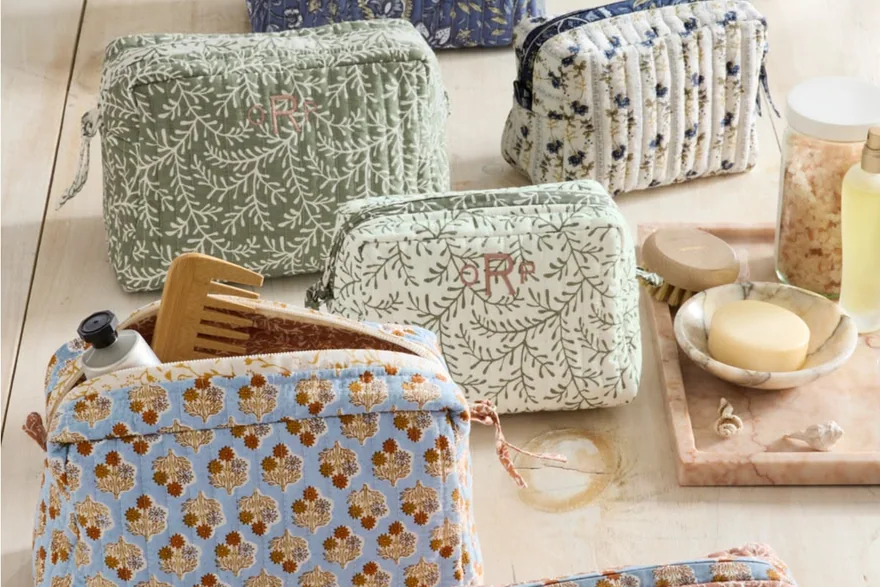
What private label actually covers on a cosmetic bag
Private label is one of the most loosely used terms in this category, and the looseness causes disputes later. In a bag programme it means that the product is built to an existing or adapted construction and the brand identity is applied to it, as opposed to a fully bespoke development where the construction itself is new. The label, the hangtag, the packaging and the logo application are private label elements. The shell fabric, the lining and the hardware may or may not be exclusive, and saying so plainly in the specification avoids the assumption that private label implies exclusivity of the whole design.
The scope should be written as a list rather than implied. A typical scope covers: the primary brand mark applied to the shell or to a label; a secondary label carrying fibre content, care instructions and country of origin as required by the destination; a hangtag or a printed belly band; the individual polybag or gift box; and the artwork files used to produce all of the above. Anything not on the list, such as a barcode, an insert card, a dust bag, a retail display unit or a documentation pack for a sustainability claim, has to be negotiated and costed separately.
Sustainability documentation is a frequent addition and it is worth deciding early, because certified trim has a longer lead time than stock trim. A brand that wants to state recycled content on the hangtag generally needs fabric certified to a recognised standard such as the Global Recycled Standard, and a brand claiming organic fibre content needs a chain-of-custody standard such as GOTS. Both require transaction documentation that travels with the order, which means the claim has to be declared at the specification stage rather than added to the artwork later.
Branding elements, and the order minimums each one carries
The bag and the trim have different economics, and confusing them is the most common cause of a first-order budget overrun. A bag runs on a 500-piece minimum per style and colourway. A custom woven label is made on a loom setup that is typically priced per design rather than per piece, so the supplier's minimum is often expressed in thousands of pieces and the unit cost falls steeply with quantity. The result is that a brand ordering 500 bags may be asked to buy 2,000 or 5,000 labels, and the surplus has to be stored or written off.
| Branding element | How it is made | Typical minimum pattern | Effect on lead time |
|---|---|---|---|
| Woven brand label | Woven on a jacquard loom, cut and folded | Priced per loom setup; often 1,000-5,000 pieces | Adds days before bulk if the design is new |
| Printed satin or care label | Printed on tape, cut to length | Lower setup cost than woven; shorter runs feasible | Short, often available within the sampling window |
| Hangtag or belly band | Printed on card, with string or adhesive | Print setup per artwork; commonly 1,000 pieces and up | Adds a print approval step alongside sampling |
| Branded zipper puller | Moulded or cast with the logo, or laser-engraved | Tooling charge plus a per-piece minimum by style | Tooling adds weeks; the longest single addition |
| Custom polybag or gift box | Printed film or board, made to bag dimensions | Print setup plus a carton-based minimum | Adds a print approval step and packing time |
| Debossed or embossed patch | Pressed or moulded PU, PVC or metal plate | Tool or die charge plus per-piece minimum | Tooling adds weeks, comparable to puller tooling |
The sensible strategy for a first programme is to decide which elements genuinely need to be custom and which can be stock. A stock black woven label with a custom printed care label reads as branded at a fraction of the setup cost of a bespoke woven design. A standard puller with a branded hangtag looks intentional. Conversely, a moulded zipper puller carrying a logo is one of the most visible and most tactile brand signals on a cosmetic bag, and for a brand positioning at a premium price point it is often worth the tooling charge and the extra weeks.
Colourway arithmetic compounds the issue. Because the bag minimum applies per style and colourway, a brand launching three colourways needs 500 pieces of each, and any trim that is colour-matched to the shell multiplies accordingly: a beige label for the beige bag, a black label for the black bag. Specifying one neutral trim colour across all colourways is the simplest way to keep both the trim minimum and the risk of surplus under control, and it usually reads as a deliberate design decision rather than a compromise.
- Decide custom versus stock trim per element, not as a single yes or no.
- Ask for the trim minimum separately from the bag minimum before budgeting.
- Neutralise trim colour across colourways where the design allows it.
- Budget the tooling charge separately, since it is not amortised into unit price on a first order.
- Plan storage for surplus trim, or negotiate to have it held against the next order.
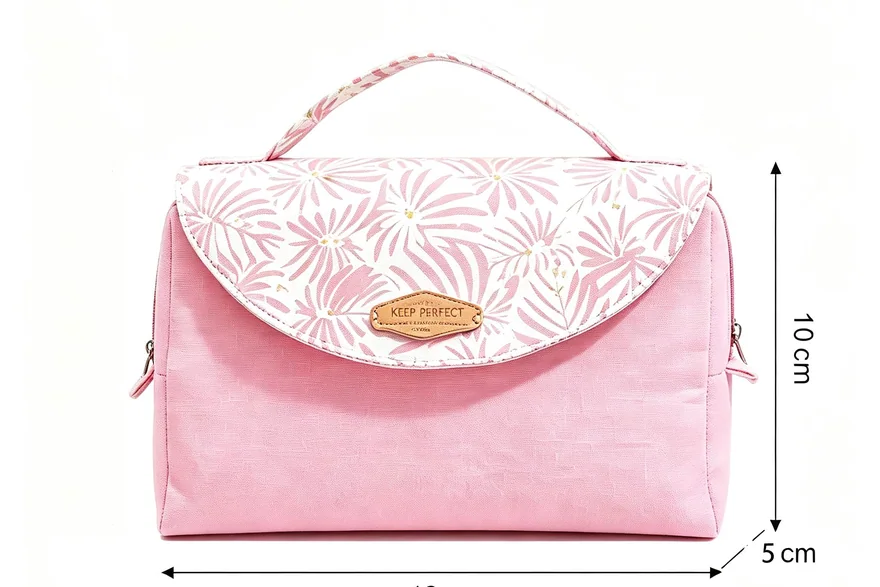
Choosing a decoration method for the brand mark
The decoration method is constrained by the shell fabric first and by the artwork second. Sublimation only works on high-polyester content and produces no surface film, so the hand of the cloth is unchanged and the print will not crack, but the colour range is limited to heat-transferable dyes and whites cannot be printed. Screen printing deposits an ink layer that can reproduce spot colours including white, but it stiffens the panel and will crack if it spans a fold line. Heat transfer sits between the two and suits photographic or gradient artwork.
- Sublimation: polyester-rich shells, all-over patterns, no cracking, no white ink.
- Screen print: spot colours and white, works on most shells, avoid printing across folds.
- Heat transfer: gradients and photographic art, moderate hand change, temperature sensitive.
- Embroidery: reads as premium on canvas and twill, not on coated film, limited to small marks.
- Debossed PU patch or metal plate: structured cases and premium positioning, requires tooling.
- Woven label: the durable option, since it survives laundering better than any printed mark.
Embroidery deserves a note, because brands ask for it on bags more often than the construction supports. It needs a stable base fabric and it is heavy relative to the cloth on a 300D pouch, where it can pucker the panel and pull the seam. On canvas, twill or a 600D shell with an interlining it works well and reads as premium. It will not hold on a PEVA or TPU film surface, where the needle perforations become tear initiation points. Where a brand wants an embroidered look on a coated shell, a woven patch applied by stitch is usually the better construction.
Placement interacts with the method. A logo placed near a zip track, a corner radius or a binding edge is constrained by the physical space the sewing or pressing head needs, and moving it 10 mm can be the difference between a print that is feasible and one that is not. The practical approach is to mark placement on a dimensioned technical drawing with tolerances, and to have the decoration method confirmed against that drawing during sampling, which runs 6-10 working days for a straightforward build and 12-15 working days where tooling or complex construction is involved.
Durability of the mark should be specified as a requirement, not assumed. A printed logo can be checked for fastness to rubbing and to washing in the same way the shell fabric is, and a brand selling a bag that will be wiped or washed should ask for the print to be tested alongside the cloth. A mark that transfers onto a customer's hand, or that cracks after a month, generates the same return rate as a failed zipper. Inspection at AQL 2.5 under ISO 2859-1 lets the buyer include print defects in the defect classes checked before shipment.
Registration and plate methods interact with artwork differently from print. A debossed mark reproduces only what the die can cut, so fine detail and small text are lost; a woven label reproduces fine detail but not gradients; screen print reproduces gradients only through halftones. Choosing the decoration method after the artwork is finalised, rather than before, is the usual cause of a logo that looks wrong on the first sample.
Artwork ownership, trademark clearance and what the buyer must clear
Ownership and clearance are two different questions and both belong with the buyer. Ownership is straightforward in principle: artwork, logo files and design drawings supplied by the brand owner remain the property of the brand owner, and the specification should say so. What is worth stating explicitly is the treatment of anything created during development, such as a technical pack, a pattern, a CAD or a digitised embroidery file, since those can become a point of friction if the brand later wants to move the programme.
Trademark clearance is unambiguously the buyer's responsibility. A sourcing partner can apply a mark to a bag, but cannot know whether that mark is registered, whether it is registered in the territories where the bag will be sold, or whether it conflicts with an existing registration in the relevant class. The same applies to character licences, designer collaborations and any artwork incorporating third-party material. A buyer should have clearance confirmed by qualified counsel in each market before artwork is released for production, because a stopped shipment or a seizure is far more expensive than the clearance work.
| Deliverable | What it is for | Who supplies it | When it is needed |
|---|---|---|---|
| Vector logo artwork | Label, hangtag, print screen and tooling | The brand owner | Before sampling, so it can be placed on the drawing |
| Dimensioned technical drawing | Placement, tolerances and construction | The brand owner, refined during development | Before sampling starts |
| Brand colour references | Shell, trim, print and packaging matching | The brand owner | Before fabric and trim are allocated |
| Labelling copy and content | Care, fibre content, origin and any warnings | The brand owner, checked against destination rules | Before the pre-production sample |
| Barcode and retail data | Retailer or marketplace scanning requirements | The brand owner or the retailer | Before packaging is printed |
| Trademark clearance confirmation | Legal right to use the mark in each market | Qualified counsel engaged by the brand owner | Before artwork is released for production |
The last element is packaging, which is where private label either looks finished or looks unfinished. A polybag is the default and the cheapest; a printed polybag adds brand presence at modest cost and can carry a barcode and safety warnings. A gift box suits a premium or gifting-led positioning and adds both material cost and carton volume, which changes freight. Where a bag is sold through a marketplace, packaging may have to meet the marketplace's own requirements, and where it is sold through a retailer the retailer may dictate the barcode format and the packing configuration. Both should be confirmed before the packaging artwork is printed.
One further ownership question is worth settling at the start: the treatment of a design that the brand owner adapts. Where a brand modifies an existing construction, the modified pattern and specification generally belong to whoever paid for the development, while the underlying construction may remain available to others. A brand that needs genuine exclusivity has to negotiate it explicitly, and should expect it to carry a higher minimum or an exclusivity fee.
Finally, artwork should be released once, in final form. Late artwork changes after trim has been ordered are the most expensive kind of change, because woven labels, printed hangtags and tooling cannot be revised cheaply. A short internal approval step before release, confirming spelling, colour references, placement and legal clearance, costs almost nothing next to re-ordering a minimum quantity of branded trim.
The B2B Customisation View
A sourcing brief for makeup bags and toiletry bags should name the test standard before it names the fabric, because the standard decides which fabrics remain on the table.
Budgeting and scheduling inputs: MOQ 500 per style and colourway; sampling 6–10 working days, extended to 12–15 for lined, moulded or hardware-heavy builds; bulk 35–50 days; pre-shipment inspection at AQL 2.5 per ISO 2859-1; FOB Xiamen; T/T 30/70.
QUANZHOU JUNYUAN BAGS sits between the brand and the production floor precisely so that the brand never has to choose between cost control and inspection discipline.
Which Brand Types Benefit Most
Private label suits different buyers for different reasons. A start-up brand uses it to look established on a first run, and the discipline that matters is deciding which single trim element carries the brand rather than branding everything at once, because each custom element adds a minimum and a lead time. An established brand uses private label differently, mainly to extend into a category quickly using a construction that already exists, and its concern is usually whether the bag's material and trim standards match the house standard well enough to sit beside the rest of the range. Retailers use it for own-brand ranges where consistency across seasons matters more than novelty. Retailers running an own-brand range have a third priority, which is uniformity: label placement, hangtag format and packaging should be identical across every product in the range so the shelf reads as one family rather than as a set of unrelated items. E-commerce sellers meet the same goal through photography, since the customer judges the brand by what the packing looks like on arrival. Gift and hospitality buyers care about presentation above specification, because the bag is received rather than chosen, and the unboxing is the product. Where a programme repeats, the same trim specification and artwork version should be reused, so a re-order matches the first shipment exactly and surplus branded trim is consumed rather than written off.
- Start-up brands: pick one custom trim element for the first run and keep the rest on stock to protect the budget.
- Established brands: map the bag's trim and labelling onto the existing house specification before artwork is locked.
- Retailers: standardise label placement and packaging across the own-brand range so shelf presentation is uniform.
- E-commerce sellers: prioritise packaging that survives fulfilment handling and carries a scannable barcode.
- Gift and hospitality buyers: favour hangtag and box presentation, since the bag is given rather than chosen.
Frequently Asked Questions
What does private label cover on a cosmetic bag order?
It covers the brand identity applied to the product: the brand label or logo application, any care and content labelling required by the destination, a hangtag or belly band, retail packaging, and the artwork for each. It does not automatically mean the construction is exclusive to the brand. Writing the scope as an explicit list prevents the assumption that private label includes exclusivity of the whole design.
Who owns the artwork and design files on a private label programme?
Artwork, logo files and drawings supplied by the brand owner remain the brand owner's property, and the specification should state this plainly. Anything created during development, such as a technical pack, a pattern or a digitised embroidery file, should also be addressed explicitly, because those items become a friction point if the programme is later moved. The safest approach is to cover development output in writing at the start.
Who is responsible for trademark clearance on a private label bag?
The buyer. Only the buyer knows whether a mark is registered, in which territories, and in which classes. A sourcing partner can apply a mark to a bag but cannot advise on registration or conflict, and cannot know whether artwork incorporates licensed third-party material. Clearance should be confirmed by qualified counsel in each market before artwork is released for production.
What label types can be applied to a cosmetic bag?
Woven jacquard labels for durability and a premium hand, printed satin or taffeta labels for fine detail and small text, care and content labels for the information the destination requires, and external patches or plates on structured cases. The choice depends on the shell: a woven label sews well into a fabric panel but needs a different attachment on a coated or film surface.
Where should a woven label be placed on a makeup bag?
Common placements are inside the lining seam, centred on the front panel, on a side gusset, or folded over the binding at the zip end. Inside placement is the most durable and least intrusive. External placement is more visible but must be positioned away from fold lines, zip tracks and corner radii, where the sewing head needs clearance. Placement should be dimensioned on the technical drawing with a tolerance.
What is the minimum order impact of a custom woven label?
The label minimum is usually set by loom setup rather than by the bag quantity, so it is often expressed in thousands of pieces and can exceed the 500-piece bag minimum. A brand ordering 500 bags may need to buy 1,000 to 5,000 labels, and the surplus has to be stored or carried into the next order. Asking for the trim minimum separately from the bag minimum avoids surprises.
How does custom hardware change the order minimum?
A branded zipper puller or a logo plate normally carries a tooling charge plus a per-piece minimum set by the hardware maker, and the tooling lead time is typically the longest single addition to a programme. Because the tooling is specific to the design, it cannot be reused across styles. Buyers should treat tooling as a separate capital line rather than expecting it to be absorbed into unit price on a first order.
What should appear on a hangtag for a cosmetic bag?
Typically the brand mark, product name or style code, materials, care guidance, country of origin where required, the barcode, and any certification claim the brand has substantiated. Claims such as recycled or organic content should only appear where supporting documentation exists, since a claim on a tag is a public statement. The tag artwork should be approved at the same time as the bag sample.
Which decoration method suits a logo on a coated polyester shell?
Screen print or heat transfer, because both can reproduce spot colours on a coated surface. Sublimation is not suitable on a coated shell since the coating blocks dye uptake. A debossed PU patch or a metal plate is the premium option on structured cases but requires tooling. Whichever method is chosen, the print should be tested for rubbing fastness alongside the shell fabric.
Can a multi-colour logo be reproduced on a nylon pouch?
Yes, with a caveat. Sublimation handles multi-colour and photographic artwork well on polyester but is not effective on nylon, so on a nylon shell the realistic options are screen print for spot colours or heat transfer for gradients. Each colour in a screen print usually means an additional screen. The artwork should be reviewed against the fabric before sampling rather than after.
How should packaging be specified for a private label cosmetic bag?
Specify the polybag or box material, thickness, dimensions, closure method, print artwork, and whether a barcode, warning text or insert card is included. Boxes add material cost and carton volume, which changes freight, so the decision has a logistics consequence as well as a presentation one. Retailer and marketplace requirements should be confirmed before packaging artwork is printed.
Does private label include retail-ready barcoding?
Not automatically. Barcodes are usually supplied by the brand owner or dictated by the retailer, and applying them to packaging is a separate step that needs the number and format confirmed before print. Marketplaces and retailers each have their own requirements for barcode symbology, placement and scannability, so treating barcoding as part of the default scope is a common source of rework.
What artwork files does a supplier need before sampling starts?
Vector logo artwork, a dimensioned technical drawing showing placement with tolerances, brand colour references such as Pantone or physical swatches, and the labelling copy for care and content. Embroidery needs a digitised file rather than a vector. Supplying raster artwork at low resolution is the single most common cause of sampling delay, because it has to be redrawn before anything can be made.
Can the brand name be debossed on a PU leather bag?
Yes, and it is a common choice on structured vanity cases. Debossing presses the mark into the surface using a heated die, so it requires a tool, adds weeks to the programme and carries a per-piece minimum from the die maker. The result is durable and reads as premium. Embossing with a metal or PU plate is the alternative where the brand wants contrast as well as depth.
How is colour matching handled for brand colours?
The brand supplies a reference, usually a Pantone number plus a physical swatch, and the fabric or trim is dyed and matched against it, with an agreed tolerance. Different substrates take dye differently, so a polyester shell and a nylon lining will not match a single reference identically. Matching should be confirmed on a physical lab dip or swatch rather than on screen, and the approved swatch retained as the reference.
What happens to unused branded trim at the end of a programme?
Surplus labels, hangtags or pullers bought above the bag quantity remain available, and the practical options are to carry them into the next order, to store them, or to write them off. Because branded trim cannot be used by anyone else, keeping quantities as close to actual need as possible is worthwhile. Negotiating in advance to have surplus held against a future order is usually the cleanest arrangement.
People Also Ask
What is the difference between private label and white label?
White label usually means an identical unbranded product sold to several brands, each applying its own name, with little or no adaptation. Private label generally implies the brand has specified at least some element of the product, such as fabric, colour, trim or packaging, alongside its own branding. The boundary is commercial rather than legal, so the scope should always be written down rather than inferred from the term used.
How much does it cost to put your own label on a bag?
Cost depends on which elements are custom rather than stock. A bag produced to an existing construction with stock trim sits at the lower end of the market unit price band of roughly 0.45 to 12.00 dollars, while custom woven labels, branded pullers with tooling and printed boxes each add cost and, more significantly, their own minimum quantities. The accurate answer comes from costing each trim element separately.
Can you trademark a bag design?
Brand names and logos are protectable as trademarks, and some aspects of a bag's appearance may be protectable as a design right depending on the jurisdiction. Whether protection exists, and in which territories, is a question for qualified counsel in each market. A sourcing partner cannot advise on this, and clearance should be confirmed before artwork is released rather than after the goods are made.
What is a private label minimum order?
The bag itself runs on a 500-piece minimum per style and colourway, so three colourways of one style means 500 of each. Branded trim carries separate minimums that are frequently higher, since they are set by loom, print or tooling setup rather than by bag quantity. The effective minimum for a branded programme is therefore the largest of the individual minimums, not the bag figure alone.
Request a Sample or a Written Quotation
Send the silhouette, dimensions, material preference and logo artwork, and the programme team will return a written quotation with MOQ, sampling window, bulk lead time and inspection standard.
Email: [email protected] · WhatsApp: +86 177 5002 0688