Best Hanging Toiletry Bags 2026: 10 Expert Recommendations
Executive Summary
The best hanging toiletry bags in 2026 are the ones whose hook, shell fabric and compartment layout match how the end customer actually travels, not the ones with the highest pocket count. The practical answer for sourcing teams is that ten specification configurations cover nearly every brief in this category, from a 1.2-litre fold-flat pouch for carry-on-only flyers to a 9-litre four-panel family organiser, and the shortlist decision reduces to four variables: hook type and load path, shell denier and coating, panel count and closure, and how the wet compartment is isolated from the dry one.
Those variables become a purchase order through a fixed commercial frame. Programmes run at 500 pieces per style and colourway, sampling takes 6-10 working days (12-15 working days for a multi-panel construction with a moulded or metal hook), bulk production runs 35-50 days after sample approval, and inspection is carried out to AQL 2.5 under ISO 2859-1. Shipments are quoted FOB Xiamen with T/T 30 deposit and 70 against bill of lading. Buyers who send a written specification covering hook load, panel dimensions and lining colour before sampling avoid most of the rework that delays this category.
What a hanging toiletry bag is, and why the hook defines the category
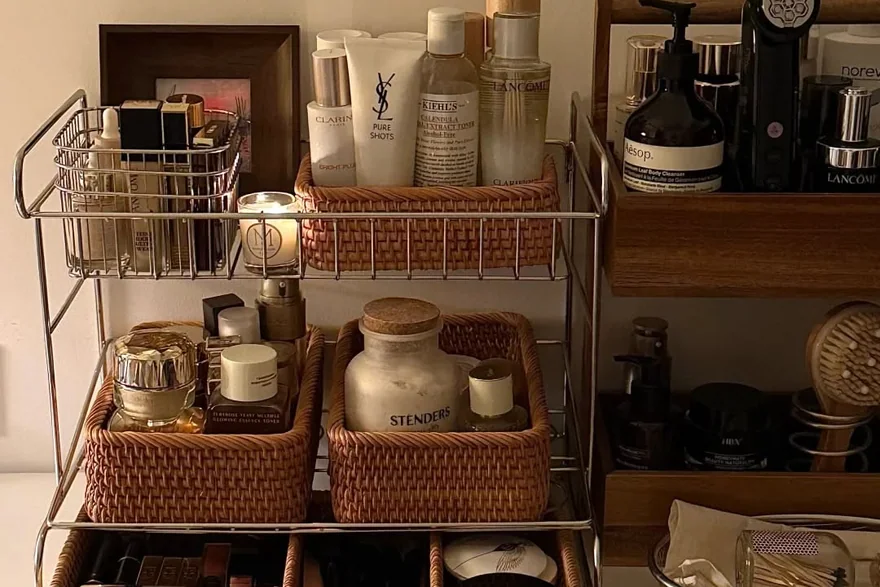
A hanging toiletry bag is a wash bag or dopp kit with a suspension element — a hook, a webbing loop or a clip — that lets the packed bag hang vertically from a door top, towel rail, shower rail, hook or mirror frame. The suspension is not decoration: it converts a bag that would otherwise lie flat on a limited counter into a vertical organiser with every compartment visible at eye level. In a shared hotel bathroom, where usable surface may be no more than 40 cm of shelf, that difference is the whole value proposition.
Demand signals support the category. Travel bag for toiletries draws roughly 110,000 monthly searches, while toiletry bag as a search term recorded about 74,810 weekly Amazon searches in the ASINSIGHT 2026.07 read. Typical unit prices sit between $0.45 and $12.00 on Alibaba (2026.10) — a wide band because it spans a 210D flat pouch and a 900D four-panel organiser with a metal swivel hook. A brand owner should therefore fix the price shelf before the specification, because the shelf dictates the denier, the hook and the panel count.
Three sub-categories structure the market. The fold-flat pouch packs flat and hangs from a single hook with one or two compartments. The single-panel hanging bag keeps a semi-rigid back panel with elastic loops and a zip pocket. The multi-panel wrap — two, three or four panels — folds closed into a compact parcel and opens into a vertical column of compartments. Each carries a different bill of materials and a different return profile, so the choice belongs at the brief stage.
The recurring failure in this category is suspension detachment, not fabric wear. A hook anchored into a single layer of lining pulls out under a full load; a hook anchored into a reinforcement patch that is bar-tacked into the shell and the binding does not. Buyers reviewing a sample should load it to the declared packed weight, hang it, and leave it overnight. Detachment shows up within hours, whereas abrasion and colour loss take months and will only appear in the returned-goods data.
- Hook type and anchoring drive the return rate more than any other component.
- Panel count drives sampling complexity, webbing cost and binding labour.
- A wet compartment needs a welded or taped seam, not a stitched one.
- Usable volume should be quoted open and closed; the two figures differ a great deal.
- Packed weight, not empty weight, is what the suspension assembly has to carry.
The ten configurations buyers shortlist in 2026
Rather than ranking finished products by brand, sourcing teams shortlist hanging toiletry bags by configuration, because configuration is what a specification sheet controls and what a factory quotation prices. The ten below span the realistic briefs a brand owner or retailer brings to this category. Sizes are closed dimensions in centimetres; the open drop is the distance from the hook to the lowest panel when the bag is hanging.
| Configuration | Closed size (cm) | Open drop (cm) | Shell fabric | Hook | Best-fit brief |
|---|---|---|---|---|---|
| Fold-flat carry-on pouch | 24 x 16 x 8 | 44 | 420D ripstop nylon, PU coated | Moulded swivel hook | Carry-on-only flyers |
| Single-panel mesh organiser | 26 x 20 x 9 | 52 | 300D polyester with mesh pockets | Moulded swivel hook | Gym, pool, shared locker rooms |
| Two-panel family wash bag | 30 x 22 x 11 | 62 | 600D polyester, PU2 coating | Metal swivel G-hook | Two people, one bathroom |
| Three-panel shower-rail organiser | 33 x 24 x 12 | 78 | 420D nylon, water-repellent finish | Carabiner plus hook | Cruise cabins, hostels |
| Four-panel road-trip organiser | 36 x 26 x 13 | 96 | 900D polyester, PVC backed | Oversized metal hook | Family car travel |
| Hanging dopp kit with detachable pouch | 27 x 17 x 15 | 50 | 500D polyester, twill lining | Snap hook with D-ring | Business traveller, two-bag kit |
| Clear TSA hanging quart pouch | 22 x 18 x 7 | 40 | 0.4 mm TPU film | Moulded hook | Air travel liquids compliance |
| Wet/dry hanging bag with drain | 28 x 20 x 12 | 56 | TPU-laminated 600D polyester | Hook plus drain grommet | Gym, beach, wet swimwear |
| Hanging vanity case with mirror panel | 32 x 23 x 11 | 70 | PU-coated 840D polyester | Folding hook with mirror | Beauty professionals, gifting |
| Kids hanging wash bag | 20 x 15 x 8 | 38 | 210D polyester, printed panel | Soft webbing loop | Children, promotional gifting |
Volume should be calculated, never quoted from a photograph. A closed parcel of 30 x 22 x 11 cm has a gross envelope of about 7.3 litres, but compartments, foam and binding reduce usable volume to roughly 5.5 litres; the same bag opened to a 62 cm drop presents its contents across four or five access levels. Buyers writing a specification should state both figures, because the closed figure drives freight and shelf footprint while the open figure drives product photography and the review score that follows it.
Panel count is the most consequential cost decision after fabric. Each additional panel adds a webbing hinge, a binding pass, a zipper or a hook-and-loop closure, and roughly another day to the sampling window — which is why a four-panel organiser falls into the 12-15 working day complex sampling bracket rather than the 6-10 working day standard one. For a first programme, a two-panel construction usually delivers the visible function at a lower tooling and labour cost than a three- or four-panel shell, and it photographs almost as well.
- Decide the travel mode first: carry-on-only, checked, road trip or gym — the mode determines the drop length.
- Set the packed weight, then size the hook and its reinforcement to that figure rather than to the empty bag.
- Choose the wet-zone strategy before choosing the panel count, because welding or taping affects the assembly sequence.
- Confirm whether the end customer hangs the bag on a door top, a shower rail or a hook, and specify the hook opening accordingly.
Suspension hardware, load path and reinforcement
A hook is only as strong as what it is sewn into. The load path runs from the hook, through a webbing strap, into a reinforcement patch, and out through the shell or the binding into the bag body. If any link in that chain is a single thickness of 210D lining, the assembly fails at that point regardless of how substantial the hook looks. A written specification should name the webbing width (commonly 20 mm or 25 mm in this category), the reinforcement material, the stitch pattern and the number of bar-tacks at each junction.
| Hook type | Typical material | Load consideration | Usual failure mode | Cost index |
|---|---|---|---|---|
| Swivel metal hook | Zinc alloy or aluminium | Highest capacity; rotates to follow the hanging bag | Gate spring weakens; plating wears against metal rails | High |
| Moulded swivel hook | POM or ABS | Light and quiet against a door; suited to modest packed weights | Hook arm snaps at the gate under shock load | Low |
| Metal G-hook | Steel or zinc alloy with webbing | Load spread across two webbing legs | Webbing abrades where it crosses the bar | Medium |
| Carabiner clip | Aluminium | Clips to a rail or a strap as well as a hook | Gate thread strips; clip opens under sustained side load | Medium |
| Webbing loop with snap | Polyester webbing plus plastic snap | Soft, packable, no metal in the folded parcel | Snap pulls through the loop without a bar-tack | Low |
| Folding hook with mirror | Zinc alloy plus glass or acrylic | Two functions in one fitting | Mirror cracks in checked handling; fitting is heavy | High |
Packed weight sets the requirement, and it is larger than most briefs assume. A 3-litre bag holding six 100 ml bottles at roughly 130 g each, plus a full-size toothpaste tube, a razor and a hairbrush, passes 1.2 kg before the bag itself is counted; a four-panel family organiser can reach twice that. The specification convention is to require the suspension assembly to carry a stated static multiple of the declared packed weight, then verify by hanging the loaded sample overnight rather than by reading a number on a quotation.
Zippers deserve the same attention as the hook, because the main opening of a multi-panel wrap cycles every time the bag is opened and closed. ASTM D2053 defines zipper terminology, and citing it in a specification removes the ambiguity that otherwise surrounds chain type, gauge and slider description. A #5 reverse coil with a metal puller and a garage — the fabric shield at the closed end — suits most hanging bags; a #3 coil suits a fold-flat pouch where packed bulk matters more than cycle life.
Inspection closes the loop. Because suspension failure is a safety-adjacent defect rather than a cosmetic one, buyers normally treat hook attachment, bar-tack count and webbing anchorage as critical defects in the inspection plan, sampled to AQL 2.5 under ISO 2859-1 alongside the usual appearance checks. Fabric and print faults that many programmes classify as minor — a missed bar-tack, a reinforcement patch cut 3 mm short — are reclassified as critical here for exactly that reason.
- Specify webbing width and reinforcement material, not just the hook type.
- Ask for the reinforcement patch to be visible in the sample rather than hidden behind lining.
- Require a bar-tack at every hook-to-strap junction and state how many are expected.
- Match zipper gauge to cycle expectation: #3 for light pouches, #5 for multi-panel wraps.
- Include the hook in the overnight hang test, not only the shell fabric.
Compartment architecture, wet zones and closure specification
Compartment architecture is where a hanging bag earns or loses its review score. The functional requirements are consistent across the category: bottles must stay upright when the bag is vertical, small items must be visible without unpacking, and anything wet must not reach anything dry. The table below sets out the features that deliver those outcomes and the trade-off each one carries, because every added feature is a pattern piece, a closure and a labour operation.
| Feature | Specification options | What it solves | Trade-off |
|---|---|---|---|
| Elastic loops | 12 mm or 20 mm elastic, three to seven loops | Keeps bottles upright while the bag hangs | Elastic loses tension over time; latex-free should be stated |
| Zip mesh pocket | #3 coil with 210D mesh | Visibility of small items without unpacking | Mesh snags on sharp trim; bound edges add cost |
| Wet compartment | Welded TPU panel or taped seams | Isolates a leaking bottle from dry contents | Welding adds a tooling step and one to three sampling days |
| Removable pouch | Snap-in tab or hook-and-loop attachment | Separates liquids for security screening | One extra pattern piece and closure per unit |
| Drain grommet | Moulded eyelet, 8-12 mm | Lets a wet compartment dry between uses | Only functions if the bag can hang open afterwards |
| Hook-and-loop divider | 25 mm tape, covered edge | Adjustable compartment widths across a panel | Collects lint; needs a bound or covered edge |
| Mirror panel | Acrylic 1.5-2 mm or glass | Packs two functions into one fitting | Adds weight and a breakage risk in transit |
The wet compartment is the single most-specified element in this category and the most frequently got wrong. A stitched seam leaks through its needle holes regardless of how waterproof the fabric is, so a genuinely leak-resistant compartment needs radio-frequency or hot-air welding, or a seam-sealing tape applied over the stitch line. Buyers should state the method in the specification rather than the adjective waterproof, because the two constructions differ in tooling, in cost and in the sampling window.
Lining colour is a commercial decision that behaves like a technical one. A light lining makes contents easy to find and photographs well, but shows mascara and foundation transfer within weeks; a dark lining hides staining and makes a bag look newer for longer, at the cost of visibility in a dim hotel bathroom. Mid-tone linings with a subtle print are the compromise many programmes adopt, and the choice should be fixed at the sampling stage because changing lining colour after approval means re-shooting the listing imagery.
Odour deserves a line in the specification too. PVC-backed shells and some solvent-based coatings carry a residual smell that customers associate with cheap luggage, particularly in a bag that lives in a warm bathroom. Specifying a low-odour coating, requiring the bulk production material to match the approved sample, and adding a simple after-approval check — sealed bag, 24 hours, room temperature, then open and smell — costs nothing and prevents a category of one-star reviews that no amount of photography can offset.
Fabric performance claims in this category are best expressed as test methods rather than adjectives. AATCC test methods cover water resistance, colour fastness and abrasion, and naming a method with a buyer-set pass threshold turns a marketing word into something a laboratory can adjudicate. That is the difference between a claim a marketplace will accept and one it will ask to be substantiated after the listing is live.
The B2B Customisation View
Programme planning for cosmetic bags starts with the end market: a hotel amenity run and a beauty-retail launch ask for completely different construction and compliance evidence.
Planning figures used across the programme: MOQ 500 pieces per style and colourway, 6–10 working days sampling (12–15 when moulding or multi-layer lamination is required), 35–50 days bulk lead time, AQL 2.5 to ISO 2859-1, FOB Xiamen, T/T 30/70.
The programme-management model exists because most import problems are documentation problems, and documentation is what this office produces and holds.
Which Brand Types Benefit Most
Different brand types enter this category from different directions, and the configuration that suits one rarely suits another. Start-up brands do best with a single two-panel construction in one or two colourways, because 500 pieces per style and colourway concentrates the budget and the 6-10 working day sampling window lets the first sample reach a photo studio before the listing copy is written. Established brands with an existing travel range usually extend into three- and four-panel organisers, where the 12-15 working day complex sampling window is acceptable because the shell fabric and hardware finish can be matched to an existing luggage line. Retailers and catalogue buyers tend to work from a price shelf downwards: fixing the retail price first, then selecting the denier, hook and panel count that fit the landed cost. E-commerce sellers competing on review score should bias towards the features that generate photographic evidence — elastic loops holding bottles upright, a zip mesh pocket, and a wet compartment that visibly separates from the dry side. Gift and hospitality buyers, including hotel amenity programmes and subscription boxes, gravitate to the smaller configurations with a printed panel, because the print area carries the brand message and the unit cost stays low enough to include as an added-value item.
- Start-up brands: one two-panel construction, one or two colourways, sampled on the 6-10 working day window before the listing copy is written.
- Established brands: three- and four-panel organisers matched to an existing luggage shell and hardware finish.
- Retailers: fix the retail price shelf first, then select denier, hook and panel count to fit the landed cost.
- E-commerce sellers: bias towards photogenic function, such as upright bottle loops and a visibly separate wet zone.
- Gift and hospitality buyers: the smaller configurations, with a printed panel that carries the brand message at an added-value unit cost.
Frequently Asked Questions
What minimum applies to a hanging toiletry bag with a custom metal hook?
The minimum is 500 pieces per style and colourway, and a custom metal hook does not change that threshold — it changes the sampling window and the tooling. A custom hook means a plating colour, a gate specification and usually a mould or a plating batch, so the programme moves into the 12-15 working day complex sampling bracket. Buyers should decide between a stock hook in a custom plating colour and a fully custom shape, because the second option adds cost without changing the minimum.
How long does sampling take for a four-panel hanging organiser?
A four-panel hanging organiser falls into the complex construction bracket at 12-15 working days, against 6-10 working days for a fold-flat pouch or a single-panel bag. The extra days come from the webbing hinges between panels, the additional binding passes and the alignment of the closure across four panels. Bulk production then runs 35-50 days after sample approval, so a four-panel launch should be planned on the longer end of both windows.
Which fabric denier suits a hanging toiletry bag that will be checked in?
A checked hanging bag needs a shell in the 600D to 900D polyester or 420D to 500D nylon range, with a PU or PVC backing for abrasion resistance along the base and corners. A 210D or 300D shell suits a carry-on pouch that is packed inside a suitcase, but it scuffs visibly against conveyor handling. Base panels on checked bags are often specified a denier higher than the sides, because abrasion concentrates there.
How is the hook load path specified on a hanging wash bag?
The load path is specified as a chain, not as a single component: hook material and gate type, webbing width and material, reinforcement patch material and dimensions, stitch pattern, and the number of bar-tacks at each junction. Writing all five into the specification sheet prevents the common failure where a strong hook is sewn into a single thickness of lining. Buyers should also state the declared packed weight the assembly must carry.
What decides whether a hanging toiletry bag gets a swivel or a fixed hook?
Swivel hooks suit bags that will hang from a door top or a towel rail, because the rotation lets the bag settle square regardless of how it is hooked. Fixed hooks suit shower rails and car headrests where the bag stays aligned anyway, and they cost less. A fixed hook on a bag that gets knocked sideways puts a twisting load on the webbing, which is why swivels dominate the mid and upper price shelves.
Can the wet compartment of a hanging toiletry bag be welded rather than stitched?
Yes, and it should be if leak resistance is the point. Radio-frequency welding suits PVC and PU-coated shells; hot-air welding or seam-sealing tape suits TPU laminates and coated nylons. Welding adds a tooling step and one to three sampling days, and it restricts the compartment shape, because a welded seam wants a simple geometry. The specification should name the method rather than describe the compartment as waterproof.
What is the usual carton packing for hanging toiletry bags at 500 pieces?
Carton count depends on the closed volume of the configuration, because these bags ship folded rather than flat. A compact fold-flat pouch packs far more per carton than a four-panel organiser with a rigid back panel. Buyers should ask for the carton dimensions, the pieces per carton and the gross weight in writing before freight is quoted, because the figure feeds directly into the landed cost and into the volumetric weight on an air shipment.
How do buyers verify colour consistency across a hanging bag's shell, lining and webbing?
Colour consistency is verified against approved lab dips or Pantone references for each material, held under the same light source, because polyester shell, twill lining and webbing take dye differently. Buyers normally approve a shade card covering all three materials plus the binding tape and the zipper tape, and then require bulk production to match it. Skipping the webbing or the zipper tape is the usual cause of a two-tone look on an otherwise well-made bag.
Which zipper specification suits the main opening of a hanging toiletry bag?
A #5 reverse coil with a metal puller and a garage suits a multi-panel wrap, because the opening cycles on every use and the reverse coil hides the chain on the outside face. A #3 coil suits a fold-flat pouch where packed bulk matters more than cycle life. Citing ASTM D2053 zipper terminology in the specification removes ambiguity about chain type, gauge and slider, which is where most zipper disputes begin.
Does the TSA liquids rule apply to a hanging toiletry bag?
The rule applies to the liquids inside the bag, not to the bag itself. A hanging toiletry bag carried through a US checkpoint has to present its liquids in a way that satisfies the screening requirement, which is why several configurations include a removable clear pouch sized to the quart requirement. Buyers targeting US travellers should treat that removable pouch as a specified component rather than an accessory.
How should the hanging drop length be chosen for a hotel bathroom?
Drop length should be set against where the bag will hang, not against what looks generous in a photograph. A 40-50 cm drop works on a door top or a hook; 60-80 cm suits a shower rail, where the bag hangs lower; a 96 cm four-panel drop assumes an open wall or a cruise cabin. If the drop exceeds the available height, the lowest panel rests on the floor or the counter and the hanging function is lost.
What causes hook detachment returns in hanging toiletry bags?
Hook detachment returns almost always trace to the anchorage rather than the hook: a reinforcement patch cut short, a missing bar-tack, or webbing sewn into lining instead of shell. Shock loading makes it worse, because a bag dropped while hanging delivers an impulse several times the static weight. Buyers should treat hook anchorage, bar-tack count and webbing attachment as critical defects in the inspection plan rather than minor appearance faults.
When should a buyer choose a moulded hook over a metal hook?
A moulded POM or ABS hook suits lighter packed weights, programmes where metal content is undesirable, and price shelves where a saving on hardware funds a better shell fabric. It is quieter against a door and will not scratch a rail. Metal is the right choice for heavy four-panel organisers, for premium positioning, and wherever the hook is visible in the hero image and reads as a quality signal.
How is AQL 2.5 applied to hanging toiletry bag shipments?
AQL 2.5 under ISO 2859-1 sets the sample size and the accept and reject numbers for the shipment, drawn against the carton count. The plan is only as good as its defect classification, so suspension faults, missing bar-tacks and welded-seam leaks should be listed as critical defects, with print misregistration and loose threads as minor. Buyers should send the defect list with the inspection booking, not after the report arrives.
What artwork constraints apply to a hanging toiletry bag with printed panels?
Printed panels on these bags usually sit on the outer shell before assembly, so artwork has to allow for seam allowance, for the fold line between panels, and for the fact that a hanging bag is photographed open rather than closed. A design centred on the closed parcel often lands across a hinge when the bag is opened. Buyers should request a printed pre-production sample photographed hanging, which is the orientation customers will see.
People Also Ask
Are hanging toiletry bags worth it for carry-on-only travel?
They are worth it when the trip involves a bathroom with limited counter space, which is most hotel and cruise bathrooms. A hanging bag turns 40 cm of shelf into a vertical column of compartments, and the fold-flat configurations pack into a carry-on without taking meaningful volume. For a trip where the bag stays inside a suitcase and is used on a wide counter, a standard dopp kit is simpler and cheaper.
How do you hang a toiletry bag when there is no hook?
Most hanging bags are specified with a hook broad enough to fit over a door top, a towel rail or a shower rail, and a carabiner or a webbing loop adds a strap or a headrest as an option. Buyers choosing a configuration should check the hook opening width against the intended fixture, because a narrow hook that only fits a rail limits where the bag can actually be used.
Do hanging toiletry bags leak in transit?
A stitched compartment will leak through its needle holes regardless of the fabric, so leak resistance depends on the seam method rather than on the shell. Welded or taped seams in the wet compartment are the specification that matters. Buyers should also specify a bottle-friendly upright orientation with elastic loops, because a bottle lying sideways against a zipper is the other common source of leaks.
How do you clean a hanging toiletry bag?
Most polyester and nylon shells clean with a damp cloth and mild soap; welded TPU compartments wipe dry and are the easiest to maintain. Lining colour choice affects how clean the bag looks between washes, which is why mid-tone printed linings are common. Care instructions on the sewn-in label should match the actual construction, because a washing-machine instruction on a bag with a metal hook invites a damaged hook.
Request a Sample or a Written Quotation
Send the silhouette, dimensions, material preference and logo artwork, and the programme team will return a written quotation with MOQ, sampling window, bulk lead time and inspection standard.
Email: [email protected] · WhatsApp: +86 177 5002 0688