Material Cost per Yard: Cosmetic Bag Sourcing Budget Guide
Executive Summary
Material cost per yard is the starting point of a cosmetic bag budget and the number buyers most often misread, because a yard of fabric is not a bag. What matters is cost per usable unit: the price per yard divided by the number of units a marker yields from that yard, plus trims, labour, packaging, testing and the amortised cost of tooling and sampling. Two fabrics that differ by 40 cents a yard can differ by almost nothing in unit cost once yield and waste are counted.
A practical budget works backwards from the target retail or landed price. Illustrative planning bands for bag fabrics run from roughly $0.55-$1.10 per yard for a 190T polyester lining to $3.40-$5.80 for a 1000D nylon shell, with certified recycled or organic materials carrying a premium. Programmes are planned at 500 pieces per style and colourway, with 6-10 working days of sampling, 35-50 days of bulk, inspection at AQL 2.5 under ISO 2859-1, FOB Xiamen and T/T 30 deposit with 70 against bill of lading.
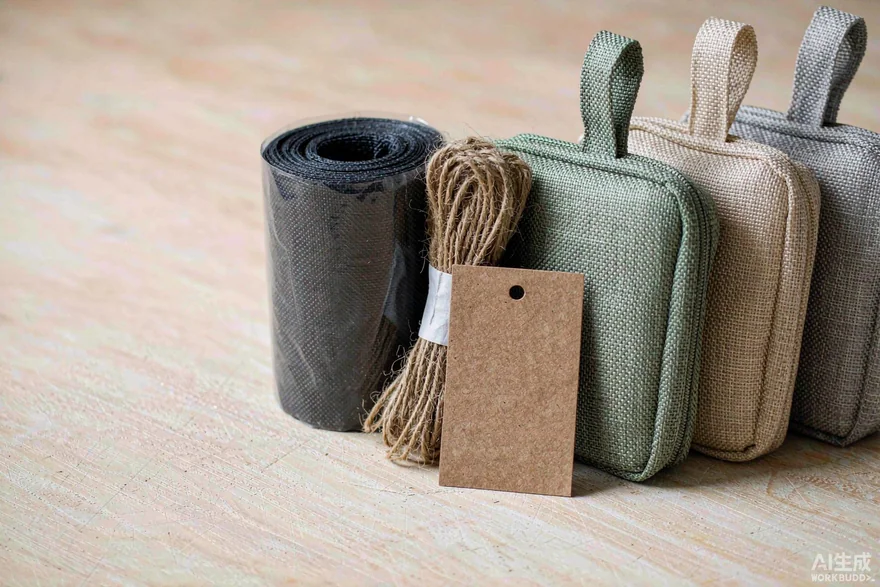
What a Price per Yard Does and Does Not Tell You
A fabric quotation is given per linear yard at a stated width, usually 58 to 60 inches, which is 147 to 152 cm. One linear yard of 58-inch cloth is about 1.33 square yards, or roughly 1.11 square metres. That is the number a buyer needs, because a bag pattern consumes area. Converting a per-yard price into a per-square-metre price is the first step in comparing quotations, and it is the step that reveals when a cheap narrow cloth is actually the expensive option.
The second correction is yield. A marker, the cutting layout of pattern pieces, never uses all the cloth. On a small bag with many small pieces, marker efficiency of 78 to 88 percent is normal; on a large panel layout it can be higher. That means the effective cost of the material consumed is the quoted price divided by the efficiency, so cloth at $2.40 per yard cut at 80 percent efficiency behaves like cloth at $3.00 cut perfectly. Buyers who compare only the yard price are comparing the wrong number.
The third correction is waste beyond the marker. Cutting-room waste, fabric lost to defects and to shade-band separation, and the allowance for defective finished units all add to consumption. A planning allowance of 12 to 18 percent over the theoretical pattern area is realistic for a simple pouch and 18 to 25 percent for a structured case with foam and binding, plus a further 2 to 3 percent for defective units. Those allowances belong in the budget before the quotation is compared, not after the invoice.
Finally there is the mill minimum, which catches more first-time programmes than any other cost. Dye lots are normally sold in minimum quantities, frequently 300 to 500 metres per colour. A 500-piece order of a flat pouch may consume well under that, which means a custom-dyed shade can force the buyer to fund fabric that will never become a bag. Recognising this before choosing a colour is what keeps a first programme inside budget.
Material Price Bands and What Each Yard Delivers
The bands below are illustrative planning ranges for budgeting a cosmetic bag programme, not quotations and not a price list. They move with fibre markets, with order volume, with certification and with the width and finish specified. Their value is comparative: they let a buyer test whether a proposed material change is a rounding error or a structural change to the unit cost, before asking anyone to price it.
| Material | Weight | Planning price per yard | Cost per m² | Budget note |
|---|---|---|---|---|
| 190T polyester taffeta lining | 52-62 g/m² | $0.55-$1.10 | $0.60-$1.20 | Cheapest lining; check opacity below 170T |
| 210D polyester lining | 70-90 g/m² | $0.75-$1.40 | $0.82-$1.53 | Standard pouch lining with better cover |
| 210D nylon lining | 70-90 g/m² | $1.15-$2.05 | $1.25-$2.24 | Better abrasion; budget for dye control |
| 300D polyester shell | 100-130 g/m² | $1.25-$2.30 | $1.36-$2.51 | Entry structured-case shell |
| 600D polyester oxford, PU backcoat | 190-230 g/m² | $2.10-$3.70 | $2.29-$4.04 | Workhorse shell; coating adds weight |
| 1000D nylon shell | 300-360 g/m² | $3.40-$5.80 | $3.71-$6.33 | Heavy duty; weight affects freight |
| 12 oz cotton canvas | About 407 g/m² | $2.40-$4.20 | $2.62-$4.59 | Natural look; shrinkage allowance needed |
| PEVA film, 0.15 mm | About 140 g/m² | $0.80-$1.55 | $0.87-$1.69 | Wipe-clean; welded construction |
| TPU-laminated polyester | 230-300 g/m² | $3.60-$6.40 | $3.93-$6.99 | Premium wipe-clean and weldable |
| rPET lining with GRS claim | 60-80 g/m² | Add $0.25-$0.70 | Add $0.27-$0.76 | Budget for transaction certificates |
Certification is the clearest example of a premium that buys something specific. A recycled polyester lining carrying a Global Recycled Standard claim typically carries an uplift over the conventional equivalent, and part of that uplift is administrative: the scope and transaction certificates that make the claim defensible have to be raised and checked on every shipment. Buyers should request the documentation with the quotation, since a claim without a transaction certificate is a marketing risk rather than a sourcing outcome. The standard itself is maintained by Textile Exchange.
Organic cotton follows the same pattern with a larger premium and a longer chain of custody. Where a programme wants an organic canvas shell, the relevant framework is GOTS, and the practical consequence for budgeting is that certified cloth is sold through certified supply chains in limited volumes, so lead time rises alongside price. A buyer should treat certification as a material specification with a schedule impact, not as a finishing touch added at the end.
Restricted-substance compliance carries a smaller but unavoidable cost. Laboratory screening against EU REACH limits, and against CPSIA requirements for the US market, is typically charged per material per test group, so a bag with a shell, a lining, a print and a zip is four sets of testing rather than one. Where a lining carries an OEKO-TEX Standard 100 certificate, the certificate should be checked for product class and expiry before the cost is counted as covered.
Trims are priced on a different basis entirely and are easy to underestimate. Binding tape, elastic and webbing are quoted per metre or per roll; zips per piece with a minimum per size and colour; pulls per piece with tooling if custom; labels and hangtags per piece with a setup charge. On a small pouch the zip can cost more than the lining fabric, which surprises buyers who have optimised the fabric price and left the trim list to the last minute.
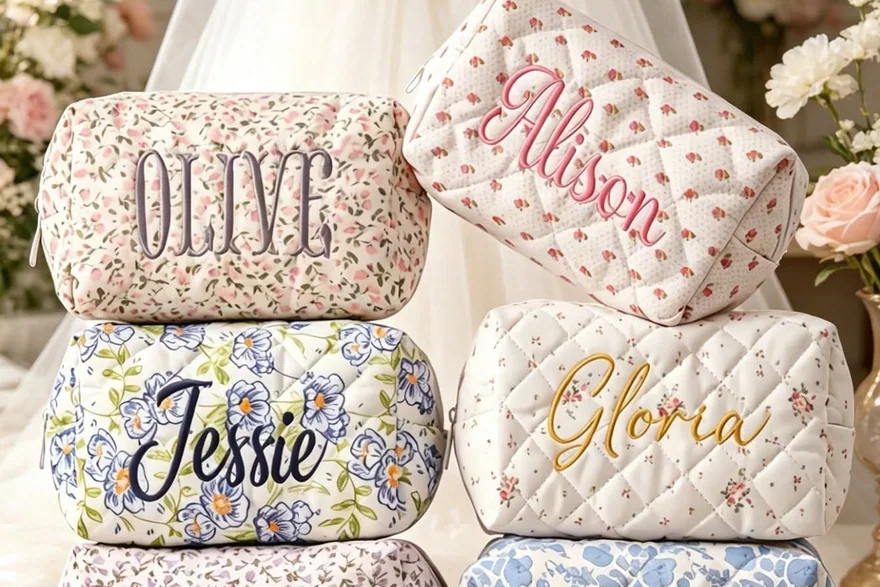
From Yardage to Unit Cost: A Worked Budget
The conversion from material to unit cost is arithmetic, and doing it once on paper prevents most budget surprises. Take a medium vanity case of 24 x 16 x 9 cm. The shell pattern area is roughly 0.16 m² including seam allowance, and the lining about 0.15 m². Applying a waste allowance of 15 percent and a marker efficiency of 82 percent gives a shell consumption of about 0.17 yards of 58-inch cloth and a lining consumption of about 0.16 yards.
| Cost element | Basis | Planning range per unit | What moves it |
|---|---|---|---|
| Shell fabric | 0.17 yd at $2.10-$3.70 | $0.36-$0.63 | Denier, coating, custom shade |
| Lining fabric | 0.16 yd at $0.75-$1.40 | $0.12-$0.22 | Fibre, print, certification |
| Interlining or foam | 0.10 yd at $1.20-$2.00 | $0.12-$0.20 | Thickness and lamination method |
| Zip and pull | One #5 coil zip, 45 cm | $0.22-$0.45 | Size, finish, custom pull tooling |
| Binding, tape, labels | Per unit trim pack | $0.10-$0.22 | Number of labels and finish |
| Cut, sew and pack labour | Minutes per unit | $1.10-$1.90 | Stitch count, bar tacks, welding |
| Packaging | Polybag, hangtag, carton share | $0.08-$0.18 | Retail packaging requirements |
| Testing and compliance | Amortised over the order | $0.15-$0.60 | Number of materials and markets |
| Tooling and sampling | Amortised over the order | $0.20-$1.50 | Print screens, welding or mould tooling |
Summing the middle of those ranges gives an indicative FOB figure in the region of $3.00 to $4.00 for that vanity case, which sits inside the broad unit price band of $0.45 to $12.00 seen across online marketplace listings for the category. The point of the exercise is not precision; it is sensitivity. The two lines that move most are labour and tooling, not fabric, which is why a buyer chasing a lower unit price usually gets further by simplifying construction than by downgrading cloth.
| Bag format | Fabric consumption | Illustrative FOB band | Cost driver |
|---|---|---|---|
| Flat pouch, 20 x 14 x 5 cm | About 0.20 yd total | $1.20-$2.60 | Zip cost dominates at this size |
| Medium vanity case, 24 x 16 x 9 cm | About 0.33 yd total | $2.60-$4.80 | Labour and interlining |
| Hanging toiletry bag, 26 x 20 x 9 cm | About 0.42 yd total | $3.80-$6.50 | Hook, binding and seam count |
| Structured train case, 30 x 20 x 12 cm | About 0.55 yd plus panels | $6.50-$12.00 | Moulded or laminated panels |
| Moulded EVA case, 25 x 18 x 12 cm | Fabric plus shell tooling | $7.50-$12.00 | Tooling amortised over 500 units |
Amortisation is the part of the budget that changes most between a first order and a repeat. A moulding tool or a welding jig costing a four-figure sum, spread across 500 units, adds dollars per unit; across 5,000 units it adds cents. A buyer planning a programme with a second season in mind should ask how the tooling cost is treated on repeat orders, because that single answer often determines whether a second order is viable at all.
Two commercial points close the calculation. FOB Xiamen covers the goods loaded on board at the port of shipment; it excludes ocean or air freight, insurance, import duty and inland delivery, all of which the buyer bears. And payment by T/T 30 deposit with 70 against bill of lading means the working-capital profile is front-loaded: 30 percent leaves at order placement and the balance before documents are released, so the budget should show two cash events rather than one.
Controlling a Sourcing Budget Over a Programme
Budgets drift rather than break. The usual causes are late material changes, additional colourways that each carry their own fabric minimum, extra sampling rounds, and specification upgrades requested after the first sample. Each is individually small and collectively enough to move a unit cost by 20 percent between the first estimate and the invoice. The control is procedural: freeze what can be frozen early, and price what cannot before it is requested.
Quantity planning deserves particular care because the minimum interacts with the unit economics. At 500 pieces per style and colourway, tooling and testing are spread across a small base, so a five-colourway launch multiplies both the fabric minimum exposure and the approval workload. Marketplace listings for the category show widely differing minimum order bands, and a buyer comparing them should check what each actually includes: sampling, tooling and testing are frequently quoted separately, and a quoted minimum that covers only cut-and-sew is not comparable with one that covers the full programme.
- Convert every quotation to cost per square metre before comparing: width differences hide real differences in price.
- Apply marker efficiency and a waste allowance on paper, not after the first invoice.
- Check the fabric mill minimum per colour before committing to a custom shade on a 500-piece order.
- Price the trim pack early: on a small pouch the zip can exceed the cost of the lining fabric.
- Amortise tooling and testing explicitly, and ask how repeat orders treat tooling already paid for.
- Separate the two cash events in the T/T 30 and 70 structure when planning working capital.
- Budget freight, insurance, duty and inland delivery on top of the FOB figure, since FOB excludes all four.
Freight is worth a short calculation of its own, because bag shipments are usually volumetric rather than heavy. A carton holding 60 medium vanity cases at 60 x 40 x 40 cm occupies 0.096 m³, and air freight is charged on the greater of actual and volumetric weight, typically at a divisor of 6,000, which turns that carton into about 16 chargeable kilograms. Reducing carton void, by nesting units or by reducing interlining thickness, lowers freight without touching the product.
Inspection and compliance close the loop on cost rather than adding to it. Inspection at AQL 2.5 under ISO 2859-1 is inexpensive relative to a rejected shipment, and the classification of defects should be agreed before the pre-shipment date so that a marginal result is not argued on the day. Sampling runs 6-10 working days, extending to 12-15 working days for complex constructions, and bulk runs 35-50 days after sample approval, so a late specification change has a schedule cost as well as a material one.
Demand context helps set the budget against expected volume. Category search interest is substantial: toiletry bag has been measured at roughly 74,810 weekly Amazon searches, travel bag for toiletries at about 110,000 monthly searches and make up bags for women at roughly 80,000 monthly searches. Those numbers do not set a price, but they do indicate the volume at which tooling amortisation stops dominating the unit cost, which is the point at which a more expensive material becomes affordable per unit and a second colourway stops carrying a disproportionate share of the fixed costs.
The B2B Customisation View
Launch calendars are unforgiving, so cosmetic pouches, vanity cases and beauty organisers programmes are planned backwards from the on-shelf date rather than forwards from the first sketch.
Fixed commercial parameters: 500 pieces per style and colourway minimum, first sample in 6–10 working days (12–15 for complex or hardware-intensive constructions), bulk 35–50 days after approval, AQL 2.5 inspection under ISO 2859-1, FOB Xiamen, T/T 30/70.
A sourcing and programme-management company is answerable for the whole file, not just the sewing, which is why inspection reports and compliance documents are issued with every shipment.
Which Brand Types Benefit Most
Budget structure differs by buyer type. A start-up brand placing a first order of 500 pieces per style and colourway is usually constrained by total cash rather than unit cost, so the priority is to avoid tooling and custom shades in season one: a stock-colour shell, a screen-printed logo rather than a woven label setup, and a construction already in regular production. An established brand with repeat volumes can afford tooling because it amortises across future orders, and should ask for the tooling treatment on repeats to be stated in writing.
- Retailers and private-label programmes: packaging and compliance costs are the lines that grow here, since retail packaging and market-specific testing are non-negotiable and should be budgeted per market rather than per programme.
- E-commerce sellers: volumetric freight is the hidden cost. Nesting units and trimming interlining thickness reduces chargeable weight without changing the product experience.
- Gift and hospitality buyers: unit cost targets in the lower part of the $0.45-$12.00 band are achievable with a polyester pouch, provided the spec avoids custom tooling and keeps to one or two colourways.
- Travel and outdoor brands: heavier shells raise both fabric and freight cost. A ripstop construction buys tear resistance at a lower weight and usually a lower total landed cost than a heavier plain weave.
- Colour-cosmetics brands: the bag is a gift-with-purchase or a bundle component, so the budget should be set against margin on the bundle rather than against a standalone bag price.
- Buyers comparing quotations: send one written specification to every party and compare line by line, since a lower figure that excludes testing, tooling and retail packaging is not a lower figure.
- Programmes planning a second season: ask how tooling paid for on the first order is treated on repeat orders, because that answer usually decides whether the second order is viable.
- Buyers new to importing: budget freight, insurance, duty and inland delivery on top of the FOB figure, and check the tariff classification, since bags with an outer surface of plastic sheeting can classify differently from textile ones.
Frequently Asked Questions
How much fabric does a medium cosmetic bag use per unit?
A 24 x 16 x 9 cm vanity case consumes roughly 0.16 m² of shell and 0.15 m² of lining in pattern area. After a 15 percent waste allowance and marker efficiency of about 82 percent, that becomes approximately 0.17 yards of 58-inch shell cloth and 0.16 yards of lining per unit. A flat pouch of 20 x 14 x 5 cm needs around 0.20 yards in total, which is why fabric is a smaller share of its cost than the zip is.
Why is fabric quoted per yard rather than per metre?
Textile trade convention in the United States and in much of Asian sourcing is linear yards at a stated width, typically 58 to 60 inches. It is not a problem provided the width is always stated, because a yard of 44-inch cloth and a yard of 60-inch cloth are very different quantities of material. Buyers comparing quotations should convert to cost per square metre or per square yard to remove the width variable entirely.
What drives the price difference between 300D and 600D polyester?
The heavier yarn uses more polymer per metre of cloth, so the raw material cost roughly doubles between a 100-130 g/m² cloth and a 190-230 g/m² cloth, and the finishing and coating costs scale with it. In planning terms the jump is from about $1.25-$2.30 per yard to about $2.10-$3.70 per yard. The offsetting consideration is that a 600D shell usually needs less interlining to hold a shape, so the total unit cost difference is often smaller than the fabric difference.
How much does a GRS-certified recycled lining add per yard?
Planning for an uplift in the region of $0.25-$0.70 per yard over a conventional polyester lining of the same construction is realistic, with part of that covering the certification chain rather than the fibre itself. The buyer should also budget administrative time: a scope certificate plus a transaction certificate per shipment is what makes the claim defensible, and requesting those documents after bulk rather than with the quotation is the most common cause of a delayed launch.
Why does a 500-piece order sometimes need more fabric than the bags require?
Dye lots are sold in minimum quantities, commonly 300 to 500 metres per colour. A 500-piece order of flat pouches can consume well under that, so a custom shade may force the purchase of fabric that will never be cut. The practical options are to choose a stock colour for a first programme, to accept a shade charge, or to plan a second colourway that can use the balance of the lot.
What does a FOB Xiamen quotation include and exclude?
FOB covers the goods and the cost of loading them on board at the named port, so it includes material, making, packing and export clearance up to the ship's rail. It excludes ocean or air freight, insurance, import duty, customs clearance at destination and inland delivery, all of which the buyer pays. A landed-cost budget should therefore add those four items to the FOB figure rather than treating the quotation as the full cost.
How should a buyer budget for sampling and tooling?
Separate the two. Sampling is a per-round cost covering materials, making and courier, and two or three rounds is normal for a new construction. Tooling is a one-off: print screens, embroidery digitising, welding jigs or moulding tools, each with its own price. The key question is amortisation: a four-figure tool spread across 500 units adds dollars per unit, so the buyer should ask how the tooling is treated on a repeat order before agreeing to it.
Does a custom-dyed colourway cost more than a stock colour?
Usually yes, in three ways: the mill minimum applies, the lab dip round adds time, and small lots are priced above standard shades. On a 500-piece first programme the combined effect can exceed the fabric saving from any other decision. A sensible approach is to launch in stock colours, validate demand, and move to custom shades once volumes justify the minimum.
How much of a bag unit cost is fabric rather than labour?
An illustrative split for a medium vanity case is fabric 25-35 percent, trims 15-25 percent, cut, sew and pack labour 30-45 percent, packaging 3-6 percent, and testing plus amortised tooling 2-8 percent. The proportions shift with construction: fabric dominates on a simple flat pouch, while labour and tooling dominate on a structured or moulded case. That is why simplifying construction usually beats downgrading cloth.
What is a realistic FOB budget for a flat promotional pouch?
For a simple 20 x 14 x 5 cm pouch in polyester with a stock zip and a single-colour print, an FOB planning band of roughly $1.20-$2.60 per unit is realistic at 500 pieces. The zip is the largest single trim line at that size, and a custom pull or a woven label moves the figure upward quickly. Buyers should treat the band as a starting point for discussion and confirm it against the actual trim list.
How does marker efficiency change material cost?
Efficiency is the proportion of purchased cloth that becomes product. At 80 percent efficiency, material cost effectively rises by 25 percent over the theoretical pattern area; at 88 percent it rises by about 14 percent. Small bag patterns with many pieces tend to nest well, while large panels on a structured case nest poorly. Asking which efficiency figure a quotation assumed is a legitimate and useful question.
Why do two quotations for the same bag differ by 30 percent?
Usually because the specifications are not the same. Common gaps are the interlining, the zip brand or size, the lining weight, the number of bar tacks, whether testing and certification are included, and whether packaging meets retail requirements. A buyer should send a written specification to both and compare line by line, since a lower figure that excludes testing and tooling is not a lower figure.
How does payment T/T 30 and 70 affect the cash budget?
It creates two cash events rather than one. Thirty percent is due when the order is placed, and the remaining seventy percent against the bill of lading, which falls before documents are released and therefore before the goods arrive or are sold. A working-capital plan should show both dates, and should allow for the 35-50 day bulk window plus transit, since the balance is typically due before any revenue from the goods is received.
How should testing and compliance costs be amortised?
Treat them as a programme cost divided by order quantity, not as a per-unit variable. Laboratory screening is charged per material and per test group, so a bag with a shell, a lining, a print and a zip is four sets. Across 500 units a few hundred dollars of testing adds well under a dollar per unit; across 5,000 units it becomes negligible. Budget it once at the start rather than discovering it at the pre-shipment stage.
What happens to unit cost when an order moves from 500 to 2,000 pieces?
The largest effect is amortisation rather than fabric. Tooling, sampling and testing spread across four times the quantity, and fabric is purchased in a larger lot with better pricing, while labour cost per unit falls modestly as operators settle into the run. A reasonable expectation is a meaningful reduction in the fixed-cost portion of the unit price, with the material portion falling by a smaller margin.
People Also Ask
How much does it cost to make a cosmetic bag?
Illustrative FOB planning bands run from about $1.20-$2.60 for a simple flat polyester pouch, through $2.60-$4.80 for a medium vanity case, to $6.50-$12.00 for a structured or moulded train case at 500 pieces. Marketplace listings across the category span roughly $0.45-$12.00 per unit, with the spread explained by material, construction and tooling rather than by supplier margin alone.
Why is fabric priced by the yard?
It is trade convention, inherited from US textile practice and widely used in Asian sourcing. The yard is a linear measure, so it is meaningless without the width, and a quotation should always state both. Converting to cost per square metre removes the ambiguity and is the only reliable way to compare a 58-inch cloth against a 44-inch one.
What is the cheapest material for a makeup bag?
A 190T polyester taffeta lining and a lightweight polyester shell are the lowest-cost combination, with planning bands of roughly $0.55-$1.10 per yard for the lining. The caveat is service life: a very light cloth wears through quickly and shows seam allowance in photographs. For a bag sold on price, that trade-off is acceptable; for one sold on reviews, a 210D lining is usually the better budget decision.
How do you calculate fabric consumption for a bag?
Add the area of every pattern piece including seam allowance, divide by the usable fabric width to get linear length, then divide by the marker efficiency to account for layout waste, and add a further allowance for defects. For a medium vanity case that gives about 0.17 yards of shell and 0.16 yards of lining per unit at 58-inch width and 82 percent efficiency.
Request a Sample or a Written Quotation
Send the silhouette, dimensions, material preference and logo artwork, and the programme team will return a written quotation with MOQ, sampling window, bulk lead time and inspection standard.
Email: [email protected] · WhatsApp: +86 177 5002 0688