Thread Count & Stitch Density for Cosmetic Bags: Quality Standards
Executive Summary
Thread count and stitch density are two different numbers governing two different failures, and confusing them is the most common reason a cosmetic bag specification looks detailed but performs badly. Thread count describes the woven cloth: how many warp and weft threads sit in an inch of fabric, which sets cover, opacity, hand-feel and resistance to seam slippage. Stitch density describes the seam: how many stitches fall in an inch of sewn join, which sets seam strength, pucker and how much the needle has perforated the material. One is a fabric number, the other is a construction number.
A workable specification states both, together with the yarn size, the sewing thread size, the stitch type and the seam allowance. Typical planning ranges are 190T-210T for a pouch lining, 300D-600D for a shell, and 6-12 stitches per inch depending on fabric weight and seam location. Buyers working to 500 pieces per style and colourway should also fix how the seam is verified: seam efficiency targets, a defect list at AQL 2.5 under ISO 2859-1, 6-10 working days of sampling, 35-50 days of bulk, FOB Xiamen and T/T 30 deposit with 70 against bill of lading.
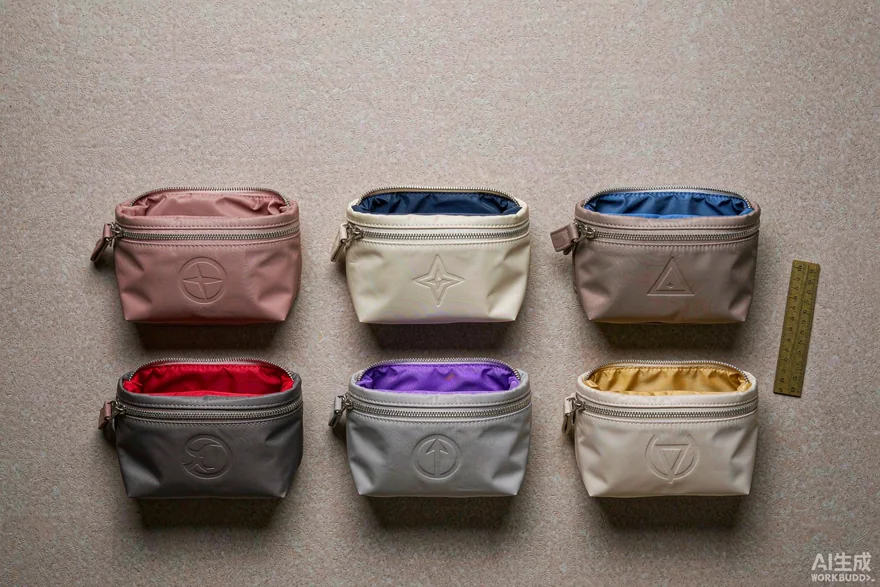
Three Numbers That Get Confused in a Cosmetic Bag Spec
A cosmetic bag tech pack usually contains the phrase 190T lining and the phrase 8 stitches per inch, often on the same page, and it is common for neither to be defined. The first is a measure of the cloth. The second is a measure of the seam that joins the cloth. A third number, yarn size in denier, hides behind the first and is frequently the one that actually determines whether the bag survives. When a sample fails, the cause is usually that one of the three was never written down.
Thread count is a woven-fabric measure: the number of warp threads plus weft threads in one inch, so a 190T taffeta is roughly 100 warp by 90 weft. It governs cover, opacity, how much light passes through a lining, and how the cloth feels. It does not, on its own, govern strength: a high-count cloth made from a very fine yarn can tear more easily than a lower-count cloth made from a heavier yarn, which is why the denier has to be specified alongside it.
Stitch density is a construction measure: stitches per inch along a seam, abbreviated SPI and convertible to stitch length in millimetres, with 8 SPI equal to roughly 3.2 mm and 10 SPI to roughly 2.5 mm. It governs how load is distributed along the join and how many needle holes the fabric carries. More stitches is not automatically better. On a heavy canvas a dense seam perforates the yarns and can reduce strength, while on a light lining a sparse seam lets the cloth slip apart under load.
The third number is the yarn or thread size. Fabric yarn is quoted in denier, the mass in grams of 9,000 metres of filament, so 600D means a much heavier yarn than 210D. Sewing thread is quoted in Tex, the mass in grams of 1,000 metres, or in the older ticket-number system where Tkt 40 corresponds to roughly Tex 30. A buyer who specifies fabric and stitch density but leaves thread size to the sewing contractor has left the single most influential variable in seam performance unspecified.
- Thread count answers: how dense is the cloth?
- Denier answers: how heavy is the yarn the cloth is made from?
- Tex or ticket number answers: how heavy is the thread holding the seam?
- Stitch density answers: how closely is that seam sewn?
- Stitch type answers: what geometry does the stitch have, and does it unravel?
Fabric Thread Count and Construction: What the Number Buys
On a cosmetic bag the shell and the lining want different things. A shell has to resist abrasion, hold a printed or embossed brand mark, and keep its shape, so it is usually a heavier yarn at a moderate count: 300D to 600D polyester, or a cotton canvas in the 10-14 oz per square yard range, where 12 oz converts to roughly 407 g/m². A lining has to cover the interior, feel smooth against the hand, and not add weight, so it is usually a fine filament at a high count: 190T to 210T taffeta at 52-75 g/m².
Thread count becomes critical at two points. The first is opacity: below roughly 170T a pale lining shows the seam allowance and any interior structure through the cloth, which reads as cheap in product photography. The second is seam slippage, the failure where a slippery filament cloth pulls apart at the seam while the thread itself holds. Slippage is a function of count, yarn smoothness and seam allowance, and it is the reason a very smooth high-count taffeta can perform worse than a slightly coarser cloth unless the seam is bound or the allowance widened.
Weave matters as much as count. A plain weave taffeta at 190T gives a crisp hand and maximum cover for the weight. A twill in the same yarn drapes better and hides creasing but shows abrasion sooner at the fold. An oxford weave, where pairs of yarns are woven as one, gives the basket texture typical of 600D bag shells and resists tearing better than a plain weave of the same weight because the yarn pairs distribute load. Ripstop constructions add a heavier reinforcing yarn in a grid, typically at 6-10 mm intervals, which stops a small puncture from running.
Buyers should also state the coating separately. A 600D polyester quoted with a PU backcoat is a different material from the same cloth uncoated: the coating adds 20-40 g/m², changes the hand, and reduces how much a seam can slip. It also changes stitch behaviour, because a needle passing through a coated face leaves a hole that does not close. Where the coating is significant, the specification should say so and the stitch density should be set for the coated cloth rather than the base fabric.
| Number | What it measures | Typical range on cosmetic bags | Common misreading |
|---|---|---|---|
| Thread count (T) | Warp plus weft threads per inch in a woven cloth | 190T-210T lining, up to 300T for downproof styles | Treated as a quality grade on its own |
| Denier (D) | Yarn mass in grams per 9,000 m of filament | 210D lining, 300D-600D shell, 1000D base panel | Compared across fibres as if strength were equal |
| Tex or ticket number | Sewing thread size; Tkt 40 is roughly Tex 30 | Tex 30-40 shells, Tex 24-30 linings | Chosen by colour rather than by size |
| Stitch density (SPI) | Stitches per inch of seam | 6-8 heavy, 8-10 mid, 10-12 light lining | Higher assumed better on every fabric |
| Stitch type (ISO 4915) | Stitch geometry: 301 lock, 401 chain, 504 overlock | 301 assembly, 504 edge finishing | Chainstitch used where lockstitch was required |
These numbers also interact with yield. A cloth at 300T woven from fine yarn costs more per yard than a 210T at the same weight, and a heavier 600D shell adds around 190-230 g/m² against 100-130 g/m² for a 300D twill, which shows up in freight as well as in fabric cost.
Stitch Density and Seam Engineering on a Cosmetic Bag
Stitch density should be specified per seam location rather than once for the whole bag, because the loads are not the same. A base seam on a loaded train case carries weight every time the bag is lifted. A zip insertion has to hold the tape against the pull of the slider. Setting one global number forces a compromise that is either too dense for a heavy shell or too weak at the base.
Coarse, heavy fabrics take fewer stitches per inch, around 6-8, because each needle hole removes material that was carrying load and a dense row of holes effectively perforates the seam. Light linings take more, around 10-12, because the failure mode there is the cloth slipping between stitches rather than the cloth tearing at them. A decorative top-stitch is usually set longer, 5-7 SPI, to give a visible line rather than a machine-like one.
Thread choice follows the fabric. A core-spun polyester, a filament core wrapped in cotton, is the general-purpose bag thread: it sews fast and holds a loaded seam. Bonded nylon 6,6 is used where maximum strength is needed on a heavy shell, though it has more stretch and can pucker a light cloth. Thread size should match the needle: Tex 40 thread normally runs with a Nm 90 or size 14 needle on a 600D shell, while Tex 24-30 with a Nm 75 or size 11 needle suits a 190T lining.
Stitch type is the other half of the seam. The ISO 4915 classification gives the shorthand: class 301 is the standard lockstitch, which does not unravel and is the default for bag assembly; class 401 is a two-thread chainstitch, which can unravel if a loop is broken; class 504 is a three-thread overlock used to finish raw edges inside the bag. A bag assembled entirely in 401 chainstitch is a return waiting to happen, and the specification should say 301 for structural seams.
| Seam location | Stitch density (SPI) | Stitch type | Thread and needle | Why |
|---|---|---|---|---|
| Base seam of a structured case | 7-9 | 301 lockstitch | Tex 40, Nm 90/14 | Carries load; needs strength without perforating a heavy shell |
| Side and gusset assembly | 8-10 | 301 lockstitch | Tex 30-40, Nm 80-90 | General structural join on mid-weight cloth |
| Lining insertion | 10-12 | 301 lockstitch | Tex 24-30, Nm 75/11 | Light cloth slips between stitches if density is too low |
| Zip insertion | 9-11 | 301 lockstitch | Tex 30, Nm 80/12 | Holds zip tape against slider pull; see zipper terminology |
| Decorative top-stitch | 5-7 | 301 lockstitch | Tex 40, contrast colour | Longer stitch reads as a deliberate design line |
| Raw edge finishing | 12-14 equivalent | 504 overlock | Tex 24, Nm 75/11 | Encases the edge and prevents fraying inside |
| Handle, D-ring or strap end | Bar tack, 20-30 stitches | 304 zigzag or bar tack | Tex 40-60, Nm 90-100 | Concentrated load; count stitches rather than SPI |
Zips deserve their own line in the specification because they fail at the stitching rather than in the chain. The row that holds the tape should be straight, set 9-11 SPI, and stopped with a bar tack or a back-tack of 6-10 stitches at each end, because the slider puts its highest load on the very end of the tape. Terminology for the parts being specified is standardised in ASTM D2053, and using those terms prevents arguments about which part was meant.
Where the shell is coated or laminated, stitch density has a second effect: every needle hole is a potential water path. A seam sewn at 12 SPI through a thermoplastic polyurethane face leaves more holes than one at 8 SPI, and on a bag with a water-resistant claim the specification should either reduce the density, use a seam-sealing tape over the join, or specify welded construction, the one case where a lower stitch count genuinely improves product performance.
Writing the Specification and Inspecting Stitch Quality
Numbers only help if they can be checked. The two measurements a buyer can request on a sample are seam strength and seam efficiency. Seam strength is the force required to break a sewn seam; seam efficiency expresses that figure as a percentage of the tensile strength of the unsewn fabric. A seam efficiency of 80 percent or better is a reasonable target for a bag shell, and anything below about 65 percent points to the thread, the density or the stitch type rather than to the fabric.
Seam slippage is the companion test and the one most often skipped. On a slippery filament lining, a seam can hold its thread while the yarns slide apart, opening a gap that widens in use. The test measures the force needed to open a specified gap at the seam. A lining at 190T with a 6 mm allowance is the classic case; the fixes are a wider allowance of 10 mm, a bound or French seam that encloses the raw edge, or a slightly coarser cloth. Naming slippage in the spec is far cheaper than discovering it in review photographs.
Visual stitching defects are the ones that reach the inspection table. Skipped stitches, broken stitches, loose tension loops, puckering along the seam line, and thread tails longer than about 3 mm are all classifiable, and a buyer should decide the severity of each before the pre-shipment inspection rather than during it. Puckering is usually a tension problem, and it shows worst on a light lining.
Inspection of a bulk lot is normally run at AQL 2.5 under ISO 2859-1, with the sample size drawn from the lot quantity and the acceptable number of defective units fixed by the table. Stitching defects are normally counted as majors when they affect function, such as an open seam or a missing bar tack on a handle, and as minors when they are purely cosmetic, such as an untidy thread tail. Writing the distinction into the inspection worksheet keeps the result defensible.
- State thread count and denier together: 190T alone can be delivered across a 20 g/m² weight spread.
- Set stitch density per seam location, not once for the whole bag; heavy cloth takes fewer stitches than light cloth.
- Specify the sewing thread in Tex or ticket number and match the needle size to the thread, not to the fabric.
- Require class 301 lockstitch for structural seams and reserve 401 chainstitch for non-load-bearing joins.
- Target seam efficiency of 80 percent or better and test seam slippage on any lining below 210T.
- Bar tack every stress point with 20-30 stitches rather than relying on back-tacking alone.
Programmes are planned at 500 pieces per style and colourway, with sampling at 6-10 working days and 12-15 working days for complex constructions such as a moulded shape or a welded interior. Bulk runs 35-50 days after sample approval, inspection is at AQL 2.5 under ISO 2859-1, and shipments are quoted FOB Xiamen with T/T 30 deposit and 70 against bill of lading. Changing stitch density after approval triggers a re-sample, because it changes both the seam test result and the appearance of the approved unit.
The B2B Customisation View
Teams developing cosmetic pouches, vanity cases and beauty organisers benefit from deciding the closure, the lining and the logo application before the pattern is drafted, because each choice constrains the next.
Standard terms: 500 pieces minimum per style and colourway, 6–10 working days for sampling (12–15 for complex builds), 35–50 days bulk production, AQL 2.5 inspection under ISO 2859-1, FOB Xiamen, T/T 30 deposit / 70 balance.
As a sourcing and programme-management company, QUANZHOU JUNYUAN BAGS holds the specification, the inspection record and the shipment schedule together, which is exactly the coordination work a single-factory relationship rarely covers.
Which Brand Types Benefit Most
The right stitch specification depends on who is selling the bag and what the buyer's customers complain about. A start-up brand launching a single pouch at 500 pieces per style and colourway usually benefits from a conservative general-purpose setup: 210T lining, 300D shell, class 301 lockstitch at 8-10 SPI, Tex 30 thread, and bar tacks at the handle and zip ends. That combination is easy to quote, easy to inspect, and does not require a sewing contractor to re-tool for a construction it has not run before.
- Established brands: a signature top-stitch at 5-7 SPI with a contrast Tex 40 thread reads as design rather than as cost, and should be specified as a visible feature with its own tolerance.
- Retailers and private-label programmes: seam slippage on a pale lining is the most common source of returns, so a 10 mm allowance or a bound seam on any cloth below 210T is worth the small cost.
- E-commerce sellers: stitch defects are the most photographed complaint. Bar tacks at the zip ends and 20-30 stitch reinforcements at handle joints remove the failure that dominates negative reviews.
- Gift and hospitality buyers: bags in the lower part of the $0.45-$12.00 market band still need 301 lockstitch on structural seams; dropping to chainstitch to save seconds per unit is a false economy.
- Travel and outdoor brands: heavier 600D to 1000D shells should be sewn at 6-8 SPI with Tex 40 to Tex 60 thread and a Nm 90-100 needle, since a dense seam perforates a heavy yarn.
- Programmes planning a re-order: ask for the machine settings to be recorded against the approved sample, since one thread size and one class 301 setup reproduces months later while a mixed setup does not.
- Buyers mixing welded and sewn construction: record the weld parameters as well, because a re-order placed without them will not match the original approved unit.
Frequently Asked Questions
What stitch density should a cosmetic bag specification state?
Rather than one figure, the specification should set density per seam location. Plan for 7-9 SPI on the base seam of a structured case, 8-10 SPI on side and gusset assembly, 10-12 SPI on lining insertion, 9-11 SPI at zip insertion, and 5-7 SPI on a decorative top-stitch. Converting to stitch length helps the sewing contractor: 8 SPI is about 3.2 mm and 10 SPI about 2.5 mm, which is how most machine settings are actually entered.
Does a higher thread count always mean a stronger cosmetic bag fabric?
No. Thread count describes how many threads sit in an inch of cloth, not how heavy those threads are. A 300T cloth woven from very fine filament can tear more easily than a 210T cloth woven from a heavier yarn, and it is certainly more prone to seam slippage. Strength comes from the combination of yarn denier, fibre type and weave; cover and hand-feel come from the count. Specifying both numbers is what prevents a supplier from delivering a beautiful cloth that fails in use.
How is thread count measured on a lining fabric?
Count warp and weft threads over a measured inch, normally with a pick glass or by unravelling a known width, then add the two figures. A 190T taffeta is roughly 100 warp plus 90 weft. The measurement should be taken on the delivered bulk cloth rather than on the approved swatch, because finishing and calendering shift the apparent count slightly. Where a buyer wants an objective check, a fabric weight in g/m² alongside the count gives a second, harder number to verify.
What is the difference between thread count and denier?
Thread count is a count of threads per inch in the finished woven cloth. Denier is a measure of yarn mass: the weight in grams of 9,000 metres of a single filament yarn. Two cloths can both be 210T and behave completely differently if one is woven from 50D yarn and the other from 75D. For a cosmetic bag the denier is usually the number that predicts abrasion and tear life, while the count predicts opacity and how smooth the surface feels.
Which sewing thread size suits a 600D polyester cosmetic bag shell?
Tex 40, roughly a Tkt 30 ticket number, run with a Nm 90 or size 14 needle, is the usual pairing for a 600D shell. A core-spun polyester gives a good balance of tenacity and sewability; bonded nylon 6,6 is used where maximum seam strength is required, though its stretch can pucker a lighter cloth. The needle must suit the thread and the fabric: too fine a needle causes breakage and skipped stitches, too coarse a needle cuts the yarns of the cloth.
Why do seams on a slippery taffeta lining open up?
This is seam slippage rather than thread failure. A smooth filament cloth lets its yarns slide past one another, so the seam gapes while the stitching itself stays intact. It is common on linings below about 210T with a narrow 6 mm seam allowance. The fixes are practical: widen the allowance to 10 mm, use a bound or French seam that encloses the raw edge, increase stitch density slightly, or move to a marginally coarser cloth. A slippage test on the sample identifies it before bulk.
Does stitch density affect the water resistance of a coated cosmetic bag?
Yes, and in the opposite direction to intuition. Every needle hole is a potential water path through a PU or TPU face, so a seam sewn at 12 SPI perforates the coating more than one at 8 SPI. On a bag with a water-resistant claim the options are to reduce density, to apply a seam-sealing tape over the join, or to specify welded construction with no needle holes at all.
How many stitches should a bar tack have on a handle attachment?
A bar tack is specified in stitches rather than stitches per inch: 20-30 stitches in a tack roughly 8-12 mm wide is typical for a cosmetic bag handle, D-ring or strap end. What matters as much as the count is placement: the tack should sit over the point where load enters the seam, and the webbing or tape should extend past the stitch line by 8-10 mm so the tack bites into material rather than into the seam edge.
What needle size should be used on a 210T lining?
A Nm 75 or size 11 needle with Tex 24 to Tex 30 thread suits a 210T taffeta lining. The principle is that the needle must be fine enough to pass between yarns rather than cutting them, and the thread must be light enough not to pucker a cloth of 62-75 g/m². A lining sewn with a heavy needle shows visible perforation along the seam, which reads as poor quality even though the seam itself may be strong.
When should a chainstitch be avoided on a cosmetic bag?
Class 401 two-thread chainstitch should be avoided on any seam carrying load, because a single broken loop can unravel along the entire row. It is acceptable for non-structural work such as temporary closing or a serging operation that will be covered. Structural seams, zip insertion, handle attachment and base seams should all be class 301 lockstitch. A buyer can check by looking at the underside of the seam: a lockstitch shows interlocking threads, a chainstitch shows loops.
How is seam efficiency calculated and what target should a buyer set?
Seam efficiency is the force required to break a sewn seam expressed as a percentage of the tensile strength of the unsewn fabric, tested by the same method. A target of 80 percent or better is realistic for a bag shell assembly. A result below about 65 percent signals that the thread is too light, the density is too low, the stitch type is wrong, or the needle has damaged the cloth — and in each case the remedy is a specification change rather than a fabric upgrade.
What stitch density applies to zip insertion on a makeup pouch?
Zip insertion normally runs at 9-11 SPI in a class 301 lockstitch with Tex 30 thread, sewn close enough to the coil or teeth to keep the tape from rolling but not so close that the needle strikes the element. Each end should be secured with a bar tack or a back-tack of 6-10 stitches, because the slider puts its greatest load at the ends. Where the bag carries a water-resistant claim, a sealed zip and a taped seam should be specified together.
How is thread colour matching specified for a cosmetic bag?
Thread should be matched to the material it is sewn into, not to a Pantone reference held by the brand. A practical method is to approve a sewn swatch under a standard light source and then require the bulk thread to match within a stated tolerance, judged on the grey scale. Contrast top-stitching should be specified as a deliberate second colour with its own approved swatch. Buyers should also note that a thread a shade darker than the shell hides minor tension variation far better than an exact match.
What stitching defects appear at an AQL 2.5 inspection?
The common findings are skipped stitches, broken or missing stitches, loose tension loops on the underside, puckering along the seam line, uneven stitch density, open seams at corners, missing bar tacks, and thread tails longer than about 3 mm. Functional findings such as an open seam or a missing reinforcement are normally classed as majors; purely cosmetic findings are minors. Deciding those classifications before the pre-shipment inspection avoids disputes on the day.
Can stitch density be changed after the sample is approved?
It can, but it should be treated as a re-sample rather than a note on the order. Changing density alters the seam strength result, the amount of pucker, the thread consumption and the appearance of the visible stitch line, all of which were part of what was approved. If the change is needed to fix a failure, the correct sequence is to re-sew a sample, re-run the seam test, re-approve, and then restart the 35-50 day bulk window from the new approval date.
People Also Ask
What is a good thread count for a makeup bag?
For a lining, 190T to 210T is the working range: enough cover to hide the seam allowance in photographs, light enough to keep the bag soft. For a shell, thread count matters less than yarn weight, so the useful number is denier, typically 300D to 600D. Above about 300T the cloth becomes fine and slippery, which increases seam slippage unless the seam is bound or the allowance widened.
What does 600D mean on a cosmetic bag?
It is the yarn size: 600 denier, meaning 9,000 metres of that filament yarn weighs 600 grams. A 600D polyester shell is a mid-to-heavy bag fabric, usually 190-230 g/m² in an oxford weave, with good abrasion resistance and enough body to hold a structured shape. It is heavier and more expensive than a 300D shell, and it should be sewn at a lower stitch density because a dense seam perforates a heavy yarn.
Why do stitches come undone on a bag seam?
The usual causes are a chainstitch where a lockstitch was needed, a missing back-tack or bar tack at the end of a row, thread that is too light for the load, or a needle that has cut the fabric yarns so the cloth tears away from the stitching. Tension problems produce loops that catch and pull. Identifying which of the four applies is straightforward on a returned unit, and each has a distinct remedy in the specification.
How many stitches per inch is standard for bags?
Most bag assembly sits between 6 and 12 stitches per inch, with the value set by fabric weight and seam function. Heavy 600D to 1000D shells take 6-8, mid-weight 300D shells take 8-10, and light 190T to 210T linings take 10-12. Decorative top-stitching is deliberately longer at 5-7. A single global figure for the whole bag forces a compromise that weakens either the heavy seams or the light ones.
Request a Sample or a Written Quotation
Send the silhouette, dimensions, material preference and logo artwork, and the programme team will return a written quotation with MOQ, sampling window, bulk lead time and inspection standard.
Email: [email protected] · WhatsApp: +86 177 5002 0688