How to Remove Odor from Toiletry Bags: 8 Proven Methods
Executive Summary
How to remove odor from toiletry bags is answered by matching the method to the source of the smell and to the fabric, not by reaching for the strongest deodoriser. Eight methods cover almost every case: ventilate with moving air, dry-vacuum the residue, absorb with sodium bicarbonate, absorb with activated carbon, wipe with diluted white vinegar, wipe with 70 percent isopropyl alcohol, wash at 30 degrees Celsius with a pH-neutral detergent, and apply a sealed cold treatment. Each works on a different mechanism and carries a different risk to coatings, prints and hardware.
Results depend on how long the odour has been in the bag and on what the shell is made of. A coated nylon shell that has carried sunscreen for one week responds well to a detergent wash; a foam-padded vanity case that has been closed while damp for a month may not return to neutral, because the smell sits inside the padding rather than on the surface. No method should be presented as a guarantee of complete odour removal. Buyers should set an odour specification at the sourcing stage and verify it with recognised test methods rather than relying on treatment after the complaint arrives.
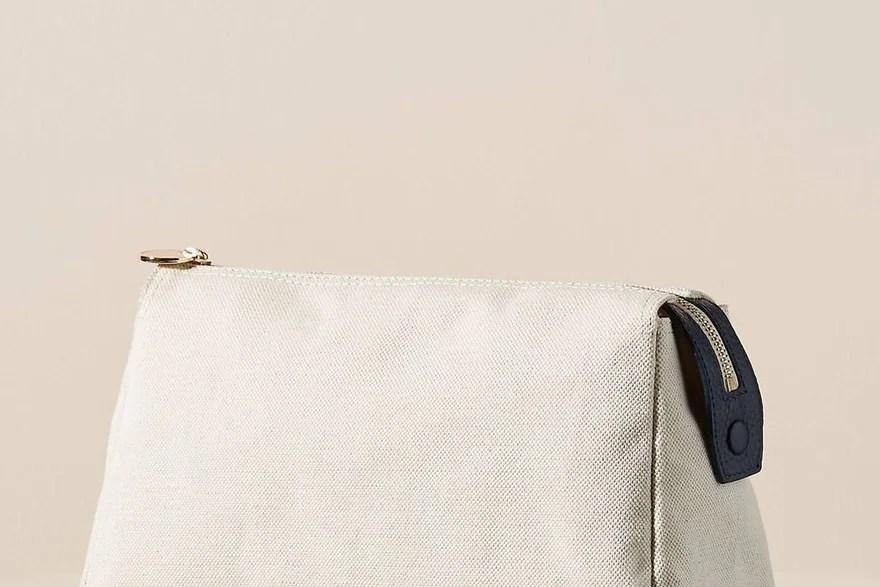
Where toiletry bag odour actually comes from
Odour in a toiletry bag is a materials problem before it is a cleaning problem. The smell is held in four places: the film of product residue on the lining, the moisture trapped in foam or interlining, the air space inside a closed shell, and the polymer itself. A bag that has carried shampoo, sunscreen or a damp flannel holds residue in the stitch holes along every seam, because on a coated shell the needle holes and the seam allowance are the only parts that absorb liquid.
Cosmetic residue is the largest source. Foundation, concealer, sunscreen and liquid lipstick contain ester oils, silicone fluids and waxes that stay fluid at room temperature and creep along a filament yarn. Once that film oxidises it produces the sweet, rancid note buyers describe as old makeup smell. A 22 x 15 x 8 cm pouch carrying six or seven liquid products accumulates 2-5 g of residue along the base seam over a season.
The second source is moisture. A bag closed within minutes of use traps 5-15 ml of water in the lining, foam and zip tape, and in a sealed shell that water has nowhere to go. The result is the flat, earthy note of damp storage. It is a moisture condition rather than a stain, which is why the first four methods below are drying methods.
The third source is the polymer itself: flexible PVC and some polyurethane coatings release plasticiser and residual solvent, strongest in the first days after the bag leaves its wrapper and fading with ventilation. The fourth is adsorption from the environment, where tobacco smoke, perfume and food leave volatile compounds that a lined bag holds and releases slowly.
- Sweet and rancid: oxidised cosmetic oils on the lining, usually along the base seam and binding.
- Flat and earthy: moisture held in foam padding, interlining or zip tape after the bag was closed wet.
- Sharp and solvent-like: plasticiser or residual solvent from a new PVC or PU shell.
- Smoke or perfume: volatile compounds adsorbed from the environment and released slowly in a closed bag.
- Sour and acidic: a spill dried inside a seam allowance or under a removable liner.
Diagnosing which of these is present takes one minute. Empty the bag, close it, leave it for two hours, then smell from about 30 cm. If the smell is strongest immediately after opening, the source is the air space. If it is strongest at the seams with the bag open, the source is residue. If it persists after an hour open, the source is the foam or the polymer.
The eight methods, ranked by risk to the fabric
The eight methods are ordered below from lowest risk to highest risk. The ordering matters, because the most common mistake is to start with the strongest chemistry on the most delicate shell. A 70 percent alcohol wipe will lift a residue film in seconds and will also lift a heat-transfer print, soften a TPU laminate and cloud a plated slider. Starting at the top of the list costs a day and saves the bag.
| Method | How it is applied | Contact time | Works best on | Do not use on |
|---|---|---|---|---|
| 1. Forced-air ventilation | Bag open, all compartments unzipped, in moving air at 20-25 degrees Celsius | 24-72 hours | New-bag solvent smell, light smoke adsorption | None |
| 2. Dry vacuum and brush-out | Soft brush along seams and binding, then vacuum with a brush head | 10-15 minutes | Powder residue, dry product spill | Loose glitter or foil laminate |
| 3. Sodium bicarbonate | 30-60 g in a breathable sachet, or dusted dry and vacuumed after | 12-48 hours | Damp smell on washable fabric shells | Suede, brushed tricot lining, wet bags |
| 4. Activated carbon | 50-100 g sachet inside the closed, completely dry bag | 48-96 hours | Smoke, perfume, mixed household odour | Bags that are still damp |
| 5. Diluted white vinegar | One part vinegar to three parts water, wiped on and wiped off | 5 minutes, then dry | Sour residue on wipe-clean linings | Acetate lining, natural rubber, bare metal hardware |
| 6. Isopropyl alcohol 70 percent | Wiped on a white cloth, one pass, then wiped dry | Under 60 seconds per area | Resin and adhesive residue on hard shells | Printed logos, TPU film, PVC film, painted hardware |
| 7. Controlled 30 degree wash | pH-neutral liquid detergent at half label dose, hand wash or delicate cycle in a mesh bag | 20-30 minutes | Cosmetic oil residue on nylon and polyester | Structured bags with cardboard or EVA formers, leather trim |
| 8. Sealed cold treatment | Bag sealed in a polyethylene bag with air pressed out, held at minus 18 degrees Celsius | 24-48 hours, then 24 hours drying | Odour in fabric shells that cannot be washed | Wet bags, PVC film, bags with liquid-crystal or gel inserts |
Methods 1, 2, 3 and 4 are the safe first line. They remove nothing from the fabric; they move the volatile compounds out of the bag and into the air or into an absorbent. For a bag that is worth 3 to 12 dollars at wholesale and that carries a printed logo, those four methods resolve the majority of complaints without touching the surface finish. Ventilation works best with actual air movement rather than still air: a bag hung in front of a fan for eight hours will out-perform a bag left on a shelf for three days.
Methods 5, 6 and 7 remove residue and therefore involve chemistry and water. They should always be preceded by a spot test on an inconspicuous area, typically the inside of the base panel or the underside of a flap, and assessed after the area has dried completely. Wet fabric hides damage: a TPU laminate softened by alcohol shows clouding only once dry.
Method 8 deserves a caution. Cold treatment slows the release of volatile compounds and suits a fabric shell that cannot be washed, but it does not remove the source. The bag must then be dried thoroughly, because a sealed cold bag generates condensation on its own lining. Any bag with a gel insert, a liquid-crystal panel or a PVC film can be stiffened by freezing and should be excluded.
Running a vinegar wipe and an alcohol wipe on the same day leaves a mixed residue and makes it impossible to tell which one caused any change in the surface. Allow 24 hours of drying between each chemical method and re-assess the bag before moving to the next one.
What each method can damage, by shell material
The same treatment produces very different results on different shells. The table below is a working risk matrix for the eight materials most commonly specified in cosmetic and toiletry programmes. Safe means the method can be used as described with a normal spot test. Spot test first means the method is acceptable on that material only after testing an inconspicuous area and checking it dry. Avoid means the risk of permanent change is high enough that another method should be chosen.
| Shell material | Bicarbonate | Vinegar 1:3 | IPA 70 percent | 30 degree wash | Cold treatment |
|---|---|---|---|---|---|
| Nylon 420D, PU coated | Safe | Safe | Spot test first | Safe | Safe |
| Polyester 600D canvas | Safe | Safe | Spot test first | Safe | Safe |
| Cotton canvas, 12 oz | Safe | Safe | Safe | Spot test first | Safe |
| TPU laminated polyester | Safe | Safe | Avoid | Spot test first | Safe |
| PVC film, 0.35 mm | Safe | Spot test first | Avoid | Avoid | Avoid |
| Moulded EVA case | Safe | Safe | Avoid | Avoid | Spot test first |
| PU (vegan) leather | Safe | Spot test first | Avoid | Avoid | Safe |
| Recycled PET with print | Safe | Safe | Avoid | Spot test first | Safe |
Two entries explain most of the damage that buyers see. Alcohol on a printed shell: solvent-based screen print, heat-transfer film and digital pigment print all sit on the surface rather than in the fibre, and a single pass with 70 percent isopropyl alcohol can lift or dull them. Colour fastness to solvents and to rubbing is measured by recognised methods, and a buyer who wants confidence on a printed shell should ask for evidence against the ISO 105 colour fastness series and the relevant rubbing and laundering methods listed in the AATCC test methods index when the specification is written, not after the complaint arrives.
The second entry is water on a structured shell. A vanity case with a 2.5 mm EVA former, a cardboard base board or a glued foam panel will hold water inside the structure, and that water cannot be dried out in a reasonable time.Immersion turns a recoverable surface odour into a structural one. Where the shell is structured, the wetted area should be limited to the lining, applied with a cloth rather than by soaking, and dried with the case open and supported so that air reaches the interior.
Hardware is the third risk and is frequently overlooked. Zinc-alloy sliders with a plated finish, brass-coloured pullers and painted metal feet all react to acid and to solvent. A vinegar wipe left on a slider for ten minutes can leave a permanent dull patch. The practical rule is to keep every liquid method at least 5 mm away from metal and to clean hardware separately with a dry cloth, using the terminology in the ASTM D2053 zipper terminology standard so that a specification names the slider, the tape and the elements correctly in a claim.
- Printed logos: keep alcohol, solvent and abrasive methods away from every decorative surface.
- Plated hardware: keep acid and solvent at least 5 mm away, and dry the slider immediately after any wipe.
- TPU and PVC film: avoid alcohol completely and avoid immersion; wipe with water and dry within minutes.
- Foam padding: no method reliably reaches odour held inside foam; treat the surface and accept the limit.
- Elastic loops and binding: heat and solvent both shorten elastic life; air dry only, never machine dry.
How to verify the result and decide when a bag is finished
Treatment without verification is guesswork. A simple protocol takes 24 hours and gives a defensible answer: empty the bag, clean it by the chosen method, dry it completely, close it, hold it at 20-22 degrees Celsius for 24 hours, then have two people smell it independently at 30 cm and record a score on a 0 to 4 internal scale, where 0 is no detectable odour and 4 is objectionable at arm's length. Repeat the cycle once. If the score has not moved after two cycles, further treatment will not help.
- Score 0-1 after two cycles: the bag is serviceable; return it to use and add a carbon sachet for a week.
- Score 2 after two cycles: usable for non-cosmetic storage; do not sell it as new stock.
- Score 3-4 after two cycles: retire the bag; the odour source is inside the foam, the former or the coating.
- Any visible coating lift, print loss or hardware dulling: stop immediately and record the method that caused it.
- Any sign of established microbial growth on a porous lining: stop cleaning and take remediation advice from a qualified professional.
The stop rule is the part buyers resist, because a returned unit costs more than a treatment. It should not. A bag that scores 3 after two correct cycles has an odour source that is inside the structure, and no amount of bicarbonate, vinegar or cold treatment will reach it. Continuing simply adds chemical stress to a shell that is already out of specification, and a shell that has been stripped of its print is unsaleable regardless of how it smells.
Every treatment result should be recorded against the style, because the pattern is more useful than the individual case. If eight units of one style come back with the same earthy note, the fault is in the lining or the packing, and no care leaflet will fix it. If complaints are spread evenly across styles, the fault is more likely to be transit or destination storage. A log with date, style, method used and score before and after takes a minute per unit and gives the buyer something concrete to take back to the specification.
The durable fix is at specification stage. Three decisions made before sampling reduce odour complaints far more than any aftercare leaflet: choose a lining that can be wiped rather than one that absorbs, specify a coating and adhesive system with documented low residual odour, and require a ventilation and packing protocol so that finished goods are not sealed into polyethylene while warm. Programmes run by QUANZHOU JUNYUAN BAGS apply an odour assessment during sampling, which typically runs 6-10 working days and 12-15 working days for complex constructions, and the assessment is repeated on bulk goods before despatch.
Buyers who document the requirement get a better result than buyers who ask for a nice-smelling bag. A workable line in a specification reads: lining wipe-clean, residual odour assessed on a 0-4 internal scale after 24 hours closed at 20-22 degrees Celsius, maximum score 1, verified on a sample of bulk goods under AQL 2.5 as defined by ISO 2859-1. That single sentence converts an argument about smell into a measurable acceptance criterion.
The B2B Customisation View
Programme planning for cosmetic bags starts with the end market: a hotel amenity run and a beauty-retail launch ask for completely different construction and compliance evidence.
Planning figures used across the programme: MOQ 500 pieces per style and colourway, 6–10 working days sampling (12–15 when moulding or multi-layer lamination is required), 35–50 days bulk lead time, AQL 2.5 to ISO 2859-1, FOB Xiamen, T/T 30/70.
The programme-management model exists because most import problems are documentation problems, and documentation is what this office produces and holds.
Which Brand Types Benefit Most
Odour control is a specification question rather than a marketing one, and the brand types that benefit differ in what they should ask for. Start-up brands launching a first pouch programme rarely have an aftercare document at all; a one-page odour and care card written at the same time as the tech pack costs almost nothing and prevents the first wave of returns that follows a summer launch. Established brands with seasonal cosmetic gift sets have the opposite problem: they already have a care claim, and the treatment method described in the leaflet must match the material actually used, or the claim becomes a liability. Retailers and wholesalers buying mixed assortments across several price bands should require the same internal 0-4 odour score from every style, because a single smelly style in a gift set damages the whole set. Two practical asks cover most of this. The first is an odour acceptance criterion written into the specification, assessed on a 0-4 internal scale after the bag has been closed for 24 hours at 20-22 degrees Celsius. The second is a packing requirement that finished goods are cool and dry before cartons are sealed, since a warm bag sealed into a carton generates its own moisture and its own smell. Both cost nothing at specification stage and both are far cheaper than a wave of returns after launch.
- Start-up brands: specify a wipe-clean lining and a documented low-odour coating before the first sample is made.
- Established brands: audit the care leaflet against the actual shell material, particularly where prints and plated hardware are used.
- Retailers and wholesalers: apply one internal odour score to every style in an assortment, not only to the premium styles.
- E-commerce sellers: photograph and record the odour score of returned units to separate a material defect from a use pattern.
- Gift and hospitality buyers: confirm that goods are packed dry and cool, since sealed warm cartons are a common source of new-bag odour.
Frequently Asked Questions
How long should a bicarbonate treatment stay inside a toiletry bag?
Twelve to forty-eight hours is the practical range, using 30-60 g of sodium bicarbonate in a breathable sachet rather than loose powder. Longer contact does not remove more odour once the absorbent is saturated, and loose powder left in a seam will absorb moisture and cake. Vacuum the bag afterwards, then leave it open for two hours before assessing the result.
Can white vinegar damage the zip on a toiletry bag?
It can. Diluted vinegar at one part to three parts water is mild, but prolonged contact dulls plated zinc-alloy sliders and can stain brass-coloured pullers. Keep the wipe at least 5 mm away from metal, wipe the zip area with water afterwards, and dry the slider with a cloth. Never leave a vinegar-dampened cloth folded over hardware overnight.
Is activated charcoal better than baking soda for a musty toiletry bag?
They work differently. Bicarbonate absorbs moisture and neutralises acidic compounds, so it suits a bag that is slightly damp or holds a sour residue. Activated carbon adsorbs a wider range of volatile compounds, so it suits smoke, perfume and mixed household odour in a fully dry bag. Use carbon only on dry goods, because water fills the carbon pores and makes it ineffective.
At what temperature should a smelly toiletry bag be washed?
Thirty degrees Celsius is the safe ceiling for coated nylon and polyester shells. Warmer water lifts cosmetic oil faster but softens polyurethane coatings, relaxes elastic and can set a protein-based stain. Use a pH-neutral liquid detergent at roughly half the label dose, rinse twice, and never machine dry, since heat is the single most common cause of coating damage on a washed pouch.
Does freezing a toiletry bag remove odour permanently?
No. A sealed cold treatment at minus 18 degrees Celsius for 24-48 hours slows the release of volatile compounds and buys time, but the source of the smell remains in the fabric. The bag must then be dried for a full 24 hours, because a sealed cold bag produces condensation on its own lining. Exclude PVC film, gel inserts and liquid-crystal panels entirely.
Why does a toiletry bag still smell after washing?
Because the smell is usually not on the surface. Residue held in a foam pad, a glued interlining or a cardboard former cannot be reached by a wash, and a wash that leaves the interior damp makes the problem worse. Dry the bag completely, repeat the 24-hour closed-bag assessment, and if the score has not improved after two cycles treat the unit as finished.
Can isopropyl alcohol remove the printed logo from a cosmetic bag?
Yes, and this is the most common avoidable damage seen in odour treatment. Screen print, heat-transfer film and digital pigment print sit on the surface of the fabric, and a single pass with 70 percent isopropyl alcohol can lift or dull them. On any printed shell, restrict alcohol to unprinted hard surfaces or avoid it and use a diluted vinegar wipe instead.
How do you remove sunscreen smell from a canvas toiletry bag?
Start dry, because sunscreen is an oil. Brush the seams and binding, then apply a pH-neutral liquid detergent directly to the base seam, work it in with a soft brush, and wash the whole bag at 30 degrees Celsius. Cotton canvas at 12 oz tolerates more agitation than coated nylon, but expect shrinkage of a few percent and dry the bag flat and supported.
What removes cigarette or smoke odour from a polyester toiletry bag?
Time and adsorption, not washing. Smoke compounds bind to filament yarn and are released slowly, so a single wash rarely resolves them. Use forced-air ventilation for 24-72 hours, then place a 50-100 g activated carbon sachet inside the closed, dry bag for 48-96 hours. Repeat once. A wash helps only if there is also a visible residue film to remove.
Is it safe to put a TPU-lined toiletry bag in the sun to air out?
Indirect light for an hour or two is acceptable; direct sun is not. Ultraviolet exposure degrades thermoplastic polyurethane and fades dyes, and the damage appears as clouding and stiffening rather than as an obvious colour change. Use moving air at room temperature instead. Where light fastness matters on a coloured shell, ask for evidence against the ISO 105 series.
How do you deodorise a toiletry bag with foam-padded interiors?
Treat the surface and accept the limit. Foam holds moisture and odour inside its cells, and no surface method reaches it. Ventilate with moving air until the bag is completely dry, which may take 48 hours for a 3 mm pad, then use an activated carbon sachet. If the score stays at 3 or 4 after two cycles, the padding is the source and the unit should be retired.
What causes the new bag smell and how long does it last?
It is plasticiser and residual solvent released from a PVC or polyurethane coating, strongest in the first days after the bag leaves its polyethylene wrapper. Ventilation with moving air at 20-25 degrees Celsius for 24-72 hours normally reduces it. Requiring finished goods to be packed cool and dry, and asking for low-odour coating evidence at sampling, prevents most of it.
Do fragrance sprays or essential oils mask toiletry bag odour safely?
They mask rather than remove, and they carry two risks. Essential oils can dissolve some coatings and printed films and can stain a light lining, and a fragranced bag can transfer scent onto products that then sit against skin. If a scent is wanted, use a purpose-made sachet held in a closed compartment away from fabric, and document it as a fragrance, not as odour removal.
How many odour treatments should a buyer attempt before replacing stock?
Two cycles of the same method, with a 24-hour closed-bag assessment after each. If the internal 0-4 score has not improved by at least one point, further treatment will not help and adds chemical stress to the shell. Replacement is cheaper than a customer complaint, and the cost of the returned unit should be logged against the style so the specification can be corrected.
What should a brand owner specify to reduce odour complaints at the sourcing stage?
Three things: a wipe-clean lining rather than an absorbent one, a coating and adhesive system with documented low residual odour, and a measurable acceptance criterion such as a maximum internal odour score of 1 after 24 hours closed at 20-22 degrees Celsius. Minimum order quantity is 500 pieces per style and colourway, and bulk production runs 35-50 days after sample approval.
Does odour treatment change colour fastness requirements for printed shells?
It should. Any method involving solvent or water can affect a printed surface, so a printed shell needs rubbing and laundering fastness evidence in addition to the odour criterion. Ask for results against the ISO 105 series and the relevant AATCC rubbing and laundering methods, and require the same evidence on bulk goods as on the approved sample.
People Also Ask
Why does my toiletry bag smell even when it is empty?
Because the smell is not in the contents. Cosmetic oils and moisture sit in the seam holes, the binding tape and the foam padding, and a closed bag re-absorbs its own volatile compounds. Empty the bag, ventilate it with moving air for 24-72 hours, and if the smell persists at the seams the source is residue in the fabric rather than anything left inside. Repeat the check after the bag has been open for an hour to tell residue apart from the polymer itself.
Can you machine wash a toiletry bag?
Only an unstructured fabric shell, and only on a delicate cycle at 30 degrees Celsius inside a mesh bag with a pH-neutral detergent at half dose. Structured cases with EVA formers, cardboard bases or glued foam panels should not be immersed, because water trapped inside the structure cannot be dried out. Never machine dry any toiletry bag. Dry the shell completely afterwards, because a bag put away damp will smell worse than before.
What absorbs odour best in a small bag?
For a dry bag, 50-100 g of activated carbon in a breathable sachet, because carbon adsorbs the widest range of volatile compounds. For a slightly damp bag, 30-60 g of sodium bicarbonate, which also absorbs moisture. Both need the bag closed and undisturbed, and neither removes the source of the smell, so they work best after cleaning and drying. Replace a sachet once it has been in a closed bag for more than three months.
How do you stop a toiletry bag from smelling in the first place?
Dry it before it is closed. Most persistent odour starts with a bag zipped shut while the lining is still damp from a wet flannel or a leaking bottle. Wipe the lining after use, leave the bag open for an hour where possible, store it with a carbon sachet, and keep liquid products in a separate sealed pouch inside the main compartment. A small carbon sachet left in the bag between trips costs very little and does most of the work.
Request a Sample or a Written Quotation
Send the silhouette, dimensions, material preference and logo artwork, and the programme team will return a written quotation with MOQ, sampling window, bulk lead time and inspection standard.
Email: [email protected] · WhatsApp: +86 177 5002 0688