Skincare Fridge Travel Bags: Mini Refrigerator Transport
Executive Summary
Skincare fridge travel bags are structured carriers patterned around a mini cosmetic refrigerator - a 4-10 L thermoelectric unit drawing 30-60 W - rather than around bottles of product. The answer to what makes one work is ventilation, not insulation. A thermoelectric module pumps heat from its cold side to a hot-side heatsink, and if the bag will not let that rejected heat leave, interior air temperature climbs and the appliance ends up pumping against its own exhaust. A workable specification therefore starts with vent area and airflow path, adds structure to hold a 2.5-6 kg appliance upright, then manages the power bank and its cable.
Because the payload is electrical, the buyer's job is to specify measurable geometry and test methods rather than cooling performance. Practical targets include net free vent area on two separated faces, a 15-25 mm standoff between the exhaust face and the lining, a grommeted cable pass-through with strain relief, and a vented upright sleeve for a 20,000-26,800 mAh power bank. Minimum order is 500 pieces per style and colourway, sampling runs 6-10 working days, and complex constructions with moulded shells or bonded panels take 12-15 working days.
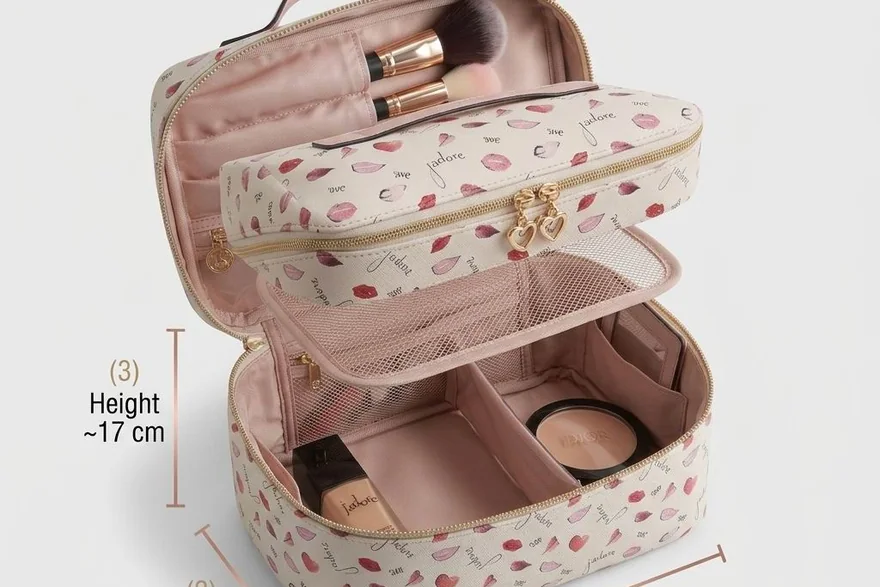
What a skincare fridge travel bag actually carries
A skincare fridge travel bag is a structured carrier patterned around a mini cosmetic refrigerator rather than around bottles and jars. The appliances in this segment run 4 L to 10 L of internal volume, stand roughly 250-400 mm tall, weigh 2.5-6 kg empty and draw 30-60 W from a 12 V or USB-C supply. That payload has a fan, a finned heatsink and a door gasket, and the bag has to carry it upright, absorb knocks and let its waste heat escape. Treating the project as a cooler bag - a sealed, insulated box meant to keep things cold - is the most common specification error in the category, because the physics runs the other way: the appliance is a heat pump that has to dump heat into the surrounding air.
Two cooling technologies appear in the mini vanity fridge segment and they behave differently inside a bag. Thermoelectric units dominate the 4-6 L class: they are light, have no compressor, and move heat from a cold plate to a hot-side heatsink that a small fan blows across, so the exhaust is a broad flow of warm air from a grille on the back or one side. Compressor units cool harder but weigh more, hum and vibrate, and rarely appear below 10 L. For pattern making the distinction decides vent placement, because a thermoelectric exhaust is a distributed face plus a fan outlet while a compressor condenser is a coil that wants open air on one side.
- Outer dimensions, and which face carries the exhaust grille and fan outlet
- Rated input: voltage, current, wattage and connector type - 12 V barrel, USB-C or captive mains lead
- Empty weight and centre-of-gravity position, plus foot height for a recessed base panel
- Door swing direction and whether the carry handle is rigid or folding
- Any requirement that the unit run upright, and the maximum tilt the maker permits
Because the payload is electrical equipment, the bag sits beside appliance safety rather than inside it. Buyers do not certify the bag as an appliance, but the appliance itself should carry the electrical safety documentation required for the destination market, and no bag panel may cover a mandatory marking, rating plate or warning label. International electrotechnical standards are coordinated through the International Electrotechnical Commission. Where a set is marketed to younger users, component materials also fall under the lead and phthalate limits in the Consumer Product Safety Improvement Act, which changes the material test plan even though the bag itself carries no current.
Why ventilation, not insulation, is the design constraint
A thermoelectric module moves heat from one face to the other; it does not destroy it. Whatever the cold side removes from the product compartment, plus the module's own electrical draw, has to leave through the hot side. If a bag wraps that hot face in closed-cell foam and a sealed lining, the rejected heat has nowhere to go, the air inside warms, and the module ends up pumping against an ever-higher sink temperature. Cooling capacity falls, the fan runs longer, and on a long car journey or an unattended hotel run the appliance can trip its own thermal cut-out. The design goal is a clear airflow path: air in low, warm air out high, nothing pressed against the exhaust face.
Three numbers make this manageable. Net free vent area is the open area after mesh, backing and any decorative overlay, not the nominal cut-out size; a 60 x 80 mm opening backed by a fine mesh and a bonded scrim can deliver less than half its nominal figure. Standoff is the distance between the exhaust face and the nearest lining, maintained by a spacer, a moulded channel or a stiffened rib rather than by hope, because a soft shell collapses against the appliance as soon as it is lifted. Separation means intake and exhaust should not sit on the same panel a few centimetres apart, or the bag simply recirculates its own warm air.
| Vent configuration | Free area and path | What it suits | Risk to watch |
|---|---|---|---|
| Two opposing mesh panels, low intake and high exhaust | 80-120 cm2 net free area, cross-flow path | 6-10 L thermoelectric units in car or hotel use | Panels blocked when the bag is set down on carpet |
| Single rear panel with 15-25 mm standoff ribs | 60-90 cm2, exhaust only, intake through the zip line | 4-6 L units with a rear fan grille | Recirculation if a rain flap tightens the zip gap |
| Hidden vent under a storm flap with side exits | 70-100 cm2, weather-shedding, indirect path | Outdoor and festival use where spray is likely | Flap membrane sticking to the mesh when wet |
| Removable mesh sleeve with no fixed panel | Open mesh across 40-60 per cent of the shell | Light 4 L units carried by hand | Little structure; the unit presses into the mesh |
| Fully sealed insulated shell | No free area | Not suitable for a running thermoelectric unit | Heat build-up, thermal cut-out, nuisance tripping |
Mesh choice is where vents are quietly lost. A polyester mesh with a 0.6-0.8 mm aperture keeps out grit and still passes useful airflow if it is backed by a stiff scrim, whereas a bonded nonwoven laminate looks tidier and can halve open area. Buyers should specify mesh by aperture and by open-area percentage rather than by appearance, and should require the same grade in the sample and in bulk. A mesh substitution at bulk stage is a classic source of field complaints that never show up in a pre-shipment report, because the report checks presence of a vent and not its permeability.
- Net free vent area stated in cm2, measured after mesh and overlay
- Minimum standoff between exhaust face and lining, held by a rib or spacer
- Intake and exhaust on different faces, or vertically separated
- Vent position dimensioned on the tech pack so it cannot drift to a blocked zone
- Confirmation that no strap, pocket or logo patch crosses any vent
- Mesh specified by aperture and open-area percentage, not by colour

Power bank and cable management inside the bag
Almost every portable use case for a mini skincare fridge depends on a power bank or a 12 V car lead, and both bring mass, heat and cabling into the bag. A 20,000-26,800 mAh bank adds 350-500 g and occupies roughly 150 x 70 x 25 mm; it is dense, hard-edged and must not be allowed to slide onto the appliance exhaust face or into the vent path. A dedicated upright sleeve on the opposite side of the bag from the vents keeps the bank clear of warm airflow and stops it abrading the appliance door. The sleeve should also be vented or unlined, because a bank that is charging and discharging inside sealed padding has its own thermal story.
Airline rules set the outer boundary. Lithium power banks are limited by watt-hours: up to 100 Wh normally travels in the cabin without airline approval, 100-160 Wh needs approval, and above that is prohibited, which is why 26,800 mAh at 3.7 V nominal - about 99 Wh - is such a common capacity. The bag cannot change that rule, but the specification can help, because an external, easy-access bank pocket lets the user remove the bank at screening without unpacking the appliance. Cable management completes the picture: a pass-through grommet, a short internal lead with strain relief, and a stow loop for the mains lead so it never lies coiled against a warm surface.
| Power option | What the bag must provide | Planning run time | Watch point |
|---|---|---|---|
| USB-C power bank, 20,000-26,800 mAh | Vented upright sleeve, external access, space for a watt-hour label | 2-5 h depending on appliance draw and ambient | Bank must stay clear of the exhaust path |
| 12 V car lead, 2-3 m | Grommet pass-through and a stow pocket for the coiled lead | Continuous while the engine runs | Lead pinched in the zip; specify a grommet, not a gap |
| Mains adapter with captive lead | Padded brick pocket isolated from vents and from the bank | Continuous | Adapter bricks run warm in use |
| PD bank with charge display | Clear TPU window over the indicator | 2-4 h | Window material must survive scuff checks at AQL 2.5 |
| No power provision | Appliance travels empty and unpowered | Not applicable | Standoff still needed so the unit is not crushed |
Two small details separate a usable bag from a frustrating one. The first is a captive loop or hook-and-loop cable tidy positioned within 100-150 mm of the appliance inlet so the lead cannot dangle where the zip will catch it. The second is a documented maximum length for the internal lead: too long and it coils and traps heat, too short and the user props the bank against the appliance. Both are cheap to correct at sample stage and expensive once bulk has shipped. Where the set is sold as a travel kit, the liquids carried inside remain subject to the TSA 3-1-1 liquids rule on the day of travel, which argues for a removable clear pouch rather than integrated bottles.
- Power bank sleeve on the opposite side from the exhaust vents
- Sleeve vented or unlined, with no sealed padding around a working bank
- Bound or moulded grommet pass-through rather than a gap at the zip line
- Cable tidy within 100-150 mm of the appliance inlet
- Flat space on the sleeve for a watt-hour label
- Mains brick pocket isolated from both the bank and the vent field
Specifying tests instead of making cooling claims
A bag programme cannot certify how cold a fridge gets, and a buyer should not ask for that number. What can be specified is a repeatable bench test demonstrating that the bag does not strangle the appliance. A practical protocol places the appliance in the bag, closes it, runs it from a regulated supply at a stated ambient for a stated period, and records three readings: compartment temperature, air temperature at the exhaust face, and the warmest exterior bag surface. The pass criterion is comparative - the bagged appliance should not run materially hotter at its exhaust face than the same appliance running uncovered on the bench, and no surface a user touches should be uncomfortable to hold.
The protocol belongs in the tech pack with numbers attached: ambient, duration, supply voltage, sensor positions and thresholds. Run it on the approval sample, keep the sample as the reference, and repeat it on a bulk pull when a result is disputed. This keeps marketing language honest. A brand can say the bag is designed with a specified vent area and airflow path and has been bench-tested for exhaust temperature, while making no claim about how cold it keeps a serum. Statements about formulation stability belong to the skincare brand and to its own stability data, never to the bag specification.
Because the vent and standoff features are functional rather than decorative, they should be listed as inspection checkpoints under ISO 2859-1 sampling at AQL 2.5. A blocked vent, a missing spacer or a denser mesh grade than the approved sample is a major defect, not an appearance issue. Sequencing also matters more than usual here: because the bag has to fit a specific appliance, the appliance sample should be in hand before the pattern is cut, and any change of appliance model or revision restarts the vent layout. Locking the appliance SKU and revision number into the tech pack avoids the most expensive failure in the category, which is a bulk run of bags that fits last season's fridge.
| Checkpoint | Method | Pass criterion | Defect class |
|---|---|---|---|
| Net free vent area | Compare against an aperture template approved at sample stage | Within 10 per cent of the approved sample | Major |
| Standoff at the exhaust face | Insert a go/no-go gauge between appliance and lining | Gauge passes at four points around the exhaust | Major |
| Vent free of obstruction | Visual check at 500 mm under 800-1000 lux | No strap, pocket or patch over any vent | Major |
| Exhaust temperature rise | Comparative bench run, bagged versus uncovered | Rise within the agreed threshold | Critical |
| Cable pass-through integrity | Insert and withdraw the specified plug 25 times | Grommet stays seated with no tear | Minor |
| Loaded drop test | Drop 450 mm onto concrete on six faces with the payload fitted | Appliance undamaged, vents and spacers intact | Critical |
Minimum order is 500 pieces per style and colourway. Sampling runs 6-10 working days, extending to 12-15 working days for constructions with moulded shells, bonded panels or integrated grommets. Bulk production is 35-50 days after sample approval. Inspection is AQL 2.5 under ISO 2859-1, shipment is FOB Xiamen, and payment is T/T 30 deposit with 70 against bill of lading.
The B2B Customisation View
Cost, compliance and craft pull against each other on every cosmetic pouches, vanity cases and beauty organisers project; the specification is the record of how those three forces were balanced.
Commercial parameters stay fixed across the range: MOQ 500 pieces per style and colourway, prototype turnaround 6–10 working days (extended to 12–15 for multi-panel or moulded builds), bulk lead time 35–50 days from approved sample, AQL 2.5 inspection to ISO 2859-1, FOB Xiamen, T/T 30 deposit and 70 against bill of lading.
Buyers who use a programme coordinator keep their own supply-chain optionality; the technical pack travels, so production can be re-placed if a launch is brought forward.
Which Brand Types Benefit Most
Beauty appliance brands benefit first, because a fitted carrier converts a boxed mini fridge into a travel product and lifts the perceived value of a gift set without changing the appliance. The pattern only works if the appliance model is frozen before the bag is developed, so these buyers should lock the appliance revision in the tech pack. Skincare brands running subscription or gift-with-purchase programmes use the carrier as a premium tier: the bag is the visible reward, the appliance is the hook, and the vent specification is what stops returns. Retailers and e-commerce sellers benefit where the listing competes on reviews, because a bag that visibly strangles the appliance generates the worst kind of review - one that blames the brand rather than the use. Hospitality and spa buyers use the format differently, as a treatment-room or suite amenity carrier, where the bag must survive daily handling and wipe-clean maintenance rather than a suitcase, and where the appliance usually runs from mains rather than from a power bank; the ventilation requirement does not disappear in that setting, because a unit running all day inside a cabinet rejects heat continuously. Promotional buyers working to a fixed gift-set budget should weigh the trade-off honestly: net free vent area, standoff spacers and a grommeted pass-through all cost money, and a carrier designed to the cheapest construction that will still hold the appliance is the one most likely to generate complaints costing more than the saving. Across every brand type the same sequencing rule applies - freeze the appliance SKU and its revision in the tech pack before the pattern is cut, allow 6-10 working days for a sewn carrier or 12-15 working days where a moulded shell or bonded panel is involved, and plan bulk at 35-50 days after sample approval.
- Appliance brands bundling a carrier with a mini fridge SKU
- Skincare brands building a premium gift or subscription tier
- Retailers and marketplaces where review quality drives the listing
- Hospitality and spa buyers needing a wipe-clean, daily-handling carrier
- Promotional buyers working to a fixed gift-set budget
Frequently Asked Questions
What net free vent area should a skincare fridge travel bag specify?
A workable starting target is 80-120 cm2 of net free area for a 6-10 L thermoelectric unit, split between a low intake and a high exhaust on different faces. Net means measured after mesh, backing and any decorative overlay, not the nominal cut-out. Smaller 4 L units with a rear fan grille can work on 60-90 cm2 provided a 15-25 mm standoff is maintained. The figure belongs in the tech pack and should be checked against the approved sample at inspection.
Can a skincare fridge travel bag be insulated at all?
Insulation helps on faces that are not involved in heat rejection and harms the exhaust face. A 3-5 mm closed-cell panel in the base and along the cold-side wall damps knocks and slows heat gain from a hot car, but any panel over the exhaust grille traps rejected heat. The practical approach is a zoned shell: insulated where the appliance is thermally inert, vented where it breathes, with the boundary marked on the pattern.
Which face of the bag should carry the exhaust vent?
The exhaust vent belongs on the same face as the appliance fan outlet, usually the back or one side, with the intake placed low on a different face or vertically separated from it. Placing intake and exhaust a few centimetres apart on one panel causes the bag to recirculate its own warm air. The appliance supplier should confirm which face carries the grille before the pattern is cut, and the answer should be recorded rather than assumed.
How is standoff between the appliance and the lining maintained?
Standoff has to be structural rather than incidental. A moulded channel, a welded rib, a stiffened welt or a spacer panel holds the lining 15-25 mm clear of the exhaust face so the shell cannot collapse against the appliance when the bag is lifted. A soft bag without a spacer presses flat under its own load. Buyers should specify a go/no-go gauge that passes at four points around the exhaust, and inspect it as a functional checkpoint.
Should the bag pattern to one fridge model or to a size class?
To one model, and ideally to one revision of that model. A 20 mm change in shell height or a relocated fan grille moves the vent layout and can make a bulk run unusable. Where a brand expects to change appliance suppliers mid-programme, the safer route is an adjustable interior with a removable spacer set and a generously sized vent field, though that trades away some of the fitted appearance that makes the product look premium.
What power bank capacity makes sense for a mini skincare fridge bag?
Most portable configurations use a 20,000-26,800 mAh bank, which at 3.7 V nominal sits at roughly 74-99 Wh and therefore stays inside the 100 Wh cabin limit that normally needs no airline approval. Actual run time depends on appliance draw and ambient temperature rather than on the bag. The bag's job is to hold the bank upright, vented and clear of the exhaust path, and to give the user access to it at security screening.
Can the power bank share a pocket with the mains adapter?
No. Adapter bricks run warm in use and a power bank also warms while charging and discharging, so the two need separate pockets, both isolated from the appliance exhaust path. Sharing a padded sealed pocket around two heat sources creates a hot spot against a lining that was never rated for it. Separation also stops the heavier brick abrading the bank's casing during transport.
Why specify a cable grommet instead of a gap at the zip line?
A gap at the zip leaves an uncontrolled opening that widens under load, lets the cable chafe against the tape and can admit water. A bound or moulded grommet fixes the opening size, protects the cable at the entry point and keeps the zip line clean. It also gives inspection a defined checkpoint: insert and withdraw the specified plug 25 times and the grommet must stay seated with no tear.
Will closing the bag around a running appliance cause overheating?
It can, if the exhaust has nowhere to go. A thermoelectric unit rejects both the heat removed from the compartment and its own electrical draw through the hot side; seal that face and local air temperature rises until the module loses capacity or the unit trips a thermal cut-out. The bag should be treated as a vented carrier, and the appliance should normally be run only with the vent field uncovered and the standoff intact.
What test demonstrates that a bag is not strangling the appliance?
A comparative bench run is the practical method. Run the appliance uncovered on a bench at a stated ambient for a stated period and record compartment temperature, exhaust-face temperature and the warmest exterior surface; then repeat with the appliance bagged. The pass criterion is comparative: the bagged unit should not run materially hotter at the exhaust face than the uncovered one, and no touched surface should be uncomfortable to hold.
Are cooling-performance claims permitted on the bag or its packaging?
Not as a bag claim. The programme can state measurable design facts such as vent area, standoff, airflow path and the fact that the design has been bench-tested for exhaust temperature. Any statement about how cold a product is kept, or how long a formulation stays stable, belongs to the appliance or skincare brand and to its own data. Keeping the claim set factual also keeps it defensible across different markets.
How do CPSIA limits apply to a skincare fridge gift set bag?
CPSIA applies when the set is a children's product by age grading or by marketing. Component materials - shell fabric, coating, zipper tape, screen print and any PVC trim - then fall under lead and phthalate limits, and the test plan has to cover components individually rather than the finished bag as a whole. Adult skincare sets sit outside that scope, but many brands specify to the same limits to keep a single material platform.
What drop test suits a bag carrying a 6 kg appliance?
A loaded drop test is more meaningful than an empty one. Load the bag with the appliance or an equivalent mass, drop 450 mm onto concrete on six faces, and require the appliance undamaged, vents intact and spacers unbroken. Empty-bag drops pass easily and say nothing about whether the structure protects the payload. Record the result on the approval sample so that bulk pieces can be judged against a known reference.
What sampling lead time applies to a vented fridge carrier?
A straightforward sewn carrier with mesh panels and a bound grommet typically samples in 6-10 working days. Constructions with moulded shells, bonded panels, welded ribs or integrated grommets fall into the 12-15 working day band because tooling and bonding trials add steps. Bulk then runs 35-50 days after sample approval, with inspection at AQL 2.5 under ISO 2859-1 and shipment FOB Xiamen.
How should the vent feature be treated at pre-shipment inspection?
As a functional checkpoint, not a cosmetic one. A blocked vent, a missing spacer, a denser mesh than the approved grade, or a strap routed across the exhaust should all be classed as major defects, and a failed comparative exhaust-temperature result as critical where it is measured at inspection. Listing these in the inspection worksheet prevents the argument that a covered vent is merely an appearance issue.
People Also Ask
Do mini skincare fridges need ventilation when packed in a bag?
Yes, when they are running. A thermoelectric mini fridge is a heat pump: it moves heat out of the compartment and rejects it through a finned heatsink and fan, so the warm air has to leave the bag. A sealed insulated carrier allows that heat to accumulate until the unit loses capacity or trips its thermal protection. Vent free area, standoff and an intake-to-exhaust path are the three specifications that make the difference.
Can you take a skincare fridge on a plane?
The appliance itself is normally carried as cabin or checked luggage subject to the airline's size and weight rules, and any lithium power bank travels in the cabin within watt-hour limits - up to 100 Wh generally without approval, 100-160 Wh with it. Bag design cannot change those rules, but an externally accessible, removable power-bank pocket makes screening quicker and keeps the bank out of the checked hold.
How long will a power bank run a mini skincare fridge?
Run time depends on appliance draw, ambient temperature and duty cycle rather than on the bag, so the honest answer is that a buyer should specify a test rather than a number. As a planning figure for budgeting, a 20,000-26,800 mAh bank at 3.7 V nominal gives roughly 74-99 Wh of stored energy, and typical 4-6 L thermoelectric units draw 30-60 W with the compressor-free fan running intermittently.
Why does a skincare fridge stop cooling inside a closed bag?
Because the rejected heat has nowhere to go. The thermoelectric module pumps heat to its hot side, a fan blows it into the surrounding air, and a closed bag recycles that warm air back across the hot side. Sink temperature rises, cooling capacity falls, and the protection circuit eventually cuts in. The remedy is design: net free vent area, a maintained standoff, and intake and exhaust on separated faces.
Request a Sample or a Written Quotation
Send the silhouette, dimensions, material preference and logo artwork, and the programme team will return a written quotation with MOQ, sampling window, bulk lead time and inspection standard.
Email: [email protected] · WhatsApp: +86 177 5002 0688