Travel Size Cosmetic Bag Filling Stations: Refill Station Design
Executive Summary
Travel size cosmetic bag filling stations are retail service points where a shopper decants product from a bulk container into small reusable bottles, then carries those bottles in a travel cosmetic bag. The honest answer is that a filling station is a retail-service concept rather than a product a buyer can source like a bag: it is furniture plus a written procedure, trained staff, a cleaning schedule and a refill log, and most of the risk sits in the procedure, not in the fixture. What a sourcing programme can supply is the vessel, the closure and the bag that carries them.
Because the risk is procedural, the vessel specification carries unusual weight. Three decisions decide whether a refill programme is defensible: how contamination is prevented during decanting, whether the bulk container and the travel bottle closures are genuinely compatible, and what labelling goes onto a refilled bottle - contents, batch code, fill date and period-after-opening. Minimum order for a travel bottle and bag programme is 500 pieces per style and colourway, sampling runs 6-10 working days, and programmes with custom closures or moulded bottles take 12-15 working days.
Why a refill station is a service concept, not a product
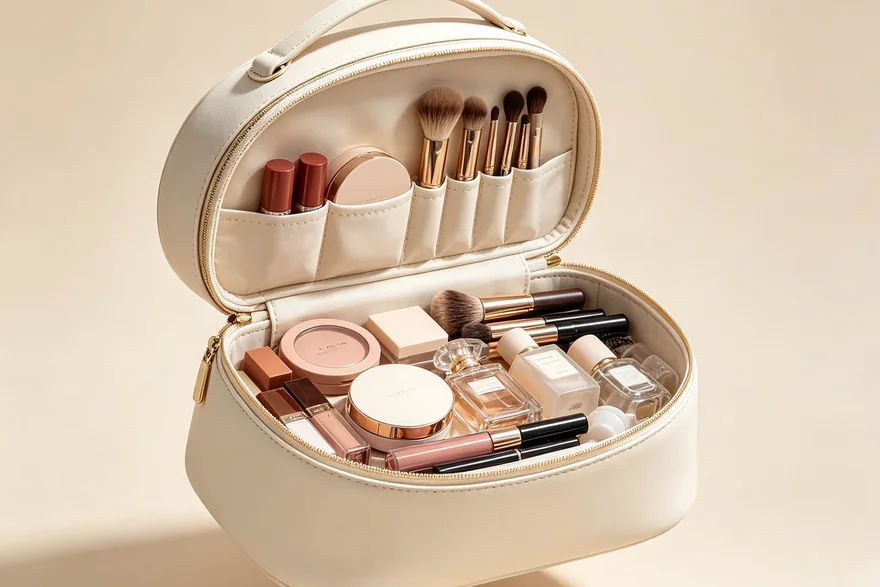
A travel size filling station is a counter or table unit that holds bulk containers, dispensing tools, fill marks or a scale, cleaning materials and a refill log. The customer decants product into a small vessel, labels it and puts it into a travel cosmetic bag. None of that is a single manufactured article. It is a piece of furniture combined with a written procedure and a trained operator, which is why a brief that asks for a filling station as though it were a bag SKU tends to stall: the fixture can be bought, but the hygiene, the record-keeping and the staff training cannot be ordered from a bag programme.
Dividing ownership makes the project workable. The product brand owns the formulation, the bulk pack and any decision about whether that formulation is suitable for repeated opening. The retailer owns the location, the station, the operator and the cleaning schedule. A sourcing programme owns what it can actually control: the travel vessel, its closure, the label stock, the bag that carries the set and the packing. Written scope along those lines prevents the common failure where a fixture arrives and nobody has decided who cleans the funnels.
Sizing is the one part of the station concept that does translate into a product brief. A travel range usually spans 10 ml for concentrate or serum, 30 ml and 50 ml for most liquids, and 100 ml as the largest container that passes the TSA 3-1-1 liquids rule in carry-on. The bag then has to hold that range upright, which sets loop diameter, liner height and the depth of any elastic band.
- Vessel range - 10, 30, 50 and 100 ml, with matched closures
- Closure set - screw cap, disc top, pump, mist sprayer or dropper, chosen by product
- Label stock - conformable film sized to the smallest bottle diameter
- Travel bag - upright loops, wipe-clean liner, labelled contents panel
- Refill log template - bulk batch code, fill date, operator, container identity
- Cleaning schedule - tool replacement frequency and wipe-down intervals
Decanting hygiene and contamination control
Every contamination route at a station is mundane and every one of them is controllable. Product residue from the previous fill is the biggest: a funnel or pipette used across products carries one formulation into the next and, worse, carries one preservative system into a formulation that depends on a different one. The bulk container mouth is the second, because repeated opening exposes product to air and to whatever touched the last tool. Hands, airborne dust and any water introduced during rinsing complete the list.
The control is to treat dispensing tools as consumables with a stated life. Single-use funnels and pipettes per fill remove the cross-product route entirely at modest cost. Where reusable tools are preferred, they should be dedicated to one product line, cleaned on a documented schedule and replaced on a stated cycle rather than when they look tired. No water should be introduced into a vessel that will hold anhydrous or preserved product, because water activity is exactly what the formulation's preservation system was designed around.
- One dispensing tool per product line, or single-use tools per fill
- Documented tool replacement cycle, not condition-based replacement
- No water introduced into vessels or bulk containers at any point
- Bulk container mouths wiped before and after each decanting session
- Refill log recording bulk batch code, fill date and operator against each fill
- Vessels cleaned and fully dried before they are returned to a customer for refill
Vessel materials still carry their own compliance obligations, independent of the procedure. Bottle bodies, closures, liners and any printed label stock have to meet the chemical restrictions of the destination market; the EU framework buyers will be asked about most often is REACH, and a refillable vessel is in scope because it is an article placed on that market. Buyers should request material declarations per component rather than a single statement covering the finished set.
Traceability is what makes a refill programme defensible after the fact. If a bulk batch is later withdrawn, the retailer needs to know which customers received it, which means the refill log has to carry the bulk batch code against the fill date. That is a procedural requirement, but it has a product consequence: the label must leave room for a batch code and a date written or printed at the point of fill, which is a design decision made months earlier, at the artwork stage.
The bulk container itself belongs to the specification. A wide-mouth jar invites tool contact and repeated air exposure; a pump, a tap or a controlled-orifice spout reduces both. Where a brand supplies bulk in a 500 ml or 1 L pack, the station should dispense from a dedicated container with a controlled outlet rather than pouring from the retail pack, and that outlet should be wiped on the same schedule as the dispensing tools.
Fill size interacts with exposure in a way that is easy to miss. Decanting 10 ml at a time means the bulk container is opened several times more often than decanting 50 ml for the same volume dispensed, so a range dominated by very small vessels multiplies the number of opening events. That argues either for a station offering fewer, larger sizes, or for a bulk pack sized so that a container is emptied within the period the formulation owner is comfortable with once opened.
Closure compatibility between bulk container and travel vessel
Leaking refill bottles are almost always a mismatch rather than a defective part. Two dimensions govern the fit: the neck finish, which is the thread geometry of the bottle mouth, and the closure family, which has to suit the product's viscosity and dispensing behaviour. A 24/410 neck with a screw cap and an induction-style liner behaves very differently from the same neck on a lotion pump. Buyers should specify both, since a closure quoted without a neck finish is not a specification at all.
| Closure family | Typical neck finish | Suits product viscosity | Leak-test method |
|---|---|---|---|
| Screw cap with liner | 20/410, 24/410 | Thin to medium liquids and gels | Inverted 24 h hold plus torque check |
| Disc top / flip top | 20/410, 24/410 | Medium viscosity, one-handed use | Inverted hold plus 1 m drop onto board |
| Lotion pump | 24/410, 28/410 | Medium to high viscosity | Pump primed, inverted hold, temperature cycle |
| Fine mist sprayer | 20/410, 24/410 | Very thin liquids only | Pressure hold with sprayer actuated 20 times |
| Dropper with bulb | 18/410, 20/410 | Serums and oils, low volume | Inverted hold with dropper filled |
| Screw cap with tamper band | 24/410 | Any, where tamper evidence is required | Band integrity check plus inverted hold |
Testing should use the real formulation. A closure that passes a water test can fail against a surfactant-rich or oil-based product, because surface tension and viscosity change how fluid finds a path past a liner. A practical sequence is: fill to the stated volume, apply the specified closure torque, hold inverted over absorbent paper for 24 hours at room temperature, then repeat after a temperature cycle. Any moisture beyond an agreed mark is a major defect, checked at ISO 2859-1 sampling at AQL 2.5.
The bag then has to protect the closure in transit. Upright loops sized to the bottle diameter stop bottles leaning on a pump actuator, which is the usual cause of a bag arriving with product pumped into the liner. Loops should be elastic or semi-elastic so they grip without compressing a pump head, and the liner under the bottle row should be wipe-clean, since a slow weep is far more likely in a refill programme than in a factory-filled retail pack.
Dispensing behaviour at the station matters as much as leak performance. A screw cap is the most leak-tolerant and the slowest to use; a disc top is one-handed and quick, which suits a counter with a queue; a pump suits viscous product but needs headroom above the bottle and cannot be laid flat in a bag. The closure should be chosen by the station's throughput and by how the bottle is then carried, not by which option looks most premium in a rendering.
Liners and torque decide whether a good closure still leaks. A foam liner compresses and reseals; an induction-style liner gives tamper evidence but is effectively a single-use seal. Over-torquing strips a thread or deforms a liner, and under-torquing leaves a path, so the specification should state an applied torque range and the tooling used to achieve it. Where a station refills the same vessel repeatedly, liner life should also be stated: a liner specified for one fill will not survive twenty.
Labelling contents, date and batch on a refilled vessel
A factory-filled retail bottle carries its identity from the production line. A refilled bottle carries whatever the station puts on it, which is why labelling is the highest-consequence part of the whole concept. Six elements belong on a refilled travel vessel: what the product is, whose it is, which bulk batch it came from, when it was filled, how long it may be used after opening, and any warning that travelled with the original product. Omitting the fill date is the most common gap.
| Label element | Why it is on the bottle | Placement | Durability requirement |
|---|---|---|---|
| Product name and contents | Identifies the product once the bulk label is gone | Front face, above the shoulder curve | Legible after 100 rubs with a damp cloth |
| Brand or station identity | Associates the fill with a responsible party | Front face, secondary position | No edge lift after 7 days at 40 C |
| Bulk batch or lot code | Makes a later withdrawal traceable | Rear or base, small type | Resistant to hand cream and sunscreen |
| Fill date | Anchors the period-after-opening calculation | Rear, written or printed at fill | Permanent marker or thermal print, not pencil |
| Period-after-opening symbol | States usable life once opened | Rear or front, near the fill date | Legible for the full stated period |
| Net volume and warnings | Mirrors the original product information | Rear, smallest legible type | No delamination at the bottle curvature |
Label stock fails on small bottles for mechanical reasons. A 30 ml bottle can be under 30 mm in diameter, so a stiff paper label lifts at the edges within days and a thick film bridges across the curvature. Conformable thin films with an adhesive matched to the bottle material - different adhesives for PE, PP and PET - hold far better. The adhesive then has to survive its environment: hand cream, sunscreen and facial oil are all aggressive against general-purpose emulsions, so adhesion testing should include a deliberate contamination step rather than a clean-surface rub only.
Minimum order is 500 pieces per style and colourway. Sampling runs 6-10 working days for a standard bottle, closure and bag combination, extending to 12-15 working days where custom closures, moulded bottle shapes or printed label programmes are involved. Bulk production is 35-50 days after sample approval. Inspection is AQL 2.5 under ISO 2859-1, shipment is FOB Xiamen, and payment is T/T 30 deposit with 70 against bill of lading.
The last decision is whether variable information is printed at the station or written on a pre-printed label. Pre-printed labels with a blank date field are cheaper and need no hardware, but handwriting varies in legibility and can smear on a film face stock. Thermal transfer printing at the station gives consistent, durable dates and batch codes, at the cost of a printer, a consumable and operator training. Most programmes start with pre-printed labels and a defined pen type, then move to printing once volume justifies it.
Label artwork has a hard physical constraint that is usually discovered too late. A 30 ml bottle may offer less than 60 mm of usable label height, and everything the procedure requires - contents, warnings, batch code, fill date and period-after-opening - has to fit at a type size that stays legible for the life of the fill. The artwork should be laid out on the actual bottle circumference before the bottle is confirmed, because the usual outcome otherwise is a vessel that cannot carry the information the refill procedure demands.
The B2B Customisation View
The brief for makeup bags and toiletry bags should state the tolerances that matter: acceptable shade drift, stitch density, and the defect threshold at final inspection.
Programme data for this category: minimum order quantity 500 pieces per style and colourway, sampling in 6–10 working days (12–15 working days for complex constructions), bulk production 35–50 days after sample approval, final random inspection at AQL 2.5 under ISO 2859-1, FOB Xiamen, T/T 30/70.
This is the model that lets a small brand launch makeup bags and toiletry bags with the same inspection discipline a large retailer would demand.
Which Brand Types Benefit Most
Retailers running sustainability or zero-waste programmes benefit most, because the station is a footfall and loyalty mechanism and the bag is the repeat-visit object: a customer who owns the vessel comes back to refill it. Established beauty brands use refill stations to test travel sizes without committing to a filled SKU and its own packaging run, though they should confirm the formulation tolerates repeated opening before committing. Start-up brands benefit least at the outset, since a station needs product volume and staff that a launch-stage brand rarely has. E-commerce sellers can use the concept differently - a refill pouch shipped to a customer who already owns the vessel - which keeps the vessel and bag programme identical while removing the fixture entirely. Gift and hospitality buyers use miniature refill sets as an amenity, where the key requirements are tamper evidence and a printed date rather than a refill log, and the bag itself is usually branded more heavily than in a retail setting because it leaves the property. Across all five brand types the same discipline applies: the procedural half of a refill programme - tools, cleaning schedule, staff training and the refill log - belongs to whoever runs the station, while the vessel, closure, label stock and bag belong to the sourcing programme, and the supply agreement should say so in writing before the first shipment. That division also keeps the commercial parameters predictable: 500 pieces per style and colourway for the bag and vessel programme, 6-10 working days for sampling of a standard bottle and closure combination, and 12-15 working days where a custom closure or a moulded bottle is involved.
- Retailers building zero-waste or loyalty footfall programmes
- Established brands testing travel sizes without a filled SKU run
- E-commerce sellers shipping refill pouches to existing vessel owners
- Hospitality buyers needing tamper-evident, dated amenity sets
- Subscription services where the vessel ships once and refills repeat
Frequently Asked Questions
Is a filling station a product that can be sourced like a cosmetic bag?
Not as a single article. A station is furniture plus a written procedure, trained staff, a cleaning schedule and a refill log, and the procedural half cannot be ordered from a bag programme. What can be sourced is the vessel, closure, label stock and carrying bag, with the hygiene procedure and staff training held by the retailer or brand. Scoping the two halves separately is usually what unblocks the project.
What sizes should a travel refill vessel range cover?
A practical range spans 10 ml for serums and concentrates, 30 ml and 50 ml for most liquids and gels, and 100 ml as the largest container that passes the TSA 3-1-1 liquids rule in carry-on. Fewer sizes mean simpler bag loops and simpler label artwork. The bag should then be patterned around the tallest vessel the station dispenses, not around an average.
Which neck finish should a refill bottle specify?
The finish has to be stated alongside the closure family, because a closure quoted without a neck finish is not a specification. Common travel sizes use 20/410 and 24/410 for screw caps, disc tops and mist sprayers, with 24/410 and 28/410 for lotion pumps. Matching the finish across the range lets one closure family serve several bottle sizes and simplifies spares.
How often should funnels and pipettes be replaced at a station?
On a stated cycle rather than on appearance. Single-use tools per fill remove the cross-contamination route entirely and suit low-margin or high-hygiene settings. Where reusable tools are used, dedicate one set per product line, clean on a documented schedule and replace on a fixed cycle. The replacement interval should be written into the station procedure and auditable, not left to operator judgement.
Can one station refill products from several brands?
Technically yes, commercially it needs care. Each brand's formulation has its own preservation system, so cross-contamination between products is a formulation risk as well as a hygiene one, and each brand will want its own identity, batch coding and any warnings preserved. A common arrangement is dedicated tool sets and dedicated dispensing slots per brand, with the refill log recording which slot served each fill.
Does decanted product need a preservative-efficacy review?
The formulation owner should confirm that a product intended for refill tolerates repeated opening and contact with dispensing tools. Decanting does not change the formula, but it changes exposure, and a product preserved for a sealed pump pack may not behave the same way in an open-mouth jar at a station. That assessment belongs to the brand owning the formulation, not to the vessel supplier.
What label information belongs on a refilled travel bottle?
Six elements: product name and contents, brand or station identity, the bulk batch or lot code, the fill date, the period-after-opening symbol, and any warning that travelled with the original product. The fill date is the one most often omitted, and without it the period-after-opening figure cannot be applied. Label artwork should reserve space for all six before the bottle is ordered.
Is the period-after-opening symbol enough, or must the fill date be written on?
The fill date is needed as well. The period-after-opening symbol states usable life once opened, but it starts counting from the moment of opening, which at a station is the moment of filling. Without a date the customer cannot do the arithmetic and the retailer cannot trace a batch. A pre-printed label with a blank date field is the usual low-cost solution.
Which label stock survives hand cream and sunscreen on a small bottle?
A thin conformable film with an adhesive matched to the bottle material - PE, PP and PET each need a different adhesive system. Stiff paper labels lift at the edges on a bottle under 30 mm in diameter, and general-purpose emulsions break down against hand cream and sunscreen. Adhesion testing should include a deliberate contamination step, since a clean-surface rub test overstates real performance.
How is label adhesion tested on a curved small-diameter bottle?
Apply the label to the production bottle, condition it for 24 hours, then run a rub test with a damp cloth and a separate test with the product or hand cream deliberately smeared on the label edge. Follow with seven days at 40 C to check for edge lift and delamination at the curvature. Record the approved stock and adhesive in the tech pack so a bulk substitution cannot slip through.
Can the travel bag itself be branded for a filling station programme?
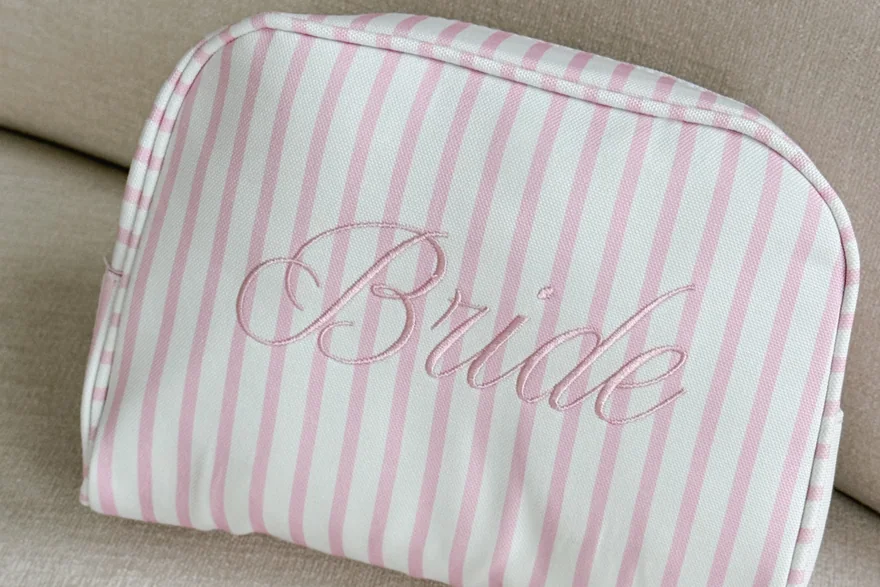
Yes, and it is the most durable branding in the concept because the bag is what the customer keeps and brings back. Branding options include a woven label, a printed liner panel and a debossed or printed patch on the front. The practical constraint is that the bag must stay wipe-clean, so branding methods that leave a raised or absorbent surface inside the liner area should be avoided.
What minimum order applies to a travel refill bottle programme?
The bag programme runs at 500 pieces per style and colourway. Bottle and closure components are quoted against the same style logic, and a custom moulded bottle shape or a bespoke closure colour will carry its own component minimum set by the component maker rather than by the bag programme. Buyers should confirm component minimums separately, since they frequently differ from the bag figure.
Who owns hygiene risk at a station - brand, retailer or the bag programme?
The retailer operating the station owns day-to-day hygiene: tools, cleaning schedule, staff training and the refill log. The brand owns whether its formulation is suitable for refilling and what warnings must travel with it. A sourcing programme owns vessel and bag quality - wipe-clean liners, closure fit, label adhesion - and should not accept responsibility for how the station is run, in writing, in the supply agreement.
How is a refilled vessel leak-tested before it goes into a bag?
Fill to the stated volume with the real formulation, apply the specified closure torque, hold inverted over absorbent paper for 24 hours at room temperature, then repeat after a temperature cycle. Any moisture beyond an agreed mark is a major defect. Sampling follows ISO 2859-1 at AQL 2.5, and the approved sample should be retained as the reference for any dispute.
Should a station refill sunscreen and other SPF products?
Only with the formulation owner's explicit agreement. SPF products carry a claimed level of protection that depends on the formula as supplied and as tested, and decanting, exposure and possible cross-contamination all sit outside that testing. Where a brand does permit it, the label should carry the original SPF statement and warnings intact, and the tool set should be dedicated to that product alone.
People Also Ask
Are refill stations hygienic for cosmetics?
They can be, but hygiene is procedural rather than inherent. The controls that matter are dedicated or single-use dispensing tools per product line, no water introduced into vessels, wiped bulk container mouths, a documented cleaning and tool-replacement cycle, and a refill log recording batch code and fill date. Vessels themselves should be cleaned and fully dried before being refilled for a customer.
How long does decanted skincare last?
The product does not change because it was decanted, so the usable life is the period-after-opening figure set by the formulation owner, counted from the fill date. That is exactly why the fill date belongs on the label. If a brand has not confirmed that its formulation tolerates repeated opening, the period-after-opening figure should not be assumed to still apply.
Can any product be decanted into a travel bottle?
No. Closure and viscosity have to match, so a fine mist sprayer will not handle a gel and a lotion pump will not handle a thin liquid. Some formulations should not be decanted at all, particularly anything whose claimed performance depends on the pack as tested, such as SPF products. The formulation owner should confirm suitability before a product joins a refill range.
Do refill stations save money for beauty retailers?
The economics depend on footfall, staff time and product margin rather than on the hardware, so a buyer should model it locally rather than assume a saving. Bulk product usually costs less per millilitre than filled travel sizes, but the station adds staff time, consumable tools, cleaning and shrinkage. The vessel and bag programme is the smaller and more predictable part of that calculation.
Request a Sample or a Written Quotation
Send the silhouette, dimensions, material preference and logo artwork, and the programme team will return a written quotation with MOQ, sampling window, bulk lead time and inspection standard.
Email: [email protected] · WhatsApp: +86 177 5002 0688