Zipper vs Zip-Top vs Drawstring Cosmetic Bags: Which Is Better?
Executive Summary
The question of whether a zipper, a zip-top or a drawstring is better on a cosmetic bag has a conditional answer. Zip-top wins for most custom pouch programmes: it holds the mouth of a gusseted bag open while the user fills it, resists spills better than a gathered cord, and typically lands 8 to 14 percent below a full-length metal zipper build. A conventional seam-set zipper wins where the closure has to follow a curve or sit on a flat face; drawstring wins only for flat, low-cost pouches packed at high density.
Three numbers decide the rest. A #5 nylon coil zipper with a branded puller adds roughly $0.18 to $0.42 per unit against a cord and toggle, and a #5 metal chain adds $0.55 to $0.90. Flat drawstring pouches pack at 60 to 90 pieces per export carton against 24 to 36 for a standing zip-top bag, so freight per unit moves materially. Minimum order is 500 pieces per style and colourway, sampling runs 6 to 10 working days, and bulk runs 35 to 50 days after sample approval.
What Zipper, Zip-Top and Drawstring Mean in a Written Specification
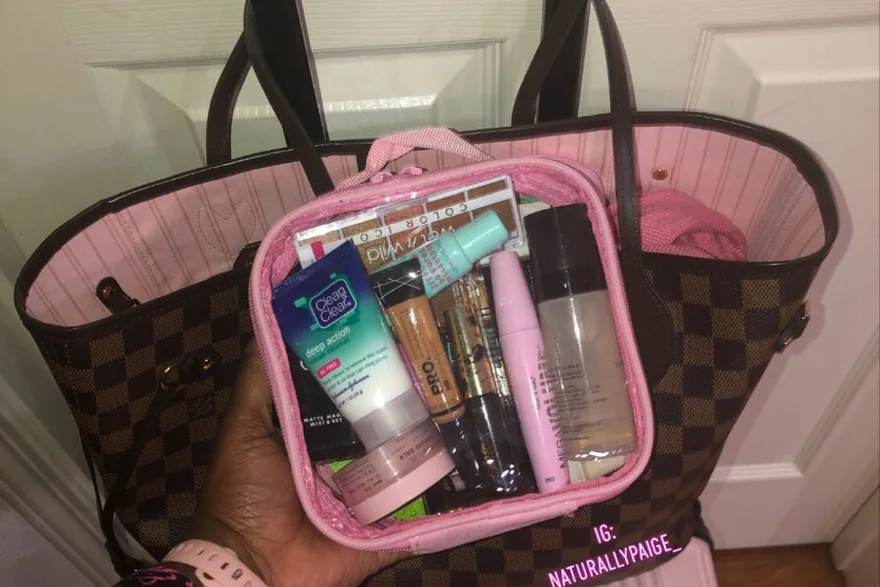
On a sourcing sheet these three words are not interchangeable, and confusing them is one of the most common causes of a first sample arriving wrong. A zipper is a chain of teeth or coil set into a seam, opened and closed by a slider, and it can run straight, around a curve or across a corner. A zip-top is a specific application of that hardware: the chain runs across the full width of the mouth of a gusseted or boxed bag, so that when the slider is parked the mouth opens like a lid and stays open. A drawstring is a cord running through a sewn casing, gathered by hand and held with a toggle, knot or spring lock.
The practical difference is what each one lets the end user do. A zip-top gives two-handed filling: the bag stands, the mouth stays square, and items can be dropped in without being held. A seam-set zipper on a flat pouch gives a wide but collapsing aperture, which suits a bag that is packed once and carried flat. A drawstring gives an aperture that narrows as it closes and never fully seals, which is why it is associated with dust bags, gift pouches and amenity sachets rather than with a bag that will hold a 100 ml bottle.
- Zipper: hardware type, defined by chain gauge and tape, set anywhere on the shell
- Zip-top: an application, chain across the full mouth of a standing bag, aperture stays open
- Drawstring: no chain, cord in a casing, aperture narrows as it closes and never seals
- The spec line must name gauge, tape colour, slider type and puller, not simply say zip
Standards bodies describe zipper hardware by its own vocabulary rather than by bag terminology, which is why a brief that says only "zip closure" leaves the gauge, the tape and the slider to be guessed. The terminology used in trade specifications is set out in ASTM D2053 zipper terminology, and referencing it in the brief is the fastest way to stop a #3 coil being substituted for a #5.
Zipper and Zip-Top Hardware: Gauge, Tape and Cycle Life
Zipper gauge is a nominal number, not a millimetre measurement, but it maps to an approximate chain width that buyers can check with a ruler on a sample: #3 is about 4.5 mm across the closed chain, #5 about 6.0 mm and #8 about 8.0 mm. Gauge drives both cost and perceived quality. On a cosmetic pouch under 24 cm wide, #3 reads as light and can feel flimsy at the mouth of a full bag; #5 is the default for a main closure; #8 is reserved for train cases and heavy shells where the mouth is wider than 30 cm.
| Closure option | Chain width | Typical application | Added unit cost | Cycle expectation |
|---|---|---|---|---|
| #3 nylon coil | 4.5 mm | Flat pouch, inner pocket | $0.10-$0.22 | 300-500 cycles |
| #5 nylon coil | 6.0 mm | Standing bag, main mouth | $0.18-$0.42 | 500-800 cycles |
| #5 metal | 6.0 mm | Premium vanity case | $0.55-$0.90 | 500-1,000 cycles |
| #8 nylon coil | 8.0 mm | Train case, wide mouth | $0.45-$0.75 | 800-1,200 cycles |
| #5 reverse coil | 6.0 mm | Wipe-clean and film shells | $0.30-$0.60 | 500-800 cycles |
Tape matters as much as gauge. Tape is the woven strip the chain is sewn to, and it is what the sewing machine actually bites. On a lined bag the tape is caught between shell and lining, so a tape narrower than 12 mm on a #5 chain leaves little margin and is a common source of a wavy seam. Most pouch programmes run 15 mm tape on a #5 and 12 mm on a #3. Tape colour should be named as a Pantone reference or as "dyed to match shell", because a near-miss shade along the mouth of a bag is the first thing a retail buyer notices.
Chain construction is quoted as closed-end or open-end, and the distinction matters on a pouch. A closed-end chain has a bottom stop and cannot be separated, which is what a cosmetic bag needs; an open-end chain has a separating bottom and belongs on garments. Auto-lock sliders hold position under load and should be specified on any bag carried full, because a non-locking slider on a zip-top creeps open as the contents push against the mouth. A two-way slider, opening from either end, adds about $0.20 to $0.45 and suits a bag wider than 28 cm where the user wants to reach in from one side. End stops are worth naming as well: a metal top stop is more durable than an injection-moulded one, costs about $0.02 more, and is the part that fails first when a user over-travels the slider.
Slider and puller are separate line items in a quotation and are the easiest place to lose money. A standard auto-lock slider costs little; a branded metal puller with a moulded or cast logo adds tooling and, on a 500-piece minimum, can add $0.25 to $0.70 per unit on its own. A garage, the small fabric tab that hides the slider at the closed end, adds one operation and roughly $0.04 to $0.09 but removes the pinch complaint that otherwise shows up in e-commerce reviews of travel pouches.
Cycle life is measured on the assembled bag, not on the chain alone, because most failures are stitch failures at the tape rather than tooth failures. A 500-cycle open-and-close test at the sampling stage is a reasonable gate before bulk. Abrasion and colour transfer of the tape and the surrounding shell are assessed under AATCC test methods, and a programme that sells into a market with hot, humid logistics should add a corrosion check on metal sliders, because a seized slider generates returns even when the bag itself is sound.
Drawstring and Soft-Closure Alternatives: Where They Genuinely Win
A drawstring is not a cheap zipper; it is a different proposition. It costs less in hardware, packs flatter, and reads as soft and natural, which is exactly what a gift-with-purchase pouch or an organic-positioned skincare kit wants. It also fails three practical tests: it cannot be opened with one hand while the other holds the bag, it does not keep powder or liquid in if the bag is inverted in a suitcase, and it does not stop dust. Buyers sourcing for travel or for liquid contents should treat those as disqualifying rather than as minor.
| Cord and toggle option | Typical specification | Observed failure mode | Best application |
|---|---|---|---|
| 3 mm polyester braid + barrel toggle | Dual-hole toggle, 8 mm body | Cord slips under load | Light gift pouch, insert bag |
| 5 mm cotton braid + wooden toggle | Unfinished natural cord | Fraying at the knot | Natural or organic positioning |
| 4 mm waxed cotton + spring toggle | Spring-loaded cord lock | Spring relaxes after about 12 months | Premium pouch, higher price point |
| Elastic cord + cord lock | Two-hole elastic lock | Elastic creep, aperture reopens | Soft accessory, children's ranges |
| 12 mm grosgrain ribbon tie | No hardware, bow closure | Unties in transit | Dust bag, shoe-style cover |
Casing construction is the hidden cost. A turned-and-topstitched casing with a bar-tack at the cord exit costs two operations; a simple folded casing with a single row of stitching costs one but tends to twist after laundering. A metal eyelet at the cord exit costs about $0.03 to $0.06 per unit and removes the most common abrasion failure on a cotton pouch. Where the pouch is machine washed by the end user, a polyester cord outlasts cotton by a wide margin and holds its colour better under the ISO 105 washing series.
Packing economics are where drawstring earns its place. A flat pouch with no gusset and no hardware nests to under 8 mm and ships at 60 to 90 pieces per standard export carton, against 24 to 36 pieces for a standing zip-top bag of the same footprint. On a 5,000-piece order that difference can move landed freight by 9 to 15 percent, which on a $1.20 unit is a larger saving than the hardware delta itself. That is why flat drawstring pouches dominate subscription-box and gift-with-purchase volumes while zip-top dominates retail shelf.
Cords carry one rule that overrides cost. A cord long enough to loop around a neck is a recognised hazard, so any pouch aimed at children should keep the exposed cord short, typically under 22 cm measured from the exit point with the bag closed, or replace the drawstring with a snap or a short webbing tab. In the United States the framework is the Consumer Product Safety Improvement Act, and a children's range should be scoped against it before sampling rather than after. Cord ends need sealing too: a braided polyester cord cut with a hot knife forms its own seal, while cotton needs an aglet or a back-tacked knot, and an unsealed cord end is one of the most common reasons a pouch fails a retail quality audit.
One hybrid is worth knowing: a drawstring pouch with an inner zip pocket. It keeps the soft outer read and adds a secure place for small items, and it typically adds $0.22 to $0.38 per unit. The hybrid is popular with hotel amenity programmes, where the outer pouch is part of the presentation and the inner pocket is what the guest actually reuses.
Costing, Failure Modes and How to Write the Closure Line
| Decision factor | Seam-set zipper | Zip-top | Drawstring |
|---|---|---|---|
| Spill control | Good when closed | Good when closed | Poor, aperture never seals |
| One-hand opening | Possible with a puller | Possible with a puller | No, needs two hands |
| Filling a standing bag | Fair | Best, mouth stays square | Poor |
| Added hardware cost | $0.10-$0.90 | $0.18-$0.75 | $0.05-$0.25 |
| Pieces per export carton | 30-48 | 24-36 | 60-90 |
| Sampling time | 6-10 working days | 6-10 working days | 6-10 working days |
| Most common defect | Wavy tape seam | Slider catches lining | Casing twist, toggle slip |
Three failure modes generate most inspection rejections on pouch closures. The first is a slider that catches the lining, caused by a lining edge set too close to the chain; it is prevented by a 3 mm clearance rule and by binding the lining edge rather than leaving it raw. The second is a wavy tape seam, caused by feeding the tape under tension; it is prevented by specifying a flat-set seam and checking the first-off piece. The third is a toggle that pulls through the casing, caused by an unsecured cord end; it is prevented by a knot plus a bar-tack.
- Name the closure type explicitly: zipper, zip-top or drawstring, never just "zip".
- State the gauge and the approximate chain width in millimetres so substitution is visible on a ruler.
- State tape width, tape colour reference and whether tape is dyed to match the shell.
- Name the slider type, the puller type and whether a garage is required.
- For drawstring, state cord material, diameter, toggle type and casing construction.
- State the cycle-life expectation to be checked on the pre-production sample.
Commercial terms do not change with the closure, but the risk profile does. Programmes with custom metal pullers or moulded toggles should allow 12 to 15 working days for sampling rather than 6 to 10, because the hardware has to be tooled before the first bag can be sewn. Bulk remains 35 to 50 days after sample approval at 500 pieces per style and colourway, and final random inspection is run at AQL 2.5 under ISO 2859-1, with closure defects counted as functional rather than cosmetic.
A worked example shows why landed cost should drive the decision. Take a 5,000-piece order of a 24 x 16 cm pouch in 600D polyester. The zip-top version costs $2.90 per unit and packs 30 per carton, so 167 cartons; the drawstring version costs $2.35 per unit and packs 75 per carton, so 67 cartons. At $38 per carton, freight is $6,346 against $2,546, a difference of $3,800 or $0.76 per unit. The hardware and sewing saving of $0.55 per unit is therefore smaller than the freight saving, and the two only break even once the zip-top supports a retail price that recovers the difference. That is the real reason many brands stay with a zip-top despite the packing penalty.
Approve the hardware on the physical sample, not on a hardware card. A puller that feels right in the hand can still catch the lining once the bag is assembled, and that is only visible on a finished piece.
The B2B Customisation View
The brief for makeup bags and toiletry bags should state the tolerances that matter: acceptable shade drift, stitch density, and the defect threshold at final inspection.
Programme data for this category: minimum order quantity 500 pieces per style and colourway, sampling in 6–10 working days (12–15 working days for complex constructions), bulk production 35–50 days after sample approval, final random inspection at AQL 2.5 under ISO 2859-1, FOB Xiamen, T/T 30/70.
This is the model that lets a small brand launch makeup bags and toiletry bags with the same inspection discipline a large retailer would demand.
Which Brand Types Benefit Most
Closure choice maps directly onto channel economics, so the right answer differs by buyer type. Start-up brands running a first 500-piece purchase usually do best with a single closure across the range: one #5 nylon coil with one puller, used on both the pouch and the standing bag. That concentrates hardware spend, avoids a second tooling charge and keeps the range visually consistent. Established brands more often run a tiered structure, with a #3 coil on entry-price pouches, a #5 with a cast puller on the core line and a #8 or metal chain on the gift set, so that price architecture is visible in the hardware itself. A useful rule of thumb is to match the closure to the retail price: below about $12 retail, a drawstring or a #3 coil keeps the arithmetic working; between $12 and $30, a #5 zip-top is what buyers expect to find; above $30, hardware becomes part of the product story and a metal chain earns its cost.
- Retailers and private-label buyers: zip-top on anything sold standing on a shelf, because a collapsing mouth photographs badly in a listing image.
- E-commerce sellers: prioritise closure defects in the inspection plan, since a caught slider is the single most common cause of a two-star review on a pouch.
- Gift-with-purchase and subscription-box buyers: drawstring at 60 to 90 pieces per carton keeps landed cost under control on high-volume, low-unit-price inserts.
- Hospitality and amenity buyers: the hybrid drawstring-with-inner-zip pocket reads as premium while surviving guest reuse.
- Travel and airport-channel buyers: avoid drawstring entirely for anything carrying liquids at the 100 ml limit, and specify a reverse coil with a garage.
- Professional and salon buyers: #8 coil or a metal chain on wide-mouth cases, because the bag is opened dozens of times a day and a light chain will not survive the duty cycle.
- Children's and junior ranges: keep any exposed cord under 22 cm or drop the drawstring for a snap, and scope the programme against CPSIA before sampling.
Frequently Asked Questions
What is the difference between a zipper closure and a zip-top closure on a cosmetic bag?
A zipper is the hardware: a chain of coil or teeth with a slider. A zip-top is an application of that hardware, where the chain runs across the full mouth of a gusseted bag so the aperture stays square and open while the bag is filled. Every zip-top uses a zipper, but not every zipper is a zip-top.
Which zipper gauge should be specified for a 24 cm wide cosmetic pouch?
A #5 nylon coil, with a chain width of about 6.0 mm and 15 mm tape, is the default for a bag of that width. A #3 at 4.5 mm is adequate for an inner pocket or a light flat pouch, while #8 at 8.0 mm is reserved for mouths wider than 30 cm or for heavy shells.
How much does a drawstring save against a zipper on a 500-piece pouch order?
Hardware saving is roughly $0.08 to $0.60 per unit depending on what is being replaced: a cord and toggle costs about $0.05 to $0.25 against $0.18 to $0.42 for a #5 nylon coil and $0.55 to $0.90 for a #5 metal chain. The larger saving is usually freight, because flat pouches pack at 60 to 90 per carton.
Do drawstring cosmetic bags pass airline liquids screening requirements?
The bag is not what is screened; the containers are. However, a drawstring does not seal, so a leaking bottle inside a soft pouch contaminates everything else. For travel programmes carrying 100 ml containers, a reverse-coil zip-top with welded or laminated lining is the safer specification, and the TSA 3-1-1 liquids rule sets the container limits to design around.
How many open-and-close cycles should a cosmetic bag zipper survive?
A reasonable gate is 500 cycles on the assembled pre-production sample for a #5 coil, rising to 800 to 1,200 for #8. Most failures at that point are stitch failures at the tape rather than tooth failures, so the test should be run on a finished bag with the lining fitted, not on a loose chain. Chains are usually tested dry; a programme sold into a humid market should repeat 100 cycles after a 24-hour humidity soak, because a swollen tape changes how the slider feels.
What causes a zipper slider to catch the lining on a cosmetic pouch?
The usual cause is a lining edge set too close to the chain, leaving no clearance for the slider throat. Specifying a 3 mm clearance and binding the lining edge rather than leaving it raw removes most cases. The defect is checked on the first-off piece and counted as functional at inspection. Where the lining is a film rather than a woven fabric, increase the clearance to 4 mm, because film edges are stiffer and sit closer to the chain.
Is a metal zipper worth the extra cost on a cosmetic bag?
It is worth it where the hardware is part of the price story, typically on gift sets and premium vanity cases retailing above about $35. The added cost is roughly $0.55 to $0.90 per unit against a coil, and the buyer should add a corrosion check if the goods ship through humid conditions or sit in a container for weeks.
What is a zipper garage and does a cosmetic bag need one?
A garage is a small fabric tab that covers the slider at the closed end of the chain. It adds about $0.04 to $0.09 per unit and one operation. It is worth specifying on travel pouches and on any bag with a metal puller, because it removes the pinch complaint and stops the puller rattling against the shell in transit.
Can a cosmetic bag have both a drawstring and a zipper?
Yes, and the hybrid is common in amenity and gift programmes. The outer drawstring provides the soft presentation, while an inner zip pocket, typically #3 coil, gives a secure place for small items. The hybrid adds roughly $0.22 to $0.38 per unit and needs 12 to 15 working days at sampling if new hardware is involved.
How is zipper tape colour matched to the shell fabric?
Tape is either dyed to match against a physical shell swatch or supplied to a named Pantone reference. Matching is confirmed under a standard light source and the tolerance is recorded on the approval sheet so a repeat order can be checked. A near-miss shade along the mouth is one of the first things a retail buyer rejects.
What minimum applies to a cosmetic pouch with a custom moulded puller?
The standard minimum is 500 pieces per style and colourway, but custom hardware is tooled separately and the tooling charge is amortised over that quantity. Sampling extends to 12 to 15 working days because the puller has to be produced before the first bag can be sewn. Bulk stays at 35 to 50 days after approval. Hardware suppliers quote their own minimum, commonly 1,000 to 3,000 pieces per puller style, so the bag minimum and the hardware minimum are two separate numbers.
How are closure defects classified during final inspection?
Closure defects are counted as functional rather than cosmetic under AQL 2.5 in ISO 2859-1, because a bag that will not close is not sellable. A caught slider, a slipped toggle and a split chain are all functional. Minor issues such as a slightly wavy tape seam are cosmetic and fall under a higher acceptance number. Naming them in the inspection plan is worth doing: a functional defect at AQL 2.5 on a 500-piece order means a rejected lot rather than a sorted one.
Which closure packs most efficiently into an export carton?
A flat drawstring pouch nests to under 8 mm and ships at 60 to 90 pieces per standard export carton. A standing zip-top bag of the same footprint ships at 24 to 36 pieces. On a 5,000-piece order that difference typically moves landed freight cost by 9 to 15 percent. A boxed gusset with a zip sits between the two at 30 to 48 pieces, and vacuum packing a soft pouch can add a further 8 to 12 percent.
Does a zip-top work on a clear PVC or TPU cosmetic pouch?
Yes, but the chain should be a reverse coil so the teeth sit on the inside and the outer face stays smooth, and the seams are usually welded rather than sewn. A #5 reverse coil typically adds $0.30 to $0.60 per unit. Film shells need a lower welding temperature than woven shells, which is checked at sampling.
What should be written on the brief to stop a factory substituting a cheaper zipper?
Write gauge, approximate chain width in millimetres, tape width, tape colour reference, slider type and puller type, and reference ASTM D2053 terminology. A brief that says only "zip closure" leaves every one of those variables open, and substitution is then visible only on the physical sample. A sample retained from the approval round then becomes the reference against which every repeat order is checked, which is the only reliable defence against silent substitution.
People Also Ask
Which closure is best for a cosmetic bag?
A zip-top with a #5 nylon coil is the best default for a standing cosmetic bag, because the mouth stays open while the bag is filled and the aperture seals when closed. Choose a flat drawstring only for low-cost gift or dust pouches, and a conventional seam-set zipper when the closure must follow a curve or sit on a flat face. State the closure on the technical sheet rather than only in the product copy, because the sheet is what the sample is actually built from.
Are zippered makeup bags better than drawstring bags?
For anything carrying liquids, powders or items the user cannot afford to lose, yes. A zipper seals and can be opened one-handed; a drawstring never fully seals and needs two hands. Drawstring pouches are better only on cost and packing density, which is why they dominate gift-with-purchase and insert programmes. The exception is a pouch sold on softness or on a natural aesthetic, where the drawstring is part of the product story rather than a cost saving.
What does zipper gauge number mean?
The gauge is a nominal size number that corresponds to the approximate width of the closed chain: #3 is about 4.5 mm, #5 about 6.0 mm and #8 about 8.0 mm. Higher numbers mean a stronger, more expensive chain. Gauge should be stated on the brief together with tape width so that substitution is detectable. Tape width is the second number to check: 15 mm on a #5 chain and 12 mm on a #3, and anything narrower than that makes the seam wave.
How do you stop a cosmetic bag zipper from snagging?
Leave 3 mm clearance between the lining edge and the chain, bind the lining edge rather than leaving it raw, and specify a garage at the closed end. Most snagging reported by end users is the slider catching fabric rather than a fault in the chain itself, so it is a pattern and clearance problem, not a hardware brand problem. A puller too heavy for the chain is the other cause, because the weight drags the slider off the tape line when the bag is carried full.
Request a Sample or a Written Quotation
Send the silhouette, dimensions, material preference and logo artwork, and the programme team will return a written quotation with MOQ, sampling window, bulk lead time and inspection standard.
Email: [email protected] · WhatsApp: +86 177 5002 0688