Makeup Bag with Perfume Atomizer Pocket: Fragile Item Protection
Executive Summary
A makeup bag with a perfume atomizer pocket is a fragile-item problem before it is a storage problem. A glass fragrance bottle carries more value per gram than anything else in the bag and fails in two ways: it breaks, and it leaks. The specification therefore has two halves. The pocket has to hold the bottle upright and off the base seam with padding around it, and the surrounding cavity has to contain a leak so a failure does not ruin the cosmetics beside it.
Both halves are measurable. A buyer can specify pocket dimensions from the bottle, padding thickness and foam density, a collar or strap that stops the bottle rising, and a coated or welded lining in the pocket that will not let liquid through a stitch hole. Programme terms start at 500 pieces per style and colourway, sampling runs 6 to 10 working days or 12 to 15 for a moulded cradle, and bulk runs 35 to 50 days after approval, inspected at AQL 2.5 and shipped FOB Xiamen.
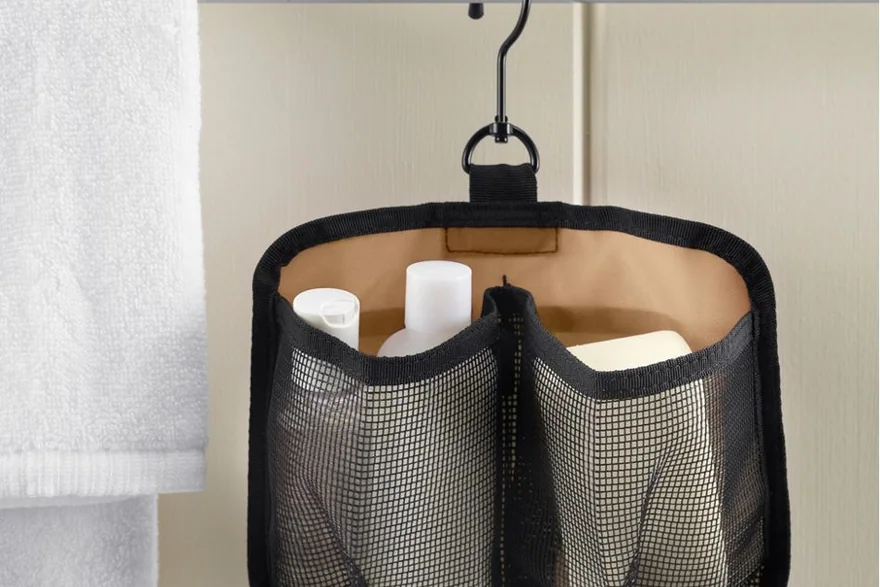
Why fragrance changes the protection brief
Most cosmetic bag contents are forgiving. A lipstick survives a knock, a powder compact cracks but stays contained, and a spill of dry product is an inconvenience. A glass fragrance bottle is different on three counts. It is rigid and brittle, so impact energy goes into the glass rather than into deformation. It holds a volatile, alcohol-based liquid that travels through stitch holes and coatings. And a failure is expensive in both directions: the bottle itself is the highest-value item in the bag, and its contents damage everything they touch.
The atomiser adds a second failure mode. A refillable travel atomiser of 5 to 10 millilitres is usually aluminium or glass with a screw collar and a spray head, and the head is the vulnerable part. Laid loose in a bag, the head takes side load, the collar loosens, and the contents empty into the lining. A dedicated pocket solves this by holding the unit upright and taking the load off the head, which is a different design problem from simply adding padding.
Scale matters when setting the pocket. A 30 ml bottle is commonly around 4 centimetres in diameter and 9 centimetres tall, a 50 ml around 4.5 by 10 centimetres, and a 100 ml around 5.5 by 11 centimetres. A slim refillable atomiser is typically 1.5 to 2 centimetres in diameter and 9 to 11 centimetres tall. A pocket specified without those figures tends to be cut to the look of the sample rather than to the bottle a customer actually carries, which is why the pocket that fits the prototype often does not fit the retail product.
Demand supports the feature. 'make up bags for women' draws roughly 80,000 monthly searches and 'custom makeup bag' between 5,400 and 6,600 monthly searches, and a fragrance pocket gives a listing a specific functional claim in a category where most listings differ only by print. Within the typical $0.45 to $12.00 unit price band reported on marketplaces, a padded pocket sits in the upper half because the added cost is largely assembly.
Pocket architecture: sleeves, cradles and collars
There are five workable ways to hold a bottle, and they differ in how much protection they give and how much they cost to assemble. An upright sleeve is the simplest: a fabric tube sewn or welded into the lining with padding between the two layers. An elastic loop with a collar grips the neck and stops the bottle rising. A moulded EVA cradle is the most protective and the most expensive. A padded pod is a removable sleeve that lifts out. A simple divider pocket is the cheapest and the least protective.
Padding thickness alone is a poor specification. A 3 mm foam on the side of a bottle protects against a knock but does nothing about a drop onto the corner, because the energy goes through the base. The pattern that works is padding on the sides, a base board or closed-cell pad under the bottle, and a collar or strap above it that prevents the bottle lifting and dropping back onto the base. Specifying all three is what separates a pocket that looks padded from a pocket that protects.
| Pocket format | Padding specification | Bottle sizes it suits | Leak containment | Cost tier |
|---|---|---|---|---|
| Upright sleeve | 3 mm foam between lining layers, bound mouth | 30 ml and slim atomisers | Only with a coated inner layer | Low |
| Elastic collar pocket | 6 to 10 mm elastic at the neck, 2 mm side padding | Atomisers and 30 ml | Poor, liquid runs down the bottle | Low |
| Padded divider pocket | 4 mm foam on both faces, own gusset | 50 ml lying flat | Moderate if the base is welded | Medium |
| Welded upright pod | 5 mm closed-cell foam, welded base seam | 50 ml and 100 ml upright | Good, no stitch holes in the base | Medium |
| Moulded EVA cradle | Moulded cavity, 5 to 8 mm wall, no fabric seam | A specific bottle shape | Best, cavity itself is impermeable | High |
The pocket should be positioned so the bottle cannot be crushed by the bag's own contents. Putting it against the outer wall means a hard item in the main cavity presses the bottle outward against a rigid surface, which is the worst possible load case. Placing it inside the main cavity, against a padded back panel, means the surrounding contents cushion rather than crush. Buyers should specify the pocket position relative to the panel and the gusset in centimetres.
Orientation is a decision worth making explicitly. An upright pocket protects the base of a bottle and suits a tall slim atomiser, but it makes the bag taller and can push the overall size past a retailer's shelf-height limit. A horizontal pocket keeps the bag flat for packing but puts the bottle on its side, where a leak reaches the collar and the cap first. Buyers should decide from the bottle they are selling with, and state the orientation in the brief rather than leaving it to the sample room.
A collar is the cheapest safety addition and the one most often omitted. A short elastic or webbing strap with a covered press stud across the top of the pocket stops the bottle rising when the bag is dropped or turned upside down, and it takes the load off an atomiser head. Where a brand wants the bottle visible for retail photography, a clear TPU window in the pocket face achieves it without removing the collar.
Send the actual bottle or a dimensioned drawing with the brief, and require the approval sample to be photographed with that bottle in the pocket, upright, with the closure done up. A pocket cut to a sketch will not necessarily hold the retail product.
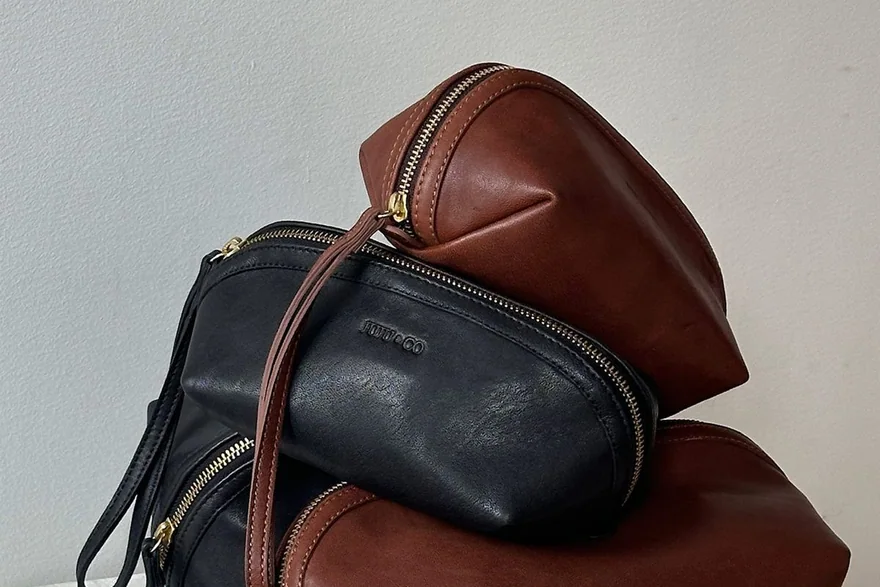
Impact paths and leak containment
Protection is best designed by following the energy. In a drop, the bag lands on a corner or an edge, the shock travels through the base panel into the base of the bottle, and glass fails at the base-to-wall radius. The countermeasures are a base board of 2 to 3 mm PE or EVA under the pocket, a pocket set 10 to 15 millimetres above the base seam so the bottle never sits on the seam, and padding that covers the lower third of the bottle as well as the sides.
Containment is the second half and it is where most designs fail. A sewn pocket has needle holes every few millimetres, and a thin alcohol-based liquid wicks through them into the interlining and then into the main cavity. A welded pocket has no holes. Where a sewn construction is preferred for cost or appearance, the pocket should have a coated inner layer or a drop-in liner, and the coating should be specified by type and thickness rather than described as waterproof.
Coated fabrics have a defined test vocabulary, and referencing ASTM D751 for coated fabrics lets a buyer name adhesion, coating thickness and flexibility tests rather than relying on a supplier's own description of a waterproof finish. A buyer does not need to commission every test in the family; naming the standard gives an agreed method to fall back on when a bulk shipment behaves differently from the approved sample.
- Set the pocket 10 to 15 mm above the base seam so the bottle never lands on the seam.
- Pad the lower third and the sides, not just the sides, and add a base board of 2 to 3 mm.
- Add a collar or strap with a covered press stud to stop the bottle rising and to take load off an atomiser head.
- Choose a welded base or a coated inner layer, because stitch holes wick alcohol-based liquid.
- Position the pocket against a padded panel rather than the outer wall, so surrounding contents cushion instead of crush.
There is a chemical dimension as well. Fragrance is an alcohol-based preparation and it attacks some coatings and adhesives, so a pocket lining that survives water may not survive perfume. Buyers can specify a compatibility check: apply the fragrance or a representative solvent to the pocket lining, hold it for a stated period, and require the lining to show no softening, colour change or delamination. That is a cheap test and it catches a failure mode that a water test never will.
One further failure path deserves attention because it is invisible until it happens: vapour transfer. A fragrance that never leaks as liquid still evaporates through a closure, and in a sealed bag that vapour reaches other cosmetics and can mark a powder or soften a plastic compact case. Separating the pocket from the main cavity with its own panel, rather than relying on padding alone, limits the transfer, and a buyer can specify a simple check by leaving a scented dummy load in the closed bag for a stated period and examining the other contents.
Restricted-substance documentation follows the same pattern as any lined bag. Textile components can be certified to OEKO-TEX Standard 100, and articles sold into the EU are declared against EU REACH. Foam, coating and adhesive each need to be covered by the declaration, since a certificate on the face fabric alone does not cover the layers the fragrance actually touches. Buyers should ask which components the certificate enumerates.
Test schedule, inspection and freight
Fragile-item claims need a test the buyer can point to, and the practical approach is to write a short schedule into the purchase order rather than to ask whether the bag is protective. The schedule should name the dummy load, the drop height and orientation, the surface, the number of samples, and what counts as a pass. A dummy bottle filled with water to the same weight as the retail product is a fair substitute and avoids destroying real fragrance.
| Test a buyer can specify | Suggested set-up | Pass condition to write down | Stage |
|---|---|---|---|
| Loaded drop | Dummy bottle of matched weight, 60 cm onto a hard surface, corner first, 3 samples | No glass breakage, pocket still holds the bottle upright | Pre-bulk |
| Upright retention | Bag inverted and shaken for 30 seconds with the bottle in place | Bottle stays in the pocket, collar holds | Pre-bulk |
| Leak containment | 10 ml of coloured water released inside the pocket, bag left flat for 30 minutes | No moisture on the outer shell or in the main cavity | Pre-bulk |
| Fragrance compatibility | Fragrance applied to pocket lining, held 24 hours, examined | No softening, colour change or delamination | Sample approval |
| Coating check | Coating adhesion and thickness named per ASTM D751 | Report matches the specification within tolerance | Pre-bulk |
| Workmanship | AQL 2.5 with a pocket-specific defect list | Defects within the acceptance number | Final random inspection |
| Freight declaration | Carton size, piece count and gross weight in the quote | Matches the purchase order | Quotation stage |
The schedule should also say who pays for a retest. A fragrance pocket programme is more likely than most to need a second round, because the first failure is usually a set-up detail such as padding that has shifted rather than a design flaw, and agreeing the retest path in advance avoids a dispute at the point where the bulk date is already under pressure.
These are specifications a buyer sets, not results anyone is promising, and that distinction matters when the schedule is written. A buyer who asks for a report against a named set-up gets something checkable; a buyer who asks whether the bag is protective gets an opinion. Where a third-party laboratory is used, the report should state the set-up as performed, so a later shipment can be tested the same way and compared rather than re-argued.
Inspection needs pocket-specific defect lines. Additions to a standard makeup bag checklist should include a pocket mouth that is not bound, padding that has shifted away from the base, a collar that does not align with its stud, a welded seam that has peeled at the base corner, and a pocket set crooked so the bottle leans. Final random inspection runs at AQL 2.5 under ISO 2859-1, and the list should reach the inspector before the inspection date rather than on the day.
Freight and packing are the last risk. Padding adds thickness, which reduces the piece count per carton, and a carton packed under compression for weeks can flatten foam so it does not recover. Buyers should ask for carton dimensions, piece count and gross weight at quotation stage, set a maximum gross weight in the purchase order, and state that padding must not be compressed beyond a stated proportion of carton height. Programme terms are 500 pieces per style and colourway, 6 to 10 working days sampling, 12 to 15 for a moulded cradle, then 35 to 50 days bulk, FOB Xiamen on T/T 30 deposit and 70 against bill of lading.
The B2B Customisation View
Brand owners approaching cosmetic pouches, vanity cases and beauty organisers usually arrive with a mood board, a target landed cost and a launch date; the technical pack is what turns those three inputs into a repeatable specification.
Programme data for this category: minimum order quantity 500 pieces per style and colourway, sampling in 6–10 working days (12–15 working days for complex constructions), bulk production 35–50 days after sample approval, final random inspection at AQL 2.5 under ISO 2859-1, FOB Xiamen, T/T 30/70.
Engaging a sourcing partner gives the brand owner one channel for the awkward questions — shade drift, component substitution, carton marking — that otherwise bounce between three vendors.
Which Brand Types Benefit Most
The fragrance pocket suits buyers whose products travel, and it suits them for a reason that is easy to state on a listing: the expensive glass item is held upright and a leak stays contained. A start-up brand building a travel set around a signature scent gains a reason to be chosen over a generic printed pouch, and the feature costs assembly rather than tooling at 500 pieces per style and colourway.
- Established beauty brands: a pocket sized to a brand's own bottle turns a general case into a fitted accessory, which supports a higher price than a universal pouch.
- Retailers and catalogue buyers: the pocket has to be shown with a bottle in it, because a padded pocket photographed empty does not communicate protection.
- E-commerce sellers: listing copy should state the bottle sizes the pocket accepts in millilitres, since that is the number a shopper checks before buying.
- Gift and hospitality buyers: a fragrance pocket works in a wedding or hotel amenity set, where the recipient is carrying glass through several transit legs.
- Fragrance brands extending into accessories: a welded pod and a stated compatibility check support a claim about the product itself that a sewn pocket cannot.
A sixth group is the brand shipping a fragrance subscription or a discovery set, where the same case is reused every month and the pocket is opened and closed far more often than in a travel-only product. For that buyer the collar and the welded base matter more than the padding thickness, because wear at the mouth and at the base corner is what ends the product's life.
In each case the discipline is the same. Send the real bottle with the brief, require a loaded photograph, and write the leak and drop expectations into the purchase order as a test rather than as an adjective. A makeup bag with a perfume atomizer pocket costs a little more to assemble and returns materially less in damaged-goods claims, which is the trade that matters once a programme reaches its second season.
Frequently Asked Questions
What size should a perfume atomizer pocket be in a makeup bag?
Set it from the bottle. A slim refillable atomiser is commonly 1.5 to 2 centimetres in diameter and 9 to 11 centimetres tall, while a 30 ml bottle is around 4 by 9 centimetres and a 100 ml around 5.5 by 11 centimetres. Add 3 to 5 millimetres of ease on the diameter for padding, and require the approval sample photographed with the actual retail bottle upright in the pocket.
How much padding does a perfume pocket need?
Specify padding in three places rather than one number: 3 to 5 millimetres around the sides, a base pad or board of 2 to 3 millimetres under the bottle, and protection across the lower third of the bottle. Side padding alone does nothing for a drop onto the base. A collar or strap above the bottle completes the pattern by stopping it rising and dropping back.
Should a perfume pocket be sewn or welded?
Welded is better for containment. A sewn pocket has needle holes every few millimetres, and an alcohol-based fragrance wicks through them into the interlining and then into the main cavity. Where a sewn construction is needed for cost or appearance, specify a coated inner layer or a drop-in liner, and name the coating by type and thickness rather than describing it as waterproof.
Where should the perfume pocket sit inside the bag?
Against a padded internal panel rather than the outer wall. A pocket on the outer wall means a hard item in the main cavity presses the bottle outward against a rigid surface, which is the worst load case. The pocket should also sit 10 to 15 millimetres above the base seam so the bottle never lands on the seam in a drop.
What test can a buyer require for a fragile-item pocket?
A loaded drop is the most useful: a dummy bottle filled to the same weight as the retail product, dropped from a stated height onto a hard surface, corner first, on three samples, with no breakage and the bottle still held upright as the pass condition. The value is in writing the set-up down, so a later shipment can be tested the same way.
How is leak containment tested on a perfume pocket?
A practical method is to release a stated volume of coloured water inside the pocket, leave the bag flat for a stated period, then examine the outer shell and main cavity for moisture. Ten millilitres over thirty minutes is a reasonable set-up. Stating the volume and duration makes the test repeatable across shipments rather than a matter of opinion.
Does fragrance damage the pocket lining?
It can. Fragrance is alcohol-based and attacks some coatings, adhesives and foams, so a lining that survives water may not survive perfume. A compatibility check is cheap: apply the fragrance to the lining, hold it for 24 hours, then require no softening, colour change or delamination. That catches a failure a water test never will.
What minimum applies to a makeup bag with a perfume pocket?
Programmes start at 500 pieces per style and colourway, and a padded pocket version counts as its own style because the bill of materials differs. Three colourways therefore commit the buyer to 1,500 pieces. Sampling runs 6 to 10 working days, or 12 to 15 where a moulded EVA cradle is required, and bulk runs 35 to 50 days after sample approval.
Is a moulded EVA cradle worth the tooling cost?
It is worth it when the bag is sold with a specific bottle, because the cradle is impermeable and holds the exact shape. It is not worth it for a universal case that must accept several bottle sizes, where a welded upright pod with padding gives most of the benefit without a mould. The decision depends on whether the bottle is part of the product offering.
How do you stop a bottle falling out of the pocket?
With a collar. A short elastic or webbing strap with a covered press stud across the top of the pocket stops the bottle rising when the bag is inverted or dropped, and it takes load off an atomiser spray head, which is the most vulnerable part of a refillable unit. Where the bottle should be visible, a clear TPU window in the pocket face works with the collar in place.
What defects are specific to perfume pocket makeup bags?
Typical issues are an unbound pocket mouth, padding that has shifted away from the base during assembly, a collar misaligned with its stud, a welded seam peeled at the base corner, and a pocket set crooked so the bottle leans. A standard makeup bag checklist covers none of these, so the defect classification needs rewriting for the construction.
Can the padding be recycled or certified?
Recycled polyester padding and recycled face fabrics can be claimed under the Global Recycled Standard when the supplier holds a valid scope certificate and a transaction certificate is requested for the purchase. OEKO-TEX Standard 100 can cover textile components. Neither covers foam, coating or adhesive unless those are enumerated on the certificate, so buyers should ask what is listed.
How does padding affect carton count and freight?
Padding adds thickness, so fewer pieces fit in a given carton and landed cost per unit rises even when the ex-works price looks competitive. Foam compressed for weeks in a full carton may not recover. Buyers should ask for carton size, piece count and gross weight at quotation stage and set a maximum carton gross weight in the purchase order.
Which lining suits a perfume pocket best?
A coated or laminated fabric that can be welded, so the base seam has no needle holes. TPU-laminated polyester in the 210D to 420D range is a common choice and can be welded and sewn. The coating should be named by type and thickness and referenced to a coated-fabric test method so the requirement is enforceable at inspection.
Should the perfume pocket be removable?
A removable padded pod costs more per unit and adds an attachment to inspect, but lets the same body be sold plain or fragrance-specific. For a brand testing whether customers want the feature, removable is the lower-risk route. Once the concept is proven, an integrated welded pocket is cheaper at volume and reads as one designed product.
What should the care card say about a perfume pocket?
It should state the bottle sizes accepted, that the collar must be fastened in transit, and how to clean the pocket after a leak. Factual limits are better than promises: a padded pocket reduces risk, it does not make glass unbreakable, and saying so in writing reduces the number of claims a brand has to argue later.
People Also Ask
Can you take perfume in a makeup bag on a plane?
Fragrance counts as a liquid at security screening, so it is subject to the same container and bag limits as other liquids. A dedicated pocket does not change the rule; it keeps the bottle upright and contains a leak if one happens. Packaging should describe that function rather than implying any particular screening outcome, since the decision rests with the officer.
How do you stop a perfume bottle breaking in a makeup bag?
Hold it upright and off the base seam, pad the sides and the lower third, add a base pad of 2 to 3 millimetres, and fit a collar so it cannot rise and drop back onto the base. Putting the pocket against a padded internal panel rather than the outer wall also stops surrounding items crushing the glass against a rigid surface.
What is a perfume atomizer?
A small refillable spray unit, typically 5 to 10 millilitres, used to decant fragrance for travel. It is usually aluminium or glass with a screw collar and a spray head, and the head is the part most likely to fail under side load, which is why a pocket should hold the unit upright rather than letting it lie loose among other items.
Are padded makeup bag pockets really waterproof?
Only if the base seam has no needle holes. A welded pocket, or one with a coated inner layer or drop-in liner, will contain liquid; a sewn pocket with a woven lining will wick it through the stitch holes into the interlining. Buyers should specify the coating by type and thickness rather than accepting the word waterproof on its own.
What padding thickness protects a glass bottle?
Thickness alone is not enough. Around 3 to 5 millimetres on the sides, a 2 to 3 millimetre base pad, protection across the lower third of the bottle, and a collar above it together address the real load case, which is a drop onto the base or a corner rather than a sideways knock in transit. Specifying all four in the brief is what makes the pocket protective rather than merely padded.
Request a Sample or a Written Quotation
Send the silhouette, dimensions, material preference and logo artwork, and the programme team will return a written quotation with MOQ, sampling window, bulk lead time and inspection standard.
Email: [email protected] · WhatsApp: +86 177 5002 0688