Cosmetic Bag with Mirror: LED, Magnifying & Foldable Options
Executive Summary
A cosmetic bag with a built-in mirror is four products in one: a container, an optical surface, often a light source and, increasingly, a folding mechanism that lets the bag stand on a counter. The specification therefore has to cover the mirror substrate and its magnification, the lighting if there is any, the hinge or fold geometry, and the safety of both the glass and the power source. Treating the mirror as a decorative accessory rather than as an optical and electrical component is the main reason these programmes go wrong.
The buying sequence is to fix the use case first - hotel bathroom, desk, handbag, or professional kit - because it determines all four. A travel bag needs a light, shatter-resistant mirror and modest magnification; a desk vanity can carry glass, higher magnification and mains or rechargeable power. Programmes start at 500 pieces per style and colourway, sample in 6-10 working days or 12-15 for complex constructions, and run 35-50 days in bulk, inspected to AQL 2.5 under ISO 2859-1, shipped FOB Xiamen on T/T 30 deposit and 70 against bill of lading.
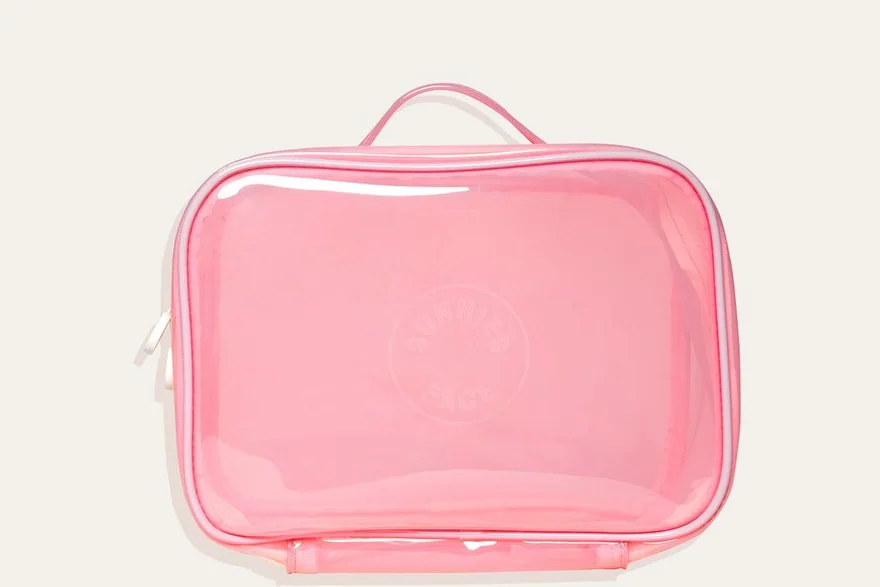
Why Mirrors Are Being Built Into Cosmetic Bags
The mirror-in-the-bag format answers a specific problem: applying makeup away from a bathroom mirror, in a hotel room with poor lighting, on a train, or in a backstage corridor. That problem is common enough that the format has moved from novelty to a recognisable category, and the search data supports it - make up bags for women runs around 80,000 monthly searches and custom makeup bag between 5,400 and 6,600, with a meaningful share of that demand now specifying a mirror or a light.
What makes the format commercially interesting is that it raises the perceived value of a bag disproportionately to its cost. A pouch that retails at $12.99 can retail at $24.99 with a mirror, a light and a stand, and the incremental bill of materials is a fraction of that difference. What makes it commercially dangerous is that the same three additions create the three most common defect and complaint sources in the category: a mirror that arrives scratched or cracked, a light that does not work out of the box, and a hinge that loosens.
Three formats dominate. The simplest is a flat mirror panel sewn or bonded into the lid or a slip pocket, removable and unlit. The second is a fold-out or standing format, where the mirror is hinged so the open bag becomes an easel. The third is the lighted vanity format, which adds an LED ring or strip around the mirror, a battery or rechargeable cell, a switch and a charging port. Each step up roughly doubles the number of components that have to be specified and inspected.
For a brand owner the decision is less about whether to include a mirror and more about which of the three formats matches the channel. A promotional or gift channel usually wants the first: cheap, flat, low risk, no electrical compliance. A travel retail channel wants the second, because a standing bag is genuinely useful in a hotel. A direct-to-consumer beauty brand wants the third, because the light is the feature that gets demonstrated in a video and the one that justifies the price step.
Mirror Substrates and Magnification: What to Specify
The mirror has three specification lines: substrate, magnification and edge treatment. Substrate decides weight, breakage and distortion; magnification decides how close the user has to be; edge and backing decide what happens when the bag is dropped. None of the three can be left open on a brief, because mirror is one of the few components where a substitution is immediately visible to the end user and immediately generates a return.
| Mirror type | Typical build | Best use | Watch out for |
|---|---|---|---|
| Float glass | 1.5-3 mm glass with silvered backing and paint | Desk vanity cases, premium sets | Weight, breakage in transit, needs safety backing |
| Acrylic sheet | PMMA 1-2 mm, vacuum metallised or film-backed | Travel bags, children and teen ranges | Scratches easily, needs a protective film in transit |
| Flexible mirror film | Metallised PET film bonded to a panel or board | Foldable formats, lightweight pouches | Optical distortion if the panel is not flat |
| Two-sided panel | 1x on one face, magnifying on the other, in a frame | Professional kits, standing vanity bags | Hinge and frame alignment across both faces |
| Magnifying insert | Glass or acrylic with a ground magnifying face | Detail work, brows, lashes, lens application | Working distance falls as magnification rises |
Magnification is the least understood line on the brief. A 2x or 3x mirror is forgiving and suits general makeup application at a normal arm's length. At 5x the user must be noticeably closer, and at 7x to 10x the working distance drops to a few centimetres, which is only useful for brow, lash and contact-lens work. The most common retail mistake is specifying a high magnification on a general-purpose bag, where users then conclude the mirror is faulty because their face is out of focus.
Optical quality needs its own acceptance criterion because distortion is subjective. A practical method is to hold the sample at a stated distance from a printed grid and agree how much bowing or edge stretching is acceptable, then photograph the result and keep it as the reference for bulk. Flatness of the mounting panel matters as much as the mirror itself: a mirror bonded to a slightly curved board will distort regardless of how good the substrate is.
Glass in a bag raises a safety question that buyers should settle before sampling. Options are a safety backing film that holds fragments if the glass breaks, a bevelled and polished edge that reduces chipping, or a move to acrylic for any bag that will be carried loose in a suitcase or sold into a children range. Where a bag is sold in the United States as a children product, the CPSIA requirements apply, and glass is rarely the right answer for that channel.
Backing and bonding method is the least glamorous line on the spec and one of the most consequential. A mirror bonded with adhesive over the whole face avoids the shadowing and edge lift that a perimeter-bonded panel develops, but it makes the panel harder to replace and can telegraph any unevenness in the board. A perimeter bond with a few central dots is cheaper and more forgiving during assembly. The brief should state the method and require a flatness check after the bag has been stored closed for a day.
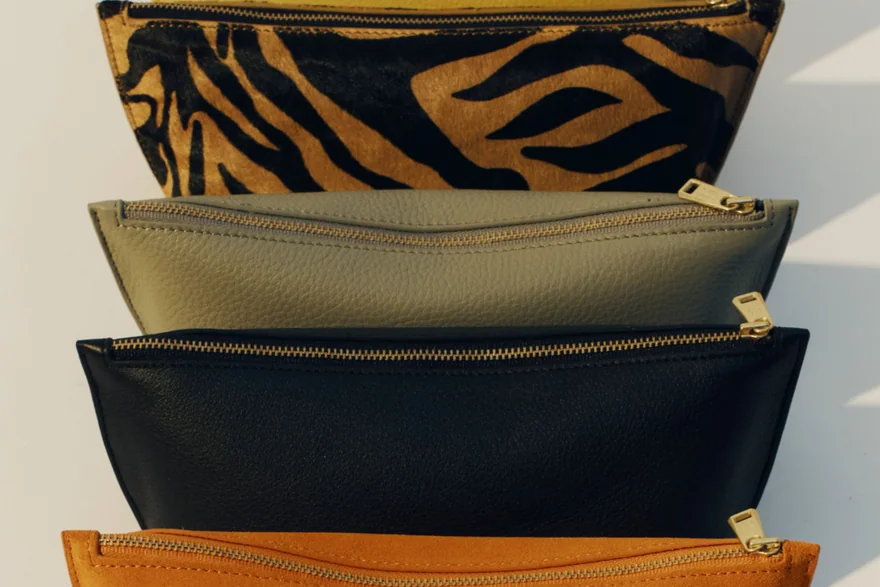
LED Lighting, Power and Electrical Compliance
An LED ring or strip turns a bag into a product with a power source, and that changes the compliance file. Four decisions govern the result: colour temperature, colour rendering, power source and switch. Colour temperature is usually offered in a warm band around 3000 K, a neutral band around 4000 K and a cool daylight band around 6000-6500 K. Makeup that will be worn outdoors or in office lighting is applied most accurately under the neutral or daylight band, which is why most vanity products specify it.
- Specify colour temperature in kelvin and colour rendering index, not the word daylight, which means different things to different suppliers
- Choose the power source by channel: replaceable coin cells for gift, USB-rechargeable for direct-to-consumer, replaceable AA or AAA where users resist charging
- State the switch type - touch, magnetic, or a zip or lid activation - and the number of cycles it is expected to survive
- Ask for the photobiological safety assessment and the cell safety documentation before sampling, not before shipment
- Plan for a dead-on-arrival rate: agree how many units will be tested at inspection and what happens above the agreed threshold
Power source drives both user experience and freight. A coin cell such as a CR2032 keeps cost and weight down and suits a gift item used a few times, but it produces a dead unit within a season of daily use and generates battery-change complaints. A rechargeable lithium cell with a USB-C port suits a premium direct-to-consumer product and matches how users now charge everything else, at the cost of a charge controller, a port, and additional transport documentation for the cell. Replaceable AA or AAA cells remain popular in professional kits, where a user can swap cells mid-job.
Compliance is the part buyers underestimate. LED products and the cells that power them fall under the international standards maintained by the International Electrotechnical Commission, including photobiological safety of lamps and safety requirements for cells and batteries, and lithium cells additionally have transport documentation requirements before they can be shipped by air. A brand owner should ask which standards the component supplier has tested the LED module and the cell against, and should obtain the reports during sampling, because a missing cell report can hold a shipment at a port weeks after the goods are finished.
Two practical points reduce field failures. The first is strain relief: the wire run between the cell box, the switch and the LED ring passes through a flexible bag, and it will be flexed every time the bag is opened, so the route needs a sleeve and a service loop rather than a tight run. The second is testing at inspection: every lighted unit in the inspection sample should be switched on and checked, because a dead-on-arrival light is the single most damaging defect in the category and it is invisible in a carton.
Diffusion is the detail that separates a pleasant light from a harsh one. An LED ring behind a diffuser gives an even field with no hot spots; bare emitters read as a row of dots and cast shadows that make blending difficult. Diffuser material, its distance from the emitters and the number of emitters all belong on the spec, and a buyer should judge the light on a face at the intended working distance rather than on a photograph of the ring.
Foldable and Standing Formats, and Getting Them Through Transit
Foldable and standing formats are what separate a bag with a mirror from a mirror in a bag. The geometry has to do two jobs: hold the mirror at a usable angle when open, and protect it when closed. The usual mechanisms are a hinged board bonded into the lid, a tri-fold panel that folds out from the body, a strap or magnet that sets the angle, and a base stiffener that stops the bag rocking on a counter.
| Format | How it stands | Suits | Risk to manage |
|---|---|---|---|
| Lid-mounted flat panel | Lies flat, no stand, mirror used in the hand | Lightweight pouches and gift sets | Mirror flexes if the lid is unlined |
| Hinged easel lid | Lid folds back and rests against a stiffener | Travel vanity bags | Hinge loosens; angle drifts as the board creeps |
| Tri-fold panel | Three panels unfold into a wide mirror surface | Professional kits and desk vanity bags | More hinges, more alignment tolerance |
| Detachable mirror board | Mirror lifts out and stands in a slot or on a fold-out foot | Hybrid travel and desk use | Slot wears, mirror rattles loose in transit |
| Hanging organiser with mirror | Hangs from a hook, mirror faces the user | Hotel and cruise use | Hook load, mirror weight pulls the panel out of square |
The hinge is the weak point, and it is worth specifying with the same care as a zip. A bonded fabric hinge made from the lining material will flex thousands of times and is cheap, but it gives no defined angle. A plastic or metal hinge gives a defined angle and a premium feel, and adds a component that can break. Where a defined angle is needed, a webbing strap with a fixed length or a magnet pair is often more durable than a manufactured hinge, because both can be replaced and neither has a pivot to wear.
Transit protection is the last line on the spec and the one that decides the return rate. A mirror should be covered by a protective film that the user peels off, separated from hard objects such as compacts and metal palettes by a padded divider, and the bag should be packed in a carton with enough fill that it cannot be crushed at the corner where the mirror sits. Where the mirror is glass, a corner-drop check on a packed carton is worth adding to the pre-shipment routine, along with a check that every lighted unit in the inspection sample switches on.
Commercially the category behaves like the rest of the range: 500 pieces per style and colourway, sampling in 6-10 working days or 12-15 for constructions that combine a hinge, a mirror and an electrical module, 35-50 days for bulk after sample approval, inspection to AQL 2.5 under ISO 2859-1, FOB Xiamen and T/T 30 deposit with 70 against bill of lading. Where the programme includes a rechargeable cell, the additional transport documentation belongs in the sampling window rather than in the shipping window.
One last line prevents a common complaint: the angle. A standing bag that holds the mirror too steeply forces the user to look down, and one that is too shallow lets the mirror fall forward when the bag is nudged. Agreeing a target angle in degrees, with a photograph of the approved sample as the reference, is quicker than arguing about it after the first return.
The B2B Customisation View
Cost, compliance and craft pull against each other on every cosmetic pouches, vanity cases and beauty organisers project; the specification is the record of how those three forces were balanced.
Commercial parameters stay fixed across the range: MOQ 500 pieces per style and colourway, prototype turnaround 6–10 working days (extended to 12–15 for multi-panel or moulded builds), bulk lead time 35–50 days from approved sample, AQL 2.5 inspection to ISO 2859-1, FOB Xiamen, T/T 30 deposit and 70 against bill of lading.
Buyers who use a programme coordinator keep their own supply-chain optionality; the technical pack travels, so production can be re-placed if a launch is brought forward.
Which Brand Types Benefit Most
Mirror bags are bought for a moment of use, and each buyer type is buying a different moment. Start-up brands tend to start with a lighted vanity bag because it is demonstrable in a short video and commands a price step, and their risk is the dead-on-arrival rate rather than the design; they should budget for 100 percent functional testing in the inspection plan. Established brands usually add a mirror to an existing best-selling pouch to lift its price point, and for them the priority is that the addition does not damage the core product: the mirror must not add creasing, weight or a bulk penalty that changes how the original bag packs.
- Retailers and pharmacy buyers favour the simplest format - a flat acrylic mirror in a slip pocket - because it carries no electrical compliance and no battery transport requirement
- E-commerce sellers benefit most from the lighted format, because the demonstration drives conversion, but they carry the highest return exposure if the light fails in the first month
- Travel retail, airline and cruise buyers want a hanging or standing format with lightweight acrylic, since every gram and every breakage risk matters in transit
- Professional and education buyers want a tri-fold or detachable board with a magnifying face, because the bag is used for detailed work at close range
- Gift and subscription buyers should stay with flat, unlit mirrors and protective film, because the product is opened once and photographed rather than used daily
- Teen and young adult channels prefer acrylic mirrors with modest magnification, because the product is used socially rather than for detailed professional work
- Buyers running influencer or affiliate launches should insist on functional testing of every lighted unit, since one dead product in a launch shipment multiplies the damage
- Gift-set and subscription buyers should keep the mirror flat and unlit, because the item is photographed once rather than used every day
Frequently Asked Questions
Is a glass or an acrylic mirror better in a cosmetic bag?
Glass gives the better optical surface and resists scratching, but it is heavy and breaks in transit. Acrylic is roughly half the weight and will not shatter, which suits travel bags and any children range, but it scratches and needs a peel-off protective film. For a bag carried loose in a suitcase, acrylic with a film is usually the safer commercial choice.
What magnification should a cosmetic bag mirror use?
For general use, 2x to 3x is forgiving and suits application at normal arm length. At 5x the user must move closer, and 7x to 10x only works a few centimetres from the face, which is useful for brow, lash and lens work. Specifying high magnification on a general-purpose bag is a common cause of users concluding the mirror is faulty.
Why does a mirror look distorted in a bag?
Usually because the panel it is bonded to is not flat, or because a flexible metallised film has been bonded to a surface with a slight curve. The remedy is a flat, rigid backing board and an acceptance check against a printed grid at a stated distance, photographed on the approved sample and used as the reference for bulk.
What colour temperature should an LED mirror bag use?
A neutral band around 4000 K or a daylight band around 6000-6500 K is usually best, because makeup worn outdoors or under office lighting is applied most accurately in that light. Warm light around 3000 K is flattering but misleading. Colour temperature should be specified in kelvin with a rendering index, not described as daylight.
Should a lighted makeup bag use a coin cell or a rechargeable battery?
Coin cells suit a gift item used occasionally, keeping cost and weight low, but they produce a dead unit within a season of daily use. A USB-C rechargeable cell suits a premium direct-to-consumer product and matches user expectations, at the cost of a controller, a port and cell transport documentation. Replaceable AA or AAA suits professional kits.
What electrical documentation does a lighted cosmetic bag need?
The LED module and the cell should each have test documentation against the relevant international electrotechnical standards, including photobiological safety for the light source and cell safety for the battery. Lithium cells additionally need transport documentation. These belong in the sampling window, because a missing cell report can hold a finished shipment at port. Where a rechargeable cell is used, transport documentation for the cell is needed before the goods can be booked by air.
How is a dead-on-arrival light handled at inspection?
By testing it. Every lighted unit in the inspection sample should be switched on and checked, and the brief should state how many units will be tested and what happens above an agreed failure threshold. A dead light is invisible in a closed carton and is the most damaging defect in the category, so it needs a specific check rather than a general visual one.
What makes a foldable mirror bag stop standing up?
Hinge creep or strap stretch. A bonded fabric hinge gives no defined angle and drifts as the board flexes; a manufactured hinge holds an angle but has a pivot that wears; a webbing strap or a magnet pair is often the most durable way to set the angle. The base stiffener matters too, since a soft base lets the whole bag rock.
Can a mirror be added to an existing pouch design?
Yes, and it is usually done as a bonded panel in the lid or a removable board in a slip pocket. The checks are whether the added weight changes how the bag hangs or stands, whether the lid still closes without pressing on the mirror face, and whether the added panel introduces a crease line that shows on the exterior shell.
How should a mirror be protected in transit?
With a peel-off protective film on the face, a padded divider between the mirror and hard contents such as compacts and palettes, and a carton with enough fill that the corner where the mirror sits cannot be crushed. For glass, add a corner-drop check on a packed carton to the pre-shipment routine. For glass, add a corner-drop check on a packed carton to the pre-shipment routine and leave the peel-off film in place until sale.
Is a mirror safe in a cosmetic bag sold to children?
Glass is rarely the right answer for that channel. Acrylic with a rounded and finished edge, or a flexible metallised film on a board, avoids the breakage risk entirely. Where a product is sold in the United States as a children product, the CPSIA requirements apply, and the safety of any rigid component should be settled before sampling rather than after.
Does a mirror add much weight to a cosmetic bag?
It depends on the substrate and the size. A 2 mm glass panel of roughly 15 by 20 cm adds several hundred grams, while an acrylic panel of the same size adds roughly half that, and a metallised film on a board adds very little. On a travel bag the difference matters, because it is felt in the hand and counted against baggage allowance.
What is a two-sided mirror panel and when is it worth it?
It carries a plain face on one side and a magnifying face on the other in a single framed panel, often pivoting. It suits professional kits and standing vanity bags where the user wants both views in one component. It costs more and adds an alignment tolerance, since both faces have to sit square in the frame.
How long should the LED module in a makeup bag last?
LED emitters themselves are long-lived; the limiting parts are the cell, the switch and the wiring. The specification should therefore cover the switch cycle expectation and the strain relief on the wire run between the cell box, the switch and the ring, since that run is flexed every time the bag is opened. The brief should therefore state the switch cycle expectation and require strain relief on the wiring between the cell box and the ring.
Can a lighted cosmetic bag be shipped by air?
Yes, but a lithium cell carries transport documentation requirements that must be arranged before booking. A brand owner should confirm which cell is used, obtain the relevant transport test documentation during sampling, and check with the freight forwarder early, because the requirement applies to the cell rather than to the bag and can affect routing.
People Also Ask
Are makeup bags with mirrors worth it?
They are worth it when the bag is used away from a bathroom mirror - in a hotel, on a train or backstage. The value is in the combination: a mirror plus a light plus a way to stand the bag up. Where the bag will only ever be used at a dressing table, the mirror adds weight and cost without much benefit.
What mirror is best for applying makeup?
A flat, undistorted surface in neutral or daylight light around 4000-6500 K, with modest magnification of 2x to 3x for general application. Higher magnification of 7x to 10x is only useful close up for brows, lashes and lenses, and warm light flatters but distorts colour judgement. A flat, undistorted surface matters more than magnification, because a curved panel distorts at any power.
Do LED makeup mirrors need batteries?
Yes, unless the bag is mains-powered, which is rare in a portable format. Options are a replaceable coin cell for occasional gift use, replaceable AA or AAA for professional kits, or a USB-C rechargeable lithium cell for premium direct-to-consumer products. Each has a different compliance and freight implication. The choice affects compliance and freight as well, since a rechargeable lithium cell needs transport documentation that a coin cell does not.
How do you stop a travel mirror from cracking?
Use acrylic rather than glass, keep a peel-off protective film on the face until the point of sale, separate the mirror from hard objects with a padded divider, and pack the carton so the mirror corner cannot be crushed. A corner-drop check on a packed carton before shipment catches most remaining problems. Specifying acrylic with a protective film and a padded divider removes most of the remaining risk.
Request a Sample or a Written Quotation
Send the silhouette, dimensions, material preference and logo artwork, and the programme team will return a written quotation with MOQ, sampling window, bulk lead time and inspection standard.
Email: [email protected] · WhatsApp: +86 177 5002 0688