Custom Cosmetic Bag Quality Control: AQL 2.5 Inspection Standard
Executive Summary
What does AQL 2.5 mean for a custom cosmetic bag order? It means the buyer and the production side have agreed that a lot averaging 2.5% major defects is the worst average tolerable, and that a random sample drawn under ISO 2859-1 will be used to test it. On a 3,000-piece lot at general inspection level II, that means 125 pieces inspected, with the lot accepted on 7 defectives or fewer and rejected on 8 or more.
AQL 2.5 is a sampling rule, not a quality promise. A lot that passes still contains defects, which is why critical defects are held at zero tolerance regardless of the 2.5 plan, and why laboratory tests for colour fastness and restricted substances run separately from the attribute count. The inspection sits at the end of a fixed calendar: sampling in 6-10 working days, 12-15 working days for complex constructions, bulk in 35-50 days after approval, then inspection at 80-100% packed before goods ship FOB Xiamen on T/T terms of 30% deposit and 70% against the bill of lading.
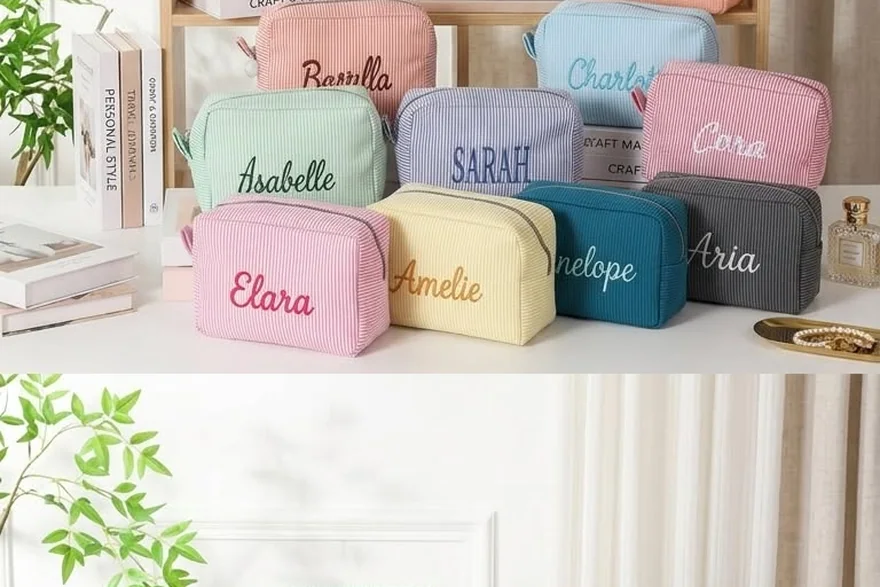
What AQL 2.5 means, and what it does not
AQL stands for acceptable quality limit: the worst process average, expressed as a percentage, that the sampling plan is designed to accept most of the time. The number 2.5 is therefore not a promise that 2.5% of a shipment may be faulty. It is the input to a statistical plan that sets a sample size and a pair of decision numbers, and the plan has a known risk on both sides: the producer risks a good lot being rejected, and the buyer risks a bad lot being accepted.
The mechanics come from ISO 2859-1, Sampling procedures for inspection by attributes. The standard indexes sampling plans by AQL and by lot size, converts the lot size into a sample-size code letter, and publishes accept and reject numbers for three states of inspection: normal, tightened and reduced. Buyers choose single, double or multiple sampling, and one of three general inspection levels. Level II is the default for consumer goods; level I uses a smaller sample and level III a larger one; the special levels S-1 to S-4 exist for destructive or expensive tests such as a zipper cycle test.
What AQL 2.5 does not do is equally important. It does not guarantee a defect-free shipment, because sampling inspects a fraction of the lot and the operating-characteristic curve of the plan leaves a real chance of accepting a lot above the limit. It does not replace laboratory testing: colour fastness to rubbing, restricted substances and coating adhesion are measured, not counted. It does not cover safety or compliance, which is why critical defects sit outside the plan at zero tolerance. And it does not work at all unless the defect definitions were written down before production started.
Three decisions therefore have to be taken in writing, in the tech pack or the inspection protocol, before a single bag is cut. First, the AQL for each defect class: 0 for critical, 2.5 for major, 4.0 for minor is the common pattern for soft goods. Second, the inspection level and sampling type, normally level II single sampling. Third, the defect list itself, with tolerances stated as numbers - 5 mm for dimension drift, 2 mm for label placement, Delta E 2.0 for shade - because an inspector cannot classify a fault against an adjective.
Sample size and the accept-reject table at AQL 2.5
The table below is the working reference for single sampling, normal inspection, general level II, at AQL 2.5. Read across: the lot size gives the code letter, the code letter gives the sample size, and the sample size gives the accept and reject numbers. Accept is the largest number of defective pieces that still passes the lot; reject is the smallest number that fails it.
| Lot size (pieces) | Code letter | Pieces to inspect | Accept | Reject |
|---|---|---|---|---|
| 51-90 | E | 13 | 1 | 2 |
| 91-150 | F | 20 | 1 | 2 |
| 151-280 | G | 32 | 2 | 3 |
| 281-500 | H | 50 | 3 | 4 |
| 501-1,200 | J | 80 | 5 | 6 |
| 1,201-3,200 | K | 125 | 7 | 8 |
| 3,201-10,000 | L | 200 | 10 | 11 |
| 10,001-35,000 | M | 315 | 14 | 15 |
| 35,001-150,000 | N | 500 | 21 | 22 |
Two examples show how it is used. A brand buying 500 pieces per style and colourway - the usual programme minimum - falls in the 281-500 band, so 50 pieces are drawn and the lot passes on 3 defectives or fewer. A retailer importing 12,000 pouches falls in the 10,001-35,000 band, so 315 pieces are drawn, and 15 defectives fail the lot. Note what the numbers do not say: in the second case, 14 defective pieces in 315 is a pass, and the same rate projected across the lot is roughly 530 pieces, which is why a passing report is a risk control rather than a clean bill of health.
Two counting rules decide most disputes. The first is that defective units are counted, not individual defects: a bag with a skipped stitch, a crooked label and a loose thread is one defective unit, filed under its most serious defect class. Many inspectors file each piece once, under the worst class it falls into; that method should be agreed in the protocol. The second is that critical defects are counted separately at zero tolerance, so a single broken needle fragment found inside a lining fails the lot regardless of how the major and minor counts stand.
ISO 2859-1 uses arrows in its tables where the plan for a code letter does not exist at a given AQL, directing the user to a different sample size. At the small end of the scale this can move a code letter to a smaller sample with an accept number of zero. Inspectors should confirm the plan against the current edition of the standard for any lot under 150 pieces, and should record the code letter and the sample size on the report.
Order composition changes the answer. Where a single style is bought in three colourways, the consignment can be declared as one lot of the total or as three lots of the individual colourway. One lot draws a larger sample against a single accept number and is cheaper to inspect, but it can conceal a fault that affects one colour only. Declaring three lots costs more in inspection time and returns three separate pass or fail decisions, which is usually the better commercial choice.
Single sampling is not the only option in the standard. Double sampling draws a first sample and only takes a second when the result sits between the accept and reject numbers, which reduces the average number of pieces inspected on very good or very bad lots; multiple sampling extends the same idea to as many as seven samples. Most bag programmes stay with single sampling because a single pair of decision numbers is easier to explain than a saving in inspection time.
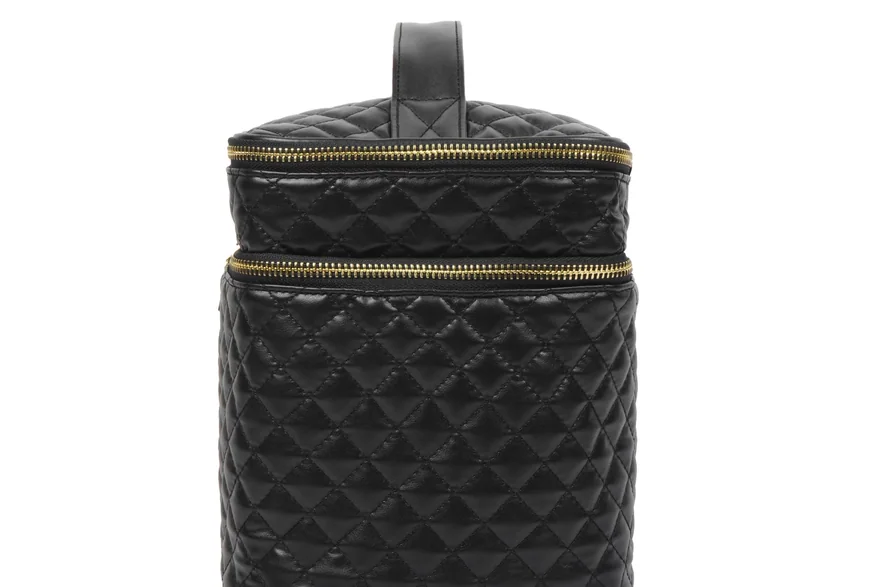
Defect classification for cosmetic bags: critical, major, minor
A cosmetic bag has a short list of things that can go wrong, and classifying them in advance is what turns a sampling plan into a decision. The list below is written the way a protocol should be written: each defect has a class and, where possible, a number attached, so that two inspectors reach the same verdict on the same piece.
- Critical, AQL 0, any finding fails the lot: a needle fragment or broken blade inside the bag; a sharp burr on a metal zipper stop or slider; a detachable small part on a bag marketed to children; a missing suffocation warning on a polybag thinner than 0.038 mm; restricted-substance results above the legal limit.
- Major, AQL 2.5, functional or commercial failure: a zipper that will not close or that splits behind the slider; an open seam longer than 10 mm; dimensions outside the tolerance on the tech pack, typically plus or minus 5 mm on a soft pouch; shade deviation above Delta E 2.0 against the sealed sample; a logo more than 2 mm off position; coating peeling or cracking over 5 mm.
- Major, continued: a hanging hook or wristlet that pulls out below its rated load; a lining tear; a bar-tack missing at a stress point; a wrong or illegible barcode; an error in composition, origin or care text; water ingress on a bag specified as leak-resistant.
- Minor, AQL 4.0, cosmetic only: loose thread ends longer than 10 mm; a print pinhole under 0.5 mm away from the main face; slight seam puckering visible only when the bag is laid flat; a carton label typo that does not affect the goods; tape wrinkles on the master carton.
- Measured checks that support the classification: stitch density of 7-9 stitches per inch on a 300-600D shell, counted over 25.4 mm; bar-tacks of 8-10 mm at every strap and handle root; seam strength of 120 N per 5 cm on a witness strip; 20 open and close cycles on every zipper in the sample.
Two of those checks deserve method notes. Zipper terminology - chain, slider, top stop, bottom stop, tape and gauge - is defined in ASTM D2053, and using the defined terms in a protocol prevents the common argument about whether a zipper that opens behind the slider is a split chain or a failed stop. Colour is assessed under AATCC test methods for crocking and under the ISO 105 grey scale for staining, with the usual pass levels for a bag of this kind being grade 4 dry and grade 3-4 wet.
Measurement conditions matter as much as the method. Dimensions are taken on a bag laid flat without tension, with a steel rule rather than a tape, on three pieces minimum. Colour is read in a light box under D65 at a 10-degree observer, with the sealed reference sample beside the piece, because a Delta E taken under TL84 will differ from the same pair under D65. Zipper cycling is done by hand at a natural speed, not snapped, since a snapped test destroys sliders that would have lasted years in service.
Inspectors should also record the composition of the sample. Drawing 125 pieces from the top layer of two cartons is not a random sample under ISO 2859-1; the standard expects pieces drawn across the lot, and the usual working rule is to take pieces from at least the square root of the number of cartons plus one, spread across the stack rather than from the front row. A report that does not say which cartons were opened is difficult to defend if the result is disputed.
Inspection timing, switching rules and the cost of rectification
Inspection is not one event at the end of a programme. Four checkpoints catch faults at the point where they are still cheap to fix, and the final random inspection only confirms what those checkpoints should already have established. The table sets out the sequence against a 35-50 day bulk run.
| Checkpoint | Timing in the run | What is examined | Typical outcome |
|---|---|---|---|
| Pre-production check | Before bulk cutting | Fabric lot, lab dip against the sealed sample, zipper batch, print plates, dies | Material deviations fixed before a single bag is cut |
| Top-of-production review | First 5-10 pieces off the line | Shade, dimensions, print position, stitch density, zipper action | Line reset or written approval to continue |
| Inline inspection | At 20-30% packed | First-off pieces against the sealed sample, housekeeping, needle control | Process correction while most of the run remains |
| Final random inspection | At 80-100% packed | AQL 2.5 level II sample, packing, carton marking, quantity | Pass, or fail with a rectification instruction |
| Loading supervision | At container stuffing | Carton count, pallet pattern, container number and seal number | Evidence that what was inspected is what shipped |
| Rectification | After a failed lot | 100% sort at the production floor, then re-inspection | 2-6 days added; sorting cost of 0.10-0.35 USD per piece |
Switching rules are the part of ISO 2859-1 that buyers forget, and they are what stops a sampling plan from being a one-off. Normal inspection moves to tightened when two out of five consecutive lots fail; tightened returns to normal after five consecutive accepted lots; normal may drop to reduced after ten consecutive accepted lots with steady production and no other concern. Tightened inspection at the same lot size typically means a larger sample for the same AQL, so the cost of a rejected lot is paid twice: once in the rectification and again in the tighter plan that follows.
Booking the inspection is a scheduling task, not an afterthought. The final inspection should be requested 5-7 days before the expected packing completion date, because a same-week request is often refused during peak season and a missed inspection delays the balance payment and the vessel booking. The report is normally issued within 24-48 hours of the inspection, and it is the document that releases the 70% balance under T/T terms against the bill of lading for goods shipped FOB Xiamen.
Finally, the report has to be read correctly. A pass at AQL 2.5 with a full quota of major defects is a different commercial event from a pass with one, and both look identical on a one-line result. Buyers should ask for the defect breakdown by class and by category - stitching, printing, hardware, packing - because a lot that used up its major allowance on zipper faults is a lot with a zipper problem, and the next order should specify a different zipper batch or a different brand rather than a tighter AQL.
Cost of the inspection itself is modest and predictable: a man-day rate covers a full working day at the production site, and a lot of 1,200 pieces is normally completed inside one day. What is not predictable is the cost of a late booking, because a missed inspection pushes the balance payment, the vessel booking and therefore the retail delivery date.
The B2B Customisation View
The brief for makeup bags and toiletry bags should state the tolerances that matter: acceptable shade drift, stitch density, and the defect threshold at final inspection.
Programme data for this category: minimum order quantity 500 pieces per style and colourway, sampling in 6–10 working days (12–15 working days for complex constructions), bulk production 35–50 days after sample approval, final random inspection at AQL 2.5 under ISO 2859-1, FOB Xiamen, T/T 30/70.
This is the model that lets a small brand launch makeup bags and toiletry bags with the same inspection discipline a large retailer would demand.
Which Brand Types Benefit Most
Start-up brands placing a first order of 500 pieces per style and colourway are in the 281-500 band, where 50 pieces are inspected and 3 defectives still pass. Because the sample is small, the defect list matters more than the AQL: a written list with tolerances is what converts a 50-piece check into a decision about a 500-piece buy. Established brands running repeat programmes benefit most from the switching rules, since a record of accepted lots justifies reduced inspection and lowers inspection cost per unit over a season. Retailers with their own QC teams usually specify AQL 2.5 for major and 4.0 for minor, and add their own packaging and barcode requirements on top, which is why a retailer protocol should be shared before production rather than at inspection. E-commerce sellers should pay attention to the defect that drives returns rather than the one that drives rejections: zipper failures and lining odour generate reviews and refunds, so those categories deserve a tighter internal target even when the AQL permits them. Gift and hospitality buyers distributing to third parties should add loading supervision, because carton count and seal number disputes are far more common in that channel than product defects. A written defect library pays for itself across seasons. Once a brand has recorded its tolerances for dimension, shade, print position, stitch density and zipper action, the same sheet can be attached to every order and every inspector brief, and results become comparable between programmes. Without one, the standard is effectively renegotiated on every lot.
- Start-up brands: the defect list, with numeric tolerances, matters more than the AQL at a 500-piece buy.
- Established brands: switching rules reward a clean record with reduced inspection on repeat programmes.
- Retailers: share the retailer's own protocol before production, not at the inspection booking.
- E-commerce sellers: set a tighter internal target on zipper action and odour, the two return drivers.
- Gift and hospitality buyers: add loading supervision, since carton and seal disputes outnumber product faults.
Frequently Asked Questions
What does AQL 2.5 mean for a custom cosmetic bag order?
AQL 2.5 is the worst process average of major defects the sampling plan is designed to accept. Under ISO 2859-1, at general inspection level II and single sampling, it converts a lot size into a sample size and a pair of decision numbers. A 3,000-piece lot draws 125 pieces and passes on 7 defectives or fewer, failing at 8 or more.
How many pieces are inspected on a 5,000-piece cosmetic bag lot at AQL 2.5?
A 5,000-piece lot falls in the 3,201-10,000 band, which is code letter L, so 200 pieces are inspected under single normal sampling at level II. The lot is accepted on 10 defective pieces or fewer and rejected at 11 or more. Critical defects are counted separately and any single critical finding fails the lot. Those 200 pieces should be drawn across the cartons, not from the top layer of the first two.
Why is ISO 2859-1 general inspection level II the default?
Level II balances the sample size against the cost of inspection for ordinary consumer goods, and it is the level most buyers, retailers and inspection agencies have agreed to use. Level I draws a smaller sample and suits low-risk repeat programmes; level III draws a larger one for new products or after a failure. Deviating from level II should be a written decision.
What are the accept and reject numbers for a 1,200-piece lot at AQL 2.5?
A 1,200-piece lot sits at the top of the 501-1,200 band, code letter J, so 80 pieces are inspected. The lot is accepted on 5 defective pieces or fewer and rejected at 6 or more. A lot of 1,201 pieces moves up to code K and 125 pieces inspected, which is a useful reason to plan order quantities with the sampling bands in mind.
Does AQL 2.5 apply to critical defects?
No. Critical defects - anything that creates a safety hazard or makes the product illegal to sell - are held at zero tolerance in almost every protocol. A single needle fragment inside a lining, a sharp burr on a metal zipper stop or a detachable small part on a children's item fails the lot regardless of how the major and minor counts stand.
Which zipper failures count as major defects on a makeup bag?
A zipper that will not close, a chain that splits behind the slider, a slider that will not lock on a locking zipper, and a top stop that lets the slider run off the end are all major defects. Terminology from ASTM D2053 should be used in the protocol. A zipper that feels stiff but functions through 20 cycles is normally recorded as minor, with a note on the report.
What stitch density should an inspector record on a 600D cosmetic bag?
A stitch density of 7-9 stitches per inch is the normal specification for a 300-600D shell, counted over a 25.4 mm length on a main seam. Below 6 the seam is at risk of opening; above 10 the needle perforation weakens the fabric. Bar-tacks of 8-10 mm at every strap, handle and hook root should be recorded at the same time.
How is colour deviation measured against an approved cosmetic bag sample?
The piece and the sealed reference sample are read side by side in a light box under D65 with a 10-degree observer, and the difference is expressed as Delta E. A tolerance of Delta E 2.0 or less is the usual pass level for soft goods. Comparisons made under TL84 or shop lighting will return different numbers, so the illuminant must be stated on the report.
What dimension tolerance is realistic for a soft cosmetic pouch?
Plus or minus 5 mm is the standard tolerance on a soft pouch, measured on a bag laid flat without tension using a steel rule. Moulded EVA cases hold a tighter tolerance of plus or minus 3 mm because they are formed in a tool. Tolerances should be written into the tech pack per dimension, with the critical ones identified, rather than applied as a blanket rule.
When should a pre-production check happen in a 35-50 day bulk run?
A pre-production check happens before bulk cutting, when fabric lots, lab dips, zipper batches and print plates are all on hand. At that point a wrong fabric or an off-shade dip costs days; after cutting it costs the run. The check normally takes half a day and should be recorded in the same report format as the final inspection.
What happens when a lot fails its AQL 2.5 inspection?
The lot is normally sorted 100% at the production floor, defective pieces are replaced or reworked, and the lot is re-presented for inspection. Sorting costs 0.10-0.35 USD per piece and adds 2-6 days. Under the switching rules, two failures out of five consecutive lots move the programme to tightened inspection, which draws a larger sample on the next order.
How does tightened inspection change the sample size?
Tightened inspection at the same AQL and code letter generally means a larger sample and a stricter accept number, which is the standard's way of protecting the buyer after a failure history. It returns to normal inspection after five consecutive accepted lots. Buyers should budget for the extra inspection time when a programme is already under tightened status.
How many cartons should an inspector draw samples from?
The working rule is to open at least the square root of the number of cartons, rounded up, and to spread those cartons through the stack rather than taking the front row. Pieces taken only from the top layer of two cartons are not a representative sample under ISO 2859-1, and a report that does not list the cartons opened is hard to defend in a dispute.
Is a passing AQL 2.5 report enough to clear a shipment for import?
No. An attribute inspection says nothing about restricted substances, colour fastness or physical safety, all of which require laboratory testing against the regulations of the destination market. Retailers and marketplaces usually ask for both: a valid test report from an accredited laboratory and the AQL inspection report. Neither substitutes for the other. Customs authorities in some markets ask for the laboratory test report before releasing the goods.
How far ahead should a final inspection be booked?
Five to seven days before the expected packing completion date is the safe window, and earlier in peak season. A same-week booking is frequently refused, and a missed inspection delays the balance payment, the vessel booking and the bill of lading. The report itself is normally issued within 24-48 hours of the inspection being carried out. Booking before the packing date is confirmed is normal, with the date adjusted once packing passes 80 per cent.
Are defective units or individual defects counted at AQL 2.5?
Defective units are counted, not individual defects. A bag with a skipped stitch, a crooked label and a loose thread is one defective unit, filed under its most serious defect class, so it counts once against the major allowance and not three times. The counting method should be stated in the inspection protocol before work starts. Recording every fault found, while counting the piece once, produces the most useful report for the next order.
People Also Ask
Is AQL 2.5 good quality?
AQL 2.5 is the industry norm for major defects on consumer soft goods, not a premium standard. It means a lot with roughly 2.5% major defects is likely to be accepted. Buyers wanting a tighter result specify AQL 1.0 or 1.5 for majors, or add 100% sorting, accepting that both options raise cost and inspection time. For a premium vanity case, AQL 1.5 for major defects is the usual step up.
What is the difference between AQL 2.5 and AQL 4.0?
AQL 2.5 is normally applied to major defects, the faults that make a unit unsellable or returned. AQL 4.0 is applied to minor, cosmetic faults. On a 3,201-10,000 piece lot, the 200-piece sample accepts 10 majors but 14 minors. Using both in the same protocol is standard practice for bags and soft goods. Minor defects are counted in the same sample, so no extra pieces need to be drawn.
How do you calculate an AQL sample size?
The sample size is not calculated, it is looked up. The lot size gives a code letter from the ISO 2859-1 table at the chosen inspection level, and the code letter gives the sample size and the accept and reject numbers for the chosen AQL. On a 5,000-piece lot at level II and AQL 2.5, that produces 200 pieces with 10 accepts and 11 rejects.
Can a buyer request 100% inspection instead of AQL?
Yes, and it is sometimes the right call for a high-value vanity case or a first run of a new construction. Full inspection costs roughly 0.10-0.35 USD per piece and adds 2-6 days, and it still misses faults that only appear in use. Most programmes use AQL sampling plus a tightened plan after any failure. It is most often used once, after a failed lot, rather than as a standing requirement.
Request a Sample or a Written Quotation
Send the silhouette, dimensions, material preference and logo artwork, and the programme team will return a written quotation with MOQ, sampling window, bulk lead time and inspection standard.
Email: [email protected] · WhatsApp: +86 177 5002 0688