Repeat Order Cosmetic Bags: Reorder Process & Consistency
Executive Summary
A repeat order cosmetic bag programme exists to reproduce an approved article, and the standard is that piece 5,001 matches piece 1 within the tolerances written into the frozen specification. Meeting that standard takes eight steps rather than one: forecast trigger, spec confirmation, golden sample retrieval, material reservation, a confirmation sample built from the new lots, slot booking, inspection against the last report, and release. Skipping the confirmation sample is the single change that most often turns a reorder into a dispute.
Consistency breaks in predictable places. A new dye lot shifts shade by delta E 1.0-1.5 or more, a re-cut die grows panels by 1-2 mm after 30,000-50,000 clicks, a re-burned print screen moves registration by 1-2 mm, and a new slider batch changes the feel of the closure. The second order also buys time: sampling compresses from 6-10 working days to 3-5, bulk from 35-50 days to 30-45, and the sample charge is usually waived.
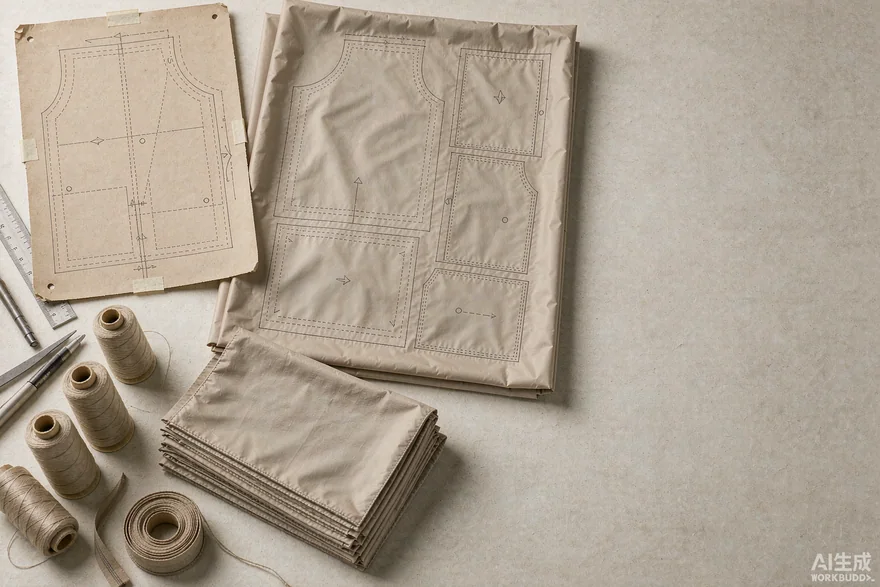
What a repeat order is meant to reproduce
A first order is a development project with a purchase order attached. A repeat order is a reproduction task, and the difference changes what the buyer should be managing. The object is not to design anything; it is to deliver 500 or 5,000 units that match an article already approved, already photographed, already listed and already in a customer's hands. Everything in a reorder process exists to protect that match.
The reference for the match is the golden sample, countersigned at the end of the first sampling round and stored by both sides. Alongside it sits the frozen specification: the revision-lettered document listing finished dimensions, fabric weight and denier, lining, zipper specification, stitch density, thread weight, hardware, print position and colour references. A reorder without both artefacts is not a reorder; it is a new order that happens to have the same name.
Drift enters through four doors. Material: a new dye lot, a new fabric roll from a different mill batch, a new adhesive batch. Tooling: a die re-cut after 30,000-50,000 clicks, a print screen re-burned after 8,000-15,000 impressions. People: an operator rotation on a line that has not run the style for four months. Time: a specification change made verbally during the last order and never written down. Each door has a control, and the controls are cheap compared with a rejected lot.
The commercial frame stays constant across runs. Minimum order quantity is 500 pieces per style and colourway; inspection sits at AQL 2.5; shipment is FOB Xiamen under T/T terms of 30% deposit and 70% against the bill of lading. What changes on a repeat is the calendar and, modestly, the price: sampling moves from 6-10 working days to 3-5, and bulk from 35-50 days to 30-45 once the pattern and materials are proven. Buyers who treat a reorder as a fresh negotiation rather than as a reproduction tend to lose both advantages, because every new question reopens a decision that was already settled.
The reorder workflow, step by step
Most reorder problems are scheduling problems in disguise. A buyer who raises the reorder when stock runs out has already lost three to five weeks; a buyer who raises it against a rolling 90-day forecast keeps the shelf full and keeps the production slot. The eight steps below are the sequence that protects both the calendar and the match, with the owner and the document attached to each.
| Step | Owner | Working days | Document produced | Common failure at this step |
|---|---|---|---|---|
| Trigger and forecast | Buyer | 1-3 | Rolling 90-day forecast by style and colourway | Reorder raised after stockout instead of before it |
| Specification confirmation | Both sides | 1-2 | Current revision of the spec sheet | An old revision is quoted and an old price agreed |
| Golden sample retrieval | Programme coordinator | 1-2 | Physical reference check and condition note | Reference lost, sun-faded or stored unsealed |
| Material reservation | Sourcing side | 2-5 | Fabric and trim booking against the mill lot | Mill has changed the shade recipe since the last lot |
| Confirmation sample | Sourcing side | 3-5 | One piece built from the new lots, compared to the reference | Skipped to save five days; drift found at inspection |
| Slot booking | Both sides | 1-2 | Confirmed position in the 30-45 day window | Slot already taken by a new style launch |
| Inspection | Third party | 1-2 | AQL 2.5 report compared with the previous report | Report filed without comparison to the last one |
| Release and payment | Buyer | 1-3 | Balance payment against the bill of lading | Balance released before the report has been read |
The confirmation sample is the step buyers try to remove and should not. It costs 3-5 working days and usually no money on an established style, and it is the only point at which a new dye lot can be caught before 500 or 5,000 pieces are cut from it. A reorder that skips it is effectively betting the whole lot on the assumption that the mill and the trim supplier have changed nothing in six months. Where the reorder is urgent, a partial substitute works: send the new fabric and trim swatches for comparison against the sealed reference, which takes one or two days and catches most shade and hand-feel problems even without a sewn piece.
Inspection on a repeat should be comparative. The report is not only a pass or fail against AQL 2.5 under ISO 2859-1; it is a data point against the last report on the same style. If majors moved from 3 to 9 between runs, the lot passed and something changed, and that trend is worth a conversation before the next order rather than after it.
One administrative control keeps the whole sequence honest: a revision log. Every change to the specification, however small, carries a revision letter and a date. Without it, two people on the same programme can hold two different specifications and both be certain they are right, which is how a reorder ends up with the previous zipper shade and no agreed remedy. A single-page log is enough: revision letter, date, what changed, who approved it, and whether a new physical reference was sealed. Buyers who keep the log on their own side, rather than relying on the other party to maintain it, settle specification disputes in minutes.

Where consistency actually breaks between runs
Shade is the most visible break and the easiest to control once a buyer knows what to ask for. Dyed fabric varies between lots; printed panels vary between screen burns and between ink batches. The practical tolerances are delta E 1.0-1.5 on dyed fabric under D65 lighting and delta E 1.5-2.5 on printed artwork, assessed against the sealed reference. Colour fastness behaviour itself is evaluated under the ISO 105 series, with grey scale 4-5 the common commercial expectation for rubbing and washing. Both tolerances should be written into the specification alongside the lighting condition used for assessment, because a shade measured under shop lighting and a shade measured under daylight are not the same argument.
- Dimensions: hold finished measurement to plus or minus 3 mm at five points, and re-check the die after 30,000-50,000 clicks when panels grow 1-2 mm.
- Hand feel: specify coating thickness, commonly 0.18-0.35 mm PU, and note the softening finish, because hand-feel changes are noticed even when the shade is right.
- Print: fix mesh count at 120-160, cure at 150-160 °C for 30-45 seconds, and register within 1 mm of the golden sample.
- Hardware: record the slider and puller batch reference; plating colour varies between batches more than buyers expect.
- Odour: agree a storage and airing period before packing, because a sealed carton shipped two days after sewing will smell of adhesive.
Dimensional drift is slower and less visible, which makes it more dangerous. A cutting die sharpened or re-cut after 30,000-50,000 cycles produces panels 1-2 mm larger, and a larger panel in a lined bag produces a fuller, softer bag that does not stand as well. The check is simple: measure the first piece off the line on every reorder against the golden sample, at the same five points, before the run continues.
Print drift comes from screen life and ink. A screen commonly holds registration for 8,000-15,000 impressions depending on mesh and ink type; after that the edges soften and the position moves. If a reorder is small enough to fall inside one screen life, the buyer should ask whether the original screen is still held, because re-burning a screen costs 30-120 USD and introduces a registration difference of 1-2 mm against the first run. Ink batch behaves the same way: a fresh batch of the same reference can dry to a slightly different gloss, which reads as a colour difference on a coated shell even when the measured delta E is inside tolerance. Keeping a dated drawdown card from the first run, stored with the golden sample, settles that question quickly.
The least discussed break is the verbal change. A buyer asks for the label moved 5 mm on the second run; the change is made; nobody updates the specification. The third run reverts, because the spec sheet still says the original position. The discipline is not to refuse small changes but to insist they are written into the revision log the same week they are agreed. A useful habit is to require that any change discussed on a call is confirmed by email within 48 hours with the revision letter in the subject line, and to treat a change that is not confirmed in writing as not made.
Commercial terms on a repeat order
A reorder buys three things a first order does not: time, certainty and a small price improvement. The time comes from not re-developing the pattern and not re-sourcing the fabric. The certainty comes from a proven article with a known defect profile. The price improvement is real but modest, and buyers who expect a large second-order discount are usually disappointed by 1-3%.
| Element | First order | Second order | Fourth order and beyond | What the buyer gains |
|---|---|---|---|---|
| Sampling time | 6-10 working days | 3-5 working days | 0-3 working days | An earlier production slot |
| Sample charge | 60-400 USD per style | Often waived | Waived | Lower development cost per style |
| Bulk lead time | 35-50 days | 30-45 days | 28-40 days | A shorter cash cycle |
| Unit price | Quoted baseline | 1-3% improvement like for like | 3-6% with a volume tier | Margin and competitive headroom |
| Payment | T/T 30 deposit, 70 against B/L | T/T 30/70 | T/T 30/70 with 30-60 day terms possible | Working capital relief |
| Inspection | First-piece plus final at AQL 2.5 | Final at AQL 2.5 | AQL 2.5 with reduced or skip-lot sampling | Lower inspection cost per piece |
Two commercial habits make reorders cheaper over time. The first is an annual framework: committing to a yearly quantity across several styles earns framework pricing of roughly 3-8% below single-order pricing and, more importantly, reserves capacity for a peak season. The second is consolidating colourways: ordering 1,000 pieces in one shell colour costs less than 500 in each of two colours, because the second colourway repeats the dye lot and zipper shade minimums. A third habit helps where demand is uneven across styles: a framework that commits to an annual quantity across several styles, released on call-off, holds framework pricing while letting the buyer decide the mix closer to the season. Framework terms also protect against the opposite risk: a buyer whose style doubles in demand can call off against reserved capacity rather than competing for a slot at short notice, which in a peak season is worth more than the pricing itself.
The reorder should also settle the question of what happens when the match is missed. The purchase order should state the remedy ladder in order: in-line rework where the defect is found before packing, a 100% sort at 0.05-0.20 USD per piece where a defect type is isolated, a credit of 0.10-0.50 USD per piece where the buyer can rework locally, and replacement production where the article is functionally wrong. Agreeing the ladder before it is needed removes the negotiation from the moment of disappointment. The ladder should also state who decides, and on what evidence: a joint measurement against the sealed golden sample, recorded with photographs and carton numbers, is the cheapest referee available and avoids an argument that costs more than the goods. The evidence clause is what makes the rest of the ladder enforceable, because every step from sort through to rejection depends on somebody accepting a measurement.
One golden sample held by each side, sealed in an opaque bag and stored away from daylight, with the revision letter written on the seal. Dyed fabric and printed panels fade, and a faded reference silently widens every tolerance on every future run. Replace both references together whenever the specification is revised.
The B2B Customisation View
A sourcing brief for makeup bags and toiletry bags should name the test standard before it names the fabric, because the standard decides which fabrics remain on the table.
Budgeting and scheduling inputs: MOQ 500 per style and colourway; sampling 6–10 working days, extended to 12–15 for lined, moulded or hardware-heavy builds; bulk 35–50 days; pre-shipment inspection at AQL 2.5 per ISO 2859-1; FOB Xiamen; T/T 30/70.
QUANZHOU JUNYUAN BAGS sits between the brand and the production floor precisely so that the brand never has to choose between cost control and inspection discipline.
Which Brand Types Benefit Most
Reorder discipline matters differently by buyer type. A start-up brand that has found a winning style should treat the reorder as the moment the business becomes predictable: the second run is where the unit price improves, the lead time shortens and the listing can be promoted without a stockout risk. An established brand running a permanent range should hold a golden sample for every style in the range and review the set annually, because a range of twenty styles accumulates twenty sets of small undocumented changes. A retailer or importer reordering private label needs the reorder to be compliance-identical, not just visually identical, which means re-testing whenever the material source changes. An e-commerce seller should reorder against sales velocity rather than against stock level, since a 30-45 day bulk window plus transit can easily exceed the remaining stock on a fast-moving listing. A gift or hospitality buyer reordering an amenity bag should fix the delivery date against the property opening or event schedule and hold a buffer carton, because a missed amenity delivery cannot be recovered by a later shipment.
- Start-up brands: reorder at 30-45 days of remaining stock, not at zero.
- Established brands: review the golden sample set annually and re-seal faded references.
- Retailers and importers: re-test whenever the fabric mill or trim source changes, even if the shade matches.
- E-commerce sellers: convert the bulk window plus transit into a reorder trigger point on the listing.
- Gift and hospitality buyers: hold a buffer carton and fix delivery against the event date, not the production date. For all five the underlying principle is identical: a reorder is won or lost in the first week, when the specification is confirmed and the material is reserved. Buyers who spend that week negotiating price instead of confirming the reference usually pay for it in week six.
Frequently Asked Questions
What is the minimum quantity for a repeat order of a custom cosmetic bag?
The same 500 pieces per style and colourway that applies to a first order. The reorder advantage is in time and certainty rather than in quantity: sampling compresses to 3-5 working days, bulk to 30-45 days, and the sample charge is usually waived because the pattern and the materials are already proven. Sampling compresses to 3-5 working days and bulk to 30-45, and the sample charge is usually waived on an established style.
Why does a repeat order need a confirmation sample at all?
Because the materials are new even when the style is not. A fresh dye lot can shift shade by delta E 1.0-1.5 and a new trim batch can change the closure feel. A confirmation sample built from the new lots costs 3-5 working days and catches that before 500 or 5,000 pieces are cut, which is far cheaper than discovering it at inspection.
How much shade variation is acceptable on a cosmetic bag reorder?
Delta E 1.0-1.5 on dyed fabric under D65 lighting and delta E 1.5-2.5 on printed artwork, measured against the sealed golden sample. Fastness performance is assessed under the ISO 105 series with grey scale 4-5 the common commercial expectation. The tolerance should be written into the specification before the reorder, not argued after it.
What happens if the golden sample has faded or been lost?
The programme loses its reference, and the reorder becomes a re-specification exercise. The practical fix is to retrieve the last retained production piece, re-seal it with both sides agreeing in writing, and note the condition on the file. This is why two sealed references should exist from the first order, one held by each party and stored away from daylight.
Can a buyer change the print position on a reorder?
Yes, but it is a specification change rather than a repeat. Moving artwork 5 mm requires the print screen to be re-burned at 30-120 USD and introduces a registration difference of 1-2 mm against the first run. The change should carry a new revision letter so that the third run does not silently revert to the original position.
How much shorter is the lead time on the second cosmetic bag order?
Roughly a week. Sampling moves from 6-10 working days to 3-5, and complex constructions from 12-15 to 6-9, because the pattern exists and the fabric is known. Bulk moves from 35-50 days to 30-45, and by the fourth run to 28-40, provided the material is reserved and the slot is booked early. By the fourth run the same style typically completes in 28-40 days once material is reserved and the slot is booked early.
Why do dimensions drift on later production runs?
Mainly tool wear. A cutting die sharpened or re-cut after 30,000-50,000 cycles produces panels 1-2 mm larger, and a larger panel in a lined bag produces a softer bag that does not stand as well. Measuring the first piece off the line against the golden sample at five points, on every run, catches the drift before it is cut into a whole lot.
Should a reorder be re-tested for compliance?
If the material source is unchanged and the certificate is still valid, no. If the mill, the coating supplier or the trim source has changed, re-test, because certificates are issued to a defined material article rather than to a style. A report costing 120-400 USD is cheap against a recall or a marketplace delisting in the EU or US.
How does a reorder affect the inspection sample size?
It does not, unless the buyer changes the plan. Sample size under ISO 2859-1 is set by lot size and inspection level, so a 500-piece reorder draws the same sample as a 500-piece first order. What can change is the frequency: programmes with a stable history sometimes move to reduced or skip-lot inspection, which lowers cost but should be reinstated after any failure.
What price improvement should a buyer expect on a second order?
Typically 1-3% on a like-for-like specification, rising to 3-6% once a volume tier is reached. Larger improvements come from annual framework commitments of 3-8% and from consolidating colourways, since each extra colourway repeats a dye lot minimum of 300-600 m and a zipper shade minimum of 1,000-3,000 m. Consolidating colourways helps too, because each additional shade repeats a dye lot minimum of 300-600 m and a zipper shade minimum.
How far ahead should a reorder be raised?
Against a rolling 90-day forecast, and in practice when remaining stock equals roughly 45-60 days of sales. With bulk at 30-45 days plus 25-40 days of sea transit to a US or European warehouse, a reorder raised at zero stock guarantees a stockout of four to eight weeks on a fast-moving listing. Raising the reorder at zero stock guarantees a stockout of four to eight weeks on a fast-moving listing.
Can a repeat order use a different fabric mill?
Only after re-sampling. Even the same nominal construction, such as 600D polyester at 210 g/m², differs between mills in weave, coating, hand feel and shade recipe. The route is a confirmation sample plus a new test report, which adds 5-10 working days and 120-400 USD, and is worth it when the alternative is a supply interruption.
What is a revision log and who maintains it?
A dated list of every change to the specification, each carrying a revision letter, maintained jointly and referenced on every purchase order. It prevents the common failure where a change agreed verbally on one run is forgotten on the next. Without it, two people on the same programme can hold two different specifications and both be certain they are right.
How is a moulded EVA case reorder handled differently?
The tooling is the asset, so consistency is usually better than on a sewn style, provided the mould has been maintained and the cavity is not worn. The checks are wall thickness at 3-5 mm, closure compression with the zipper fitted, and shell surface finish. If the mould has been idle for more than twelve months, a first-piece trial of 3-5 working days is prudent before the run.
What remedy applies when a reorder does not match the reference?
The ladder agreed in the purchase order: in-line rework where the defect is found before packing, a 100% sort at 0.05-0.20 USD per piece where the defect type is isolated, a credit of 0.10-0.50 USD per piece where the buyer can rework locally, and replacement production where the article is functionally wrong. Agreeing the order of the ladder beforehand removes the negotiation from the disappointment.
People Also Ask
How do you reorder custom cosmetic bags?
Confirm the current specification revision, retrieve the sealed golden sample, reserve the fabric and trim lots, build a one-piece confirmation sample from the new lots, book the slot, then inspect at AQL 2.5 and release. The minimum stays at 500 pieces per style and colourway and bulk runs 30-45 days. Skipping the confirmation sample is the change that most often turns a reorder into a dispute about shade.
Why does the second batch look different from the first?
Usually a new dye lot, a re-cut die or a re-burned print screen. Fabric varies by delta E 1.0-1.5 between lots, panels grow 1-2 mm after 30,000-50,000 die cycles, and a new screen can move registration by 1-2 mm. Measured checks against the sealed reference catch all three before the lot is cut. All three are caught by measuring against the sealed reference before the lot is cut.
Is the second order cheaper than the first?
Slightly. Expect 1-3% on a like-for-like reorder, rising to 3-6% at a higher volume tier and 3-8% under an annual framework. The larger saving is time: sampling drops from 6-10 working days to 3-5 and bulk from 35-50 days to 30-45, which shortens the cash cycle more than the price change does. Consolidating colourways into one shell colour is usually worth more than negotiating the unit price.
What is a golden sample used for on a reorder?
It is the physical reference for shade, dimension, print position and construction. Inspectors and production supervisors compare the new run against it, and any dispute is settled by measuring both units. Two sealed copies should exist, one held by each side, replaced together whenever the specification is revised. Two sealed copies should exist, one held by each side, replaced together whenever the specification is revised.
Request a Sample or a Written Quotation
Send the silhouette, dimensions, material preference and logo artwork, and the programme team will return a written quotation with MOQ, sampling window, bulk lead time and inspection standard.
Email: [email protected] · WhatsApp: +86 177 5002 0688