Do Men Use Cosmetic Bags? Men's Toiletry Bag Market Analysis
Executive Summary
Men do use cosmetic bags, and the demand is measurable rather than anecdotal. ASINSIGHT's 2026.07 data records roughly 74,810 weekly Amazon searches for toiletry bag, while travel bag for toiletries draws about 110,000 monthly searches and make up bags for women sits near 80,000 monthly. Those figures describe one product family reached through three different entry terms. The functional brief is identical in every case: carry liquids, blades, brushes and grooming tools from a shelf to a suitcase without leaking. What changes is retail language, colourway and trim level, not the underlying engineering.
For a buyer the practical consequence is efficiency. One base pattern can serve a men's wash bag and a general cosmetic pouch with a change of shell fabric, zipper pull, lining and hangtag, which keeps sampling rounds and colourway minimums under control. Programmes start at 500 pieces per style and colourway. Sampling runs 6 to 10 working days, or 12 to 15 working days for moulded or multi-compartment builds, and bulk ships 35 to 50 days after sample approval, inspected to AQL 2.5 under ISO 2859-1, FOB Xiamen, T/T 30 deposit and 70 against bill of lading.
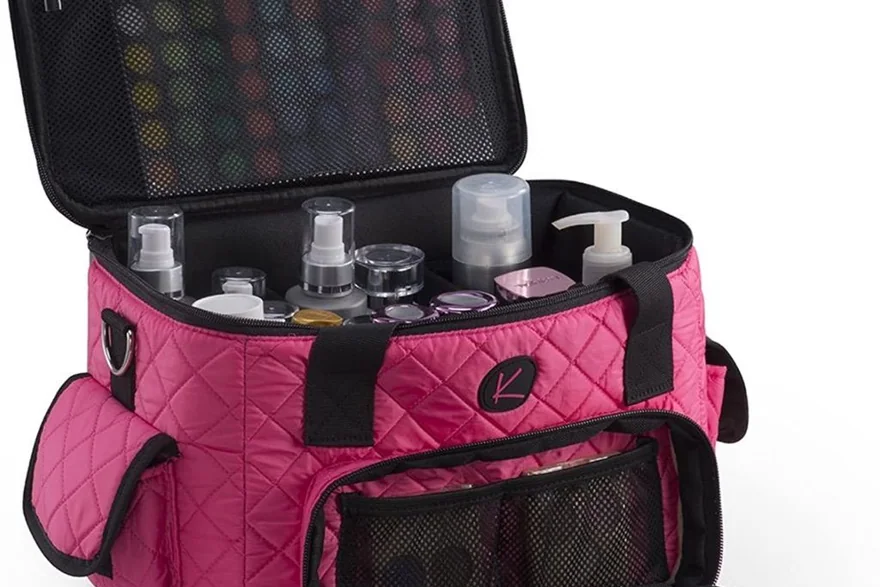
What the search record actually shows about men's toiletry bag demand
The question behind this article is normally a commercial one: is a men's line a real category, or is it the same bag with a different photograph? The search record answers it. ASINSIGHT's 2026.07 data puts toiletry bag at roughly 74,810 weekly searches on Amazon, while travel bag for toiletries records about 110,000 monthly searches and make up bags for women around 80,000 monthly. Those are not three markets. They are three vocabularies pointing at one job: move a set of grooming items, some of them liquid, from a bathroom shelf into a bag that can be carried, packed and unpacked repeatedly without soaking everything around it.
Retail taxonomy does the segmentation. Cosmetic bag, makeup bag and vanity case are the labels used across women's assortments; toiletry bag, wash bag, dopp kit and shaving kit are the labels used across men's assortments. Photography, colourway naming and category placement carry the positioning. A buyer who treats the men's line as a separate engineering problem spends money on tooling that changes nothing about function, while a buyer who treats it purely as a relabel misses the handful of specification changes that genuinely do change performance and returns.
The stereotyping trap is worth naming explicitly. Grooming routines are not determined by gender, and product copy that assumes otherwise narrows the addressable market for no commercial gain. The defensible method is to specify for contents and context: liquid volume carried, blade and sharp-tool containment, frequency of travel, shared-bathroom storage, and how the bag is cleaned. Photography and colourway then carry the positioning without the specification having to make claims about who the user is.
Price framing follows the same logic. The typical unit band on marketplaces in Alibaba's 2026.10 data runs from $0.45 to $12.00, and men's wash bags cluster in the upper half of that band because they tend to be larger, use heavier shell fabric and carry a structured base. That is a size and materials effect, not a gender premium, and it is worth reflecting in the cost model before a buyer assumes the men's line will automatically command a higher margin.
Specification changes that justify a separate men's SKU
Four changes genuinely separate a wash bag from a soft cosmetic pouch: volume, base structure, opening geometry and lining. A pouch sized for a lipstick, a compact and a brush roll holds roughly 0.8 to 2.0 litres. A wash bag sized for a full-size deodorant stick, a 200 ml shampoo bottle, a razor and a shaving brush holds 3.5 to 6.0 litres, which is a different pattern block rather than a graded-up version of the same one. Packing volume also has to be understood against the TSA 3-1-1 liquids rule, which caps carry-on liquids at 100 ml per container in a single quart-sized bag; the wash bag has to hold those containers flat and reachable, not buried.
| Attribute | Men's wash bag brief | General cosmetic pouch brief | Effect on the tech pack |
|---|---|---|---|
| Packed volume | 3.5-6.0 litres | 0.8-2.0 litres | New pattern block, not a grade |
| Base | Structured, 3-5 mm EVA or PE board insert | Flat soft base | Insert plus corner bartacks |
| Opening | Three-sided U zipper, 35-45 cm run | Single straight zipper, 20-25 cm | Longer zipper, gusset geometry |
| Lining | TPU-laminated or PVC-coated 190T polyester | 210D plain polyester | Seam sealing method changes |
| Interior | 2-4 elastic loops plus one zip pocket | Single open compartment | Adds 0.6-1.2 minutes sewing time |
| Shell | 600D polyester, 12 oz canvas, or PU-coated | 300D polyester or satin | Needle size and thread change |
| End handle | 12-15 cm webbing loop, reinforced | Wrist strap or none | Reinforcement plate at stress point |
| Colourways per drop | 2-3: navy, charcoal, olive, black | 6-10 seasonal prints | Fewer colourways, deeper units each |
| Branding | Debossed PU patch, woven label, tonal embroidery | Metallic heat transfer, printed logo | Different artwork and placement spec |
| Water resistance | Shower-resistant coating, taped interior seams | Decorative finish only | Adds coating and seam tape operations |
The colourway row carries the biggest commercial consequence. At 500 pieces per style and colourway, a three-colourway wash bag launch commits 1,500 units before the first shipment, whereas a ten-print pouch drop commits 5,000 units across the same style. A men's line therefore suits a buyer who wants depth in fewer colours; a print-led pouch line suits a buyer with the capital to spread risk across more variants. Marketplace listings commonly advertise an MOQ band of 100 to 1,000 pieces, but that band usually applies to stock designs with fixed materials rather than to a specified build.
Zipper specification is where wash bags most often fail, because a three-sided opening puts the slider under load at both corners every time the bag is opened. Buyers should specify gauge, tape material, slider type and pull, and use consistent terminology drawn from ASTM D2053 so that a written brief and a physical sample can be compared without ambiguity. A #5 coil with a metal-look pull is the common resolution between cost and the tactile weight that men's assortments are usually merchandised on.
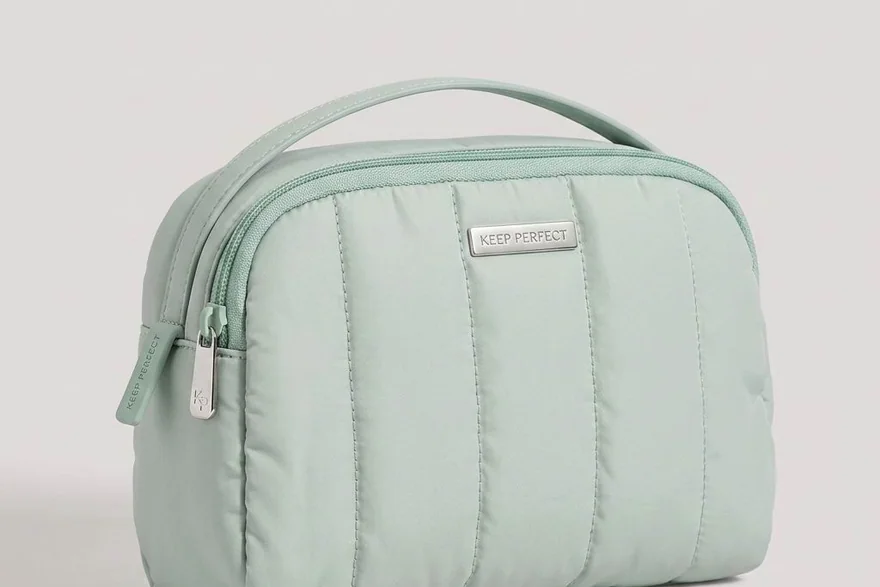
Materials and hardware that decide whether a wash bag comes back
Returns on toiletry bags cluster around four causes: zipper failure at the corner, lining delamination after contact with shaving foam or alcohol-based products, colour transfer from dark shell fabric onto light clothing, and odour retention in a bag that is stored closed between trips. All four are specification problems with specification answers, and all four can be written into a sample-approval checklist before bulk is released.
- Zipper: #5 coil or metal-look, 35-45 cm run, bartack at both ends, 3,000-cycle pull test on the approval sample.
- Shell: 600D polyester at roughly 210-260 g/m², or 12 oz canvas, with a shower-resistant finish tested to spray rating rather than by eye.
- Lining: TPU-laminated 190T polyester at 0.12-0.18 mm film thickness, wipe-clean, resistant to alcohol-based aftershave and shaving foam.
- Colour fastness: dark navy, charcoal and olive shells tested for rubbing and perspiration transfer against a white cotton cloth.
- Odour: lining and foam inserts conditioned and smelled after 72 hours sealed at 40 °C before approval.
- Hardware: metal-look pulls and D-rings salt-spray checked so a coastal or humid warehouse does not produce rust spots in carton.
- Base insert: 3-5 mm EVA or PE board, removable for washing, corners bartacked rather than single-stitched.
Two details are routinely missed. Elastic loops lose tension after repeated contact with warm, damp bottles, so buyers should specify a covered or braided elastic and require a stretch-recovery check on the approval sample rather than a visual one. Mesh panels behave the opposite way: they solve moisture build-up but snag on a razor handle or a nail clipper, so a fine-gauge mesh at the wet pocket and a solid lining everywhere else is the safer pairing. Both choices belong in the sample-approval checklist, because neither can be corrected after bulk is cut.
Chemical compliance belongs in the same checklist. Shell fabric, lining, coating, zipper tape, thread, elastic and printed labels all sit against a restricted-substance list, and OEKO-TEX Standard 100 certification on the fabric roll is the fastest way to evidence it without testing every trim separately. Where a buyer sells into the EU, the REACH restriction list applies in parallel, and the documentation request should be made at sampling rather than after bulk, when substitution is no longer cheap.
Colour transfer deserves specific attention on men's assortments because the palette is dominated by dark shades. Rubbing fastness is measured by standardised methods published by AATCC, and a buyer can request a grey-scale rating on dry and wet crocking for navy and charcoal shells before approving a lab dip. A lab dip approved on appearance alone, without a crocking result, is the single most common cause of a dark wash bag arriving at a retailer with a complaint already attached to it.
Assortment depth, colourway count and replenishment maths
Once the specification is settled, the commercial question is how many styles, how many colours and how many units to commit. Three programme shapes cover most of the market, and each produces a different risk profile against the 500-piece-per-style-and-colourway minimum. The table below sets them out with the sampling route that applies to each and the position each tends to occupy inside the $0.45 to $12.00 unit band recorded on marketplaces in Alibaba's 2026.10 data.
| Programme shape | Colourways | Units committed at 500 per colourway | Sampling route | Cost position in the market band |
|---|---|---|---|---|
| Single-style launch, one wash bag | 2 | 1,000 | 6-10 working days, soft build | Middle of the band; one tool set amortised over one style |
| Two-size ladder, small and large wash bag | 2 each | 2,000 | 6-10 working days, graded blocks | Middle to upper; grading cost is low once the block exists |
| Three-style capsule, wash bag plus pouch plus shaving roll | 2 each | 3,000 | 12-15 working days, mixed constructions | Upper middle; shared fabric buy offsets three tooling sets |
| Moulded EVA wash case, rigid shell | 1-2 | 500-1,000 | 12-15 working days plus mould time | Top third; amortisation dominates until volume climbs |
| Private-label refresh of an existing wash bag | 1-3 | 500-1,500 | 6-10 working days, artwork-led | Lower middle; pattern already amortised |
Replenishment timing follows from the production calendar. Bulk runs 35 to 50 days after sample approval, so a buyer working to a fixed retail date should count backwards: 10 working days for sampling, a few days for courier transit and internal sign-off, then 35 to 50 days of production, then freight and customs clearance. Treating the 35-day figure as a guarantee rather than the fast end of a range is the most common cause of a missed launch window.
Carton planning is the last piece of the maths and it is frequently overlooked at briefing stage. A 5-litre wash bag with a structured base does not nest or compress, so pieces per carton is governed by the packed dimensions rather than by weight, and a buyer who assumes pouch-style packing density will misprice freight and misjudge warehouse space. The brief should state pieces per carton, carton dimensions and whether the bag ships flat, stuffed or individually polybagged, because each option changes both freight cost and the labour required at the distribution centre before the product reaches a shelf. Inspection and payment terms close the loop. Shipments are inspected to AQL 2.5 under ISO 2859-1, which defines the sample size and the accept and reject numbers for a given lot, so a buyer who wants tighter screening should specify AQL 1.5 at the briefing stage rather than expecting it by default. Standard terms are FOB Xiamen with T/T 30 deposit and 70 against bill of lading, and carton packing should be specified with a stated pieces-per-carton figure so a warehouse can plan shelf replenishment from the inbound count.
The B2B Customisation View
Development of makeup bags and toiletry bags is a sequence of small approvals, and each approval is cheaper than the rework it prevents.
The numbers a buyer can plan around: 500 pieces minimum per style and colourway, 6–10 working days to a first sample (12–15 where tooling or moulding is involved), 35–50 days to bulk completion, AQL 2.5 under ISO 2859-1 at final inspection, FOB Xiamen terms, T/T 30/70 payment.
As the programme coordinator, QUANZHOU JUNYUAN BAGS owns the sample history, which is what makes a repeat order of makeup bags and toiletry bags look like the original rather than a near-miss.
Which Brand Types Benefit Most
The men's toiletry bag line rewards buyers who can hold depth in a narrow palette, and it punishes buyers who want to test many colours in small runs. Start-up brands benefit most from the single-style launch: one wash bag in navy and charcoal commits 1,000 units, gives two shelf facings and leaves capital for photography, which is what actually carries the positioning in this category. Established brands with an existing men's grooming range get more from the three-style capsule, because a wash bag, a pouch and a shaving roll share one fabric buy and one trim package, so the incremental style costs less than it appears. Retailers planning an own-brand men's fixture should think in terms of a two-size ladder, since the small and large wash bag answer different trip lengths and produce a natural good-better-best price ladder without new tooling between sizes.
- Start-up brands: one style, two colourways, 1,000 units; spend the remainder of the budget on photography and copy that describe contents rather than identity.
- Established brands: three-style capsule with shared shell fabric and trim, 3,000 units, so the programme reads as a range rather than a single product.
- Retailers and own-brand teams: two-size ladder at 2,000 units, giving a clear price ladder and a fixture block that can be reset by size rather than by colour.
- E-commerce sellers: private-label refresh of an existing wash bag at 500 to 1,500 units, where the differentiation is artwork, pull hardware and hangtag rather than pattern.
- Gift and hospitality buyers: a wash bag in a single neutral colourway with debossed or woven branding, packed as a gift-boxed unit for corporate and hotel amenity programmes, where the carton count matters more than the colour range.
Frequently Asked Questions
How large is toiletry bag search demand compared with makeup bag demand?
ASINSIGHT's 2026.07 data records roughly 74,810 weekly Amazon searches for toiletry bag. For comparison, travel bag for toiletries draws about 110,000 monthly searches and make up bags for women around 80,000 monthly. Read together, the figures say the carrying need is broadly similar across the segments and that the label is what differs. A buyer planning shelf space should treat these as one family with three entry terms rather than three separate categories.
Do men's toiletry bags need different interior dimensions than cosmetic pouches?
Yes, mainly because of what goes inside. A cosmetic pouch at 0.8 to 2.0 litres carries lipstick, a compact and a brush roll. A wash bag at 3.5 to 6.0 litres has to stand a full-size deodorant stick upright, lay a 200 ml bottle flat and keep a razor away from fabric. That difference requires a new pattern block rather than a scaled-up pouch, because upright height and gusset depth change independently.
Which closure works best on a men's wash bag: zipper, roll-top or magnetic?
A three-sided U zipper in #5 coil is the standard answer. Roll-top closures save cost but slow access and let liquid escape at the fold; magnetic closures are inadequate for a bag that will be compressed inside a suitcase. The U zipper should run 35 to 45 cm with bartacks at both ends, since the corners take the load every time the bag opens.
What shell fabric weight suits a structured men's wash bag?
600D polyester in the 210 to 260 g/m² range, or 12 oz canvas, gives enough body to hold shape when the bag is only half full. Lighter 300D shells collapse and make a structured base insert look like a manufacturing fault rather than a design feature. Where a wipe-clean exterior is wanted, a PU-coated 600D keeps the same weight while adding shower resistance.
How should colourways be planned for a men's toiletry bag line?
Plan two or three per drop: navy, charcoal, olive and black dominate because they hide scuffing and read as durable. At 500 pieces per style and colourway, three colours on one style commits 1,500 units, so adding a fourth colour costs more in working capital than it returns in shelf presence. Reserve brighter accents for the lining, where they cost nothing extra in minimums.
Is a hanging hook worth the added cost on a wash bag?
It is worth it when the end user faces a shared bathroom, a gym locker room or a hotel rail, because a hanging bag keeps contents off a wet surface. The hook adds hardware, a reinforcement plate and roughly 15 cm of webbing. Cost is modest; the risk is a weak attachment, so specify a bartacked webbing anchor and a load test on the approval sample.
What minimum applies to a men's toiletry bag programme?
The programme minimum is 500 pieces per style and colourway. A single wash bag in two colourways therefore starts at 1,000 units, and a two-size ladder in two colourways each starts at 2,000. Marketplace listings may advertise an MOQ band of 100 to 1,000 pieces, but that band generally covers stock designs with fixed materials rather than a specified build.
How long does sampling take for a multi-compartment dopp kit?
Sampling runs 6 to 10 working days for a soft build and 12 to 15 working days for complex constructions, which includes moulded shells and bags with several internal compartments, elastic loops and sealed linings. A multi-compartment dopp kit with taped interior seams sits in the longer window. Buyers should allow courier transit and internal sign-off on top before counting the 35 to 50 days of bulk production.
Which lining fabric resists razor and shaving foam residue best?
A TPU-laminated or PVC-coated 190T polyester at 0.12 to 0.18 mm film thickness wipes clean and resists alcohol-based aftershave, shaving foam and toothpaste. Plain 210D polyester absorbs residue and will stain and smell within a season. The trade-off is breathability: a fully sealed lining holds moisture, so specify a vented pocket or a mesh panel for wet items.
How does the TSA liquids rule affect toiletry bag sizing?
The TSA 3-1-1 rule caps carry-on liquids at 100 ml per container inside a single quart-sized bag, so a wash bag does not need to be large to be travel-compliant; it needs to hold the compliant containers flat and reachable. Designing a dedicated clear, removable liquids pocket at the top of the bag solves the checkpoint step without forcing the whole bag to be oversized.
What inspection standard applies to a toiletry bag shipment?
Shipments are inspected to AQL 2.5 under ISO 2859-1, which sets the sample size and the accept and reject numbers for a given lot size. A buyer who wants tighter screening should request AQL 1.5 at the briefing stage. Defects should be classified in the brief as critical, major and minor, with zipper function and seam integrity normally treated as major.
Can one base pattern serve both a toiletry bag and a cosmetic pouch?
Not directly, because the volume change from 2 litres to 5 litres alters gusset depth and upright height independently. What can be shared is the trim package: the same zipper gauge, pull hardware, webbing, lining fabric and branding method across both. Sharing trim is where the real saving sits, and it also makes the two products photograph as one range.
Which branding methods work best on a canvas or coated wash bag?
Debossed PU patches, woven labels and tonal embroidery survive washing and abrasion better than surface prints, and they read as durable on a men's assortment. Metallic heat transfer looks strong in photography but cracks on a coated shell after repeated flexing. Placement matters too: a patch centred above the end handle stays visible when the bag hangs on a hook.
Where should a men's wash bag sit on the wholesale price ladder?
The typical unit band on marketplaces in Alibaba's 2026.10 data runs $0.45 to $12.00. A structured wash bag with a coated lining, base insert and #5 zipper sits in the middle to upper half of that band, driven by size and materials rather than by positioning. Buyers should model landed cost including freight and duty before setting retail, since a 5-litre bag ships fewer units per carton than a pouch.
What most often causes zipper failure on a toiletry bag?
Corner load on a three-sided opening. When the bag is opened, the slider travels around two radii and the tape twists, so a lightweight #3 coil or an unbartacked end will split. The second cause is corrosion of metal pulls in humid storage. Specifying #5 coil, bartacked ends and a salt-spray-checked pull removes both failure modes for a small unit-cost increase.
People Also Ask
Are toiletry bags and makeup bags the same product?
Functionally yes, dimensionally no. Both carry personal-care items and both need a liquid-resistant lining and a reliable closure, but a wash bag holds 3.5 to 6.0 litres with upright space for a deodorant stick, while a makeup pouch holds 0.8 to 2.0 litres for flat items. For a sourcing programme that means two pattern blocks sharing one trim package.
What size toiletry bag is best for travel?
For air travel, size the bag around the liquids rule rather than around the bag itself: 100 ml containers in one quart-sized bag. A wash bag of roughly 24 x 14 x 12 cm holds that set plus a razor and toothbrush and still fits a cabin bag. Larger 6-litre builds suit road trips and gym use better than flights.
Do toiletry bags have to be clear for airport security?
The bag does not have to be clear; the liquids inside do have to be presented in a single quart-sized transparent bag at the checkpoint. The practical design answer is a wash bag with a removable clear liquids pocket at the top, so the end user lifts one panel out at the tray instead of emptying the whole bag in front of a queue.
What is a dopp kit called now?
Dopp kit, wash bag, toiletry bag and shaving kit are used interchangeably in retail, and the label chosen affects discoverability more than design. Search data shows travel bag for toiletries drawing about 110,000 monthly searches, so listings that use the descriptive term tend to reach more shoppers than listings leaning on the heritage term alone. The sensible approach for a buyer is to carry both terms in the taxonomy and let the photograph do the merchandising work.
Request a Sample or a Written Quotation
Send the silhouette, dimensions, material preference and logo artwork, and the programme team will return a written quotation with MOQ, sampling window, bulk lead time and inspection standard.
Email: [email protected] · WhatsApp: +86 177 5002 0688