Cosmetic Bags for Women: Market Size & Product Preferences
Executive Summary
Cosmetic bags for women is a search phrase, not a product category, and it is best sized by demand signal rather than by a headline figure. Published market-size estimates for this category differ by methodology, since some count all bags and others count only beauty organisers, so no single number is usable for planning. What is usable is keyword-level demand: make up bags for women around 80,000 monthly searches, travel bag for toiletries near 110,000 monthly, toiletry bag about 74,810 weekly Amazon searches (ASINSIGHT 2026.07).
Preference here is best read as repeat ordering behaviour rather than as an attribute of any buyer group. Gender is not a specification: nothing about a closure, a lining or a capacity band changes because of who buys it. What changes is the brief. The patterns that recur in buyer briefs are a zip-top closure, a wipe-clean lining, a hanging hook on travel formats and a capacity tier matched to how the bag will be carried. Orders start at 500 pieces per style and colourway, sample in 6 to 10 working days, and run 35 to 50 days after approval under AQL 2.5 to ISO 2859-1, FOB Xiamen, T/T 30 deposit and 70 against bill of lading.
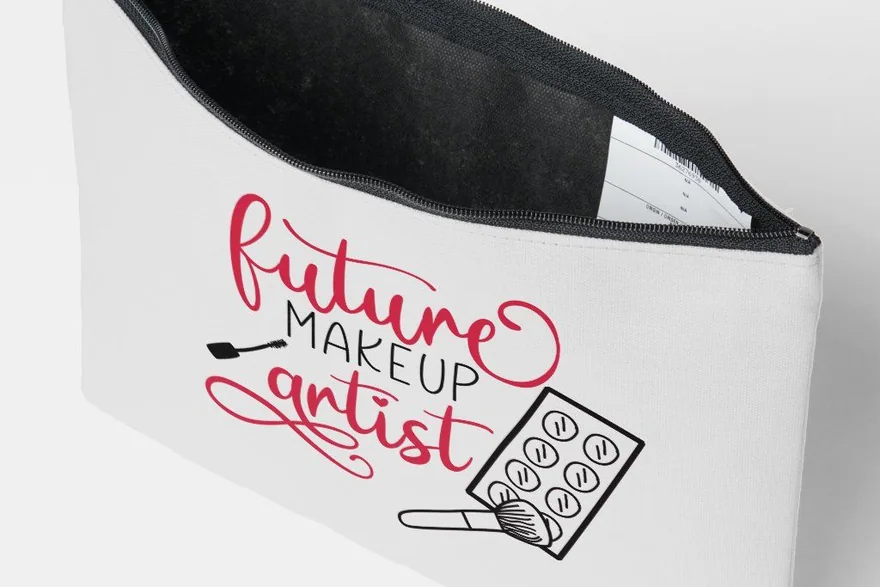
Sizing the category without relying on a headline figure
Buyers planning an assortment usually start by looking for a market-size number, and in this category that search produces more confusion than guidance. Published estimates differ by methodology: some count every bag sold, some count only beauty organisers, some fold in vanity cases and hard-shell train cases, and some count at retail value while others count at factory gate. The same category can therefore be reported at materially different sizes depending on where the boundary is drawn and which price basis is used.
For an assortment decision, the number is the wrong instrument anyway. What a brand owner needs is not the size of the category but the shape of demand inside it: which sizes are searched, which closures recur in briefs, which formats are bought for travel rather than for the dressing table, and which price band a given specification lands in. Those are answerable from search data and from repeat ordering patterns, and both are specific enough to act on.
The second framing point is that the phrase itself is a keyword, not a definition. Cosmetic bags for women is how a shopper types a query; it does not describe a construction. Nothing about a zipper gauge, a lining substance, a capacity band or a carry mode changes because of the buyer's gender. Treating the phrase as a product specification is what produces the tired category cliche of a pink pouch with a glitter slogan, and it is also what causes assortments to miss the actual demand, which is functional: something that wipes clean and holds a specific set of bottles.
- Size demand at keyword level, not at headline-market level.
- Treat a search phrase as a query string, not as a product definition.
- Read preference from repeat briefs and reorders, which are directly observable.
- Specify to the use case: travel, dressing table, gym, or gift.
- Keep the assortment narrow and deep rather than broad and shallow.
Demand signals: what the search data actually shows
Four keyword-level figures give a workable picture of where demand sits. They are not a market size, and they should not be presented as one. They are demand signals, useful for deciding which formats to develop first and how many colourways a first run should carry.
| Search term | Recorded volume | Cadence | Source | What it tells a buyer |
|---|---|---|---|---|
| make up bags for women | Around 80,000 | Monthly | ASINSIGHT 2026.07 | The broad head term; competitive, and won on closure and interior detail |
| travel bag for toiletries | Around 110,000 | Monthly | ASINSIGHT 2026.07 | The largest of the four, and it points to a travel use case rather than a storage one |
| toiletry bag | Around 74,810 | Weekly, Amazon | ASINSIGHT 2026.07 | Marketplace demand concentrated in hanging and structured formats |
| custom makeup bag | 5,400 to 6,600 | Monthly | ASINSIGHT 2026.07 | The branded-programme end: low volume, high intent, price-insensitive |
| typical unit price band | $0.45 to $12.00 | Category range | Alibaba 2026.10 | Sets the realistic corridor for a first specification brief |
Search data has limits worth stating plainly. Volumes are queries, not transactions: a term with 80,000 monthly searches includes comparison shopping, gift research and people looking for a replacement, and none of those convert at the same rate. Volumes also move with season, and this category shows a pronounced peak around holiday gifting and a second one around the northern-hemisphere summer travel season. A buyer planning a first production slot should read the figures as relative weights between formats rather than as a forecast, and should book the sampling slot early enough that bulk lands ahead of the peak rather than into it.
The price band matters as much as the volumes. A typical corridor of $0.45 to $12.00 covers an enormous spread of constructions, from a flat printed pouch to a structured hanging kit with a welded pocket. Where a programme sits inside that corridor decides which features are affordable at all: below roughly $3 landed, the realistic list is limited to closure, lining and finish; above roughly $6, a base board, a hook and a wet pocket come into reach. Reading the volumes without reading the price band produces a specification that cannot be built to the price the channel requires.
Read together, the four signals point in one direction. The largest volume attaches to a travel use case, not to a static storage one, which means the formats that recur in briefs are the ones that survive being packed: a wipe-clean lining, a closure that stays shut in a suitcase, and a capacity tier that matches a real product load. The head term is the most competitive, so a new programme wins there on the details a photograph cannot show, which is exactly the argument for spending the budget on closure and interior rather than on print.
The custom makeup band deserves separate treatment. At 5,400 to 6,600 monthly searches it is a fraction of the head term, but the intent behind it is commercial rather than personal: brand owners, retailers and gift buyers looking for a programme. Those enquiries arrive with a specification, a quantity and a deadline, which is why the commercial terms matter more to them than the colour range. A sourcing partner coordinating a programme for that buyer type is doing specification work, not merely supplying a catalogue item.
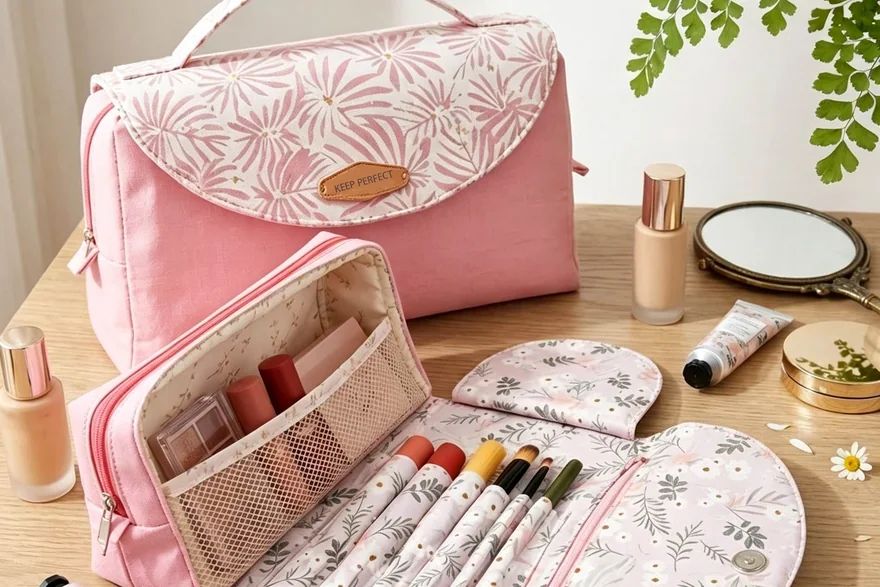
Recurring purchasing-behaviour patterns in the category
Preference in this category is observable as repeat ordering behaviour rather than as survey data. What follows is a set of patterns that recur across buyer briefs in the category, described qualitatively. They are not measured shares of any population, and no figure should be attached to them; they are the questions and requirements that come up repeatedly when a brief is written.
| Recurring pattern in briefs | How it shows up in a specification | What to state in the brief |
|---|---|---|
| Zip-top preferred over drawstring for travel | Closure requests specify a zip almost without exception on travel formats | Tape width, gauge, slider type, and a stated open-close cycle count |
| Wipe-clean lining requested on most everyday formats | Lining briefs ask for a coated or laminated face that can be wiped | Lining substance, coating method, and a stain-resistance expectation |
| Hanging formats requested for shared bathrooms | Travel kits specify a hook rather than a flat base | Hook material, rated load, and a swivel versus fixed decision |
| Capacity specified by product count, not by litres | Briefs describe how many bottles and palettes must fit | Internal dimensions in centimetres plus a pack-out test with the real range |
| Two-bag behaviour: one kept at home, one kept packed | Reorders often split into a vanity format and a travel format | Assortment plan with one structured and one compressible SKU |
| Travel SKUs checked against liquids rules | Buyers ask whether the bag works with a clear liquids bag | Reference the <a href="https://www.tsa.gov/travel/security-screening/liquids-rule" rel="nofollow noopener" target="_blank">TSA liquids rule</a> in the copy, not as a bag specification |
| Substance documentation requested before listing | Marketplaces and retailers ask for textile substance evidence | OEKO-TEX Standard 100 or an equivalent test report |
| Recycled-content requests rising in briefs | Buyers increasingly specify a recycled shell or lining | A recognised recycled-content claim and its documentation chain |
| Colourway briefs arrive as a neutral base plus an accent | Reorders favour a neutral shell with a contrast zip or lining | Two or three colourways rather than eight, to keep 500-piece minimums workable |
One further pattern changes how a programme is planned: documentation requests now arrive with the brief rather than after it. Buyers who ask for substance evidence and recycled-content certificates at sampling receive them as a matter of course, because the material can still be changed; buyers who ask at shipment receive them as a delay. The practical move is to treat documentation as a line in the first brief rather than as a question to answer later.
Two of those patterns deserve a note because they are frequently mishandled. The liquids rule is a rule about what the traveller carries, not about the bag, so a bag cannot be compliant or non-compliant with it; what a bag can do is include a clear pocket sized for a one-quart liquids bag and say so accurately in the copy. Recycled content is the other: a claim needs a documentation chain behind it, and the standard route is a recognised recycled-content standard with transaction certificates, otherwise the claim becomes a liability at the marketplace level.
Documentation is where these preferences convert into orders. Textile substance evidence is most simply handled through OEKO-TEX Standard 100, which most marketplaces and many retailers accept without further correspondence. Recycled-content claims are normally evidenced under a chain-of-custody standard such as the Global Recycled Standard, and the buyer should ask for the transaction certificate with the first shipment rather than after the listing goes live.
Turning preference patterns into an assortment and a specification
The practical output of reading demand this way is a narrow, deep assortment. Two formats and three colourways serve this category better than six formats and eight colourways, because a 500-piece minimum per style and colourway applies to each combination, and spreading a first order across too many combinations produces a run too small to price well and too shallow to reorder confidently.
| Assortment slot | Suggested format | Indicative dimensions | Specification priority |
|---|---|---|---|
| Slot 1: everyday pouch | Soft zip-top pouch, wipe-clean lining | 20 to 22 cm wide, 6 to 8 cm deep | Closure quality and a contrast lining |
| Slot 2: travel kit | Hanging kit with hook and wet pocket | 24 to 26 cm wide when closed | Hook rated load, welded pocket leak test |
| Slot 3: vanity or dressing-table case | Structured case with a base board and feet | 26 to 30 cm wide, 12 to 15 cm high | Standing stability and interior compartment sizing |
| Slot 4: gift or seasonal | Compact pouch with a retail finish pack | 16 to 18 cm wide | Unboxing finish, hangtag and dust bag |
| Slot 5: programme or corporate | Any slot above with a debossed or embossed logo | Matches the base format | Logo application method and hardware finish |
- Choose the two formats that match the use cases in the demand signals, which usually means one travel and one everyday format.
- Fix capacity by product count rather than by litres, then confirm with a pack-out test using the brand's own bottles and palettes.
- Write the closure specification with shared terminology and verify it with a cycle test before bulk.
- Decide which documentation the channel requires, substance, recycled content or both, and request it at sampling rather than at shipment.
- Keep to two or three colourways for the first run so that each combination clears the 500-piece minimum comfortably.
Assortment depth is the decision most often got wrong in a first programme. Because the minimum applies per style and colourway, four formats in four colourways is sixteen production combinations, and a first order spread that thin produces runs too small to price well and too shallow to reorder on confidently. A better opening position is two formats in two colourways, four combinations at 500 pieces each, with the budget concentrated where the demand signals point. Further colourways follow on the reorder, once the first run has shown which combination actually sells.
Timing follows the same shape as any programme in the category. Sampling runs 6 to 10 working days for a soft build and 12 to 15 working days where a structured base, a welded wet pocket or a moulded hook housing is involved. Bulk production runs 35 to 50 days after sample approval, which leaves room for the lining and closure checks that these formats need. Inspection is to AQL 2.5 under ISO 2859-1, shipment is FOB Xiamen, and payment is T/T 30 deposit and 70 against bill of lading, with a minimum of 500 pieces per style and colourway.
The B2B Customisation View
A realistic cosmetic bags schedule assumes one round of sample revision; planning for a perfect first sample is the most common cause of a slipped launch.
Fixed commercial parameters: 500 pieces per style and colourway minimum, first sample in 6–10 working days (12–15 for complex or hardware-intensive constructions), bulk 35–50 days after approval, AQL 2.5 inspection under ISO 2859-1, FOB Xiamen, T/T 30/70.
A sourcing-partner structure also protects the buyer when volumes grow, because capacity for cosmetic bags can be spread across SGS-verified production lines without changing the specification.
Which Brand Types Benefit Most
Reading the category this way helps each buyer type in a different place. Start-up brands benefit most from the demand-signal table, because it tells them which two formats to launch with and prevents the common error of launching six SKUs across a 500-piece minimum each. Established brands get more from the behaviour-pattern table, which is effectively a checklist of what reorders ask for: a zip-top, a wipe-clean lining, a hook on travel formats and capacity stated in products rather than litres. Retailers planning private label use the assortment table to keep a range narrow enough that each combination clears its minimum at a workable price. E-commerce sellers, competing on the head term where demand is broadest, win on the details a photograph cannot show, which is why the closure and interior patterns matter more to them than colour range. Gift, corporate and hospitality buyers are the group most likely to add a logo application and a finish pack, and they should decide that at sampling, because a deboss die or a moulded puller carries its own lead time and its own supplier minimum. Across every group the same caution applies: keyword demand tells a buyer which formats to develop, but only the brief tells them what to specify, and the two should not be confused when a 500-piece commitment is being signed.
- Start-up brands: launch two formats, not six, so each clears the 500-piece minimum at a workable price.
- Established brands: use the recurring-pattern list as a reorder checklist.
- Retailers and private label: keep the range narrow and deep across two or three colourways.
- E-commerce sellers: win the head term on closure and interior detail rather than on colour variety.
- Gift and corporate buyers: decide logo application at sampling, since hardware tooling carries its own lead time.
- All buyer types: separate the demand signal from the specification, and commit quantity only to the second.
Frequently Asked Questions
How large is the market for cosmetic bags bought under this search phrase?
Published market-size estimates for the category differ by methodology, because some count all bags and others count only beauty organisers, so a single headline figure is not a reliable planning input. Buyers are better served by keyword-level demand: make up bags for women around 80,000 monthly searches and toiletry bag about 74,810 weekly Amazon searches (ASINSIGHT 2026.07).
Why is search volume a better planning input than a market-size estimate?
Because it is specific to a format and a use case. A headline figure aggregates vanity cases, pouches and hard-shell train cases into one number, which tells a brand owner nothing about which two formats to develop. Keyword volume separates the travel use case from the storage one, which is the decision actually being made, and it moves with season in a way an annual market figure cannot show.
Is a cosmetic bag for women different from any other cosmetic bag?
Not in construction. The phrase is a search query, not a specification: nothing about zipper gauge, lining substance, capacity or carry mode changes because of who buys the bag. What differs is the brief, and the briefs in this category ask for a zip-top closure, a wipe-clean lining, a hanging hook on travel formats and a capacity matched to a real product load rather than to a stated volume.
Which closure recurs most often in buyer briefs?
A zip-top. Briefs for travel formats specify a zip almost without exception, because a drawstring or a snap does not stay shut in a suitcase. The follow-on decision is tape width and gauge, plus a cycle test, commonly 3,000 open-close cycles, which verifies the closure rather than assuming a brand name on the slider guarantees performance. Snap and drawstring closures appear mainly on the smallest gift pouches.
How should capacity be specified for this category?
By product count rather than by litres. A brief that says the bag must hold four bottles, two palettes and a brush roll is testable; one that says two litres is not. The practical method is internal dimensions in centimetres plus a pack-out test using the brand's own tallest bottle, widest palette and thickest brush. Litre figures are rarely quoted in briefs and are difficult to verify at inspection.
What capacity band suits an everyday pouch?
Twenty to twenty-two centimetres wide by six to eight centimetres deep covers a daily product load without becoming a travel kit. Below 18 cm the bag stops holding a full-size foundation bottle upright, which is the complaint most often raised against small pouches, and above 24 cm it competes with the travel format inside the same assortment. Depth matters as much as width.
Does a cosmetic bag need to comply with the TSA liquids rule?
No bag complies with or violates that rule, because it governs what the traveller carries, not the container. What a bag can do is include a clear pocket sized for a one-quart liquids bag and describe it accurately. The TSA liquids rule should be referenced in listing copy as guidance for the traveller, never as a product certification, and a brand that claims compliance invites a question nobody at the desk will accept.
Which documentation do marketplaces and retailers ask for first?
Textile substance evidence. The simplest route is OEKO-TEX Standard 100, which most channels accept without further correspondence. Holding one certificate is cheaper than answering the same question for every listing, every marketplace and every season, and it converts a recurring delay into a one-off task completed before the first shipment.
How is a recycled-content claim evidenced on a cosmetic bag?
Through a chain-of-custody standard with transaction certificates, such as the Global Recycled Standard. The buyer should request the transaction certificate with the first shipment rather than after the listing goes live, since an undocumented claim becomes a marketplace liability rather than a marketing asset. Scope certificates cover the material; transaction certificates cover the specific order, and marketplaces ask for the second.
How many colourways should a first run carry?
Two or three. A 500-piece minimum applies per style and colourway, so eight colourways across two formats commits a first order to sixteen production combinations. Two formats in two colourways is four combinations, which concentrates the quantity where the demand signals point and leaves room to add colourways on the reorder. Starting with a neutral base plus a contrast zip or lining covers the reorder pattern without fragmenting the quantity.
Why do reorders often split into two bag types?
Because the use cases differ. One bag stays on the dressing table and is judged on standing stability and interior organisation; the other stays packed and is judged on whether it compresses and whether the closure holds. Programmes that offer both capture the reorder rather than losing it to a competitor's travel format, and the two SKUs share fabric and hardware, which keeps the component minimums workable.
What hanging hook specification suits a travel kit in this category?
A swivel hook with a stated rated load, commonly 2 to 3 kg, made from steel wire rather than a zinc casting, with the load path reinforced into the bag body. A fixed hook is cheaper but twists the bag when weight shifts to one side, which is how hanging kits actually fail in a hotel bathroom. The load path should be reinforced into the bag body rather than carried by the lining alone.
What minimum applies to a two-format launch in this category?
The minimum is 500 pieces per style and colourway, so two formats in three colourways is six production combinations at 500 pieces each, or 3,000 pieces in total. Brands frequently underestimate this arithmetic and end up with a run too small to price well; starting with two colourways per format keeps the first order concentrated and leaves the third colourway for the reorder.
How long does sampling take for a pouch and a hanging kit?
Six to ten working days for a soft zip-top pouch, and twelve to fifteen working days where a structured base, a welded wet pocket or a moulded hook housing is involved. Bulk then runs 35 to 50 days after sample approval, which leaves room for the lining and closure checks these formats need.
How should preference data be presented in a buying decision?
As recurring patterns in briefs and reorders, which are directly observable, rather than as measured shares of any population. The distinction matters because a buyer can act on a pattern safely, while an invented percentage is a claim nobody can defend if a retailer, a marketplace or a regulator asks for its source. A returns log with four fields produces better decisions than any survey.
People Also Ask
How big is the cosmetic bag market?
Published estimates differ by methodology, since some count all bags and others only beauty organisers or vanity cases, so no single figure is a reliable planning input. Buyers planning an assortment get further from demand signals: make up bags for women around 80,000 monthly searches and travel bag for toiletries near 110,000 monthly (ASINSIGHT 2026.07), read as relative weights between formats rather than as a forecast.
What do buyers look for in a cosmetic bag?
Recurring briefs ask for a zip-top closure that stays shut in transit, a wipe-clean lining, capacity stated as a product count rather than a volume, and on travel formats a hanging hook. Those requirements are functional rather than decorative, which is why colour range ranks below closure, lining and interior detail in reorder decisions, and why a neutral shell with a contrast zip reorders more steadily than a fashion shade.
What size cosmetic bag is most useful?
For everyday use, 20 to 22 cm wide by 6 to 8 cm deep holds a daily load without becoming a travel kit. For travel, 24 to 26 cm closed with a hanging format. The reliable test is a pack-out with the brand's own tallest bottle, widest palette and thickest brush, rather than a litre figure that no inspector can verify at the factory gate.
Do cosmetic bags need certification to sell online?
Most marketplaces and many retailers ask for textile substance evidence, and OEKO-TEX Standard 100 is the most widely accepted answer. Where a recycled-content claim is made on the listing, a transaction certificate under a chain-of-custody standard is also needed, and it should be requested with the first shipment rather than after launch, while the material can still be changed.
Request a Sample or a Written Quotation
Send the silhouette, dimensions, material preference and logo artwork, and the programme team will return a written quotation with MOQ, sampling window, bulk lead time and inspection standard.
Email: [email protected] · WhatsApp: +86 177 5002 0688