What Is a Toiletry Bag? Definition, Types & Travel Use Cases
Executive Summary
A toiletry bag is a lined, leak-resistant case sized and constructed to carry personal care liquids, mainly bottles and tubes between 50 and 400 ml, plus the small hard items used with them. That liquid-carrying purpose, not the shape, is what defines it: the lining is coated or welded, the seams are sealed or bound, and the interior is arranged to keep bottles upright or contained. Hanging, flat and roll are the three architectures, and each suits a different carrying state rather than a different product category.
Commercially the category is pulled by travel rather than by fashion. Travel bag for toiletries draws roughly 110,000 monthly searches and the toiletry bag term itself about 74,810 weekly Amazon searches, so demand is volume-led and replacement-driven. A custom programme carries a 500-piece minimum per style and colourway, 6 to 10 working days for sampling, 35 to 50 days for bulk after approval, inspection at AQL 2.5 under ISO 2859-1, and shipment FOB Xiamen on T/T 30 percent deposit and 70 percent against the bill of lading.
Defined by the Liquids It Carries, Not by Its Shape
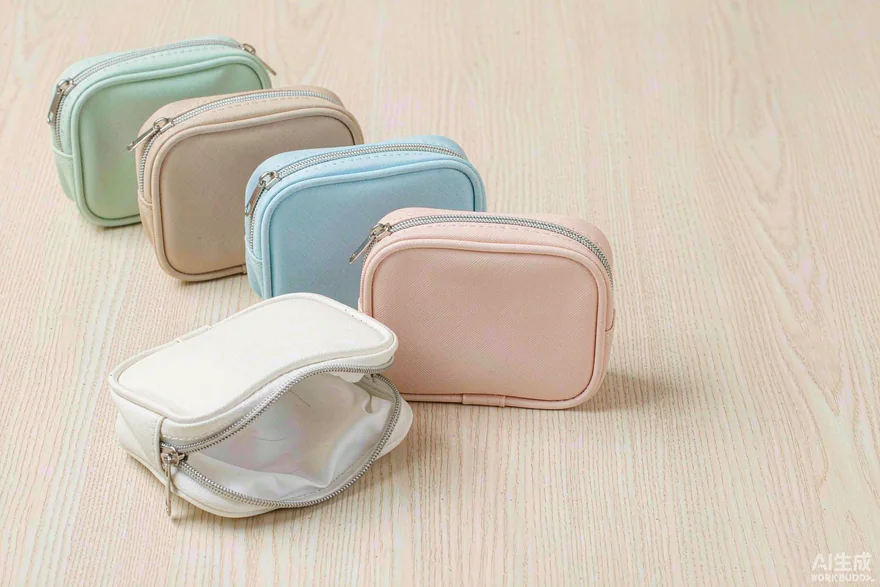
A toiletry bag is a lined, closable case whose interior is engineered around containers of liquid: shampoo, conditioner, shower gel, toothpaste, shaving foam and the small hard goods used alongside them, such as a razor, a toothbrush and a comb. The working definition has three parts. The contents are dominated by liquids, the interior is designed to contain a leak rather than merely to organise, and the surfaces are specified to be wiped dry. A bag that organises dry toiletries but has an uncoated lining and raw interior seams is a wash bag in name only.
The practical consequence is that volume is measured in millilitres rather than in items. A typical travel load is one 100 ml bottle, two 50 ml bottles, a 75 ml tube, a razor and a toothbrush, which is roughly 400 ml of liquid and 9 to 12 discrete objects. A family or long-haul load doubles that. Because the load is liquid-first, the specification conversations that matter are about coating weight, seam sealing and bottle retention, not about pocket counts.
| Typical contents | Volume or size | Requirement this places on the bag | Common specification answer |
|---|---|---|---|
| Shampoo or shower gel bottle | 100 ml travel, 400 ml full size | Upright retention, leak containment | Elasticated bottle loops 4 to 6 cm wide |
| Toothpaste tube | 75 ml | Isolation from fabric if it bursts | Coated zip pocket or TPU sleeve |
| Razor and blades | 10 to 15 cm | Separation from textiles | Mesh slip pocket with a wipeable backing |
| Toothbrush | 18 to 20 cm | Ventilation after use | Mesh pocket or external quick-dry sleeve |
| Cotton pads and swabs | Loose small items | Containment | Zip pocket with a bound seam |
| Liquid foundation or serum | 30 to 50 ml glass | Impact protection | Padded divider or central sleeve |
Three names compete in this space and buyers should treat them as regional rather than as technical. Toiletry bag is the North American e-commerce term and the one with the strongest search demand. Wash bag and sponge bag are British usages with the same meaning and a slightly more fashion-led positioning. Dopp kit is an American term that implies a specific shape, a rounded rectangular case with a single main compartment, and is used most often for men's positioning. None of the three changes the specification, but each changes the listing language and the photography.
The contrast with a makeup bag is worth stating plainly because the two are frequently confused in briefs. A toiletry bag is specified around containment: coated lining, sealed or bound seams, upright bottle retention, and a floor that can be rinsed. A makeup bag is specified around organisation: brush loops, palette pockets, pencil pockets and a wipeable floor for powder and cream. Where one product is asked to do both jobs, the compromise usually lands on a coated lining with a brush panel on the lid, and that compromise is the honest answer for dual-use listings.
- Definition rests on liquid contents, leak containment and wipeable surfaces
- Size loads in millilitres: a travel load is about 400 ml, a family load about 800 ml
- Toiletry bag, wash bag and dopp kit differ by region and positioning, not by construction
- The real contrast is containment versus organisation, which separates it from a makeup bag
Lining and Seam Technology: Where Leak Resistance Comes From
Leak resistance is a property of the lining and the seams, not of the shell. A bag with a 600D polyester shell and an uncoated 190T lining will soak through in under a minute, while the same shell with a 0.15 mm TPU laminate and welded seams will hold a burst bottle long enough to reach a sink. Buyers evaluating a quotation should ignore the shell denier and read three lines instead: the lining material and its coating weight, the seam construction, and whether the base is a single welded pan or a stitched corner.
| Lining option | Construction | Leak behaviour | Cost effect per unit | Best for |
|---|---|---|---|---|
| PEVA film, 0.12 to 0.15 mm | Loose or tack-welded liner | Contains a spill for minutes | +$0.10 to $0.25 | Promotional and amenity bags |
| TPU laminate on 210D | Heat-welded seams | Fully watertight panel | +$0.45 to $0.90 | Mid-market travel bags |
| PVC-coated polyester | Sewn then seam-taped | Watertight if tape holds | +$0.25 to $0.55 | Gym and swim bags |
| 210D with PU coating | Sewn, bound seams | Resists damp, not a burst | +$0.12 to $0.30 | Light travel and gift programmes |
| Uncoated 190T polyester | Sewn, raw seams | Soaks through | Baseline | Dry toiletries only |
| Coated ripstop 420D | Sewn, taped corners | Good containment, low weight | +$0.30 to $0.60 | Hanging organisers |
Seam construction is the second half of the equation and the more common point of failure. A sewn seam is a line of needle holes; it will pass liquid regardless of how impermeable the fabric is. Three remedies exist, in ascending order of cost: binding the seam with tape at about $0.10 per bag, applying a heat-applied seam-sealing tape over the stitch line at about $0.18, and eliminating the seam altogether by radio-frequency or hot-air welding the panel at about $0.35. Welding requires a thermoplastic face on both panels, which restricts it to TPU, PVC and certain coated polyesters.
The base is where failures concentrate, because gravity pools a leak at the lowest point and because a stitched corner box has four seams meeting at one point. The robust construction is a single-pan base: the lining is cut as a tray with folded corners, welded or seam-taped at two points rather than four, then dropped into the shell. That construction adds roughly $0.20 to $0.40 per unit over a stitched corner box and removes the majority of leak returns on travel programmes. One further question belongs on the brief: whether the lining is loose or bonded to the shell. A loose liner can be pulled out for cleaning, which suits amenity programmes, while a bonded liner holds its shape and suits retail.
Material performance is verified rather than asserted. Coated and laminated fabrics are assessed under ASTM D751, which covers coated-fabric behaviour including hydrostatic resistance and adhesion of the coating, and water-repellent finishes on the shell are checked against the AATCC test methods. Where the lining is PVC, a restricted-substance review under EU REACH belongs in the brief for European destinations, because plasticiser selection is the usual reason a PVC lining fails a retailer's chemical screen.
- Read lining coating weight and seam method before reading shell denier
- A sewn seam leaks through needle holes unless it is bound, taped or eliminated by welding
- Single-pan welded or taped base costs $0.20 to $0.40 more and removes most leak returns
- PVC linings need a REACH restricted-substance review for EU destinations
Hanging, Flat and Roll Architecture Compared
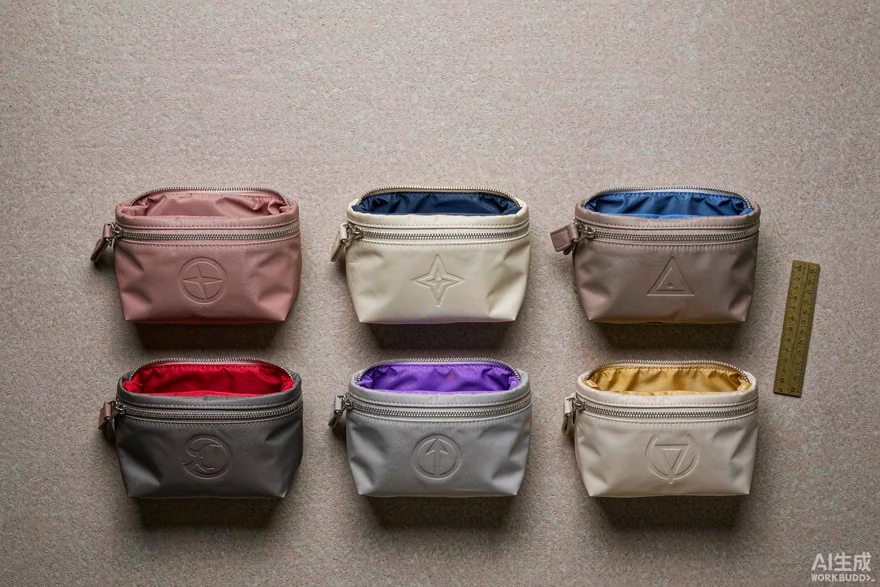
Three architectures cover the category, and the choice between them is a decision about the carrying state rather than about capacity. A hanging bag is designed to be used open and suspended from a door, a shower rail or a towel hook. A flat bag is designed to be packed closed inside a suitcase. A roll is designed to compress around its contents and be strapped shut. Each has a different pattern, a different hardware set and a different failure profile.
| Architecture | Typical open or closed size | Hardware set | Carton count | Failure point to specify against |
|---|---|---|---|---|
| Hanging | 24 x 20 cm closed, 24 x 60 cm open | Metal or plastic hook, 2 to 4 zip pockets | 20 to 30 | Hook attachment tearing out of the top panel |
| Flat | 24 x 16 x 8 cm | Single or double zip, internal elastic | 36 to 48 | Corner seams splitting under overpacking |
| Roll | 26 x 50 cm open, 26 x 12 cm rolled | Side-release buckle or cord and toggle | 40 to 60 | Buckle webbing pulling away from the panel |
| Framed case | 28 x 18 x 15 cm | Frame, clasp, mirror panel | 8 to 12 | Frame distortion under compression |
| Two-piece set | Two bags 20 and 24 cm | Shared zipper gauge and puller | 24 to 36 | Shade mismatch between the two pieces |
Hanging bags dominate hotel and cruise use because the bathroom counter is usually the only available surface and is often wet. The engineering question is the hook: a swivel hook rated to about 2 kg of static load, anchored through a reinforcement patch of at least 5 x 5 cm on the top panel, with the patch stitched on all four sides rather than two. A hook anchored only into the lining pulls out within a season, and that single failure accounts for the largest share of negative reviews on hanging formats.
Flat bags are the volume leader in e-commerce because they pack efficiently and photograph well. Their weakness is overpacking: a shopper will add a full-size bottle to a bag designed for travel sizes, and the corner seams split. The specification remedy is a reinforced corner, either a bound seam with a second pass or a bar-tack at each corner, at roughly $0.08 per bag. Buyers should also state the intended contents in millilitres on the product page, because the mismatch between the stated and the assumed load is what generates the return.
Roll formats suit gym, swim and outdoor positioning, where the bag is expected to be stuffed and strapped. Compression is the selling point and the risk: a roll with a side-release buckle needs webbing anchored with a box stitch at least 3 cm deep, and the buckle should be specified at 25 mm for a 26 cm roll. Cord-and-toggle closures are cheaper by about $0.30 but slip under compression, so they suit a light roll holding under 500 ml of contents and not much more.
- Choose architecture by carrying state: suspended, packed, or compressed
- Hanging hardware needs a 5 x 5 cm reinforcement patch stitched on four sides, rated around 2 kg
- Flat bags need bar-tacked corners; roll bags need a 3 cm box stitch on the webbing
- State intended contents in millilitres on the listing to prevent overpacking returns
Airline Compliance, Hospitality Use, Failure Modes and a Specification Checklist
Airline security is the single largest driver of the category. The liquids rule applied at United States checkpoints permits containers of 100 ml or less carried in one transparent, resealable bag of about one litre capacity, and that constraint has shaped product design for two decades: the 100 ml bottle, the 20 x 20 cm transparent pouch and the two-compartment bag that separates screenable liquids from everything else are all responses to it. Buyers selling into travel should read the rule directly at the TSA liquids rule page rather than from a competitor's listing, because the container limit and the bag limit are separate requirements.
The design consequence is a two-part specification. The first part is a transparent, resealable pouch of roughly 20 x 20 cm, in 0.3 mm TPU or PVC, holding six to eight 100 ml bottles. The second part is the main bag, which carries everything else. Many travel programmes now sell the pair as one SKU, which raises unit cost by about $0.60 to $1.20 but lifts the listing above commodity competition and gives the product page a compliance story that a plain bag cannot match.
Hospitality and amenity use is the second non-retail channel, and it has a different specification logic. A hotel amenity bag is not sold, it is placed, so the buying criteria are unit cost, print crispness at small sizes, packing configuration and whether the bag survives one week of bathroom humidity. Typical specification is a 210D or cotton shell with a PEVA lining, a one- or two-colour print, bulk packing in tens, and a unit cost target under $1.50. Durability requirements are lower than for retail, but odour control is higher, because a bag stored flat in a linen cupboard for months must not smell musty on arrival.
| Failure mode | Root cause | Specification remedy | Added cost per unit |
|---|---|---|---|
| Musty odour on opening | Bag packed and stored before the lining is fully dry | Cure linings 24 hours before packing; add a vented mesh panel | $0.05 to $0.12 |
| Leak soaking through the base | Stitched corner box with four seams | Single-pan lining with welded or taped corners | $0.20 to $0.40 |
| Hook tearing from the panel | Anchor stitched into lining only | 5 x 5 cm reinforcement patch, four-sided stitch | $0.12 to $0.20 |
| Zipper corroding in humidity | Untreated metal teeth and slider | Coated teeth or nylon coil with a chrome-plated puller | $0.10 to $0.35 |
| Seam tape lifting in hot water | Tape applied below the melting point of the coating | Specify tape temperature and dwell time on the brief | $0.03 to $0.08 |
| Mould at the mesh pocket | Mesh never dries between uses | Use 1 mm open mesh and an external quick-dry sleeve | $0.08 to $0.15 |
Failure modes should be read as a specification exercise rather than as a warranty problem. Each of the six listed above costs between $0.03 and $0.40 per unit to design out, against a return cost that typically runs several times the unit price once freight and processing are included. A buyer spending an extra $0.60 per unit on lining, hook reinforcement and a coated zipper is usually buying down a return rate rather than upgrading a product.
Documentation closes the programme. Where the bag is marketed for children, the United States requires assessment under CPSIA for lead and phthalates; European destinations require a restricted-substance review under REACH; and many retailers request OEKO-TEX Standard 100 as a baseline because it tests the finished article. Final random inspection runs at AQL 2.5 under ISO 2859-1, and the stitching, coating and hardware defects listed above should be written into the defect list before inspection rather than discovered afterwards.
- State the liquid load in millilitres and the bottle diameters the bag must retain
- Name the lining material and coating thickness, then the seam method: bound, taped or welded
- Specify a single-pan lining base with welded or taped corners rather than a stitched corner box
- Add hanging hardware only with a 5 x 5 cm reinforcement patch stitched on four sides
- Fix zipper type and finish for humid environments: coated teeth or nylon coil with a plated puller
- Include a transparent 100 ml pouch if the bag is sold against the TSA liquids rule
- State drying and packing requirements so linings are cured before packing
- Confirm carton count, inspection at AQL 2.5 under ISO 2859-1, and the shipment term
The B2B Customisation View
A well-run cosmetic bags programme is a documentation exercise as much as a sewing exercise, and the documents are what keep the first shipment identical to the thousandth.
Budgeting and scheduling inputs: MOQ 500 per style and colourway; sampling 6–10 working days, extended to 12–15 for lined, moulded or hardware-heavy builds; bulk 35–50 days; pre-shipment inspection at AQL 2.5 per ISO 2859-1; FOB Xiamen; T/T 30/70.
The practical outcome for the buyer is a single accountable counterpart holding cost, quality and calendar together across the life of the programme.
Which Brand Types Benefit Most
Start-up travel brands usually launch one flat bag at 24 x 16 x 8 cm with a TPU-lined base, in a single colourway at 500 pieces, then extend into a hanging version once reviews confirm the load assumption. That sequence matters: the flat bag establishes the size that shoppers accept, and the hanging version can then reuse the shell, lining and zipper gauge, so the second style skips most of the sampling work.
Established luggage and outdoor brands treat toiletry bags as an accessory to a case programme rather than as a standalone line. The specification is driven by co-ordination: matching zipper tape, matching puller and a lining colour drawn from the brand palette. Because these programmes are usually placed alongside a larger luggage order, the 35 to 50 day bulk window is planned against the case delivery date rather than against the bag's own launch date.
Retailers and e-commerce sellers in this category compete on compliance clarity rather than on styling. The listings that convert are the ones stating the bottle capacity the bag is designed for, whether a transparent pouch is included, and the open dimensions of a hanging format. Sellers who publish the open dimensions of a hanging bag, typically 24 x 60 cm, see fewer returns than those who publish only the closed size.
Hospitality and amenity buyers are the highest-volume and lowest-unit-value segment. Hotel groups, cruise lines and airlines buy flat or hanging bags in the $0.90 to $1.80 band with a one- or two-colour print, bulk-packed in tens, and reorder on a six- to twelve-month cycle tied to refurbishment schedules rather than to seasons. The binding constraints in that segment are odour control, packing configuration and carton count per property.
Gym, swim and outdoor buyers occupy a narrow but stable niche where the roll format dominates and the requirement is wet containment rather than travel compliance. The specification is a welded TPU or PVC-lined roll with a 25 mm buckle, sold against a wet-kit use case. Programmes coordinating this type of specification, including those run through QUANZHOU JUNYUAN BAGS, typically plan the 6 to 10 working day sampling window around artwork approval rather than around the brief.
Frequently Asked Questions
What makes a bag a toiletry bag rather than a wash bag or a dopp kit?
Nothing technical. Toiletry bag is the North American e-commerce term and carries the strongest search demand; wash bag and sponge bag are British usages for the same object with a slightly more fashion-led positioning; dopp kit implies a rounded rectangular case with one main compartment and is used mostly for men's lines. The specification is identical across the three names.
What size toiletry bag fits the airport liquids rule?
The rule limits the containers, not the bag: each container must be 100 ml or less and all containers must fit in one transparent resealable bag of about one litre, roughly 20 x 20 cm. A main toiletry bag of 24 x 16 x 8 cm carries that pouch plus dry items. Buyers should check the rule text rather than a competitor's listing, because the container limit and the bag limit are separate requirements.
Does a toiletry bag need a waterproof lining or only a water-resistant one?
It needs a waterproof lining if it is to contain a burst bottle, and water resistance is not enough for that. Water-resistant means a finish that sheds splashes; waterproof means a coated or laminated film with sealed seams. A 0.12 to 0.15 mm PEVA liner contains a spill briefly, while a heat-welded TPU laminate holds it until the bag is emptied.
Which lining material gives the best leak containment for a travel toiletry bag?
A TPU laminate on 210D with heat-welded seams, at 0.15 mm or thicker. It adds $0.45 to $0.90 per unit over an uncoated lining and is the only common option that is genuinely watertight at the seams rather than only at the panel. PVC-coated polyester is the mid-cost alternative at $0.25 to $0.55 but needs a restricted-substance review for EU destinations.
Are welded seams better than stitched and taped seams on a toiletry bag?
Welded seams are better for containment and worse for repairability. Welding removes the needle holes entirely, so the panel is continuous, but it requires a thermoplastic face on both panels and it cannot be re-stitched if it fails. Stitched and taped seams cost about $0.18 per bag less and are adequate for splash containment, which is enough for most gym and amenity programmes.
How strong does the hook on a hanging toiletry bag need to be?
A swivel hook rated to roughly 2 kg static load, anchored through a reinforcement patch of at least 5 x 5 cm stitched on all four sides. The panel, not the hook, is the failure point: a hook anchored into the lining alone pulls out within a season, and that single failure drives the largest share of negative reviews on hanging formats.
Which zipper resists corrosion in a bathroom environment?
A nylon coil zipper with a chrome-plated or painted puller, or a metal zipper with coated teeth. Untreated brass and aluminium teeth discolour and stiffen within weeks in a humid bathroom. The coating adds $0.10 to $0.35 per unit and should be specified on the brief as a finish rather than left to the default hardware selection.
How many compartments should a hanging toiletry bag have?
Two to four zip compartments is the workable range. Fewer than two wastes the hanging format, because the point of hanging is to lay contents out vertically; more than four reduces each compartment below about 6 cm of depth, which will not take a 100 ml bottle upright. One compartment should be a transparent TPU panel for items that need to be found quickly.
What causes a toiletry bag to smell musty when opened?
Almost always residual moisture in the lining at the point of packing. Linings that are welded, inspected and packed within the same shift trap humidity, and the smell develops in transit or in storage. The remedy is a 24-hour cure before packing plus a vented mesh panel, which together cost $0.05 to $0.12 per unit and remove the most common complaint in amenity programmes.
What construction suits a hotel amenity toiletry bag programme?
A light shell in 210D polyester or cotton with a 0.12 to 0.15 mm PEVA lining, bound seams rather than welded ones, a one- or two-colour print, and bulk packing in tens. Unit cost targets sit between $0.90 and $1.80. Durability requirements are lower than for retail, but odour control and carton count per property matter far more.
Can a toiletry bag hold full-size bottles upright?
Only from the large band upward. A 400 ml bottle is about 6 cm in diameter and 18 cm tall, so the bag needs at least 20 cm of internal height and elasticated loops 4 to 6 cm wide to keep it upright. A 24 x 16 x 8 cm travel bag is designed around 100 ml bottles and will hold a full-size bottle only on its side.
How many hanging toiletry bags ship per export carton?
Between 20 and 30, against 36 to 48 for a flat bag of similar footprint and 40 to 60 for a roll. The difference is the hook and the reinforcement patch, which prevent flat folding. Buyers should confirm carton count before calculating freight, because it moves landed cost more than most lining upgrades do, and carton dimensions drive the freight quote.
What documentation applies to a PVC-lined toiletry bag entering the EU?
A restricted-substance review under EU REACH, with attention to plasticisers and to any surface coating. Many retailers additionally request OEKO-TEX Standard 100 because it tests the finished article rather than the input fibre. The review belongs at brief stage, because reformulating a lining after samples are approved restarts the sampling window. Buyers should also confirm whether the destination retailer applies its own restricted-substance list, which is usually stricter than the regulation itself.
How long does sampling take for a welded TPU toiletry bag?
Twelve to fifteen working days, because welded construction requires tooling and parameter setting for weld temperature, pressure and dwell time, plus a leak check on the finished sample. A sewn bag with a loose PEVA liner falls in the standard 6 to 10 working day window. Artwork in vector format with Pantone references should be supplied at the enquiry stage.
How is AQL 2.5 applied to stitching and coating defects on a toiletry bag order?
Final random inspection samples against ISO 2859-1 at AQL 2.5, with defects classified as critical, major or minor. Open seams, a detached hook patch and a failed weld are major; a skipped stitch on a non-load-bearing seam is typically minor. The defect list should be agreed before inspection, because generic lists rarely cover coating adhesion or weld integrity.
People Also Ask
What is a toiletry bag used for?
It carries personal care liquids and the small items used with them: shampoo, shower gel, toothpaste, a razor and a toothbrush. The interior is built to contain a leak, so the lining is coated or welded and the seams are sealed or bound. Travel is the dominant use case, with gym, swim and hotel amenity programmes making up the rest of demand.
What is the difference between a toiletry bag and a wash bag?
There is no construction difference. Wash bag and sponge bag are British terms for the same object, while toiletry bag is the North American e-commerce term with the strongest search demand. Dopp kit implies a particular rounded rectangular shape with one main compartment and is used mainly for men's positioning. Buyers choose between the three names by market, not by specification.
Do toiletry bags have to be waterproof?
Not legally, but a bag sold as a toiletry bag is expected to contain a leak. A water-resistant finish sheds splashes; a waterproof construction uses a coated or laminated lining with welded or seam-taped joins. For travel use with liquids, the waterproof construction is the specification that prevents returns, and it costs $0.25 to $0.90 more per unit at 500 pieces.
What size toiletry bag is best for air travel?
A main bag around 24 x 16 x 8 cm plus a transparent resealable pouch of about 20 x 20 cm holding 100 ml containers. The pouch is what airport screening examines, and the bag carries it alongside dry items. Hanging versions should be specified by open dimensions too, typically 24 x 60 cm, so shoppers know what they are buying.
Request a Sample or a Written Quotation
Send the silhouette, dimensions, material preference and logo artwork, and the programme team will return a written quotation with MOQ, sampling window, bulk lead time and inspection standard.
Email: [email protected] · WhatsApp: +86 177 5002 0688