Toiletry Bag Size Guide: Carry-On, TSA & Travel Dimensions
Executive Summary
Toiletry bag dimensions for carry-on travel sit between roughly 20 x 11 x 9 cm and 28 x 16 x 12 cm, with the everyday travel kit clustering near 24 x 14 x 10 cm. That band is set from the outside in: the liquids container itself absorbs border-security screening requirements, a clear liquids pocket of around 20 x 18 cm is needed to hold that bag flat and accessible, and the remaining volume must still fit the space a traveller has left in a cabin case after clothing and footwear are packed.
The matching internal budget is smaller than most first-time buyers assume - typically three to five litres of a cabin case for toiletries, which is why bags above about five litres only sell well in checked-luggage contexts. Search interest supports the category: roughly 110,000 monthly searches for travel bag for toiletries. Section by section, this guide covers the carry-on volume budget, converting the TSA 3-1-1 liquids rule into dimensions, the airline personal-item limits that cap external size, and how each bag format behaves once it is actually packed.
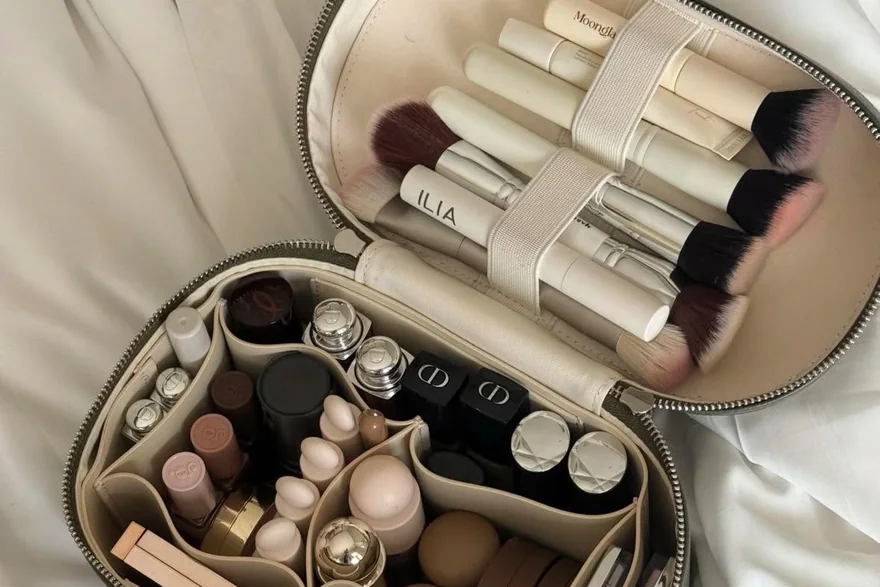
The Carry-On Volume Budget That Sets Every Toiletry Bag Size
Toiletry bag size is decided by subtraction. A traveller has a fixed carry-on allowance, and everything else in the case is claimed before toiletries get a look in. Starting from the outside: a standard cabin roller measuring roughly 55 x 40 x 23 cm has a nominal volume near 50 litres, but the shell, handle posts, wheel housings and internal straps consume about a quarter of it, leaving roughly 38 litres of usable interior. Of that, clothing for a week typically claims 22 to 26 litres, footwear another four to five, and electronics and documents around two. What remains for toiletries is usually three to five litres.
That arithmetic explains the category's shape. A kit near 24 x 14 x 10 cm carries about 3.4 litres and fits the remaining gap comfortably; anything above five litres forces the traveller to make an unwelcome trade elsewhere, most commonly leaving a pair of shoes behind. This is also why the extra-large travel kits that photograph so well online generate comparatively few repeat purchases: they work beautifully in a hotel bathroom and badly in the overhead bin on the way there.
Demand confirms the practical framing. Around 110,000 monthly searches for travel bag for toiletries indicate that sizing rather than styling drives research, and the queries skew towards phrases combining a product type with a travel context. Buyers building a line should therefore treat travel toiletry sizing as a constraint-driven exercise and lead listings with both external centimetres and litre capacity, since the second figure is what a traveller compares against the case they already own.
- Standard cabin case: roughly 55 x 40 x 23 cm externally, about 38 litres usable
- Clothing for seven days typically claims 22 to 26 litres
- What remains for toiletries is usually 3 to 5 litres
- A kit of 24 x 14 x 10 cm fits that gap; above 5 litres it usually does not
- Format behaves differently standing, hanging or rolling even at identical volume
There is a second budget that matters: how much can be reached without unpacking. Travellers remove the toiletry bag several times a day at the security checkpoint, at the hotel sink and at the gym locker, and a bag that requires emptying the case to retrieve costs goodwill every time it happens. Convenience therefore favours internal organisation over raw volume, and it is the reason a well-divided 3-litre kit consistently scores above an unstructured 4-litre one.
Converting the Liquids Rule Into a Bag Dimension
The liquids Rule is the single most constraining influence on travel toiletry design, and it is dimensional rather than stylistic. Under the US 3-1-1 rule, liquids must be carried in containers of 3.4 ounces or 100 millilitres or less, all of which fit in one clear quart-sized bag, one bag per passenger. The international standard applied across the ICAO community is close to identical: containers up to 100 ml in a single transparent resealable bag with a capacity not exceeding one litre. For the bag designer, that converts directly to a required clear pocket of about 20 x 18 cm that opens flat.
| Reference travel item | Typical dimensions (cm) | Volume equivalent | Liquids-bag compatible | Notes for the tech pack |
|---|---|---|---|---|
| Shampoo bottle, 100 ml | 4.5 x 4.5 x 11.5 | 100 ml | Yes, single layer | Sets minimum pocket depth near 12 cm |
| Toothpaste tube, 75 ml | 4.0 x 14.0 x 1.5 flat | 75 ml | Yes, lies flat | Rolls into dead space; allow a slip sleeve |
| Shaving foam, 75 ml aerosol | 4.0 dia x 13.0 | 75 ml | Yes | Pressurised; keep away from heat in transit |
| Solid deodorant stick, 50 g | 4.5 x 4.5 x 7.0 | Larger than 50 ml solid | Exempt - solid | Belongs outside the clear pocket |
| Contact lens solution, 60 ml | 4.0 x 4.0 x 8.5 | 60 ml | Yes | Leak risk; specify a wipeable pocket floor |
| Toothbrush, full length | 1.5 x 2.0 x 19.0 | Liquid-free | Exempt | Drives the long-axis minimum near 20 cm |
| Razor with handle | 2.0 x 2.0 x 11.0 | Liquid-free | Exempt but blade-restricted in some airports | Needs a covered sleeve, not loose storage |
| Quart or 1 litre clear bag | 20 x 18 flat, ~3 cm filled | 1 litre capacity | Required to be produced at checkpoint | Dedicate a pocket of at least 21 x 19 cm |
The usable pocket dimension follows from those rows rather than from guesswork. Six 100 ml bottles laid in a single layer occupy roughly 360 square centimetres of footprint, and with realistically shaped containers mixed in alongside flat tubes, a clear pocket needs to be around 21 x 19 cm internally to close without strain. Sitting below 20 cm on either axis forces the traveller to remove items from the bag at the checkpoint, which is precisely the failure mode a good design exists to prevent.
Material choice for that pocket is not incidental. Transparent film must be genuinely see-through after folding, resistant to cracking at low temperatures and compliant with the destination market's chemical rules; coated constructions are characterised under ASTM D751 coated fabrics, and a TPU film at around 0.3 mm behaves far better after repeated folding than PVC of the same thickness. Specifying the film gauge in the tech pack, alongside the pocket dimension, prevents the substitution that turns a compliant sample into a cloudy production run.
Finally, plan for retrieval rather than just containment. A traveller needs to lift the clear bag out in one motion, which means the pocket should open along at least two thirds of its own length and should not be blocked by an overlying brush panel or mirror. Positioning the liquids pocket on the exterior panel of a hanging kit is generally the cleanest solution, because it keeps everything else packed while the liquids come out.
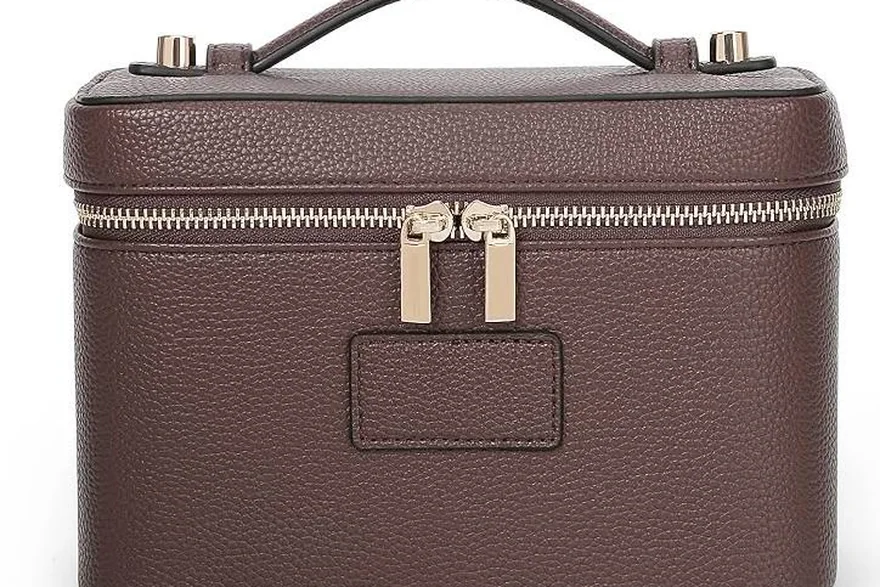
Airline Allowances That Cap the External Dimension
Airlines do not generally publish a limit for the toiletry bag as such; the bag is governed by whichever cabin allowance it travels inside. Two categories matter. A piece carried as part of the main cabin bag is subject to that airline's cabin dimensions and weight limit, typically around 55 x 40 x 23 cm and 7 to 10 kg. A piece counted as a personal item - the small second item most carriers permit alongside a cabin case - is subject to a much tighter envelope, and this distinction is what buyers most often get wrong when briefing a compact design.
| Allowance type | Indicative published limit | What it means for the toiletry bag | Design response |
|---|---|---|---|
| Main cabin bag, full-service carriers | About 55 x 40 x 23 cm, often 7 to 10 kg | Toiletry bag shares space with clothing; 3 to 5 L usable | Keep volume near 3.4 L with organisation rather than bulk |
| Personal item, full-service carriers | Commonly fits under the seat, around 40 x 30 x 15 cm | Bag must work alongside a laptop or handbag | Compact kit near 20 x 11 x 9 cm |
| Low-cost carrier free small bag | Around 40 x 25 x 20 cm on several European carriers | A toiletry kit can travel alone as the free item | Under 25 cm length and under 20 cm depth keeps options open |
| Low-cost carrier included cabin bag | Commonly around 45 x 36 x 20 cm | Shared with clothing under paidupgrade rules | Prioritise compressibility over rigid structure |
| Checked baggage route | No useful upper bound for this category | Large kits up to 8 L are viable | Structured shells, mirror panels and hanging formats become practical |
Published allowances change frequently, and the figures above are indicative rather than contractual: the only reliable source is the specific carrier's page for the specific booking. What does generalise is the ratio rather than the number. Every published personal-item limit is smaller than the main cabin allowance, and every low-cost carrier includes at least one dimension below 25 cm in the free tier. Designing a travel toiletry bag around 24 x 14 x 10 cm keeps it compatible with the largest share of published envelopes at once.
Weight plays a quieter role. Cabin allowances are usually enforced by weight rather than dimension, so the tare weight of the toiletry bag competes directly with the travellers' contents. An empty kit at 250 grams leaves 9.75 kg for everything else against a 10 kg limit, while a structured, hardware-heavy equivalent at 500 grams does not feel heavy in the hand and nevertheless costs more than most travellers will tolerate. Specifying a target tare weight alongside the dimension, and verifying it on the sample rather than the drawing, prevents creeping hardware additions through successive revisions.
Inspection closes the loop for repeat programmes. Dimensional verification belongs in the same final random inspection as the rest of the build, sampled at AQL 2.5 under ISO 2859-1, with the clear pocket dimension measured separately since that is the one that governs compliance. A bag that is 2 cm over on overall length will still be accepted at most checkpoints; a clear pocket that has shrunk 1.5 cm below the specification will not hold the liquids bag, and that defect only appears once production is complete.
How Each Toiletry Format Behaves Once Packed
Identical volumes behave very differently depending on format, because what the traveller experiences is not the nominal litre count but the footprint the bag occupies in a case or on a bathroom counter. A soft kit bulges when full, a hanging kit transfers the problem from horizontal space to vertical space, and a roll-up converts length into diameter. Choosing between them is a decision about which surface is scarce: the inside of a suitcase or a patch of hotel counter.
| Format | Packed footprint | Clearance needed in use | Realistic capacity | Best travel context |
|---|---|---|---|---|
| Flat compact kit | 20 x 11 x 12 cm once bulged | 40 x 25 cm of counter when unzipped | About 2 litres | Short trips, low-cost-airline personal item |
| Standard gusseted kit | 24 x 14 x 11 cm once bulged | 24 x 14 cm counter, stands unaided | About 3.4 litres | One-week carry-on travel |
| Large family kit | 28 x 16 x 13 cm once bulged | 28 x 16 cm counter | About 5.5 litres | Checked baggage, family travel |
| Hanging organiser, closed | 24 x 18 x 9 cm | Roughly 50 cm of vertical hook drop | Three tiers of about 1.1 litres | Hotel bathrooms, cruises, shared facilities |
| Roll-up travel roll | 26 cm long x 12 cm diameter rolled | 60 x 26 cm unrolled on a counter | About 2.5 litres | Backpacking, adventure travel |
| Structured travel case | Holds nominal 26 x 17 x 11 cm exactly | Same as its footprint | About 4 litres | Checked baggage, professional kit |
Hanging organisers deserve special handling in the brief because their published footprint is misleading. Closed for travel the piece measures around 24 x 18 x 8 or 9 cm, which fits comfortably into the carry-on gap, but in use it needs roughly 50 cm of vertical drop from a hook or towel rail and its packed tiers project about 9 cm from the wall. Buyers should measure both states and publish both: the closed figure for packing, the open figure for use, and the hook swallow needs specifying since hotel hooks vary and a stiff hook will not wrap around a wide rail.
Bulge is the other commonly ignored behaviour. Soft-sided kits constructed from uncoated fabric gain roughly 8 to 15 percent in every dimension when fully loaded, because contents push the panels outward and seams have a little give. A design quoted at 24 x 14 x 10 cm may measure 26 x 15 x 11 cm once six bottles and a washbag are inside, which is enough to break the careful fit inside a personal-item envelope. Specifying a structured base panel or a lightly coated shell reduces that expansion to around 4 percent, at the cost of perhaps 30 to 50 grams of tare weight.
The practical test is cheap and should be part of every programme. Fill three production samples with a representative liquids set, zip them closed, measure each axis again, and publish the packed figure rather than the empty one. Bags that pass this test also tend to survive the downward drop test better, because the same coated shell that resists bulge resists seam stress. It costs one afternoon and removes the single most common source of size-related returns in travel toiletries.
The B2B Customisation View
Range planning for makeup bags and toiletry bags works best when the hero style and the gift-with-purchase style are engineered together, sharing linings and hardware to protect the budget.
Planning figures used across the programme: MOQ 500 pieces per style and colourway, 6–10 working days sampling (12–15 when moulding or multi-layer lamination is required), 35–50 days bulk lead time, AQL 2.5 to ISO 2859-1, FOB Xiamen, T/T 30/70.
The value of a programme-coordination model is continuity: QUANZHOU JUNYUAN BAGS keeps the approved reference sample, the shade standard and the AQL record for every repeat order.
Which Brand Types Benefit Most
Airline-adjacent and travel retailers benefit most from standardising on the 24 x 14 x 10 cm kit, because it satisfies the largest share of published personal-item envelopes at once and can be merchandised as carry-on compatible without qualification. Those buyers should also insist on a dedicated clear liquids pocket of at least 21 x 19 cm internally, since that feature is the one travellers recognise as compliant and it is the first thing inspected during pre-travel searches. Start-up travel brands are usually better served launching one size in one colourway at the 500-piece minimum per style and colourway, validating sell-through, and adding a hanging or large variant on the reorder rather than committing working capital to three formats at once.
Established luggage and beauty brands can carry a complete ladder precisely because their distribution reaches both carry-on and checked-bag customers, and sharing the shell fabric, lining and hardware across formats keeps material buys consolidated. E-commerce sellers should note that the hanging format ships awkwardly - its closed footprint is small but its rolled bulk often pushes the carton beyond the standard size tier - whereas flat kits and gusseted kits both compress well. Hospitality and cruise buyers sit in a category of their own: their dimension is dictated by the amenity tray or the cabin bathroom shelf, so those programmes should specify the shelf clearance first, typically 30 x 20 cm with 12 to 15 cm of headroom, then derive the bag.
- Travel and duty-free retailers: standardise at 24 x 14 x 10 cm with a 21 x 19 cm clear pocket
- Start-up travel brands: one size, one colourway at 500 pieces, expand on reorder
- Established luggage brands: full ladder across flat, hanging and structured sharing one material set
- E-commerce sellers: avoid formats whose carton crosses standard size tiers
- Hospitality and cruise: derive dimensions backwards from shelf clearance rather than from trend
Frequently Asked Questions
What toiletry bag size is allowed in carry-on luggage?
Airlines do not publish a separate limit for toiletry bags; the bag simply consumes part of the cabin or personal-item allowance. Practically, a kit near 24 x 14 x 10 cm fits the space most travellers have left after clothing and footwear. Larger kits near 28 x 16 x 12 cm generally require checked baggage.
Why does the liquids rule dictate toiletry bag dimensions?
Because the quart-sized clear bag must fit inside it and be produced at the checkpoint without unpacking. That bag is roughly 20 x 18 cm laid flat, so the dedicated clear pocket needs about 21 x 19 cm internally. Every other dimension in the travel kit follows from that fixed interior requirement.
What size is a TSA quart bag in centimetres?
Approximately 20 x 18 cm laid flat, holding up to one litre or one quart, and typically about 3 cm thick when filled with six to eight 100 ml containers. Because it must be resealable and transparent, the pocket designed to hold it should be 1 to 2 cm larger than that footprint on each axis.
Can a toiletry bag count as an airline personal item?
Yes on most carriers, provided its dimension fits the published personal-item envelope, which commonly runs around 40 x 30 x 15 cm for full-service airlines and nearer 40 x 25 x 20 cm on several European low-cost carriers. A compact kit near 20 x 11 x 9 cm fits almost all published personal-item limits.
How much does a soft toiletry bag expand once packed?
Typically 8 to 15 percent on each axis for an uncoated fabric shell, so a bag quoted at 24 x 14 x 10 cm may measure closer to 26 x 15 x 11 cm when full. Adding a coated shell or structured base panel reduces expansion to roughly 4 percent for 30 to 50 grams of extra tare weight.
What dimensions suit a hanging toiletry organiser in hotel bathrooms?
Closed dimensions of roughly 24 x 18 x 8 cm work for packing, opening to about 24 x 55 cm with three tiers of around 22 x 14 x 4 cm. The design also needs about 50 cm of vertical clearance below the hook and a hook able to wrap a rail up to about 3 cm in diameter.
Is it better to size a travel toiletry bag by litres or centimetres?
Publish both. Centimetres tell a traveller whether the bag fits their case; litres tell them how much it holds. A standard travel kit of 24 x 14 x 10 cm carries about 3.4 litres, and that single pair of figures resolves more pre-purchase uncertainty than photographs do.
Do 100 ml bottles actually fit side by side in a standard clear pocket?
Six typical 100 ml cylinders need roughly 360 square centimetres of footprint, comfortably inside a 21 x 19 cm pocket, and mixed shapes such as flat tubes normally allow eight or nine items. Below about 20 cm on either axis the contents begin competing for space and the pocket will not close cleanly.
Which toiletry bag formats are unsuitable for carry-on travel?
Structured travel cases above roughly 4 litres and large hanging organisers with more than three tiers tend to exceed the available cabin space. They sell well for checked baggage, cruises or professional kit, but items in those categories generate more returns when marketed as carry-on compatible.
How heavy should an empty travel toiletry bag be?
Ideally 150 to 300 grams for a soft kit and up to 500 grams for a structured one. Because cabin allowances are enforced by weight rather than by dimension, every gram of tare weight is taken directly from what the traveller can carry, and heavy hardware is the most common cause of complaints.
What dimension accommodates a full-length toothbrush comfortably?
A full-length toothbrush measures about 19 cm, so the interior needs at least 20 cm on the long axis, allowing roughly 1 cm of clearance for closure. Compact kits shorter than that require a folding or travel-length toothbrush, which should be stated on the listing to avoid returns.
How should clear pockets be specified so they stay transparent in production?
Specify film material and gauge, not just the word transparent. A TPU film at roughly 0.3 mm retains clarity after repeated folding, while thin PVC hazes and cracks at low temperatures. Naming the gauge and requesting a retention sample prevents a compliant prototype becoming a cloudy production run.
Should the liquids pocket sit inside or outside the main compartment?
Outside, and preferably on the exterior face of a hanging kit. The traveller needs to remove the clear bag in one motion at the checkpoint without disturbing packed contents. Interior pockets force unpacking at every screen, which defeats the purpose of the compartment entirely.
What size toiletry bag suits children or family travel?
A family kit near 28 x 16 x 12 cm holding about 5.5 litres works, because children's items are bulky relative to their liquid volume - nappies, wipes and creams dominate. These kits generally travel in checked baggage, since few carry-on allowances leave five litres free.
How are travel toiletry bag dimensions verified before shipment?
Through final random inspection sampled at AQL 2.5 under ISO 2859-1, measuring length, width and height on drawn pieces and additionally measuring the clear liquids pocket. The pocket dimension deserves separate recording because it governs compliance, whereas overall size governs usability.
People Also Ask
What size toiletry bag is best for carry-on?
Around 24 x 14 x 10 cm, carrying roughly 3.4 litres. That size fits the space most travellers have left in a cabin case after clothing and footwear, matches the largest share of published personal-item envelopes, and still leaves room for a dedicated clear liquids pocket.
Does a toiletry bag have to be TSA approved?
The bag itself does not require approval; the contents do. Liquids must be in containers of 3.4 ounces or 100 millilitres or less, in one clear quart-sized resealable bag, one per passenger. A toiletry bag simply needs a clear pocket large enough to hold that bag and open it flat at the checkpoint.
How many millilitres fit in a standard travel toiletry bag?
A 3.4 litre travel kit will physically contain far more than the liquids rule permits, but the binding constraint is that only 100 ml containers in a single one-litre bag may travel through screening. Typically that means six to eight 100 ml items plus solid and liquid-free items such as razors and brushes.
Are hanging toiletry bags bigger than regular ones?
In closed travel dimensions they are comparable, typically about 24 x 18 x 8 cm against 24 x 14 x 10 cm for a gusseted kit. In use they occupy far more space vertically - roughly 50 cm of hanging drop - but free horizontal counter space, which is why they suit hotel bathrooms.
Request a Sample or a Written Quotation
Send the silhouette, dimensions, material preference and logo artwork, and the programme team will return a written quotation with MOQ, sampling window, bulk lead time and inspection standard.
Email: [email protected] · WhatsApp: +86 177 5002 0688