Tumi vs Samsonite Toiletry Bags: Travel Luxury Comparison
Executive Summary
Tumi vs Samsonite toiletry bags is a comparison between two different definitions of travel luxury. Tumi builds around dense ballistic nylon in the 840D to 1050D range, metal or moulded-tooth zippers and cast hardware, while Samsonite builds around coated polyester in the 420D to 600D range, coil zippers and moulded hardware at a shelf price that commonly lands at a third to a half of the premium tier. Both answer the same brief: carry liquids, survive a leak, hang from a door and clear security without a repack.
For a brand owner the comparison is more useful as a specification map than as a shopping decision. Most of the visible gap comes from four line items that can be written directly into a brief: face fabric denier, coating type and thickness, zipper grade and hardware finish. A private-label kit at 600D polyester with a 0.12 mm TPU laminate and a #5 coil zipper will not be identical to either product, but it can be positioned deliberately against one tier. Programmes start at 500 pieces per style and colourway, sample in 6 to 10 working days and ship 35 to 50 days after approval.
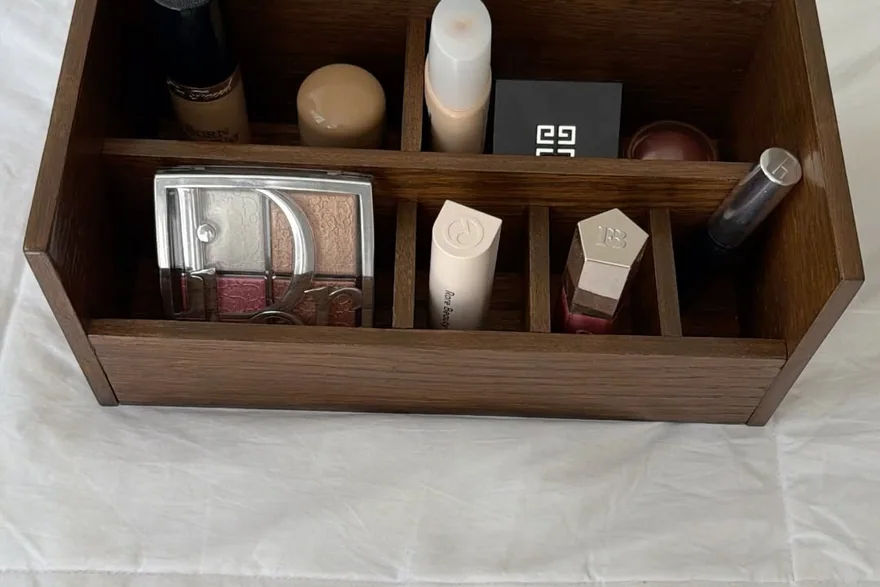
Two definitions of travel luxury in the same category
Tumi and Samsonite sit at different points on the same shelf, and the distance between them is easier to measure in specifications than in brand language. The premium tier is built around dense woven nylon, with ballistic nylon in the 840D to 1050D range as the signature material, paired with metal or moulded-tooth zippers, cast hardware and interior layouts that assume the owner flies every week. The mid-premium tier is built around coated polyester at 420D to 600D, coil zippers and moulded hardware. Both products answer the same functional brief: hold toiletries, survive a leak, hang from a bathroom door or towel rail, and pass through airport security without a full repack.
For a brand owner or retail buyer studying the segment, the useful question is not which one to purchase but which tier to build against. Search data gives a sense of the audience: 'travel bag for toiletries' draws roughly 110,000 monthly searches, and 'toiletry bag' around 74,810 weekly searches on Amazon. Demand is broad rather than niche. Within that demand the premium end is smaller but carries the margin, while the mid-premium end carries the volume. A private-label programme can sit in either position, but the decisions that place it there are concrete rather than atmospheric: denier, coating weight, zipper grade, stitch density and the type of hanging hook.
This comparison therefore reads the two brands as specification packages rather than as shopping options. Neither brand supplies materials to, partners with, or endorses any sourcing programme discussed here; they are reference points in the market that a buyer can measure a brief against. The practical value is that both have already absorbed years of returns data and customer feedback, and the outcome is visible in the finished product. Reading that specification backwards, from shelf to spec sheet, is a faster route to a defensible private-label brief than starting from a blank page and guessing at what a frequent traveller will tolerate.
Face fabric, lining and hardware: the specification gap
The face fabric is the most visible difference and the easiest line item to specify. Ballistic nylon at 840D to 1050D weighs roughly 260 to 340 g/m² before coating and resists the abrasion of being slid across airport floors and hotel counters. Coated polyester at 600D weighs roughly 180 to 220 g/m² and is noticeably lighter in the hand. The heavier cloth costs more per metre and more per minute to sew, because it needs a larger needle, a slower feed and a more experienced operator at corners and at the zipper turn. That difference appears in the labour line of a quotation as well as the material line, which is why the price gap between tiers is wider than the fabric invoice alone would suggest.
| Specification | Premium tier (Tumi-class) | Mid-premium (Samsonite-class) | Private-label target |
|---|---|---|---|
| Face fabric | 840D to 1050D ballistic nylon | 420D to 600D coated polyester | 600D polyester, 0.12 mm TPU laminate |
| Lining | 210D nylon, PU coating, wipe-clean | 150D polyester, light PU finish | 190T polyester, 0.08 mm TPU |
| Main zipper | #8 metal or moulded tooth, two sliders | #5 coil, single branded puller | #5 nylon coil, auto-lock slider |
| Hanging hook | Cast zinc alloy, 360 degree swivel | Moulded POM hook, fixed orientation | Steel swivel hook, nickel finish |
| Stitch density | 8 to 9 stitches per inch | 7 to 8 stitches per inch | 8 stitches per inch, specified in brief |
| Interior panels | 7 to 9 panels, mesh and elastic | 4 to 6 panels, mesh only | 6 panels, two elastic brush loops |
| Indicative retail band | $145 to $225 | $55 to $95 | $24 to $45 landed unit cost |
Coatings deserve their own line item on the brief. A thermoplastic polyurethane laminate at 0.10 to 0.15 mm gives a genuinely wipe-clean surface and improves resistance to water penetration, but it adds stiffness and can crease permanently if the bag is folded sharply in a packed case. Polyurethane-coated polyester is cheaper and softer to the hand, yet it is more prone to hydrolysis over a multi-year life in humid storage, which shows up as a tacky surface and, later, as flaking. Buyers comparing tiers should ask for the coating chemistry and the thickness in millimetres rather than accepting the words 'water resistant'. Colour fastness of both face fabric and lining should be checked against the ISO 105 series, and stain release behaviour against AATCC test methods, so a dark lining does not crock onto a light-coloured product packed beside it.
Hardware is the second visible tier marker and, per unit of cost, the most efficient place to spend. A cast zinc alloy hook with a 360-degree swivel will carry a loaded bag on a door without twisting the strap, while a moulded POM hook of identical outline is lighter and cheaper but tends to creep under sustained load and can deform in a hot car. The same logic applies to sliders and pullers: a cast metal puller has a weight and a sound that shoppers read as premium, and the absolute cost difference over a 500-piece run is small. Because hardware is a low share of unit cost and a high share of perceived quality, it is the first place a value-tier programme should upgrade.
Zipper terminology is standardised, which makes the closure one of the easiest components to specify unambiguously. The ASTM D2053 standard defines zipper component vocabulary, so a brief that reads '#5 nylon coil, auto-lock slider, 12 cm tape, two-way open on the main compartment' is interpreted the same way by any production floor. Without that vocabulary, a quotation promising a 'good quality zipper' leaves the most frequently returned component on the entire bag undefined. Chain width, slider type, tape width and stop type should each appear as separate lines, together with a pull test requirement on the finished seam.
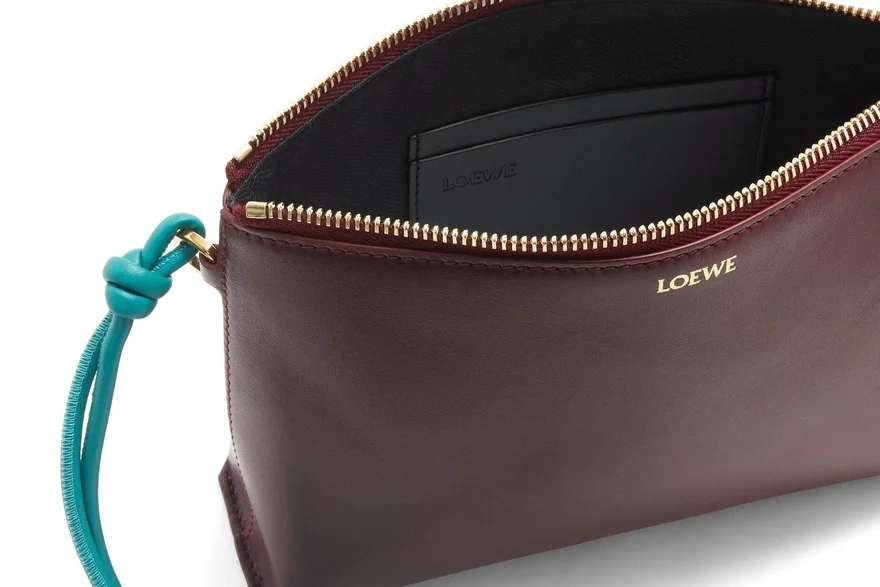
Internal layout, capacity and the 100 ml liquids constraint
Capacity is where the two tiers diverge in a way that is easy to misread. Published closed dimensions for premium hanging kits cluster near 25 x 20 x 10 cm, which multiplies to roughly 5 litres, while mid-premium kits cluster near 23 x 17 x 9 cm, roughly 3.5 litres. Usable volume is smaller than that arithmetic in both cases, because hanging kits carry stiffened back panels, a hook assembly and multiple dividers that consume space before a single bottle is packed. A buyer comparing the two should measure the leak-proof compartment separately from the dry compartments, since the liquid compartment is the part a traveller fills first and the part most likely to drive a return when it is too small.
Layout quality is not a function of how many pockets a bag has. A 4-litre volume with nine internal panels becomes difficult to search, and users end up unpacking it to find a single item, which defeats the purpose of a hanging kit. Six to eight panels is a practical working range for this size class, provided at least two are elastic-topped so that tall bottles stand upright rather than lying across the pocket mouth. Mesh choice matters too: a fine 0.3 mm mesh traps powder residue and is hard to rinse, while a 0.8 to 1.0 mm mesh rinses clean but lets small items escape.
- A leak-proof compartment of at least 0.7 litres, with bonded rather than stitched-only seams, keeps a failed bottle away from clothing in the same suitcase.
- Six to eight internal panels is the working range for a 4 to 5 litre hanging kit; beyond that, search time inside the bag rises faster than useful storage.
- At least two elastic-topped pockets let 200 ml and 250 ml bottles stand upright instead of lying across a pocket mouth and leaking onto the lining.
- A detachable transparent pouch is the only reliable way to satisfy the liquids rule without unpacking the whole kit at the checkpoint.
- Mesh at 0.8 to 1.0 mm aperture rinses clean after powder spills; finer mesh traps residue and generates the complaints that show up as returns.
The liquids constraint is a regulatory fact rather than a design preference, and it shapes the product. Under the TSA 3-1-1 liquids rule, containers must be 100 ml or less and must be gathered into a single transparent, resealable, quart-sized bag that can be lifted out at the checkpoint. A toiletry kit's built-in leak-proof compartment is almost always opaque, so security staff will still ask for the liquids out unless the kit provides a clear pouch. Premium kits solve this with a detachable transparent pouch that clips inside the main compartment and lifts out in one motion. That pouch is a functional component of a travel kit, not an accessory, and belongs on the bill of materials.
Weight is the final layout variable and it interacts with the hanging hook. An empty premium kit at 5 litres typically weighs 480 to 620 g because of the stiffened back panel and the cast hook; a fully packed kit with 1 litre of liquids and a full set of 100 ml bottles reaches 2.4 to 3.2 kg. That figure, not the empty weight, is what the hook and the top strap have to carry. Any brief for a hanging kit should state a packed design load in kilograms and require the hook assembly to be tested at a multiple of that figure, rather than leaving load capacity to be discovered by the customer.
Turning the comparison into a private-label specification
A buyer who wants to build against one of these tiers should convert the comparison into a two-tier brief rather than a single specification. Writing a Tier A and a Tier B version of the same product makes the cost of each upgrade explicit, so the decision becomes commercial rather than technical. The table below sets out the six line items that move the positioning most, with an indicative share of unit cost. Percentages vary with order quantity, fabric availability and hardware choice, and should be confirmed against a live quotation rather than treated as fixed.
| Line item | Tier A (premium positioning) | Tier B (value positioning) | Indicative cost impact |
|---|---|---|---|
| Face fabric | 840D nylon, durable water repellent finish | 600D polyester, PU backing | 22 to 30 percent of unit cost |
| Main zipper | #8 moulded tooth, two sliders, metal puller | #5 coil, single auto-lock slider | 6 to 9 percent of unit cost |
| Hanging hook | Cast zinc alloy, 360 degree swivel | Moulded POM hook, fixed orientation | 4 to 7 percent of unit cost |
| Interior panels | 8 panels, elastic and mesh mix | 5 panels, mesh only | 8 to 12 percent of unit cost |
| Branding | Woven label plus metal badge | Single woven label | 2 to 4 percent of unit cost |
| Retail packaging | Rigid gift box, two-colour print | Polybag plus barcode sticker | 5 to 8 percent of unit cost |
Two of those lines deserve a note. Packaging is routinely underestimated: a rigid gift box for a hanging kit has to be sized to the bag in its folded, not flat, state, and a box that is 2 cm too shallow will arrive with crushed corners after a 35 to 50 day ocean transit. Branding sits at the other end of the scale, costing a few percent of unit cost while carrying a disproportionate share of perceived value; a metal badge on the front panel of a Tier B bag is the cheapest available way to move a shopper's impression up one tier.
Verification closes the loop. A brief should state the inspection standard rather than simply asking for a quality check: inspection at AQL 2.5 under ISO 2859-1 gives a defined sample size and a defined accept and reject number for a 500-piece run, which removes the argument about whether a batch is acceptable. Sampling for a standard hanging kit runs 6 to 10 working days; a complex construction with a cast hook, bonded seams and a moulded panel runs 12 to 15 working days. Bulk production is 35 to 50 days after sample approval, with shipment on FOB Xiamen terms and payment by T/T, 30 percent deposit and 70 percent against bill of lading.
Freight planning is the last piece and it interacts with the hardware decision. A hanging kit packed flat with the hook detached ships at roughly 24 to 36 pieces per export carton, while a kit shipped with the hook attached and the compartments stuffed to shape can drop to 14 to 20 pieces, because the metal component prevents tight stacking. Across a 500-piece programme that difference moves the freight bill by more than the cost of the hardware itself, which is worth knowing before deciding whether to specify a detachable hook.
Comparing two retail brands is a way of reading market expectations, not a licence to reproduce them. Fabric constructions, hardware finishes and layouts should be treated as category norms to be met with a brand owner's own specification, artwork and labelling, checked with qualified counsel before any programme is launched.
The B2B Customisation View
Most delays on cosmetic pouches, vanity cases and beauty organisers trace back to one unanswered question in the brief, so the first working session is spent removing ambiguity rather than choosing colours.
The numbers a buyer can plan around: 500 pieces minimum per style and colourway, 6–10 working days to a first sample (12–15 where tooling or moulding is involved), 35–50 days to bulk completion, AQL 2.5 under ISO 2859-1 at final inspection, FOB Xiamen terms, T/T 30/70 payment.
QUANZHOU JUNYUAN BAGS operates as the custom bag specialist on the file, managing the parts of the process that brands rarely resource in-house: shade matching, component sourcing and pre-shipment inspection.
Which Brand Types Benefit Most
Different buyer types get different value from a two-tier travel kit specification. A start-up brand entering the travel accessories category usually wants the Tier A shell, because the first product has to survive photography, reviews and the unboxing moment, and a cast hook plus a metal puller are visible in every image. An established brand with an existing luggage line more often wants consistency: matching the denier, the lining colour and the hardware finish of the existing range matters more than adding panels, because the kit is sold as part of a set. Retailers and wholesalers tend to buy the Tier B specification in volume, then use packaging and display to lift the perceived tier. E-commerce sellers sit between the two and usually specify the Tier A fabric with the Tier B internal layout, because the fabric shows in the listing photograph while the panel count does not. Gift and hospitality buyers ordering for a travel-related promotion need a third thing again: a defensible landed cost, a carton count that fits their warehouse, and a lead time that can be written into a campaign calendar. Across all five buyer types one rule holds: the closure, the hook and the lining are the three components a customer notices in use, and a specification that underfunds any one of them will be felt even when the face fabric is excellent.
- Start-up brands: specify the premium shell and cast hardware first; the first 500-piece run sets the review baseline.
- Established brands: match denier, lining colour and hardware finish to the existing luggage range before adding features.
- Retailers and wholesalers: buy the value specification in volume and lift perceived tier through packaging and display.
- E-commerce sellers: premium face fabric for the listing photograph, simpler internal layout to hold the landed cost down.
- Gift and hospitality buyers: prioritise landed cost, carton count and a lead time that fits a fixed campaign date.
Frequently Asked Questions
Which of the two brands offers more usable interior volume in a hanging kit?
Published closed dimensions put premium hanging kits near 25 x 20 x 10 cm, roughly 5 litres, and mid-premium kits near 23 x 17 x 9 cm, roughly 3.5 litres. Usable volume is lower than the arithmetic product in both cases because stiffened back panels, hook assemblies and dividers consume space first. A buyer comparing them should measure the leak-proof compartment separately, since that is the space a traveller fills first. For a seven-day trip, 0.8 to 1.2 litres of sealed liquid storage plus about two litres of dry storage is a realistic target.
Is ballistic nylon worth the surcharge on a hanging toiletry kit?
Ballistic nylon in the 840D to 1050D range costs more per metre and more per minute to sew, typically adding 20 to 35 percent across the material and labour lines together. It earns that cost when a bag is dragged across rough surfaces or packed tightly against a hard-shell case. For a kit that lives inside a suitcase and hangs in a bathroom, 600D polyester with a 0.12 mm TPU laminate delivers most of the practical benefit. Reserve ballistic nylon for outer shells positioned above the mid-premium tier.
How does a metal zipper compare with a coil zipper on a bag that carries liquids?
Metal and moulded-tooth zippers in the #8 range resist bursting better than a #5 coil when a full bag is compressed, because the teeth interlock under lateral load. Coil zippers are lighter, quieter and cheaper, and an auto-lock slider prevents the slider creeping open. In both cases the weak point is the seam between the zipper tape and the panel: liquid pressure finds the stitch line before it finds the teeth. Bonding the seam behind the zipper or adding a storm flap does more for leak performance than upgrading gauge alone.
Do premium toiletry bags meet the 3-1-1 liquids rule without a separate pouch?
Most do not. The liquids rule requires containers of 100 ml or less gathered into one transparent, resealable, quart-sized bag that can be removed at the checkpoint, and a kit's built-in leak-proof compartment is usually opaque. Premium kits solve this with a detachable clear pouch that clips inside the main compartment and lifts out in one motion. Buyers specifying a travel kit should treat that pouch as a functional component on the bill of materials rather than as an optional accessory.
What causes a hanging hook to fail in service?
Three failure modes dominate. The first is creep: a moulded polymer hook deforms slowly under a 2.5 to 3 kg packed load, especially in a hot car or a steamy bathroom. The second is strap tear-out, where the webbing anchor is stitched with too few bar-tacks and pulls away from the back panel. The third is swivel seizure, where a plated swivel corrodes and stops rotating, so the bag hangs twisted. All three are addressable in a brief by specifying hook material, bar-tack count and a salt spray requirement.
How many internal panels are useful before a hanging layout becomes cluttered?
Six to eight panels is the working range for a 4 to 5 litre hanging kit. Below five, bottles lie loose and rattle; above nine, users end up unpacking the bag to find one item, which removes the point of a hanging design. At least two of the panels should be elastic-topped so tall bottles stand upright. Panel count should be specified alongside panel dimensions, because eight shallow pockets hold less than five deep ones.
Should the lining of a travel toiletry bag be light or dark?
A light lining makes contents easier to find in a dim hotel bathroom, which is the main functional argument for it. A dark lining hides mascara, foundation and toothpaste residue, which is the main argument for the other choice. Many premium kits compromise by lining the liquid compartment dark and the dry compartment light. Whichever is chosen, the lining should be tested for colour fastness so that a dark lining does not transfer dye onto light-coloured items packed beside it.
What stitch density should be specified for a hanging toiletry kit?
Eight to nine stitches per inch is the range used in the premium tier, with seven to eight common in the value tier. Higher density raises strength but also perforates the fabric more heavily, which matters on a coated laminate where every needle hole is a potential water path. On a laminated face fabric, seam sealing or a bonded tape behind the seam is more useful than simply increasing density. The brief should state stitches per inch and seam type together.
Can a private-label bag use a ballistic nylon weave without infringing a brand's rights?
A weave construction is a generic textile structure and is not, by itself, protected. What is protected are trade dress, registered designs, logos, named hardware shapes and distinctive colour combinations. A buyer may specify 840D ballistic nylon freely, but should not copy a recognisable silhouette, a named hardware form or a signature colour pairing. Because trade dress analysis is fact-specific, any programme intending to sit close to an existing retail product should be reviewed by qualified counsel before tooling starts.
How should warranty terms be compared between two retail travel brands?
Read the warranty for what it excludes rather than its headline length. A five-year limited warranty that excludes zippers, hardware and damage from airline handling covers less than a two-year warranty with no component exclusions. Check whether the claim requires proof of purchase, whether the brand pays return freight, and whether the remedy is repair, replacement or store credit. For a private-label programme, the warranty length chosen should match the component specification, because warranty claims are paid out of margin.
Which colourways sell best in travel toiletry bags?
Black and charcoal dominate the travel category because they hide scuffing from conveyor belts and hotel counters, typically taking the largest share of a range. Navy and deep green follow, and lighter tones sell mainly in the gift segment. A prudent first run splits a 500-piece order across two or three colourways rather than committing to one, since colour preference varies sharply by region. Metallic hardware finish should stay consistent across colourways to keep component inventories simple.
What carton count makes sense for a premium hanging kit?
A hanging kit packed flat typically allows 24 to 36 pieces per export carton, depending on whether the hook assembly is attached or packed separately. Packing the hook detached and capping it protects the face fabric from impressions during a 35 to 50 day transit and lets the carton be about 15 percent smaller. Carton count should be fixed before the freight quotation, because it changes both the per-unit landed cost and the warehouse handling cost at destination.
How much does a TPU laminate add to the unit cost of a kit?
Laminating 0.10 to 0.15 mm of thermoplastic polyurethane onto a 600D polyester face typically adds a few percent to unit cost, well below the cost of moving up to ballistic nylon. The trade-off is in hand and stiffness: a laminated panel resists water but creases if folded sharply. Buyers should request the laminate thickness in millimetres and a bonded sample panel before approving, because thin laminates delaminate at the seam after repeated flexing.
Should a travel toiletry kit include a removable mirror?
A removable mirror is popular in vanity-style kits but adds three complications: weight, breakage risk and a sharp-edge hazard if the glass is unbacked. If a mirror is specified, it should be at least 1.5 mm thick, backed with safety film and held in a padded sleeve rather than a loose pocket. For a hanging travel kit intended for airline use, most buyers drop the mirror and spend the cost allowance on the hook and the zipper instead.
What sampling timeline applies to a nine-panel hanging kit with a cast hook?
A standard hanging kit samples in 6 to 10 working days. A complex construction with a cast hook, bonded seams, a moulded back panel and a detachable clear pouch falls into the 12 to 15 working day bracket, mainly because the metal hardware has to be tooled or sourced before assembly. Bulk production then runs 35 to 50 days after sample approval. Buyers working to a fixed retail date should add freight time on top of the production window, not inside it.
People Also Ask
Are expensive toiletry bags worth it for occasional travellers?
For someone taking two or three trips a year, the premium tier buys durability that will not be worn out within the ownership period, so the value case is weak. The mid-premium specification at 600D polyester with a #5 coil zipper survives occasional use comfortably. Where the extra spend does pay off is on the hook and the zipper, because those are the two components that fail first and neither can be repaired easily at home.
What size hanging toiletry bag fits in a carry-on?
A closed footprint of roughly 23 to 25 cm wide, 17 to 20 cm tall and 9 to 10 cm deep fits alongside packing cubes in most carry-on cases while leaving room for a folded hanging kit. Larger kits exceed 5 litres and begin to displace clothing. Buyers should confirm the packed depth rather than the empty depth, because a stiffened back panel and a full liquid compartment add 2 to 3 cm.
How do you clean the lining of a travel toiletry bag?
Empty the bag, brush out dry powder residue, then wipe the lining with a cloth dampened in mild detergent and warm water. A TPU or PU laminated lining wipes clean; an uncoated nylon lining may need a soft brush and will hold stains longer. Rinse with a clean damp cloth and air dry fully open with the hook extended, since trapped moisture behind a laminated panel leads to hydrolysis over time.
Can a hanging toiletry bag go through airport security without unpacking?
Only if the liquids are already inside a transparent, resealable, quart-sized bag that can be lifted out in one motion. The kit itself can stay in the carry-on; it is the liquids that must be presented separately. Kits with a detachable clear pouch save time at the checkpoint. A leak-proof opaque compartment alone does not satisfy the rule, because screeners need to see the containers.
Request a Sample or a Written Quotation
Send the silhouette, dimensions, material preference and logo artwork, and the programme team will return a written quotation with MOQ, sampling window, bulk lead time and inspection standard.
Email: [email protected] · WhatsApp: +86 177 5002 0688