Family Travel Toiletry Bags: Shared vs Individual Organization
Executive Summary
Shared organisation wins for a family of four on a trip of up to seven days, because one 7-9 L case with colour-coded removable pouches carries roughly 2.1 L of product for the whole group and eliminates four separate repacks. Individual bags win from about ten days, when each person's kit exceeds 600 ml and a shared case becomes a single heap that nobody wants to search. The practical answer for most programmes is a hybrid: one shared case that hangs, plus four removable pouches at 0.45-0.6 L each.
Buyers specifying a family range should fix three numbers in the brief: pocket count, child-safety hardware and colourway count. Pocket count drives whether a shared case stays organised past day three; a zipper pull on a child's pouch has to pass a small-parts pull test under CPSIA; and each colourway carries its own fabric dye lot, so four colours means four runs of 500 pieces rather than one. Sampling takes 6-10 working days, bulk 35-50 days, inspection is to AQL 2.5 under ISO 2859-1, and shipment is FOB Xiamen on T/T 30/70 terms.
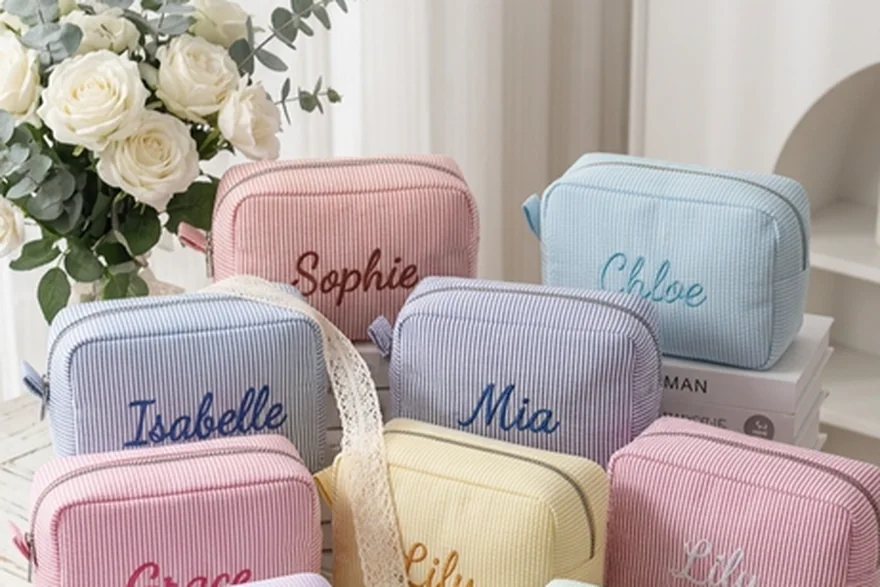
Shared versus individual: the decision that drives every dimension
The shared-versus-individual question is not a preference question; it is an arithmetic one. A shared case consolidates four people's toothpaste, sunscreen and shampoo into one volume, which saves packing time and, more importantly, saves the hunt for the SPF 50 tube a family needs five minutes before the beach. An individual pouch gives each person sovereignty over a small kit, which matters from about ten days onward, when refill cadence diverges and a teenager's routine no longer fits beside a toddler's nappy cream.
The crossover point is worth calculating rather than guessing. An adult carries about 380-450 ml of product for a week, a child aged seven to twelve about 180-220 ml, and a toddler about 120-160 ml including wipes. A family of two adults and two children therefore needs roughly 1.0-1.3 L of liquids per week, plus brushes and a first-aid handful, which lands at 2.0-2.4 L of usable volume. Four pouches at 0.6 L each provide the same volume at four times the shell and zipper cost, and give four things to lose in a hotel room.
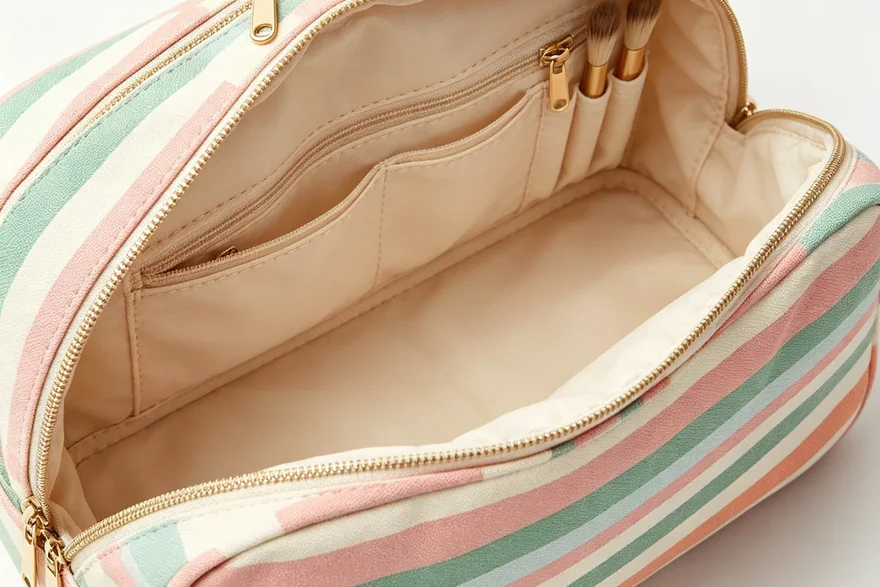
Shared organisation has one structural weakness that the specification has to solve: it becomes a heap. A single 8 L cavity fills with loose bottles that migrate to the bottom, and by day three the family is unpacking the whole case to find a nail clipper. The fix is internal division rather than a bigger bag: removable pouches, a bottle bay with elastic loops of 45-60 mm, and a mesh lid pocket for flat items, which let one person take a single pouch to a shared bathroom without carrying the case.
There is also a security-screening dimension that favours the hybrid. When a family carries liquids in cabin, each container is limited to 100 ml under the TSA 3-1-1 liquids rule, so a shared 400 ml bottle of shampoo cannot fly in cabin at all. A shared case with removable 100 ml pouches lets each family member lift out a compliant set at the checkpoint, rather than four people producing bottles from different bags at the tray.
For buyers, the decision shapes the SKU architecture. A shared case is one style and one carton spec at a higher unit price; individual pouches are a four-colour family at four times the style count. The hybrid is the most defensible structure, because the outer case carries the margin and the pouches drive replacement sales.
Capacity maths for a family of four on a seven-day trip
Start the capacity calculation with consumption, not with bag dimensions. An adult uses roughly 8 ml of shampoo per wash, 2 ml of shower gel per shower, 1.5 ml of facial cleanser per use, 0.25 g of toothpaste per brush and about 25 ml of sunscreen per beach day at SPF 50. Over seven days that is about 380-450 ml for one adult. A child aged seven to twelve uses about half of that in liquids plus a similar sunscreen load, so 180-220 ml, and a toddler needs 120-160 ml plus a pack of wipes that occupies about 0.35 L on its own regardless of volume.
Weight follows volume and matters more than buyers expect. At roughly 1 g per ml, 2.2 L of product is about 2.2 kg before the bag, which is a meaningful share of a 23 kg checked allowance when a family is pooling luggage. The efficient target is a shared case of 600-900 g empty with 7-9 L of usable volume, or four pouches of 120-180 g each. Packed, the shared case should stay under 3.5 kg if it is going to hang from a standard towel hook or shower rail, because most bathroom hooks and over-door hangers are rated well below that once the door is opened and closed.
| Configuration | Pieces carried | Usable volume (L) | Packed weight (kg) | Best for | Failure mode |
|---|---|---|---|---|---|
| One shared hanging case, four removable pouches | 1 + 4 | 7.0-9.0 | 2.8-3.5 | Trips of 3-9 days, one bathroom | Heap forms if pouches are not fixed |
| Two adult cases plus one children's case | 3 | 5.4-6.6 | 2.4-3.0 | Trips of 10-14 days | Three things to remember at checkout |
| Four individual pouches | 4 | 2.0-2.6 | 1.6-2.2 | Older children, split rooms | No shared sunscreen or first aid |
| Shared rolling family case with trays | 1 | 12.0-16.0 | 4.5-6.0 | Road trips and self-catering | Too heavy for air travel |
| Shared case plus one clear flight pouch | 2 | 7.0-8.0 + 1.0 | 3.0-3.8 | Any flight with cabin liquids | Double handling at the checkpoint |
Pocket count is the number that turns capacity into organisation. A shared family case needs a minimum of four defined zones: a bottle bay with 45-60 mm elastic loops for upright bottles, a flat mesh lid pocket for toothbrushes and combs, a wipe-clean bay for sunscreen and nappy cream, and a small first-aid pocket with a 12-15 cm opening for plasters, tweezers and children's medication. Below four zones, a shared case degenerates into a single cavity within about three days of family use, regardless of total volume.
The bottle bay deserves its own dimension check. Family sizes are larger than travel sizes: a 400 ml shampoo bottle is 20-21 cm tall and 62-68 mm in diameter, and a 250 ml sunscreen tube is 17-19 cm tall. A bay that only accepts 100 ml decants forces a family to decant four times over, which is exactly the chore that makes buyers abandon a shared system. Specifying an internal bottle-bay height of 21-22 cm with loops at 60 mm lets a family carry shop-bought sizes and still close the case.
Finally, the packed case has to fit the family's actual storage, which in a holiday rental or a hotel is usually a bathroom shelf 30-45 cm wide or a single hook behind the door. A closed shared case at 30 x 22 x 14 cm fits both; a 36 x 26 x 18 cm case fits neither and ends up on the floor of a bedroom, where it is stepped on. That is the most common reason a family toiletry bag is retired after one holiday, and it is entirely predictable from the dimensions.
Child-safe materials, closures and documentation
A toiletry bag marketed to families, or sold in a channel where children will use it, is treated differently from an adult wash bag in the United States. Children's products fall under the Consumer Product Safety Improvement Act, which sets limits on lead and phthalates and requires third-party testing and a certificate for regulated articles. Buyers shipping a kids' pouch into that channel should read the CPSIA statute directly and confirm scope with their own compliance adviser, because the definition turns on the intended user and the article class rather than on the word toiletry.
The physical hazards are predictable and can all be designed out. A decorative metal zipper pull is a small part if it detaches under tension; a long drawcord on a soft pouch is an entanglement risk; a magnetised closure can detach and be swallowed; and a stiff PVC window can contain plasticised vinyl that fails a phthalate screen. Each has a design answer that costs very little if chosen at brief stage and a great deal if discovered at inspection: a moulded pull in one piece, no drawcord below a defined length, a hook-and-loop closure instead of a magnet, and a TPU window instead of PVC.
| Hazard | Where it appears on a family bag | Control or test | Practical acceptance |
|---|---|---|---|
| Detachable small part | Metal or decorative zipper pull | 90 N pull test in all directions, 10 seconds | No detachment, no fracture |
| Lead in coating | Printed logo, metal hardware finish | Total lead screen on accessible coating | Within the CPSIA limit for the class |
| Phthalates | PVC window, soft grip, coated shell | Material substitution to TPU or PU | Declaration plus test report |
| Entanglement | Drawcord on a soft pouch | Remove the cord or limit free length | No cord in the neck area |
| Sharp point or edge | Broken slider, cut metal trim | Touch test on edges after drop test | No accessible sharp edge |
| Microbial growth | Damp pouch packed closed | Vent panel plus removable liner | Dries within 12 hours at 20 C |
| Colour transfer | Saturated child print onto pale lining | Rubbing assessment to ISO 105 | Grade 4 or better on the lining |
Cleaning is a child-safety issue as much as a hygiene one, because a family bag will meet a stomach bug, a leaking nappy cream and at least one crushed yoghurt. The specification that survives is a coated shell that can be wiped with a diluted bleach solution without colour loss, a lining with welded seams so nothing wicks into the interlining, and a removable liner that can be washed at 60 C. Absorbent cotton linings and unbonded interlinings both fail here, and they are the two most common reasons a family bag is thrown away rather than cleaned.
Coated fabrics are worth specifying by test rather than by name. Coating adhesion, hydrostatic resistance and blocking are covered by ASTM D751 coated fabrics, and citing the relevant procedures in the tech pack is what stops a sample room substituting a lighter coating that looks identical on day one and peels after a season. For a family bag, the useful targets are a hydrostatic head above 600 mm and a coating adhesion of at least 12 N per 25 mm after five wash cycles.
Documentation closes the section. Beyond any child-safety certificate, family programmes usually carry an OEKO-TEX Standard 100 certificate on the shell and lining and a written declaration on cleaning agents and odour. Buyers should also decide, before bulk, whether a care label is sewn in or printed on a card, because a sewn label inside a wipe-clean bay will delaminate in a hot wash and end up as a loose part in a bag used by a small child.
Labelling systems, colour coding and the re-order cycle
A shared family case only stays organised if ownership is visible without opening it, and that is a labelling problem rather than a capacity one. The systems that work in practice are all low-technology: colour, initials and icons. The systems that fail are anything requiring a family member to remember a code, because children under about eight will not reliably use a numbered system, and adults will not maintain a written roster on holiday.
- Colour coding: one body colour per family member, held to a Delta E of 1.5 across shell, zipper tape and pull, so a pouch is identifiable at a glance in a shared bathroom.
- Initials: 6 mm cap-height embroidery or a debossed patch on the pouch face, placed lower left where the panel flexes least.
- Icon labels: a toothbrush, a sun and a bottle icon printed at 8-10 mm, which children read faster than words and which survive translation across markets.
- Name window: a 60 x 15 mm clear TPU window with a writable card insert, replaceable when a child's bag is handed down.
- Wet-and-dry split: a mesh panel of 70 cm2 or more on the pouch gusset, so a toothbrush dries instead of seeding odour in a closed case.
- Fixed pouch anchors: four short webbing tabs with snap closures, so pouches return to the same slot instead of migrating to the bottom of the case.
- Refill marker: a printed fill line inside the bottle bay at 21 cm, telling a family when a shop-bought bottle is too tall to close the case.
Colourway count is the commercial constraint on all of this. The minimum is 500 pieces per style and colourway, so a four-colour family set is 2,000 pieces if every colour is a separate body fabric, and a five-colour set with a spare is 2,500. Buyers who want four identities on a 500-piece budget do it with trim rather than body fabric: one shell colour, four zipper-tape and pull colours, and four printed icon labels. That keeps one dye lot, one cutting marker and one fabric purchase while still giving four distinguishable pouches.
Replacement is where a family programme earns its second order. Individual pouches get lost, stained and outgrown at a far higher rate than an outer case, so the range should be specified as a system with a saleable spare: the outer case at 500 pieces per colourway, and the pouches available in single-colour runs of 500 that a retailer can merchandise as replacements. Sizing the pouch to a standard carton count, typically 40 units of a 22 x 15 x 7 cm pouch per 60 x 40 x 40 cm carton, keeps the spare economical to ship on its own.
The sourcing calendar for a family range follows the retail year rather than the travel year: back-to-school in July and August, winter holiday in October and November, and summer holiday in March and April. Working backwards from an August shelf date, the brief is signed in late March, sampling runs in April at 6-10 working days, or 12-15 for a complex hanging case with welded bays, bulk production takes 35-50 days after sample approval, and sea freight and inland delivery add 25-35 days. Inspection is to AQL 2.5 under ISO 2859-1, with colour mismatch between pouch and outer case classified as a major defect because a consumer will notice it immediately.
Commercial terms complete the picture: FOB Xiamen, T/T 30 deposit and 70 against bill of lading, and a retained pre-production sample as the reference for the re-order. Because a family range repeats annually with the same colours, freezing the approved references for shell, tape, pull and print, and recording them by supplier reference rather than by commercial name, is what makes year two a confirmation instead of a redevelopment costing another sampling round. Specifications and drawings can be sent to [email protected] for a feasibility review ahead of the retail calendar.
The B2B Customisation View
What separates a smooth cosmetic pouches, vanity cases and beauty organisers launch from a painful one is usually the quality of the technical pack rather than the price of the fabric.
Planning figures used across the programme: MOQ 500 pieces per style and colourway, 6–10 working days sampling (12–15 when moulding or multi-layer lamination is required), 35–50 days bulk lead time, AQL 2.5 to ISO 2859-1, FOB Xiamen, T/T 30/70.
QUANZHOU JUNYUAN BAGS keeps the relationship deliberately narrow: specification control, sampling, inspection and logistics coordination, all documented against the buyer's own standard.
Which Brand Types Benefit Most
Family travel toiletry bags suit five buyer profiles, each buying a different part of the argument. Mass retailers and hypermarkets buy the colour-coded pouch set as a summer-season impulse line where price and shelf impact dominate, and where a 40-unit carton count keeps the shelf-ready tray economical. Outdoor and camping brands buy the shared hanging case for a customer who is genuinely living out of a vehicle for two weeks and who values a welded wipe-clean bay over a decorative print. Pharmacy and drugstore chains sell the children's pouch alongside sunscreen and toothpaste, so child-safe hardware and a documented test file are the entry ticket rather than an optional extra. Across all five, the specification that sells twice is the same: a shared outer case with four genuinely distinguishable, separately saleable pouches inside it, ordered against the retail calendar rather than the travel one, because the pouches are the part a family replaces.
- Start-up brands: a pouch set with icon labels is a defensible first product, and four colours applied as trim on one shell keeps the buy at 500 pieces rather than 2,000.
- Established brands: a family case extends an existing shell and hardware platform into a higher-price category without new tooling, usually inside the 6-10 day sampling window.
- Retailers and chains: replacement pouches drive repeat footfall, so the range should be designed with a saleable single-colour spare from the start.
- E-commerce sellers: reviews in this category mention organisation by name, so pocket count and colour coding generate more conversion than capacity claims, and a listing that shows four zones outsells one that shows a litre figure on an 8 L single cavity.
- Hospitality and holiday-park buyers: a house-branded shared case in a rental bathroom reduces lost-property calls, and a wipe-clean coated shell at 210-240 g/m2 survives a same-day changeover schedule without staining between guests.
Frequently Asked Questions
Should a family of four carry one shared toiletry bag or four individual pouches?
Shared for trips up to about nine days, individual beyond ten. A family of four needs roughly 2.0-2.4 L for a week, which one 7-9 L shared case with four removable pouches covers in a single 2.8-3.5 kg load. Past ten days each kit exceeds 600 ml, refill cadence diverges and a shared case becomes a heap, so individual pouches win.
What total volume does a family of four need for seven days?
About 2.0-2.4 L of usable volume. An adult consumes roughly 380-450 ml in seven days, a child aged seven to twelve about 180-220 ml and a toddler 120-160 ml plus a wipe pack occupying 0.35 L. Add shared sunscreen and a first-aid handful and the target is a case of 7-9 L with at least four defined internal zones.
How are liquids split when one parent's bag travels in cabin?
Use removable pouches, because the cabin liquids rule caps containers at 100 ml and a shared 400 ml family bottle cannot fly in cabin at all. Each pouch should hold a compliant decant set so one person can lift out a single pouch at the checkpoint, rather than four people producing bottles from four different bags at the tray.
What pocket count stops a shared family bag becoming a single heap?
Four defined zones minimum: a bottle bay with 45-60 mm elastic loops, a flat mesh lid pocket for brushes and combs, a wipe-clean bay for sunscreen and creams, and a first-aid pocket with a 12-15 cm opening. Below four zones a shared case degenerates into one cavity within about three days of family use, whatever its total volume.
Which zipper pull passes a child small-parts pull test on a kids' pouch?
A one-piece moulded pull with no decorative cap or split ring, tested at 90 N in all directions for 10 seconds with no detachment or fracture. Two-piece metal pulls and detachable charms are the usual failures. For a children's pouch, specify a moulded pull on a #3 coil chain and avoid magnets, which introduce a separate ingestion hazard.
Does a kids' travel toiletry bag need CPSIA documentation in the United States?
A bag intended for children's use is generally treated as a children's product, which brings lead and phthalate limits, third-party testing and a certificate under CPSIA. Buyers should confirm scope with their own compliance adviser rather than assume, since the classification turns on intended user and article class. Design the hazards out at brief stage so testing is a formality.
How is a shared family bag cleaned after a stomach bug on a trip?
Specify a coated shell that tolerates a diluted bleach wipe without colour loss, welded lining seams so nothing wicks into the interlining, and a removable liner washable at 60 C. Absorbent cotton linings and unbonded interlinings fail here. A bag with those three features is cleaned rather than discarded, which is the outcome a family buyer actually wants.
What colour coding survives a week of use by children?
Colour plus icon, not colour plus number. Children under about eight will not maintain a numbered system, and adults will not keep a written roster on holiday. One body colour per family member, held to a Delta E of 1.5 across shell, zipper tape and pull, combined with a printed toothbrush, sun or bottle icon at 8-10 mm, survives a full trip.
How heavy should an individual child's pouch be?
Between 120 and 180 g empty, holding 0.45-0.6 L. A child's seven-day kit is roughly 180-220 ml of product, so about 0.2 kg plus the shell. Keeping the empty pouch under 180 g matters because a child carries it to a shared bathroom one-handed, and because four pouches at that weight add only 0.7 kg to the family's checked allowance.
What fabric resists sticky hands and sunscreen on a family trip?
A coated polyester at 210-240 g/m2 with a 0.18-0.22 mm PU face and a hydrostatic head above 600 mm, tested for coating adhesion after five wash cycles to ASTM D751. Sunscreen at SPF 50 and sugar-based residues both migrate, so the wipe-clean face matters more than the print. Avoid PVC windows, which also raise a phthalate question.
Can a family set be ordered in four colours at 500 pieces each?
Yes, but a four-colour body set is 2,000 pieces, because the minimum is 500 per style and colourway. On a 500-piece budget, use one shell colour with four zipper-tape and pull colours plus four printed icon labels, which keeps one dye lot and one cutting marker. That is the usual route for a first family season.
How is mould prevented when a shared family bag is packed damp?
Design for drying: a mesh gusset panel of at least 70 cm2, a removable liquids liner that comes out overnight, and feet or a hanging hook so the case never lies flat on a wet surface. Acceptance should be that a wet pouch dries within 12 hours at 20 C. Pack with a vented polybag and desiccant, not a sealed one.
What inspection sampling applies to a children's toiletry bag shipment?
Inspection to AQL 2.5 under ISO 2859-1 with the plan sized to the lot. Children's programmes normally add zero-acceptance for safety-critical defects such as a detachable pull or an accessible sharp edge, regardless of the AQL level, and classify colour mismatch between pouch and outer case as a major defect because consumers see it at once.
What lead time applies to a back-to-school family travel range?
Sign the brief about 110-130 days before the shelf date. For an August launch that means late March, with sampling in April at 6-10 working days, or 12-15 for a complex hanging case with welded bays, bulk production of 35-50 days after approval, and 25-35 days of sea freight and inland delivery. Missing the window leaves only an air top-up on part of the quantity, at a freight cost that usually exceeds the margin on the goods.
How do you stop children's toothbrushes contaminating adult items?
Give brushes their own vented bay with a mesh panel and drainage, physically separated from the liquids bay by a bonded panel rather than a stitched wall. A wet brush stored against a bottle thread transfers moisture and bacteria, so the bay should also hold brushes head-up in 15-20 mm loops. Venting matters as much as separation.
What closure stops a toddler opening a shared toiletry bag?
A reverse-coil zipper with a garage at the top stop and a short moulded pull, which resists a small hand pulling at the chain, plus a snap tab over the pull when parked. Avoid magnets and long drawcords entirely on a bag a toddler can reach. The first-aid pocket should have the same treatment, since plasters and tablets are the contents that matter most.
People Also Ask
What size toiletry bag does a family of four need?
Roughly 7-9 L of usable volume for a week, packed to 2.8-3.5 kg. That covers about 380-450 ml per adult, 180-220 ml per older child and 120-160 ml per toddler, plus shared sunscreen and a first-aid pocket. Closed dimensions of 30 x 22 x 14 cm fit a bathroom shelf or a hook behind a door, which is where the bag actually lives.
Should children have their own toiletry bag when travelling?
From about age seven, yes: a 0.45-0.6 L pouch at 120-180 g empty is light enough for a child to carry and teaches ownership of a kit. Below that age, a colour-coded pouch inside a parent's case works better, provided any decorative pull passes a 90 N pull test and the pouch has a vented bay for a toothbrush.
How do you pack toiletries for a family holiday?
Pack by zone rather than by person: one bottle bay for shop-bought sizes up to 21 cm tall, one wipe-clean bay for sunscreen and creams, one vented bay for brushes, and one first-aid pocket. Colour-code the removable pouches so ownership is visible without opening them, and keep 100 ml decants in a clear pouch for any cabin leg.
Are children's toiletry bags subject to toy safety rules?
A bag intended for children's use is generally regulated as a children's product rather than as a toy, which in the United States brings CPSIA limits on lead and phthalates, third-party testing and a certificate. The practical design response is the same either way: no detachable small parts, no magnets, no PVC, no long cords, and test reports retained on file.
Request a Sample or a Written Quotation
Send the silhouette, dimensions, material preference and logo artwork, and the programme team will return a written quotation with MOQ, sampling window, bulk lead time and inspection standard.
Email: [email protected] · WhatsApp: +86 177 5002 0688