UV-Protective Cosmetic Bags: Light-Sensitive Product Storage
Executive Summary
A UV-protective cosmetic bag is a bag built with an opaque, laminated or reflective construction that limits the amount of ultraviolet radiation reaching the products stored inside it. Several common formulations are sold by their own makers in opaque or amber packaging precisely because they are described as light-sensitive, including leave-on products containing retinoids and vitamin C, and products based on essential oils or certain fragrance materials. The bag extends that protection beyond the primary pack.
For a brand owner the specification is about transmitted light, not about shade. The measurable property is UV transmittance through the fabric system, tested on the production colourway, plus a light fastness grade for the bag fabric itself. Closures, stitch holes and a clear window leak light regardless of how good the face fabric is. Programmes start at 500 pieces per style and colourway, sample in 6 to 10 working days and run 35 to 50 days after approval, with insulated and welded constructions sampling in 12 to 15 working days.
Which cosmetics are light-sensitive, and what actually happens to them
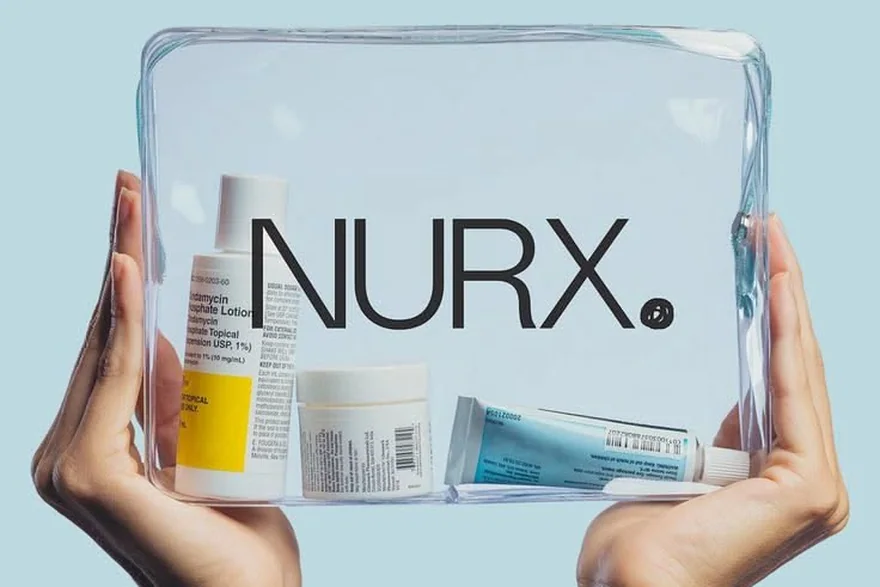
Light sensitivity in cosmetics is a formulation property, and the clearest signal a buyer can read is the primary packaging. Products sold in opaque airless pumps, amber glass or foil tubes are usually packaged that way because the formulator wanted light kept out. Leave-on treatments containing retinoids, ascorbic acid and some peptide blends are the best-known examples, and products built around essential oils, citrus oils or delicate fragrance materials are frequently packaged the same way for the same reason.
What light does to a formulation is broadly consistent and rarely dramatic in the short term. Ultraviolet energy accelerates oxidation in the oil phase, which shows up as a change in colour, a change in odour, a loss of viscosity or a separation that the formulator did not design for. Pigmented products can shift shade, and some active ingredients lose potency over time. For the brand that made the product, that is a shelf-life problem; for the buyer choosing a bag, it is a reason to think about storage rather than a reason to make claims.
It is worth separating two things that get conflated in this category. A product stored in a bag for a weekend is exposed to far less light than a product left on a bathroom windowsill for a month, because the bag is closed and dark most of the time. The bag matters most in the situations where it is not: a beach bag, a poolside tote, a car glovebox, a clear quart bag at a security checkpoint, or a vanity case that sits open on a lit counter. Those are the use cases that justify specifying UV protection at all.
The other factor buyers underestimate is that the primary packaging already does much of the work. A product in an opaque pump inside a fabric pouch is protected twice; a product in a clear bottle inside a clear PVC pouch is protected not at all. The bag specification should therefore start from what the customer will actually put in it, and a range that sells mostly in opaque packs gets less benefit from a UV-blocking lining than a range that sells in clear or amber glass.
How UV protection is engineered into a bag
Fabric blocks light by absorbing it, reflecting it or simply not letting it through, and a bag construction can use all three. Absorption is what a UV-absorbing additive in a coating does. Reflection is what a metallised film does. Physical blocking is what yarn density, thickness and an opaque pigment loading do. Most commercial bags rely on the third, which is why a lightweight pale lining performs poorly and a heavy dark laminated lining performs well.
The single most common leak is not the fabric at all. It is the needle holes along a stitched seam, the gap at a zipper line and any clear window panel. Light behaves like water here: it finds the path of least resistance, and a lining with excellent transmittance figures can still deliver light to the interior through 2 millimetres of unsealed stitch line. Constructions that tape or weld the seams, or that use a bound interior seam, close that path, which is why a welded construction outperforms a stitched one at the same fabric specification.
| Construction | How it blocks light | Where it is used | Watch point |
|---|---|---|---|
| Tightly woven opaque face fabric | Yarn density and thickness reduce transmission before light reaches the interior | Everyday pouches and soft cases | Transmittance rises when the fabric is stretched taut over a frame |
| Opaque pigmented laminated lining | A loaded film inside the lining blocks light passing through the fabric | Mid and premium vanity cases | Stitch holes leak light unless the seam is taped or welded |
| Reflective metallised liner | A metallised film reflects rather than absorbs | Travel cases and cooler-style bags | Creases can crack the film over time; adds measurable bulk |
| UV-absorbing additive in the coating | Additive in the coating layer absorbs in the ultraviolet range | Coated polyester and TPU-laminated faces | Effect depends on coating weight; confirm on the production colour |
| Dark interior colourway | A dark lining absorbs transmitted light instead of reflecting it onto contents | Any construction | Colour alone is not a tested property; pair it with a transmittance figure |
| Double-layer lid panel | Two layers with an air gap reduce transmission further | Structured hanging cases | Adds material cost and thickness at the closure line |
How much protection is enough is a commercial question rather than a technical one. A range sold into resort and beach retail justifies a reflective liner and a welded seam; a range sold as a bathroom organiser does not, because the bag will spend its life closed inside a cupboard. The primary packaging is the guide: where products are sold in opaque packs the bag adds little, and where they are sold in clear or amber glass the bag is doing real work. Matching the specification to that answer avoids paying for performance nobody will notice. Cost follows coverage. A single reflective panel in the lid of a hanging case is the cheapest meaningful intervention, because volatiles and heat rise and the lid is the surface most exposed when the case sits open on a counter. A full opaque laminated lining costs more and is the specification for a range sold in clear or amber packaging. Buyers should also note the substance question: an additive in a coating has to be declared for the destination market, and a current declaration under EU REACH plus screening against the OEKO-TEX Standard 100 limit values is the usual documentation set for the finished fabric.
Heat and humidity: the other half of storage
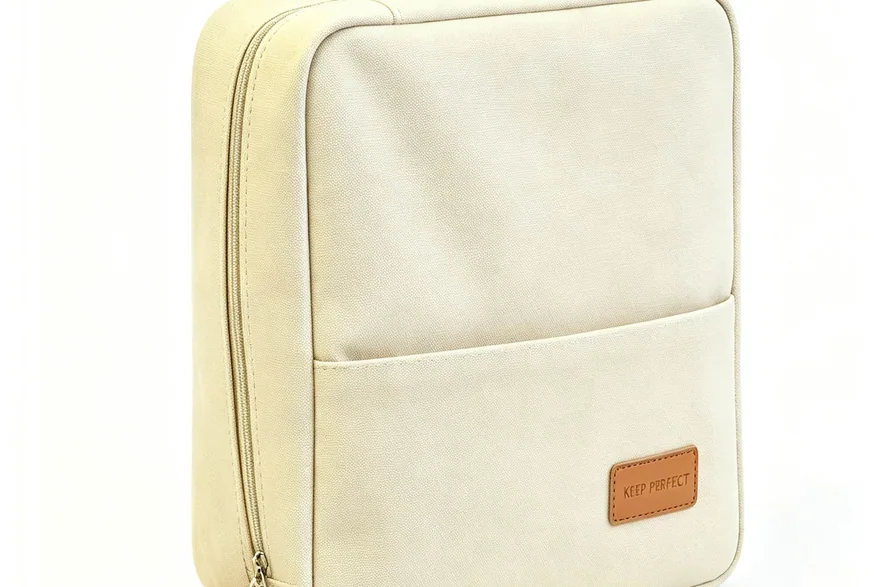
Light is rarely the only stressor. A bag left on a beach, in a car or on a sunlit counter warms up, and heat accelerates the same degradation pathways that light does. A reflective or insulating layer addresses both, because a film that reflects radiation also reduces the rate at which the interior gains heat. That is why UV-protective and insulated constructions are usually specified together, and why a buyer who only asks for UV protection often ends up with a bag that protects against the less damaging of the two.
- Reflective liner: reduces radiant heat gain as well as light transmission, and works best with an air gap on the outer side.
- Closed-cell foam layer: slows temperature change through insulation rather than reflection, adding 2 to 3 millimetres of wall thickness.
- Light-coloured exterior: reflects solar radiation on the outside before it reaches the wall, which is the cheapest single intervention for a beach or pool bag.
- Ventilation path: a mesh panel or a breathable lining lets moisture escape, which matters more than light in a bag that holds damp items.
- Separation of wet and dry: a welded wet compartment keeps humidity away from products that are sensitive to it, independent of any light performance.
- Thermal mass: a larger case with more contents changes temperature more slowly than a small pouch, so size itself is a factor in the specification.
Humidity is the third variable and the one most often ignored. A sealed, insulated bag holding a damp sponge or a wet razor keeps the interior humid, and humidity damages packaging, labels and powder products in ways that have nothing to do with light. The resolution is compartment separation rather than more insulation: a welded wet pocket or a removable wet pouch keeps moisture in one place. Buyers specifying a fully sealed UV-protective interior should decide explicitly whether the bag will ever hold anything damp.
Thermal claims need the same discipline as optical ones. A statement that a bag keeps contents cool means nothing without a stated starting temperature, ambient condition, duration and a control bag built without the reflective layer. Buyers who want a defensible thermal claim should specify those four variables and ask for the interior temperature to be logged at stated intervals, which produces a curve rather than a slogan. The curve also sets honest care wording, because it shows how long the bag buys before the interior approaches ambient. Buyers who want a figure on the card should state the test condition in the brief and ask for the logged curve as part of the sample approval file. There is also a practical end-user dimension that belongs on the care card. An insulated or reflective bag works best when it is kept closed and out of direct sun, and no construction protects contents in a car parked in full sun for hours. Stating that plainly on the card is more useful to the customer than a stronger claim on the label, and it keeps the brand's wording defensible. Where a range is sold with a product that carries its own storage instruction, that instruction should be repeated on the bag's card rather than contradicted by it.
Verification: transmittance, light fastness and claim scope
Two different measurements get quoted in this category and they are not interchangeable. UV transmittance describes what passes through a fabric and is the property that matters for the products inside a bag. Light fastness describes how the bag fabric itself responds to light, meaning whether it fades or shifts shade. A bag can have excellent transmittance and poor light fastness, which produces a bag that protects its contents while going pale and tired on the outside, and that is exactly the combination buyers should test against.
Transmittance methods are published in the AATCC test methods catalogue, where the ultraviolet transmittance procedure measures the fraction of radiation in the ultraviolet range passing through a fabric specimen. Buyers should note that the common ultraviolet protection factor rating used for sun-protective clothing is calculated for fabric worn against skin, and does not transfer directly to an enclosed bag. The useful request is a transmittance report naming the wavelength range, the method and the production colourway, not a rating borrowed from apparel.
Light fastness for the bag fabric comes from the ISO 105 series, maintained by the ISO technical committee for colour fastness of textiles, which includes exposure methods for artificial light. This is the test that predicts whether a dark lining or a printed exterior will still look right after a summer on a bathroom counter. State the required grade on the brief for both the exterior and the lining, because they are different fabrics with different dye systems and they will not age at the same rate.
| Check | What it measures | What to ask for |
|---|---|---|
| Ultraviolet transmittance | Fraction of ultraviolet radiation passing through the fabric system | A report naming the method, the wavelength range and the production colourway |
| Light fastness of the bag fabric | Whether the exterior or lining fades or shifts shade | A grade from the ISO 105 series on the production colour of each fabric |
| Opacity of the face fabric | Whether lining or print shows through to the outside | A defined check on the production fabric under stated lighting |
| Seam and closure check | Whether light enters at stitch holes or at the zip line | A check on a finished sample, not on a flat swatch |
| Thermal behaviour | How quickly the interior warms in a stated condition | A stated environment, start temperature and duration, with a control bag |
| Substantiation file | Whether public wording is supported | A file tying the claim to the tested construction and its conditions |
Claim scope is where programmes get into difficulty. A transmittance result on a dark laminated lining does not support the same claim for a pale one, and a result measured on a flat fabric specimen does not account for light entering through a closure or a clear window. Marketing claims have to be substantiated in the market where the bag is sold, and the safest wording describes the construction and the tested condition, for example an opaque laminated lining with a stated transmittance result, rather than promising that contents are protected. Agree the wording before the sample is built.
A flat fabric specimen can show excellent ultraviolet transmittance while the finished bag leaks light through its stitch holes, its zip line and any clear window. Request the check on a finished sample and keep the result tied to the production lot.
The B2B Customisation View
Teams developing cosmetic pouches, vanity cases and beauty organisers benefit from deciding the closure, the lining and the logo application before the pattern is drafted, because each choice constrains the next.
Standard terms: 500 pieces minimum per style and colourway, 6–10 working days for sampling (12–15 for complex builds), 35–50 days bulk production, AQL 2.5 inspection under ISO 2859-1, FOB Xiamen, T/T 30 deposit / 70 balance.
As a sourcing and programme-management company, QUANZHOU JUNYUAN BAGS holds the specification, the inspection record and the shipment schedule together, which is exactly the coordination work a single-factory relationship rarely covers.
Which Brand Types Benefit Most
UV protection sells to a narrower set of buyers than odour or stain resistance, and it sells best where the contents are expensive or the use case is outdoor. Established skincare brands get the most from it, because a vanity case sold alongside a serum range can mirror the storage logic of the primary pack and justify a premium tier. Travel-focused brands use it for destination ranges sold into sunny climates, where the bag doubles as a beach or pool case. Retailers and private-label buyers specify it selectively, usually on a single hero case rather than across a range.
- Start-up brands: strongest where the range already sells in clear or amber glass and the storage story supports the product story.
- Established brands: a natural tier marker for a premium vanity case sold with a light-sensitive serum or treatment.
- Retailers: specify on a hero case rather than the full range, since the cost only pays back at higher price points.
- E-commerce sellers: the claim has to match the tested construction, so keep the listing wording narrow and specific.
- Gift and hospitality buyers: most relevant for resort and spa welcome kits in sunny destinations, paired with insulation.
Against a published unit band of roughly 0.45 to 12.00 dollars, a reflective or laminated lining pushes a programme into the upper half, so the specification should be reserved for styles where the customer will understand it. Buyers should decide early whether the requirement is light only or light plus thermal, because an insulated construction adds wall thickness and changes the pattern. Standard constructions sample in 6 to 10 working days and insulated or welded constructions in 12 to 15, with bulk production running 35 to 50 days after sample approval. Buyers should agree the care wording at the same time as the specification, since the storage instruction on the card is what the end customer actually reads.
Frequently Asked Questions
Which cosmetics are most sensitive to light?
The clearest signal is the primary packaging. Products sold in opaque airless pumps, amber glass or foil tubes are usually packaged that way because the formulator wanted light excluded. Leave-on treatments containing retinoids, ascorbic acid and some peptide blends are the best-known examples, as are products built around essential oils and delicate fragrance materials. Products sold in clear bottles are the ones that gain most from a dark bag.
What does light actually do to a stored cosmetic product?
Ultraviolet energy accelerates oxidation in the oil phase, which shows up as a change in colour, odour or viscosity, or as a separation the formulator did not design for. Pigmented products can shift shade and some actives lose potency over time. It is a shelf-life issue for the brand that made the product and a storage consideration for the buyer choosing the bag.
How much ultraviolet radiation does a bag fabric actually block?
It depends on the fabric system: yarn density, thickness, pigment loading, coating weight and colour all contribute, and a pale lightweight lining transmits far more than a dark laminated one. Rather than accept a general statement, ask for a transmittance report naming the method, the wavelength range and the production colourway, so quotes can be compared on the same basis.
Is a dark lining enough to protect light-sensitive products?
A dark lining helps, because it absorbs transmitted light rather than reflecting it back onto the contents, but colour on its own is not a tested property. Two dark linings of different weights can perform very differently. Specify the colour and then require a transmittance result on that specific colourway, and check the seams and closure as well as the fabric.
What is the difference between a UV-protective fabric and a UPF-rated fabric?
The ultraviolet protection factor rating used for sun-protective clothing is calculated for fabric worn against skin, and it does not transfer directly to an enclosed bag. What transfers is transmittance: the fraction of ultraviolet radiation passing through the fabric system. Buyers should ask for a transmittance report rather than a rating borrowed from apparel. A transmittance figure also lets two quotes be compared on the same basis.
How is ultraviolet transmittance through a bag fabric measured?
By an instrument method that measures the radiation passing through a fabric specimen across the ultraviolet range. The relevant procedures are published in the AATCC test methods catalogue. The report should name the method, the wavelength range covered and the exact fabric and colour tested, because a result on a similar fabric does not describe the production one.
Does a clear PVC cosmetic bag protect contents from light?
Essentially not. A clear window or a clear PVC body transmits rather than blocks, so whatever light reaches the outside reaches the contents. Clear bodies are chosen for visibility and for security screening convenience, which are valid reasons, but a range that sells light-sensitive products in clear packaging should not rely on a clear bag for storage. Where visibility is needed for security screening, a clear panel set into a dark opaque body keeps the function and limits the light path.
Do stitch holes and closures let light into a supposedly UV-protective bag?
Yes, and this is the most common leak. Light behaves like water and finds the path of least resistance, so a lining with good transmittance figures can still deliver light through an untaped stitch line, a zip gap or a window. Welded or taped seams and a bound interior seam close that path, and the check should be run on a finished sample.
Does a UV-protective bag also need insulation?
Usually, because light is rarely the only stressor. A bag on a beach, in a car or on a sunlit counter also warms, and heat accelerates the same degradation pathways. A reflective layer addresses both, since a film that reflects radiation also slows heat gain. Buyers who specify only UV protection often end up defending against the less damaging factor.
How does heat inside a parked car or a beach bag affect cosmetics?
Heat accelerates oxidation and can change viscosity, separate an emulsion or soften a wax-based product. A reflective or insulated layer slows the rate of temperature gain but cannot hold an interior below ambient indefinitely. Care wording should state plainly that no bag protects contents in a car parked in full sun for hours. An insulated layer slows the rise and buys time; it does not hold the interior at room temperature.
Can a UV-absorbing additive be put into a bag coating?
Yes. Additives can be carried in the coating or laminate layer, and the effect depends on how much coating is present, so coating weight in grams per square metre becomes part of the specification. The additive also has to be declared for the destination market, so ask for a current substance declaration alongside the performance report.
Does the bag fabric itself need a light fastness test?
Yes, and it is a different question from transmittance. Light fastness describes how the bag fabric responds to light, meaning whether the exterior or lining fades or shifts shade. The ISO 105 series covers this. A bag can protect its contents well and still look pale and tired within a season, which is worth testing for.
Is UV protection still useful when products are already in opaque packaging?
The benefit is smaller but not zero, because it adds a second barrier and covers the times the bag sits open on a lit counter. A range sold mostly in opaque airless packs gets less from a UV-blocking lining than a range sold in clear or amber glass. Buyers should match the specification to what customers actually store.
What minimum applies to a case with a reflective liner and a custom print?
The standing minimum is 500 pieces per style and colourway. A reflective liner is a cut-piece layer and a custom print adds a set-up step, so this counts as a complex construction with a 12 to 15 working day sampling window rather than the standard 6 to 10. Buyers should confirm the liner lot size before quoting.
How should a UV-protective claim be worded on a listing?
Keep it inside the evidence and substantiate it in the market of sale. Describing the construction and the tested condition, for example an opaque laminated lining with a stated transmittance result, is defensible. A general statement that contents are protected from light is not, particularly if the bag has a clear window or a stitched seam.
People Also Ask
Do cosmetics really need to be kept out of light?
Many formulations are sold by their own makers in opaque or amber packaging, which is the clearest signal that the formulator wanted light excluded. Exposure accelerates oxidation, showing up as colour, odour or texture change over time. A closed bag already keeps most light out, so the specification matters most for beach, car and counter use. An opaque or laminated lining supports that without adding much cost.
What is UV-protective fabric?
Fabric engineered so less ultraviolet radiation passes through it, by absorption, reflection or physical blocking. In a bag that usually means a dense weave, a pigmented laminated lining or a reflective film, and the measurable property is transmittance rather than a rating. Seams and closures matter as much as the fabric, because light enters through gaps. Colour choice helps too: a dark interior absorbs transmitted light rather than reflecting it onto the contents.
Can you store a retinol product in a makeup bag?
Products containing retinoids are commonly sold in opaque or foil packaging, so the storage logic is the same as the primary pack: keep them dark, cool and closed. An opaque or laminated lining supports that. The bag should also be kept out of direct sun and out of a hot car, since heat is as much of a factor as light. An insulated or reflective layer slows the temperature rise but cannot stop it indefinitely.
How do you keep cosmetics cool while travelling?
Use a case with a reflective or insulated layer, keep it closed, and keep it out of direct sun, since no construction holds an interior below ambient indefinitely. Separate anything damp into a welded wet compartment, because humidity damages packaging and powders. A light-coloured exterior reflects solar radiation before it reaches the wall. Keep the case closed and out of direct sun, since no construction holds an interior below ambient indefinitely.
Request a Sample or a Written Quotation
Send the silhouette, dimensions, material preference and logo artwork, and the programme team will return a written quotation with MOQ, sampling window, bulk lead time and inspection standard.
Email: [email protected] · WhatsApp: +86 177 5002 0688