Private Label Beauty Packaging Trends: Cosmetic Bags as Brand Extension
Executive Summary
Cosmetic bags work as brand extension rather than as throwaway packaging, and the reason is use life: a bag is the one element of a beauty packaging system still carried in public months after the carton is discarded and the product inside is finished. The answer for a private label owner is to specify the bag as a durable secondary packaging item with a fixed brand language — shell colour, hardware finish, puller shape and interior shade — rather than as a seasonal giveaway, because the bag becomes the longest-lived brand asset in the range.
No published statistic measures private label cosmetic bags as a segment, so demand evidence is search-based: custom makeup bag draws 5,400-6,600 monthly searches and make up bags for women about 80,000 monthly searches (ASINSIGHT), figures describing interest rather than revenue. Unit prices on open marketplaces run about $0.45 to $12.00 (Alibaba, 2026.10). Programme terms: 500 pieces per style and colourway, 6-10 working days for sampling or 12-15 for complex builds, 35-50 days bulk, AQL 2.5 under ISO 2859-1, FOB Xiamen, T/T 30 deposit and 70 against bill of lading.
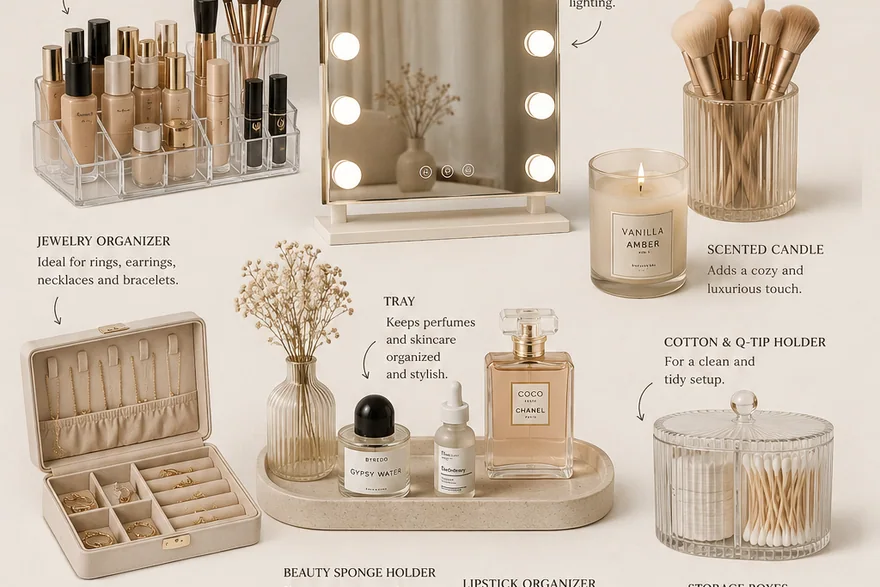
Where cosmetic bags sit in a private label packaging system
Packaging is conventionally described in three tiers. Primary packaging touches the formulation: the bottle, jar, tube or compact. Secondary packaging groups and presents the primary unit: the carton, sleeve or outer box. Tertiary packaging exists for transport: the master carton and pallet. A cosmetic bag does not sit cleanly in any of the three, and that ambiguity is precisely why it is useful as brand extension.
In function the bag behaves as secondary packaging, because it groups products and presents them. In behaviour it behaves as a product, because the customer keeps it, uses it daily and carries it where other people see it. A carton is opened once and discarded within a minute; a bag is opened several times a day for years. No other part of a beauty packaging system has that lifespan, which is why a bag specification deserves more attention than its unit cost alone would suggest.
Because the bag outlives the product, the brand language on it has to be stable rather than seasonal. Four elements carry that language and should be held constant across a range: shell colour, so a customer recognises the brand from across a room; hardware finish, so the metal reads as one family across shapes; puller shape, which is the part the hand touches most; and interior shade, which is the part the customer sees every single time the bag is opened.
Cost position follows from that logic. A bag specified as brand extension is priced as an asset against lifetime brand exposure, not as a per-unit consumable against a single transaction. Within the observed marketplace band of roughly $0.45 to $12.00 per unit (Alibaba, 2026.10), a brand-extension bag almost always sits in the upper half, because the lower half is occupied by constructions that will not survive the use life the strategy depends on. A bag that fails in month three does not merely waste its unit cost; it attaches the failure to the brand name printed on it, which is the opposite of the outcome the extension was meant to produce.
Five private label packaging trends that reach the bag
Trends in beauty packaging are usually discussed at the level of bottles and cartons. Five of them reach the bag as well, and each one converts into a specific line on a bag specification rather than remaining a design intention.
| Trend | What it means in packaging | How it appears on a bag | Specification consequence |
|---|---|---|---|
| Mono-material design | One polymer family per pack | Shell, lining and webbing all polyester | Simpler trim sourcing, clearer recyclability claim |
| Refill-first formats | Product sold once, refilled | Interior sized for refill vessels | Loop widths set to refill diameters |
| Quiet branding | Reduced exterior logos | Debossed puller, tonal embroidery | Logo strike-off and placement tolerance |
| Tactile finishes | Surface feel as a brand signal | Soft-touch coating, peached face | Coated-fabric testing added to the brief |
| Documentation-led buying | Proof before price | Certificate pack attached to the brief | Longer pre-production calendar |
Quiet branding is the trend that most often fails in production, because restraint is harder to manufacture than excess. A tonal logo embroidered in a shade two steps from the shell has to be sampled on the actual production fabric, not on a screen, since the surrounding fabric colour shifts how the thread reads. Fine detail is the second casualty: strokes below roughly 0.3 mm do not hold on a woven polyester face, so a logo designed for a carton usually needs redrawing for a bag. The same caution applies to placement: a mark positioned close to a zip end or a folded edge will distort in production regardless of how well it was drawn, which is why placement belongs in the brief alongside the artwork rather than after it.
Tactile finishes carry the opposite risk. A soft-touch or peached coating is what makes a bag feel expensive in the hand, and it is also what introduces a coating-specific failure mode. Coated fabrics are assessed under ASTM D751 rather than under the methods used for uncoated wovens, because coating adhesion, flexibility and behaviour under cold fold are the properties that fail. A tactile finish without that test line is a finish that has not been qualified.
Refill-first formats change the interior rather than the exterior, which is why they are easy to overlook. If the brand sells refills, the customer will eventually carry a refill vessel rather than the original retail pack, and a bag interior dimensioned around the retail pack will not hold it. Elastic loops at 20-25 mm flat width and compartment heights of 8-14 cm suit typical refill vessels; loops cut for full-size retail bottles leave the refill rattling.
Documentation-led buying is the trend with the clearest schedule impact. Retail and distribution partners increasingly request substance declarations before discussing price, and textile articles placed on the European market are subject to the restrictions set out under EU REACH. A private label owner should add the certificate lead time to the pre-production calendar at the same moment the bag is specified, not after the sample is approved.
- Redraw carton artwork for textile: keep logo strokes above roughly 0.5 mm.
- Add ASTM D751 to the brief whenever a soft-touch or peached coating is specified.
- Dimension interiors around the refill vessel, not the original retail pack.
- Add certificate lead time to the calendar when the bag is specified, not later.
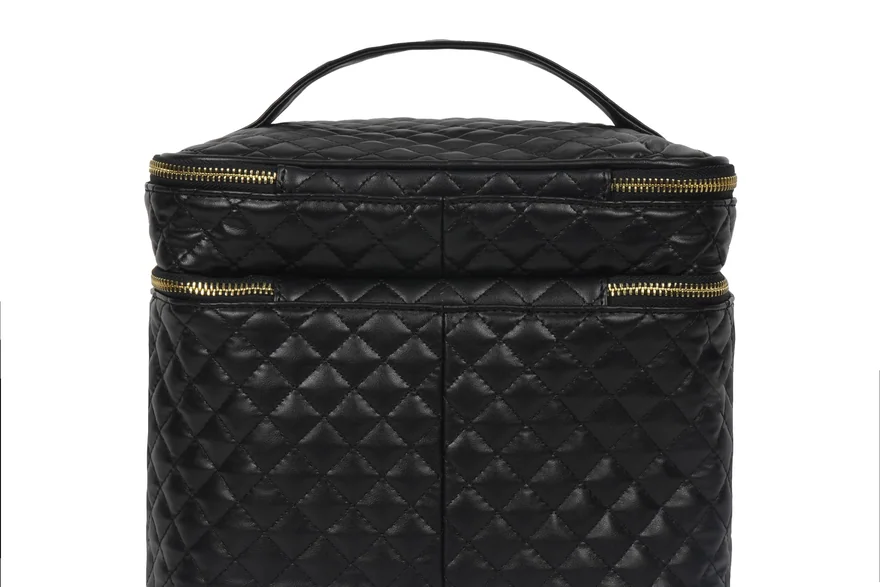
Design language that survives production at 500 pieces
A design language is only a brand asset if it reproduces identically on every re-order. The table below sets out six elements that brand owners treat as fixed and the production reality that applies to each at a 500-piece run, with the specification that keeps the design intact.
| Brand element | Design intent | Production reality at 500 pcs | Safe specification |
|---|---|---|---|
| Shell colour | Exact Pantone match | Dye-lot variation across a single run | Agree a numeric tolerance, commonly 1.5-2.0 Delta E |
| Logo application | Fine line detail | Screen mesh limits stroke reproduction | Keep strokes above roughly 0.5 mm |
| Hardware finish | Custom plated shade | Plating minimums and added lead time | Standard finish with a branded puller shape |
| Interior shade | Brand-tinted lining | Soil visibility and fastness limits | Mid-tone lining with a stated fastness rating |
| Print placement | Edge-to-edge artwork | Panel cutting tolerance during production | Keep an 8-10 mm bleed margin |
| Zip puller | Cast logo puller | Tooling cost and 12-15 day sampling | Debossed standard puller instead |
Shell colour is where most brand-extension disputes begin. A dye lot is not a Pantone reference; it is a production event, and two lots of the same shade can differ visibly when laid side by side. The defence is procedural rather than technical: agree a numeric colour difference tolerance, commonly 1.5-2.0 Delta E under a defined illuminant, approve a lab dip as the physical standard, and retain that dip as the reference for every subsequent re-order.
Logo reproduction is the second dispute. Artwork created for a printed carton assumes a flat, stable substrate with high resolution; a woven polyester face has texture, and screen printing through mesh loses the finest strokes. The reliable route is to redraw the mark for textile at the outset, thickening strokes and opening counters, rather than to approve a sample and then argue about fidelity at bulk when the screens have already been cut.
Hardware is where brand owners most often overspend. A custom plated finish looks like the most direct expression of brand identity and is usually the most expensive line in the programme, because plating carries its own minimum and its own lead time. A standard finish paired with a distinctive puller shape delivers most of the recognisable brand signal at a fraction of the cost and, importantly, re-orders identically years later, when a bespoke plating bath may no longer be available.
Print placement is the quiet failure. Panels are cut with tolerance, and artwork that runs to the edge of a panel will sit differently from unit to unit once that tolerance is applied. Keeping an 8-10 mm bleed margin and positioning critical elements away from seams, folds and zip ends converts a visible defect into an invisible one, which is the least expensive quality improvement available on a decorated bag.
Before the first bulk, record the approved lab dip, the approved logo strike-off, the puller reference and the linings specification as physical standards held by both sides. A brand-extension programme only works across years, and across years a verbal description of a shade is worthless. Freezing the language before bulk is what allows a re-order in eighteen months to sit beside the original drop without visible difference.
Compliance, testing and documentation for private label cosmetic bags
A private label bag is an article in its own right, and the compliance obligations attach to the bag independently of the cosmetics it will eventually carry. This surprises brand owners whose regulatory experience is entirely in formulations, and it is the most common cause of a delayed private label launch.
For placement on the European market, textile articles are subject to the restriction of hazardous substances under EU REACH. What a distributor asks for is not a verbal assurance but a written declaration supported by a laboratory report, and the request arrives before the price conversation rather than after it. Building that document into the brief at specification stage is faster and cheaper than assembling it under deadline.
Substance testing on the finished article is the second requirement, most often met through OEKO-TEX Standard 100, which tests for harmful substances in the finished textile product rather than in the input material. A certificate is only useful if its scope covers the article actually being shipped and its validity dates are current, so a buyer should read the scope line on the certificate rather than filing it unread.
Where a bag is sold to or for children in the United States, the obligations under CPSIA apply, including testing, a children's product certificate and permanent tracking information on the article. This catches promotional programmes and junior ranges that were specified as adult accessories, and the tracking label has to be designed into the bag rather than added afterwards.
| Requirement | Applies when | Document to request | Who asks for it |
|---|---|---|---|
| REACH substance restrictions | Placing textile articles on the EU market | Declaration plus laboratory report | EU distributors and retailers |
| OEKO-TEX Standard 100 | Retail programmes requiring article testing | Certificate showing scope and expiry | Specialty retail and marketplaces |
| CPSIA testing and tracking | Bags sold to or for children in the US | Children's product certificate, tracking label | US mass retail and promotional buyers |
| ISO 105 colour fastness | Any dyed shell, lining or webbing | Test report naming the method used | Brand owners with shade standards |
| ISO 2859-1 inspection | Every bulk lot before shipment | Inspection report with defect counts | Importers and brand owners |
| Closure specification | Bags with load-bearing zips | Description using ASTM D2053 terminology | Technical buyers and QA teams |
Inspection closes the loop. A private label programme lives or dies on whether the tenth re-order matches the first, and the mechanism that enforces that is a defined sampling plan: AQL 2.5 under ISO 2859-1, with defect classes agreed in writing before bulk begins. On a brand-extension bag, print misregistration and shade deviation should be classified explicitly, because those two faults are the ones that damage the brand rather than merely the unit.
Count 6-10 working days for sampling on standard constructions and 12-15 working days where tooling, welded seams or moulded shells are involved, then 35-50 days for bulk after sample approval, then freight. Add the certificate lead time at the front, not the back: a REACH declaration or an OEKO-TEX certificate requested after sample approval is the most common reason a finished private label bag misses its launch date.
The B2B Customisation View
Most delays on cosmetic pouches, vanity cases and beauty organisers trace back to one unanswered question in the brief, so the first working session is spent removing ambiguity rather than choosing colours.
The numbers a buyer can plan around: 500 pieces minimum per style and colourway, 6–10 working days to a first sample (12–15 where tooling or moulding is involved), 35–50 days to bulk completion, AQL 2.5 under ISO 2859-1 at final inspection, FOB Xiamen terms, T/T 30/70 payment.
QUANZHOU JUNYUAN BAGS operates as the custom bag specialist on the file, managing the parts of the process that brands rarely resource in-house: shade matching, component sourcing and pre-shipment inspection.
Which Brand Types Benefit Most
Brand extension through bags works differently at each stage of a brand's life. Start-up brands gain the most relative to cost, because a single well-specified bag at 500 pieces per style and colourway gives the brand a physical object that outlives a sample vial and travels further than a business card; the discipline required is to fix the brand language — shell colour, puller shape, interior shade — before the second shape is commissioned, since a language defined retroactively is rarely coherent. Established brands gain leverage rather than awareness, because a bag attached to an existing launch travels into gyms, hotels and aircraft cabins carrying a mark the brand has already paid to make familiar, and the specification priority becomes fidelity: a numeric colour tolerance and a retained lab dip, so the bag matches the campaign it accompanies. Retailers and own-label chains use bags to make a private label range feel designed rather than assembled, which is achieved less through logo size than through consistency of hardware finish and interior shade across every shape in the range. E-commerce sellers benefit when the bag is photographed once and re-ordered identically, which makes a booked material lot and a frozen trim list commercial assets rather than operational detail. Gift and hospitality buyers use the bag as the durable half of a gift: the product is consumed, the bag remains, and the specification priority is flat-pack behaviour and carton fit rather than shelf presence. In every case the longest-lived asset in the packaging system is also the one most often specified last, which is the mistake worth avoiding.
- Start-up brands: fix shell colour, puller and lining shade before commissioning a second shape.
- Established brands: match the bag to the campaign with a retained lab dip and numeric tolerance.
- Retailers: hold hardware finish and interior shade constant across the whole own-label range.
- Marketplace sellers: freeze the trim list so photography survives the next re-order.
- Gift buyers: specify flat-pack behaviour and carton fit ahead of shelf appearance.
- All programmes: classify print and shade faults in the inspection plan before bulk starts.
Frequently Asked Questions
Why is a cosmetic bag treated as brand extension rather than as packaging?
Because of use life. A carton is opened once and discarded; a bag is opened several times a day for years and carried in public. That makes the bag the longest-lived branded object in a beauty range, and the only one whose exposure continues after the product inside is finished. Specifying it as a consumable undervalues the asset.
Where does a cosmetic bag sit between primary and secondary packaging?
Functionally it is secondary packaging, because it groups and presents products. Behaviourally it is a product, because the customer keeps and uses it. That dual role is why a bag specification cannot be written like a carton specification: the carton only has to survive one opening, while the bag has to survive years of daily handling.
What brand elements should stay constant across a private label bag range?
Four carry the language: shell colour, so the brand is recognisable at a distance; hardware finish, so shapes read as one family; puller shape, which is the part touched most; and interior shade, which the customer sees every time the bag opens. Holding these constant does more for recognition than enlarging the logo. Recording each one as a physical standard - a lab dip, a puller reference, a lining swatch - is what allows a re-order placed eighteen months later to sit beside the original drop.
How does a refill-first product strategy change bag interior dimensions?
The interior has to be dimensioned around the refill vessel rather than the original retail pack, because that is what the customer will carry. In practice this means compartment heights of 8-14 cm and elastic loops at 20-25 mm flat width. Interiors cut for retail packaging leave refill vessels leaning and rattling, which reads as a design failure.
What is mono-material construction and why do brands ask for it?
It means the shell, lining, webbing and thread all sit within one polymer family, typically polyester, so the bag can be assessed and recycled as a single material rather than separated. On a specification it mostly constrains trim choices: nylon webbing, cotton labels and mixed-fibre threads have to be replaced with polyester equivalents. The commercial benefit is a simpler and more defensible end-of-life claim, which is increasingly requested in retailer sourcing templates before price is discussed.
Why are fine-line logos hard to reproduce on a textile bag at 500 pieces?
A woven polyester face has texture, and screen printing through mesh loses the finest strokes. Detail below roughly 0.3 mm does not hold reliably. Artwork drawn for a flat carton therefore needs redrawing for textile: thicken the strokes, open the counters and simplify the gradients, rather than approving a marginal sample and arguing about fidelity at bulk.
What stroke width is safe for screen-printed logos on cosmetic bag shells?
Roughly 0.5 mm and above is a safe working minimum on a woven polyester face, with larger type sizes preferred for small bags. Below that, the stroke breaks up across the weave. The practical step is to redraw the mark for textile at the design stage rather than discovering the limit during sampling, when screens are already being cut.
How should a brand owner specify shell colour to avoid shade disputes?
Procedurally rather than verbally. Agree a numeric colour difference tolerance, commonly 1.5-2.0 Delta E under a defined illuminant, approve a lab dip as the physical standard, and retain that dip as the reference for all future re-orders. A Pantone number alone is not a tolerance and leaves the accept-or-reject decision entirely subjective. On recycled shells the same controls matter more, because recycled feedstock varies in base colour more than virgin feedstock does.
What is the trade-off between a custom plated hardware finish and a branded puller?
A custom plated finish is the most direct identity expression and usually the most expensive line, because plating carries its own minimum and lead time. A standard finish with a distinctive puller shape delivers most of the recognisable signal at a fraction of the cost and, critically, re-orders identically years later when the plating bath is no longer available.
When does EU REACH apply to a cosmetic bag rather than to the cosmetics inside?
REACH obligations attach to articles placed on the European market, so the bag is in scope independently of its contents. A brand owner whose compliance experience is in formulations often assumes otherwise and discovers the gap at goods-in. The practical step is to request a declaration supported by a laboratory report at specification stage. Treating the bag as a regulated article in its own right from the first brief removes the most common cause of a delayed private label launch.
What does OEKO-TEX Standard 100 certify on a finished cosmetic bag?
It certifies that the finished textile article has been tested for harmful substances, rather than certifying an input material in isolation. A buyer should read the scope line and the validity dates on the certificate, because a certificate covering a fabric but not the finished bag, or one that has expired, will not satisfy a retail goods-in check.
When does CPSIA apply to a cosmetic bag sold in the United States?
When the bag is sold to or for children. That triggers testing, a children's product certificate and permanent tracking information on the article itself. Promotional programmes and junior ranges are frequently specified as adult accessories and then reclassified, at which point the tracking label has to be designed into the bag rather than added afterwards.
Why does print placement need a bleed margin on a sewn panel?
Panels are cut with tolerance, so artwork running to a panel edge sits differently from unit to unit once that tolerance is applied. Keeping an 8-10 mm bleed margin and holding critical elements away from seams, folds and zip ends turns a visible defect into an invisible one, which is the cheapest quality improvement available on a decorated bag.
What inspection evidence should accompany a private label cosmetic bag shipment?
An inspection report referencing AQL 2.5 under ISO 2859-1, with defect counts by classification. The classification has to be agreed in writing before bulk begins, with print misregistration and shade deviation named explicitly, because those two faults damage the brand rather than the unit and are otherwise the most argued-over findings. A brand-extension programme is judged on whether the tenth re-order matches the first, and a written defect classification is what makes that judgement objective rather than negotiable.
How long should a private label bag programme allow from design to delivery?
Allow 6-10 working days for sampling on standard constructions and 12-15 working days where tooling, welded seams or moulded shells are involved, then 35-50 days for bulk after sample approval, then freight. Add the certificate lead time at the front: requesting REACH or OEKO-TEX documentation after sample approval is the most common cause of a missed launch.
People Also Ask
Are cosmetic bags considered packaging?
Functionally yes, because they group and present products. In practice they behave as a retained product rather than as disposable packaging, which is why they are specified more like a durable good than like a carton: shell weight, lining fastness and closure durability all matter in a way they never do for a box that is discarded immediately. That dual role is what makes the bag the longest-lived branded object in a beauty range.
What is private label beauty packaging?
Packaging produced under a retailer's or brand's own name rather than under the name of the product maker. It covers primary containers, secondary cartons and, increasingly, durable accessories such as cosmetic bags. The bag is the element with the longest use life, which makes it the most valuable brand asset in a private label range. Specifying it as a consumable rather than as an asset is the most common and most costly error in this segment.
How do you make brand packaging feel premium on a budget?
Spend on consistency rather than on decoration. Holding shell colour, hardware finish and interior shade constant across a range reads as designed, while a custom plated finish or an oversized logo reads as expensive but not coherent. A distinctive puller shape and a mid-tone wipe-clean lining deliver most of the premium signal at low cost. Standardising the trim to one polymer family also reduces unit cost and simplifies any recycled content claim.
Do private label cosmetic bags need certification?
Usually yes, depending on the market. EU placement requires a REACH declaration supported by testing; many retail programmes additionally request OEKO-TEX Standard 100 for the finished article; and bags sold to or for children in the US fall under CPSIA. Each document takes lead time, so it should be requested when the bag is specified. Filing each certificate with the purchase order rather than by supplier name makes substantiation quick if a retailer asks months later.
Request a Sample or a Written Quotation
Send the silhouette, dimensions, material preference and logo artwork, and the programme team will return a written quotation with MOQ, sampling window, bulk lead time and inspection standard.
Email: [email protected] · WhatsApp: +86 177 5002 0688