Modular Cosmetic Bag Systems: Interchangeable Inserts & Pods
Executive Summary
A modular cosmetic bag system is a base bag plus a set of interchangeable inserts or pods that attach by a standardised interface, so the owner reconfigures the interior instead of buying a second bag. The interface is the product. Hook-and-loop panels, snap tabs, short zip-in runs, elastic loops and rail tracks each trade holding strength against speed of reconfiguration, and the choice decides whether the system feels precise or fiddly in daily use.
Commercially a modular system multiplies SKUs faster than it multiplies units. Each pod is a style in its own right, so the 500-piece minimum per style and colourway applies pod by pod, and colour matching across modules has to be controlled deliberately. Buyers should plan the pod range, the colourway plan and the interface together before quoting. Sampling runs 6 to 10 working days, or 12 to 15 for complex constructions, with bulk 35 to 50 days after approval at AQL 2.5 under ISO 2859-1, FOB Xiamen, T/T 30 deposit and 70 against bill of lading.
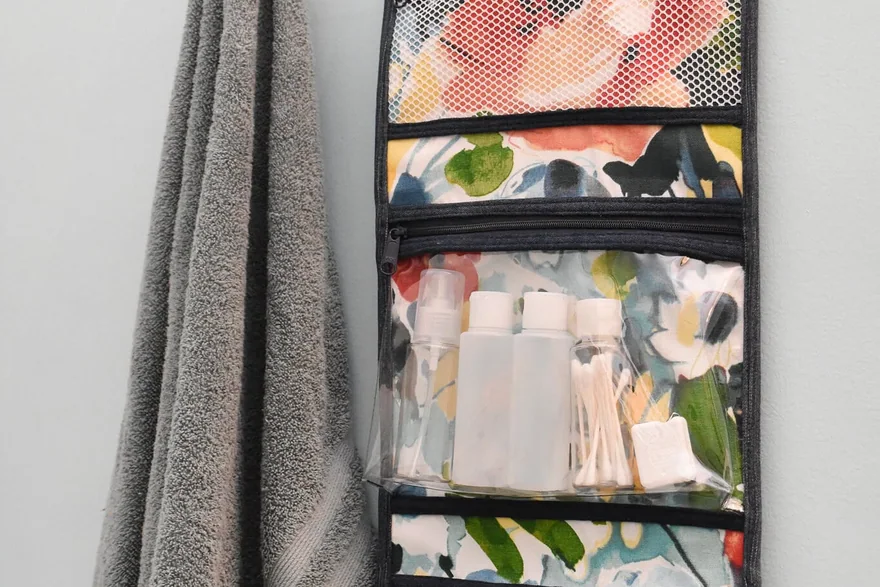
What makes a cosmetic bag system modular
Modularity in this category means the interior is separable from the shell. A base bag provides structure, closure and carrying; inside it, pods or dividers hold categories of product and can be removed, swapped or rearranged. The customer promise is that one bag serves a minimal everyday set and a full travel set without compromise in either state. The commercial promise is different and more interesting: a modular system creates a repeat-purchase path, because an owner who has bought the base bag returns for pods.
There are three depths of modularity, and they are often confused. The shallowest is a fixed divider set that can be repositioned within one bag. The middle is a set of removable pouches that share a bag but attach loosely. The deepest is a system with a defined interface: every pod attaches the same way, every pod fits any compatible base, and the range can be extended over time. Only the third creates a genuine accessory economy, and only the third needs the interface documented as a specification rather than drawn as a shape.
Demand context matters because modular systems sit at the premium end. 'custom makeup bag' draws 5,400 to 6,600 monthly searches, a small but commercially sharp audience that is specifying rather than browsing, while 'make up bags for women' draws roughly 80,000 monthly searches at the general end. Published marketplace pricing for cosmetic bags spans about $0.45 to $12.00 per unit, and a modular system sits above that band as a set rather than a single bag. The price of the set is the opportunity and the risk: buyers have to show enough utility to justify a multiple of a single-bag price.
The failure mode specific to modular design is a system nobody reconfigures. If swapping a pod takes more than a few seconds, or if the pods only fit one way round, the owner settles on one arrangement in the first week and the rest of the range never sells. Every design decision in a modular programme should therefore be tested against one question: how long does it take to change the configuration, and does it require the bag to be emptied first. That test is more predictive of repeat pod sales than any feature list.
Interface design: how inserts and pods actually attach
The interface is the engineering core of a modular system and the part most briefs under-specify. A hook-and-loop interface is cheap, quiet and forgiving of tolerance, because the panel does not have to line up precisely. Its weaknesses are noise when peeled, lint and makeup powder clogging the hook side, and a loss of grip over repeated cycles. A hook-and-loop system should specify the tape width, the hook versus loop density, and the cycle life expectation, and the loop side should face outward in the bag so it collects less debris.
Snap tabs and press studs are more precise and more tactile, and they give a satisfying confirmation that a pod is seated. They require accurate placement, because a pod with a stud 2 mm out of position will not sit flat, and they put a hard point inside a soft bag that can press against the shell. Snaps also need reinforcement: a stud set into a single layer of lining will pull through under load. Where snaps are used, the backing should include an interfacing patch or a washer on the reverse face.
Zip-in pods are the most secure and the most expensive option. Each pod carries a short zipper run that mates with a corresponding run in the base bag, so the pod becomes part of the structure rather than something sitting in it. This is the interface to choose when the pod holds heavy or fragile items. The zipper specification should be written as carefully as a main closure: gauge, tape, slider and end treatment, using the terminology in ASTM D2053 so the buyer, the pattern maker and the sewing floor are describing the same component.
Elastic loops and rail systems suit different jobs. Elastic loops are the cheapest way to hold brushes, pencils and slim tools in a fixed position, and they tolerate a range of diameters, which is useful when the contents vary by market. A moulded rail or track gives the most precise and most premium feel, with pods sliding in and locking, but it needs tooling and it fixes the pod dimensions permanently. Whichever interface is chosen, the tolerance should be stated in millimetres, because a system that fits only in the sample room has not been specified at all.
Whichever interface is chosen, it should be tested inverted and shaken. A pod that seats neatly in a static bag can walk out of position when the bag is carried by a handle, tipped upside down or dropped into a suitcase, and the contents then end up loose at the bottom. The check is simple: load the system, close it, invert it and shake it a defined number of times, then record whether each pod is still seated. Written into the brief as an acceptance test, this catches the majority of interface problems before tooling or volume is committed.
| Interface | Holding strength | Speed to reconfigure | Tolerance sensitivity | Cost and tooling |
|---|---|---|---|---|
| Hook-and-loop panel | Moderate, degrades with debris | Fastest; peel and press | Low; forgiving of misalignment | Lowest; no tooling |
| Snap tab or press stud | Good, with reinforcement | Fast; audible confirmation | High; placement accuracy critical | Low; stud setting tools only |
| Zip-in pod run | Highest; pod becomes structure | Slower; zipper must be run | Medium; chain alignment matters | Higher; extra zipper per pod |
| Elastic loop strip | Low to moderate | Fast; slide in | Low; tolerates diameter variation | Lowest; webbing and elastic |
| Moulded rail and track | High, with positive lock | Fast once learned | Highest; dimensions fixed by tool | Highest; rail tool required |
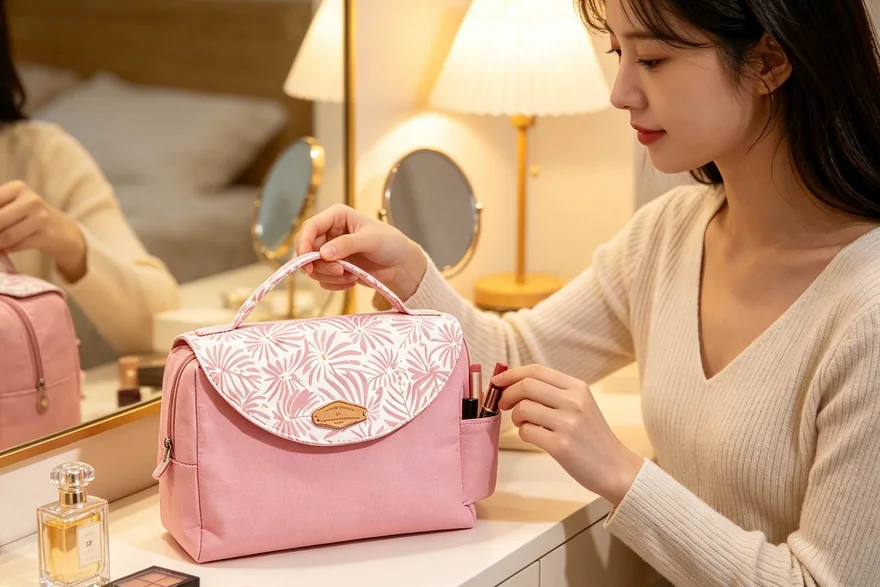
Pod sizing, colour consistency and material planning
Pod dimensions should be derived from the contents, not from a tidy grid. A brush pod needs length more than depth; a palette pod needs a flat footprint with a padded lid; a liquids pod needs a wipe-clean lining and a sealed base. Deriving sizes from actual products produces an irregular set, which is harder to merchandise but far more useful, and usefulness is what drives the second pod purchase. Where a brand wants a regular grid for visual reasons, the compromise is to standardise the interface and the height while allowing footprint to vary.
Colour consistency is the most common quality complaint in modular ranges, because the base bag and each pod are separate dye lots. A navy base with a navy pod that is half a shade lighter looks like a mistake on a shelf photograph, and the mismatch is more visible across small panels than across a whole bag. The control is to approve physical shade standards, reference a numeric colour system rather than a name, and require shade bands to be checked against the standard under consistent lighting. Colour fastness behaviour should be specified through ISO 105 test methods so that every component in the system ages in the same direction.
Material planning has one rule that surprises buyers: pods are usually more expensive per unit of volume than the bag that holds them. Each pod needs its own pattern, its own lining, its own closure and its own label, and each carries the same fixed overheads of cutting and inspection as a standalone item. A system with a base bag and four pods is five products, not one product with four accessories. Buyers who cost a modular range as a single bag with extras consistently under-budget the first production run.
Spare and replacement strategy should be decided at the design stage. If a pod is lost or damaged, can the customer buy one? A system designed for that possibility needs a defined pod code, a retail pack for a single pod, and enough forecast volume to keep a pod in production. Without it, a lost pod means an unusable system and a dissatisfied customer. The alternative is to design pods that are interchangeable enough that a missing one is an inconvenience rather than a failure, which is a stronger position for a first modular launch.
Pod identification is a small design task that pays off daily. An owner reaching into a bag wants to know which pod holds brushes without opening three of them, so a numbered tab, a small icon, a contrast binding or a colour-coded pull does real work. The identification should survive the life of the pod, which favours a woven tab or a contrast stitch over a print that abrades against the base bag every time the pod is removed. It also gives the retail listing a naming convention, so a customer can order the right replacement without guessing.
- Derive pod dimensions from the products they hold; a tidy grid is a merchandising choice, not a functional one.
- Approve physical shade standards and a numeric colour reference for every component in the system.
- Cost each pod as a separate product, with its own pattern, closure, label and inspection overhead.
- Decide at design stage whether a lost pod can be replaced as a single retail unit.
- State interface tolerance in millimetres; a system that fits only in the sample room is not specified.
Cost, compliance and programme planning for a modular system
The quantity question is the one that decides whether a modular programme is viable. The minimum order quantity is 500 pieces per style and colourway, and a pod is a style. A base bag plus three pods in two colourways is therefore eight separate minimum commitments rather than two. Buyers can manage this by reducing the colourway count rather than the pod count, by sharing a common pod shell across the range, or by launching with two pods and extending later. Forecasting pod mix matters as much as forecasting total volume, because an unbalanced mix leaves a warehouse full of one pod and a system nobody can complete.
Compliance applies to the components as well as the set. Small parts such as studs, snaps and pulls bring sharp-point and small-parts considerations for any product that may be sold as a children's item or alongside one, and CPSIA sets the framework buyers should reference in the brief. Chemical compliance applies to every component individually: the shell fabric, the lining, the coating, the elastic and the hardware finish each need to be covered by the same restricted-substance declaration rather than assumed to inherit compliance from the base bag.
Timing is longer than for a single bag because there are more first articles to approve. Sampling runs 6 to 10 working days where the pods are simple sewn pouches, and 12 to 15 working days where a pod includes a zip-in interface, a moulded component or a padded structure. Bulk production is 35 to 50 days after sample approval. Inspection at AQL 2.5 under ISO 2859-1 should be applied per component, with the interface treated as a critical dimension rather than a cosmetic feature, because a pod that does not seat is functionally defective however good it looks.
Kitting and packing planning belongs in the same conversation. A modular set has to arrive with the right pods in the right bag, which means a packing instruction, a labelled polybag per component and a carton plan that states how many complete sets fit per carton. Errors here are expensive because a set missing one pod cannot be sold as a set and usually cannot be repaired economically at the destination. Buyers should ask for the packing list to be part of the sample approval rather than an afterthought at dispatch.
| Component | Minimum commitment | Sample complexity | Critical acceptance point |
|---|---|---|---|
| Base bag with interface | 500 per style and colourway | Standard to complex | Interface placement tolerance |
| Zip-in pod | 500 per style and colourway | Complex; 12-15 working days | Chain alignment and seating |
| Hook-and-loop pod | 500 per style and colourway | Standard; 6-10 working days | Tape width and grip after cycling |
| Padded palette pod | 500 per style and colourway | Complex; 12-15 working days | Panel flatness and lid clearance |
| Brush roll insert | 500 per style and colourway | Standard; 6-10 working days | Loop spacing and elastic recovery |
A pod that passes inspection on its own can still fail in the bag. Approval should require every pod to be seated in every compatible base with production components, and the interface should be treated as a critical dimension in the defect list.
The B2B Customisation View
The first technical conversation about cosmetic bags normally resolves three things: dimensions, material laminate and the surface that will carry the logo.
The numbers a buyer can plan around: 500 pieces minimum per style and colourway, 6–10 working days to a first sample (12–15 where tooling or moulding is involved), 35–50 days to bulk completion, AQL 2.5 under ISO 2859-1 at final inspection, FOB Xiamen terms, T/T 30/70 payment.
QUANZHOU JUNYUAN BAGS acts as the sourcing and programme-management layer between the brand owner and the SGS-verified production floor, coordinating specification, sampling, inspection and shipment paperwork on the buyer's behalf.
Which Brand Types Benefit Most
Modular systems suit buyers who can think in ranges rather than in single products. Start-up brands use a modular launch to create a reason for a second purchase: the base bag is the first transaction and the pods are the follow-on, which is a cheaper route to a repeat customer than acquiring a new one. Established brands use modularity to extend a mature range without redesigning it, adding a pod format for a new product category instead of creating another bag. Retailers like the shelf story, because a system can be presented assembled and disassembled in the same fixture, and the disassembled presentation demonstrates the feature. E-commerce sellers benefit from attach rate: a pod listed as an accessory to a strong base-bag listing converts well and costs nothing in additional acquisition. Gift and hospitality buyers use modular kits for premium amenity programmes where the contents change by season but the base bag stays the same.
- Start-up brands: a base bag plus pods as a repeat-purchase path from the first transaction.
- Established brands: extend a mature range by adding pod formats rather than new bags.
- Retailers: a shelf story that can be shown assembled and taken apart in one fixture.
- E-commerce sellers: pods as accessories to an established listing, sold on attach rate.
- Gift and hospitality buyers: one base bag with swappable contents across seasons.
The discipline a modular range demands is restraint in the launch assortment. Three well-chosen pods sell better than six, because a customer confronted with a large array of options tends to buy the base bag and nothing else, and because each additional pod is another 500-piece commitment per colourway. Buyers who launch narrow and extend on evidence keep working capital in the base bag, where it converts. Programme terms do not vary with the system: 500 pieces per style and colourway, sampling in 6 to 10 working days or 12 to 15 for complex constructions, 35 to 50 days to bulk after approval, AQL 2.5 under ISO 2859-1, FOB Xiamen, T/T 30 deposit and 70 against bill of lading.
Frequently Asked Questions
Does the 500-piece minimum apply per pod or per complete set?
The minimum is 500 pieces per style and colourway, and a pod is a style. A base bag plus three pods in two colourways is eight commitments. Buyers usually manage this by launching fewer pods, sharing a common pod shell across the range, or reducing colourways rather than cutting pod formats. Forecasting the mix between base bags and pods matters as much as forecasting the total, because an unbalanced mix strands stock.
Which interface holds a pod most securely?
A zip-in interface, because the pod becomes part of the structure rather than resting inside it, which suits heavy or fragile contents such as glass bottles or palettes. Hook-and-loop is the fastest to reconfigure but loses grip as debris accumulates, and a moulded rail is precise but fixes pod dimensions permanently. The right choice depends on what the pod carries and how often the owner intends to move it.
How much tolerance should a pod interface allow?
Enough that a pod seats when the bag is loaded and slightly out of square, and not so much that it rattles. Tolerance should be stated in millimetres on the drawing rather than implied, and approved by seating every pod in every compatible base with production components rather than with a hand-made sample. A tolerance that is too generous produces a pod that rattles, which reads as poor quality even when it stays seated.
How is colour matching controlled across a bag and its pods?
Through physical shade standards and a numeric colour reference rather than a colour name, with each component checked against the standard under consistent lighting. Colour fastness behaviour should also be specified so all components of the system age in the same direction rather than diverging after use. Approving physical shade standards early is cheaper than rejecting a finished pod run for a half-shade mismatch.
How long does sampling take for a modular bag system?
Simple sewn pods sample in 6 to 10 working days. A pod with a zip-in interface, a moulded rail component or a padded structure counts as complex and samples in 12 to 15 working days. Because several first articles are involved, buyers should plan approval as a system review rather than as separate sign-offs. Buyers should build in time for pods to be seated in the base bag during approval, not only reviewed separately.
Can pods be sold separately as accessories?
Yes, and the design should anticipate it. That means a defined pod code, a single-pod retail pack and a forecast that keeps the pod in production. Without those, a lost or damaged pod leaves the owner with a system that cannot be completed, which is a common source of dissatisfaction in modular ranges. Without a replacement path, a single lost pod can turn an otherwise good system into an unusable one.
What zipper specification suits a zip-in pod?
The same care as a main closure: gauge, tape width, slider type and end treatment should all be named, and the standard zipper terminology in ASTM D2053 gives a shared vocabulary for doing so. The chain alignment between pod and base is the critical dimension, because a pod that will not zip in is functionally defective however well it is finished.
Are snaps safe and durable inside a soft bag?
They are durable if reinforced. A stud set into a single layer of lining pulls through under load, so the backing needs an interfacing patch or a washer on the reverse face. Sharp-point and small-parts considerations also apply where a product may be sold as or alongside a children's item, and should be referenced in the brief.
How should pod sizes be decided?
From the products they hold. A brush pod needs length, a palette pod needs a flat footprint with a padded lid, and a liquids pod needs a sealed, wipe-clean base. Deriving sizes from real contents produces an irregular set that sells better than a tidy grid that fits nothing properly. Standardising the interface and the height, while allowing the footprint to vary, keeps both function and visual order.
What inspection level applies to modular components?
AQL 2.5 under ISO 2859-1, applied per component with a written defect classification. The interface should be treated as a critical dimension rather than a cosmetic feature, because a pod that will not seat defeats the purpose of the system regardless of how good the finishing looks. Treating interface dimensions as critical rather than cosmetic stops a seating fault being accepted as a minor defect.
Does chemical compliance for the base bag cover the pods?
No. Each component needs its own restricted-substance declaration: shell fabric, lining, coating, elastic, hook-and-loop tape and hardware finish. Assuming a pod inherits compliance from the base bag is one of the more common documentation gaps in a modular programme, and it is usually found late, at retailer onboarding. Collecting declarations per component at sampling time is far cheaper than doing so after a retailer requests them.
How many pods should a launch range include?
Two or three is usually right. A large array tends to produce a base-bag-only purchase, and every additional pod is another minimum commitment per colourway. Launching narrow and extending on sales evidence keeps working capital where it converts and gives real data on which pods customers actually want. Sales data from the first two pods is a better guide to the third than any forecast made before launch.
Can a modular system include a liquids pod for air travel?
Yes, and it is one of the most useful pods in the range, because it lets the owner lift out just the liquids at a checkpoint. The pod should have a sealed base and a wipe-clean lining. Containers themselves remain subject to the TSA 3-1-1 liquids rule, at 100 ml or less in a single quart-size bag.
Why do pods cost more per unit of volume than the base bag?
Because each pod carries the same fixed overheads as a standalone product: its own pattern, lining, closure, label and inspection. Cutting and handling a small item is not proportionally cheaper than cutting a large one. Costing a modular range as one bag with accessories is the most common budgeting error in this format. Small items also attract the same cutting, handling and inspection time as larger ones, which surprises most first-time buyers.
How do you stop a hook-and-loop interface losing grip?
Specify tape width and hook density, put the loop side outward so it collects less debris, and set a cycle-life expectation in the brief. Makeup powder and lint are the practical enemies of hook-and-loop, so some brands reserve that interface for pods that are rarely moved and use a zip-in or rail for daily ones.
People Also Ask
What is a modular cosmetic bag?
It is a base bag with a standardised interface that accepts interchangeable inserts or pods, so the owner reconfigures the interior instead of buying another bag. The defining feature is the interface: pods must attach the same way, fit any compatible base, and be removable quickly without emptying the bag first. If the pods fit only one base, or need the bag emptying to swap, the range has not been designed as a system.
Are interchangeable makeup inserts worth the extra cost?
They are when the contents genuinely change between uses, such as an everyday set and a travel set, because one base bag then covers both. They are poor value when the contents are stable, since the owner pays for flexibility that is never used and settles on one arrangement in the first week. Where the contents never change, a well-divided single bag usually gives better value for the same money.
How do pods attach inside a cosmetic bag?
Common interfaces are hook-and-loop panels, snap tabs, short zip-in runs, elastic loops and moulded rails. Hook-and-loop is fastest and cheapest but collects debris, snaps are precise but need accurate placement, and zip-in runs are the most secure because the pod becomes part of the structure. The choice is a trade-off between speed of reconfiguration, holding strength and how precisely the parts must be made.
Can you buy replacement pods separately?
Only if the brand planned for it. A replaceable pod needs its own product code, a single-pod retail pack and enough forecast to stay in production. Where that has not been planned, a lost pod leaves a system that cannot be completed, which is why some brands prefer interchangeable pods over unique ones. Brands that plan for it usually find replacement pods a useful secondary line rather than a service burden.
Request a Sample or a Written Quotation
Send the silhouette, dimensions, material preference and logo artwork, and the programme team will return a written quotation with MOQ, sampling window, bulk lead time and inspection standard.
Email: [email protected] · WhatsApp: +86 177 5002 0688