Makeup Bags for Plus-Size Travelers: Larger Capacity Needs
Executive Summary
Makeup bags for plus-size travellers are best specified as a capacity question rather than a body question. What distinguishes the shopper is the kit: full-size bottles rather than minis, a hair-tool set, and a complete skincare routine. That moves the useful format from the 3 to 5 litres of a standard wash bag into 10 to 22 litres, or from 30 by 20 by 15 cm to 38 by 25 by 22 cm. Capacity belongs in litres and centimetres, and the opening should fit the largest single item.
Three problems then appear that a small bag never has. The mouth must open wide enough to reach the bottom of a full bag, the base must carry 3 to 5 kg without collapsing, and the empty weight must stay inside a cabin allowance. The answers are a U-zip with twin #8 sliders, a 2 to 3 mm EVA base board, and structure concentrated in the base and lid. Programmes start at 500 pieces per style and colourway, sample in 6 to 10 working days, and ship 35 to 50 days after approval under AQL 2.5 to ISO 2859-1, FOB Xiamen, T/T 30 deposit and 70 against bill of lading.
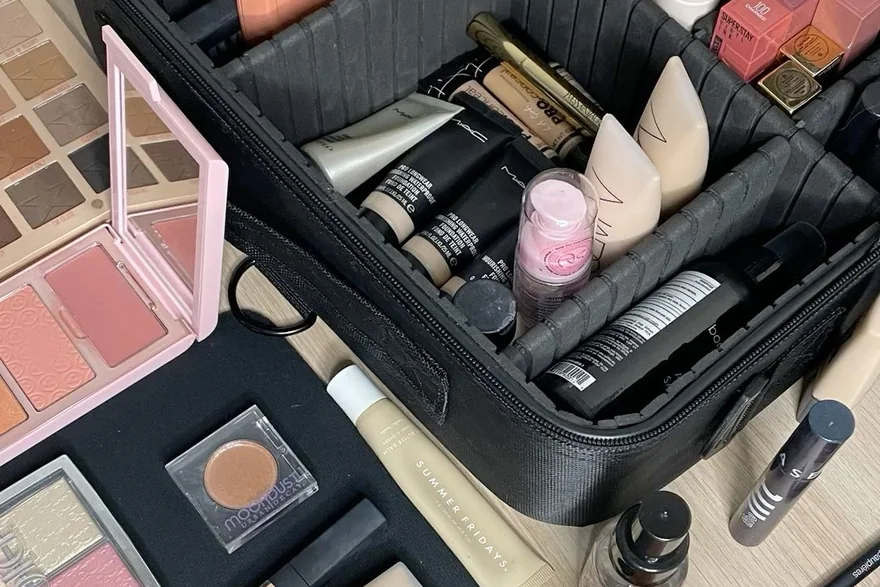
Capacity as a sizing question, not a body question
The useful way to read this category is through the kit rather than through the traveller. What actually drives the need for a larger bag is a set of packing decisions: full-size bottles instead of travel minis, a complete skincare routine rather than a decanted subset, a hair dryer or straightener alongside the usual brushes, and enough product for a trip measured in weeks rather than in days. Two travellers of identical size can need bags four litres apart because one decants and one does not. That is why capacity is the correct variable to specify and to merchandise, and why a size range should be built around litre tiers with published dimensions rather than around any label applied to the shopper.
This matters commercially as well as editorially. Capacity-led copy converts because it answers the question the buyer is actually asking, which is whether their bottles fit and whether the bag will close. Copy that implies the traveller's body is the problem generates complaints and does nothing to help a shopper decide. The practical guidance for a brand writing this category is to publish litre capacity, closed dimensions, opening width and empty weight, and to show the largest single item the bag is designed to accept. Those four facts replace a paragraph of description and reduce the return rate, which in this size band is driven overwhelmingly by a bag that turned out smaller than expected.
There is also a structural reason to treat large capacity as its own engineering problem. A bag of 15 litres and above is no longer a pouch; it is a case. The base carries a payload that can exceed 4 kg, the mouth spans 30 cm or more, and the panels are long enough to bow under load. Design decisions that are trivial at 3 litres become load-bearing at 18: seam construction, handle attachment, base stiffness and zip gauge all have to be revisited. Buyers who simply scale up a small-bag pattern by 150 per cent usually discover the failure at the first bulk inspection rather than at the sample stage, because the sample is photographed empty.
Reading capacity: litres, dimensions and what actually goes inside
Litres are the honest unit but they are not sufficient, because two bags of 15 litres can accept entirely different items. A tall narrow bag will not take a straightener laid flat; a wide shallow bag will not take a 400 ml bottle standing up. The brief should therefore state three things: the litre capacity, the internal base dimensions in centimetres, and the largest single item the bag must accept. That last requirement is the one that prevents disappointment, and it is usually a hair tool at 30 to 34 cm, a pump bottle at 20 to 24 cm tall, or a palette at 25 by 18 cm.
Capacity tiers are easier to merchandise than a continuous range. Four tiers cover the market: a weekend tier at 4 to 5 litres, a short-trip tier at 8 to 10, a long-trip tier at 12 to 15, and a full-kit tier at 18 to 22. Each tier has a distinct payload and a distinct buyer, and offering all four with consistent branding lets a shopper self-select without a size chart. The tiers also map onto different constructions: the bottom two can be soft pouches with a bound base, while the top two need a base board and a structured lid, which is why they sit at a different price point rather than merely at a different volume.
Payload weight is the number most often left out of a specification and it drives every structural decision. A full-size kit with liquids, glass and a hair tool typically weighs 3 to 5 kg before the bag itself is counted. That figure sets the handle attachment strength, the base board thickness and the zip gauge. Liquid volume also brings a travel rule into the specification: where the bag is carried in the cabin, containers are subject to the carry-on limit, and the framework is set out in the TSA 3-1-1 liquids rule. A large bag with a dedicated liquids pocket sized to that rule is easier to use at a checkpoint than a large bag with no separation.
| Capacity tier | Closed dimensions | Typical payload | Trip length | Empty weight target |
|---|---|---|---|---|
| 4-5 L weekend | 25 x 15 x 12 cm | Decanted minis, brush set, compact mirror | 1-3 nights | 180-280 g |
| 8-10 L short trip | 30 x 20 x 15 cm | Full-size bottles, skincare, one hair tool | 4-7 nights | 350-520 g |
| 12-15 L long trip | 34 x 22 x 18 cm | Full routine plus tools and palettes | 1-3 weeks | 600-850 g |
| 18-22 L full kit | 38 x 25 x 22 cm | Everything, including a dryer and a palette case | 3 weeks and longer | 900-1200 g |
One safety point belongs in every brief for the larger tiers. Heat styling tools should be allowed to cool completely before they are packed, and the bag should provide a separate compartment for them rather than letting them sit against fabric or product. A heat-resistant sleeve or a removable pouch helps, but it is a convenience and not a substitute for cooling the tool. Buyers should also avoid lining a tool compartment with a film that has a low softening temperature, since a warm barrel resting against a thin TPU face will mark it permanently.
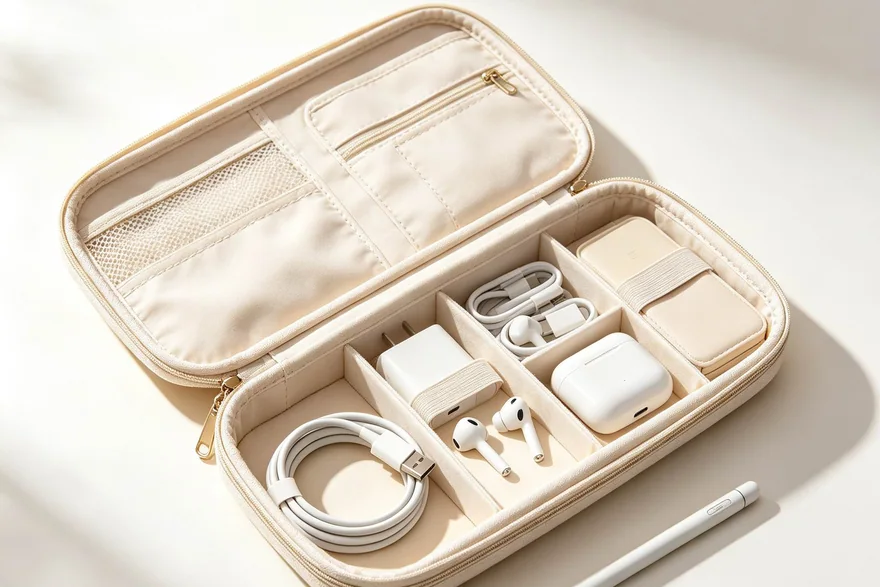
Structure, opening geometry and reaching the bottom of a full bag
The defining usability problem in a large cosmetic bag is retrieval. At 18 litres with 4 kg inside, the item wanted is usually at the bottom, and a bag that opens only at the top forces the user to unpack onto a hotel bed to find it. Opening geometry therefore deserves more attention than pocket layout. A U-shaped zip that runs down both gussets and stops about 3 to 4 cm short of the base gives an opening of 150 to 175 degrees and lets the lid fall back flat; a straight zip across the top gives roughly 90 degrees and leaves the user holding the lid with one hand while searching with the other. On a 34 cm wide bag the difference in usable opening is about 12 to 15 cm of clear width.
Structure keeps that opening usable. A 2 mm EVA base board in the bottom panel of an 8 to 15 litre bag, rising to 3 mm at 18 litres and above, stops the bag collapsing when it is set down and keeps the mouth from deforming when it is opened. A frame wire or a 2 mm panel in the lid lets it stand back. Four stud feet on the base keep a coated fabric off a wet hotel counter, and they cost very little against the benefit. Where a buyer wants the bag to stand open unaided on a surface, the base board and the lid panel have to work together; a stiff base with a floppy lid still collapses forward.
Interior layout should then solve visibility rather than capacity. A light lining at 90 to 110 g/m² in 210D polyester makes dark bottles and caps readable in a dim hotel bathroom, which is where most of these bags are used. An elastic strip holding six to ten upright items keeps bottles standing and stops them rolling into a heap when the bag is moved. One or two clear pockets over the small-item zone allow a shopper to see ties, clips and cotton pads without opening further pockets. A removable divider lets the user trade one large void for two smaller ones, which is the single most flexible thing a buyer can add at low cost.
- Opening: U-zip down both gussets, stopping 3-4 cm short of the base, for a 150-175 degree mouth on bags from 10 litres up.
- Base: 2 mm EVA board at 8-15 litres, 3 mm at 18 litres and above, with four stud feet on any coated fabric.
- Lid: 2 mm panel or a frame wire so the bag can stand open unaided on a counter.
- Lining: light 210D at 90-110 g/m² so dark bottles read in low light; specify fastness so it does not crock onto light clothing.
- Interior: elastic strip for six to ten upright bottles, one or two clear pockets, and a removable divider.
- Tools: separate compartment for heat styling tools, and a note that tools must cool before packing.
Colour behaviour deserves a line in the brief at this size, because a large bag is carried against clothing more often than a small one, and a lining or shell that crocks will mark a light garment. The assessment family used for this is described under ISO 105 colour fastness, and the requirement should state whether dry rub, wet rub or both are being tested. Linings and trims that sit near the face or hands should additionally be checked against a restricted-substance framework such as OEKO-TEX Standard 100, which most retail channels already recognise.
Weight distribution, closures and staying inside travel limits
Empty weight is the quiet constraint on every large-format brief. Cabin baggage allowances commonly sit somewhere in the 7 to 10 kg range depending on the carrier and the fare, and they vary enough that a buyer should not design to a single number. What is safe to design to is a proportion: the bag should account for a modest share of the allowance, which puts the empty target at 600 to 850 g for a 12 to 15 litre bag and 900 to 1200 g for an 18 to 22 litre case. Exceeding those figures makes the bag a checked item, and a checked cosmetic bag is the one most likely to arrive with a broken zip and a leaked bottle.
Weight can be managed without weakening the bag by placing material where it does work. Structure belongs in the base and the lid; the side gussets and the back panel can be a lighter fabric with a light interlining. Moving from 600D polyester at 300 g/m² to 420D nylon ripstop at 195 g/m² on the panels while keeping a 3 mm base board saves roughly 200 to 300 g on a 20 litre build and costs nothing in function. Hardware is the other place to save: a moulded clip and a webbing loop weigh less than a metal hook and a plate, and on a bag that usually sits in a suitcase the hook is rarely used.
Closures are where large bags fail, and the failure is predictable. A long zip run on a heavily loaded bag puts tension at the ends of the tape and at the gusset curve, and the two most common results are tape splitting at the end stop and slider jumping at the curve. The specification should therefore be a #8 coil rather than a #5 on anything above 10 litres, twin sliders on a U-zip so the bag can be opened from either side, a sewn stop and a reinforced end box at both ends, and a puller large enough to grip with a full hand. Terminology for gauge, tape, slider and stop is defined in ASTM D2053 zipper terminology, which makes the requirement unambiguous.
| Closure and carry option | Opening width | Practical load | Failure mode | Best for |
|---|---|---|---|---|
| Single #5 top zip | 90 degrees, 25-30 cm | Up to 2 kg | Tape splits at the end stop | Weekend tier only |
| Twin #8 U-zip | 150-175 degrees, 30-40 cm | 3-5 kg | Slider jump at the gusset curve | 10 litres and above |
| Zip plus magnetic flap | 150 degrees | 3-5 kg | Magnets misalign when the bag is full | Structured vanity cases |
| Roll-top with clip | Full mouth, 25-35 cm | 2-4 kg | Clip releases under compression | Soft packing cubes and pouches |
| Clamshell with frame | 180 degrees, 35-45 cm | 5-7 kg | Frame distorts if the base is undersized | Full-kit tier and vanity cases |
Carry comfort completes the specification. A padded wrap of 8 to 12 mm foam on the handle spreads the load of a 5 kg kit across the palm, and a detachable shoulder strap of 38 mm webbing with a sliding pad is worth specifying above 15 litres because a full bag is awkward to carry by hand across a terminal. A trolley sleeve of 18 to 20 cm width on the back panel, with a bottom strap to stop the bag swinging, turns a heavy case into something that rides on a suitcase handle. Buyers should check the sleeve against the handle widths actually sold in the destination market rather than assuming one dimension fits all.
Publish litre capacity, closed dimensions, opening width and empty weight on the listing. Three-quarters of returns in this size band come from a bag that was smaller than the shopper expected, and those four numbers prevent the return more reliably than any photograph.
The B2B Customisation View
Programmes for cosmetic pouches, vanity cases and beauty organisers move fastest when the artwork is supplied as vector files and the Pantone references are confirmed before sampling starts.
Budgeting and scheduling inputs: MOQ 500 per style and colourway; sampling 6–10 working days, extended to 12–15 for lined, moulded or hardware-heavy builds; bulk 35–50 days; pre-shipment inspection at AQL 2.5 per ISO 2859-1; FOB Xiamen; T/T 30/70.
QUANZHOU JUNYUAN BAGS is structured as a sourcing and programme-management company, which lets a buyer compare materials across several SGS-verified production lines inside one quotation.
Which Brand Types Benefit Most
Large-format organisers suit buyers differently depending on how they present size. Start-up brands can use the category to differentiate on honesty: publishing litre capacity, internal dimensions and empty weight is still uncommon, and it wins the shopper who has already been disappointed once by a bag that looked large in a photograph. Established brands extend into the tier as a natural step above a standard wash bag, where the larger format carries a higher unit price and is bought less often but with less price sensitivity. Retailers value the tier because it merchandises as a range: four litre tiers with consistent branding let a shopper trade themselves up without a salesperson, and the top tier anchors the price ladder. E-commerce sellers gain most from the specification detail, because the questions that drive conversion in this band are dimensional and a listing that answers them outranks one that does not. Gift and hospitality buyers use the 8 to 12 litre tier for welcome and amenity kits in extended-stay settings, where a larger organiser reads as generous rather than as excessive. One further commercial point concerns returns. In larger formats the dominant return reason is a bag smaller than the shopper expected, and it is prevented more cheaply by accurate specification than by better photography. Buyers who publish litre capacity, internal base dimensions, opening width and empty weight both convert better and return less, which matters more at this price point than anywhere else in the category. Tiering helps the shopper self-select: four sizes with consistent branding outsell one size described generously.
- Start-up brands: published capacity and dimensions differentiate in a category short on facts.
- Established brands: a natural trade-up step with higher unit price and lower price sensitivity.
- Retailers: four tiers merchandise as a visible ladder and anchor the top of the price range.
- E-commerce sellers: dimensional detail answers the conversion question and cuts returns.
- Hospitality buyers: the 8-12 litre tier reads as generous in extended-stay welcome kits.
Frequently Asked Questions
How is capacity measured on a large travel makeup bag?
By litres for the volume and by internal base dimensions in centimetres for what actually fits. Both are needed, because a tall narrow 15 litre bag and a wide shallow 15 litre bag accept different items. Buyers should also state the largest single item the bag must take, which for this category is usually a hair tool of 30 to 34 cm or a pump bottle of 20 to 24 cm.
What litre size replaces a standard wash bag for a longer trip?
A standard wash bag runs 3 to 5 litres. For a trip of one to three weeks with full-size bottles and a hair tool, 12 to 15 litres is the working range, at roughly 34 by 22 by 18 cm. Below that the bag will not close; above 18 litres it becomes a checked case rather than a bag that sits in a cabin bag.
Does a larger bag need internal structure?
Above about 10 litres, yes. A 2 mm EVA base board at 8 to 15 litres and 3 mm at 18 litres and above keeps the bag from collapsing when it is set down and keeps the mouth from deforming when it is opened. A lid panel or frame wire lets it stand open unaided, and four stud feet keep a coated base off a wet counter.
How wide should the opening be on a 15-litre cosmetic case?
Aim for 150 to 175 degrees of opening and 30 to 40 cm of clear width, which a U-zip running down both gussets and stopping 3 to 4 cm short of the base will give. A straight top zip on the same bag gives about 90 degrees and roughly 15 cm less clear width, which is the difference between reaching the bottom and unpacking the bag to find one item.
Can a large makeup bag hold full-size hair tools?
Yes, if the internal base dimension is specified for it. A straightener of 30 to 34 cm needs a base of at least 35 cm on the diagonal or a compartment that allows it to lie flat. Tools should be allowed to cool completely before packing, and the compartment should not be lined with a film that softens at a low temperature.
What empty weight is reasonable for a 20-litre organiser?
Between 900 and 1200 g with structure. Below that the bag usually lacks the base board it needs; above it, the packed bag starts pushing a cabin allowance. Weight can be kept in range by using a lighter panel fabric such as 420D ripstop at 195 g/m² while keeping a 3 mm base board and a structured lid.
How do larger bags stay within airline liquid rules?
By giving them a dedicated liquids pocket sized to the rule. The carry-on framework is set out in the TSA 3-1-1 liquids rule, which limits containers to 100 ml or less in a single clear bag; limits are set nationally and vary, so buyers should check the markets they ship to. A large bag with separation is far easier to use at a checkpoint than one large void.
Which zipper gauge suits a wide-mouth cosmetic case?
#8 coil with twin sliders for anything above 10 litres. The load on a long run on a heavily loaded bag splits tape at the end stop and jumps sliders at the gusset curve, both of which a #5 is more prone to. Specify a sewn stop and a reinforced end box at both ends and a puller large enough to grip with a full hand.
How do buyers test zipper life on a wide opening?
By specifying a cycle count and a cycle test rather than asking for a strong zip, and by naming the components. The vocabulary of gauge, tape, slider, stop and puller is set out in ASTM D2053, which lets a buyer write a requirement that cannot be interpreted loosely. The inspection should check the ends of the run rather than the middle of it.
What minimum applies to a large-format structured cosmetic case?
500 pieces per style and colourway, the same as any other style. Structured cases affect the schedule rather than the quantity: a framed or board-built case samples in 12 to 15 working days against 6 to 10 for a soft build, because the board and the frame have to be cut and fitted before a representative sample exists.
How long does sampling take for a case with a frame wire and base board?
12 to 15 working days. The frame and board need a pattern and a fitting trial, and the sample should be assessed loaded rather than empty, because a frame that looks correct empty can distort under 4 kg. Bulk production then runs 35 to 50 days after sample approval under AQL 2.5 to ISO 2859-1.
Can a large bag be carried as cabin baggage?
It depends on the carrier's size and weight allowance, which commonly sits in the 7 to 10 kg range and varies by fare and route. The design implication is to keep the empty weight at 600 to 850 g for a 12 to 15 litre bag and at 900 to 1200 g for an 18 to 22 litre case, so the packed bag stays within a typical allowance.
How is colour transfer tested when a dark lining rubs against light clothing?
Specify dry and wet rub fastness by test rather than by description. The ISO 105 colour fastness family covers the assessment, and the brief should state which conditions apply and the grade expected. This matters more on a large bag, because it is carried against clothing more often than a small pouch and the surface area in contact is greater.
What inspection level applies to a 500-piece large-case run?
AQL 2.5 under ISO 2859-1, which sets the sample size and the accept and reject numbers for the lot. The procedure is published as ISO 2859-1 sampling procedures. For large cases the buyer-defined defect list should weight structural failures above cosmetic ones: base board seating, frame alignment, handle attachment and zip performance at the gusset curve.
Should a large organiser have a trolley sleeve?
Above 15 litres, yes. A sleeve of 18 to 20 cm with a bottom strap stops a heavy case swinging on a suitcase handle and removes the need to carry 5 kg by hand across a terminal. Buyers should check the sleeve width against the handle widths actually sold in the destination market rather than assuming one dimension fits all.
How should brands write size copy for a larger-capacity range?
Lead with capacity and dimensions and avoid any language that implies the traveller's body is the issue. Phrases such as high-capacity, full-size and long-trip describe the kit and help the shopper decide; a label applied to the person does neither and generates complaints. Publishing litre capacity, dimensions, opening width and empty weight is both more useful and safer.
People Also Ask
What size makeup bag do I need for a two-week trip?
Twelve to fifteen litres, at roughly 34 by 22 by 18 cm, if you carry full-size bottles and a hair tool. Decanting into minis brings it down to 8 to 10 litres. The decisive check is not the total volume but the largest single item: a straightener of 30 to 34 cm needs a base dimension that lets it lie flat.
How many litres is a large toiletry bag?
The working bands are 8 to 10 litres for a short trip, 12 to 15 for a long trip, and 18 to 22 for a full kit with hair tools and palettes. A standard wash bag is 3 to 5 litres. Above 18 litres most bags become structured cases with a base board, and they usually travel checked rather than in the cabin.
Why do large makeup bags collapse when you open them?
Because the panels are long enough to bow under load and the base has no board. A 2 mm EVA base board at 8 to 15 litres, rising to 3 mm above 18 litres, plus a lid panel or frame wire, keeps the mouth open and the bag upright. A stiff base with a floppy lid still collapses forward, so both are needed.
What is the best closure for a wide-opening cosmetic case?
A twin-slider #8 coil U-zip running down both gussets, stopping 3 to 4 cm short of the base. It gives 150 to 175 degrees of opening and can be worked from either side. Below 10 litres a single #5 top zip is adequate; above it, the longer run loads the tape enough for a #5 to split at the end stop.
Request a Sample or a Written Quotation
Send the silhouette, dimensions, material preference and logo artwork, and the programme team will return a written quotation with MOQ, sampling window, bulk lead time and inspection standard.
Email: [email protected] · WhatsApp: +86 177 5002 0688