Debossed vs Embossed Logo on Leather Cosmetic Bags
Executive Summary
Debossed or embossed is the decision brand owners face when a leather cosmetic bag carries a pressed logo, and debossing wins most programmes. A debossed logo sits below the surface, so nothing can peel, the mark survives abrasion from daily handling, and the effect reads as quality on both PU and genuine leather. An embossed logo stands above the surface and needs either a thicker substrate or a matched male-and-female die pair, which raises tooling cost and restricts where the mark can sit. The choice follows four variables: substrate thickness, stroke width in the artwork, contrast against the base colour, and the tooling budget.
A blind deboss on a 0.8-1.0 mm PU panel, pressed at 110-130 degrees C for 4-6 seconds, leaves a recess of 0.2-0.4 mm that outlasts the bag. Hot foil is added when the base is dark, because tone-on-tone impressions vanish on black. Tooling is a one-off charge spread across a 500-piece minimum per style and colourway. The calendar is then fixed: 6-10 working days for sampling, 12-15 working days for complex constructions, 35-50 days for bulk after approval, and inspection at AQL 2.5 under ISO 2859-1 before goods ship FOB Xiamen.
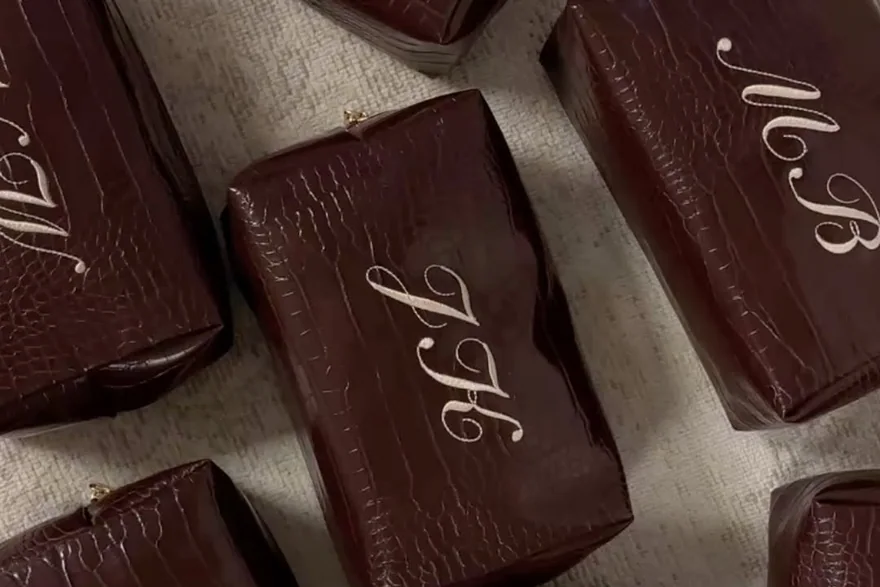
What debossing and embossing actually do to leather
Debossing presses a heated metal die into the finished surface of a leather cosmetic bag so that the logo ends up below the surrounding plane. Embossing does the opposite: the mark is pushed up, usually by a matched pair of tooling, so the logo stands proud of the panel. Both are compression processes rather than printing processes, which is why the substrate matters more than the artwork. Colour fastness of the surrounding finish, assessed under the ISO 105 series, and the thickness of the coating determine whether an impression holds its shape or springs back within a day.
Three commercial variants sit under those two names. A blind deboss uses a single female die with no foil, giving a shadow-only mark that reads in raking light. A foil deboss uses the same die but feeds a hot-foil carrier between die and panel, so the recess is filled with pigment or metal. A true emboss needs a male die beneath the panel and a female die above it, capturing the leather between the two; without the male half, the panel simply bulges at the edges and the logo loses definition within a few millimetres of its own outline.
The substrate decides most of the outcome. PU leather is a polyurethane coating of roughly 0.15-0.30 mm laid over a polyester or polyester-cotton base of 0.5-0.8 mm; the coating takes the impression and the base stops it recovering. Genuine leather behaves differently: full-grain and top-grain skins at 1.0-1.4 mm hold a crisp edge because the fibre structure is dense, while a corrected-grain split at 1.2-1.6 mm relies on its finish layer and can glaze under too much heat. Coated wovens such as 600D polyester do not hold a press mark at all; the yarns flatten and rebound.
Placement interacts with the press. On a structured cosmetic bag measuring 22 x 14 x 8 cm, the front panel is the usual target, with the logo centred horizontally and its top edge 25-35 mm below the zipper line. At least 8-10 mm should separate the die footprint from any seam, because a press platen cannot reach over a bulky seam without rocking, and rocking produces one shallow side and one deep side on the same logo. Small marks also work on a zipper pull tab of 10-14 mm width, provided the tab is PU-wrapped rather than bare metal.
Tooling, heat and dwell: the variables that decide a clean impression
A press log is short but unforgiving. Four settings run the job: plate temperature, dwell time, pressure and the relief depth cut into the die. Change one and the other three need adjusting. Most cosmetic bag panels are pressed on a 10-20 tonne clicker or a pneumatic heat press with a 200 x 300 mm platen, and the die is shimmed so that pressure lands evenly across the logo rather than concentrating at the tallest letter.
| Variable | Blind deboss | Foil deboss | Emboss, matched dies |
|---|---|---|---|
| Tooling | Single female brass die, 3-5 mm relief | Female brass die plus foil carrier | Male and female matched pair |
| Plate temperature | 110-140 C on PU; 90-120 C on genuine leather | 130-160 C | 110-130 C after pre-heat |
| Dwell | 4-8 seconds | 3-6 seconds | 5-10 seconds with 2-second pre-heat |
| Pressure | 30-60 psi | 40-70 psi | 35-55 psi |
| Resulting relief | 0.2-0.5 mm recess | 0.2-0.4 mm recess | 0.4-0.8 mm raise |
| Contrast source | Shadow, tone on tone | Foil sheen and pigment | Shadow plus edge highlight |
| Tooling charge | 80-150 USD, cut in 5-8 days | 80-150 USD die plus foil stock | 180-320 USD matched pair |
| Best substrate | Soft PU 0.7-1.0 mm, top-grain 1.0-1.2 mm | Corrected-grain PU, coated split | PU 1.0-1.4 mm, veg-tanned 1.4-2.0 mm |
Temperature errors show up in two directions. Too hot and the PU coating glazes: a shiny halo appears around the logo within seconds and, on darker colours, the finish micro-cracks along the letter edges after flexing. Too cool and the mark recovers. Polyurethane has a memory effect, so a shallow impression can lose 30-50% of its depth over the first 24-48 hours at room temperature. The standard check is to press three panels at 10 C intervals across the working range, rest them for 48 hours at 23 C, then measure depth with a dial indicator reading to 0.01 mm and keep the setting that loses less than 15%.
Foil adds its own constraints. Release temperature sits inside a window of roughly plus or minus 10 C, and the foil needs a smooth face: on a heavily embossed or pebbled grain, coverage breaks up into pinholes at the bottom of the grain valleys, which inspectors read as a print defect. Where a brand insists on foil over textured leather, the practical fix is a smooth recessed patch - a blind debossed plaque of 30 x 15 mm pressed first, with the foil laid into it on a second pass using a die 0.2 mm smaller all round.
Artwork geometry closes the loop. Minimum cap height of 4 mm and minimum stroke width of 0.8 mm keep a deboss legible after the press rounds the edges; letter spacing below 0.6 mm closes up completely at 0.4 mm depth. Serif typefaces lose their feet, so a sans-serif with open counters survives better. Finally, PU stretches further across the roll than along it, so a logo placed off-grain can distort by 3-5% under pressure; keeping the die footprint within 60% of the panel width limits that drift.
Die material follows volume as well as budget. Brass holds an edge through 20,000 impressions and more and is the default for a programme that will reorder; magnesium cuts faster and cheaper but deforms after a few thousand presses, suiting a one-off promotional run; silicone rubber sheet bonded to an aluminium plate presses at lower temperature and conforms to uneven panels, at the cost of a softer edge on fine lettering.
Choosing a substrate that will actually take the impression
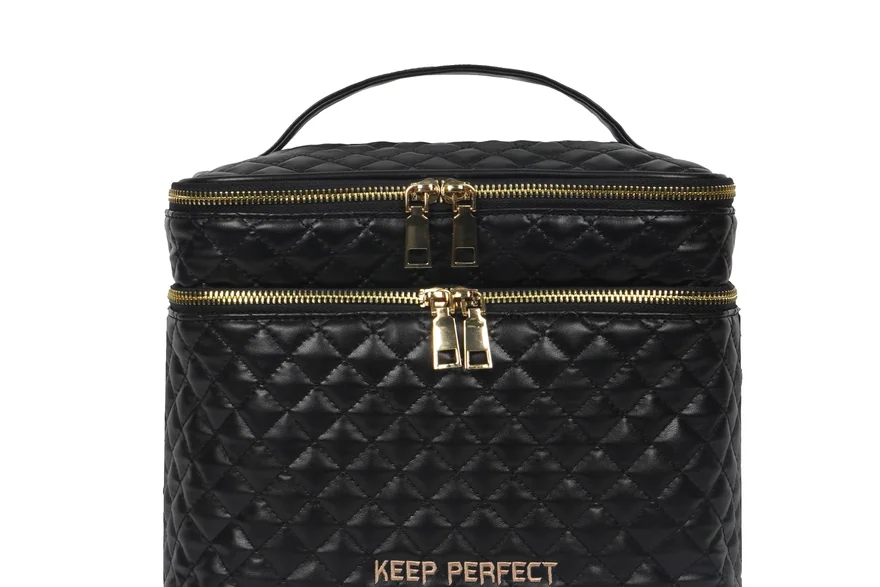
Not every leather in a cosmetic bag specification takes a pressed mark, and choosing the wrong one is the most common cause of a rejected logo sample. The list below covers the substrates that appear most often on vanity cases, pouches and toiletry bags, with the press behaviour a buyer can expect from each.
- PU leather, 0.7-1.0 mm: the default for debossing; coating 0.15-0.30 mm over a knit or woven base, holds 0.2-0.4 mm recess, recovers less than 15% after 48 hours.
- Microfibre PU, 0.6-0.8 mm: dense non-woven structure gives the sharpest edge of any synthetic; suits small lettering down to 3 mm cap height.
- Semi-PU or PVC leather, 0.8-1.2 mm: plasticiser content makes it soft at 90-110 C; risk of gloss halo above 120 C.
- Top-grain genuine leather, 1.0-1.4 mm: dampen the surface for 30-60 seconds, press at 90-110 C for 6-10 seconds; develops a deeper patina in the recess over time.
- Vegetable-tanned leather, 1.4-2.0 mm: the only substrate that reliably holds a raised emboss of 0.5-0.8 mm with a matched die pair.
- Cork fabric on textile backing, 0.6-1.0 mm: presses well but compresses permanently, so depth above 0.3 mm thins the sheet and can telegraph through the lining.
- Recycled PU with GRS-certified backing, 0.8-1.0 mm: behaves like standard PU; confirm the recycled content claim on the transaction certificate before artwork is released.
Two materials fail outright. Neoprene, used on some slim pouches at 3-5 mm thickness, rebounds almost completely within an hour; the only durable mark on it is a heat-transfer film or a rubber badge. Moulded EVA cases take their logo from the mould itself, which is engraved 0.5-0.7 mm deep and therefore raises the mark rather than sinking it; that is a tooling decision made at the mould-cutting stage, 20-30 days before any sample exists.
Durability of the finished mark is measured, not assumed. Abrasion behaviour of coated substrates is covered by ASTM D751 for coated fabrics, and rub fastness of the surrounding dye is graded on the grey scale referenced by AATCC test methods. A practical in-house screen is 500 cycles of a dry crock test across the logo followed by 200 cycles wet: if no foil lifts and the recess is still visible at arm's length under D65 light, the specification is sound for daily handling.
Cost follows the substrate as much as the process. A blind deboss on stock PU adds 0.03-0.08 USD per piece against the base bag price; a foil pass adds 0.08-0.18 USD; a matched-die emboss adds 0.10-0.22 USD plus the higher tooling charge. Against a typical unit price band of 0.45-12.00 USD for imported cosmetic bags, even the most expensive of those options moves the unit cost by a small percentage, while the perceived value of a pressed mark on leather is disproportionately high.
The cheapest way to settle a substrate argument is a press trial card: three candidate materials, each pressed at two temperatures, mounted on one card with the settings written beside them. The card costs little, travels in an envelope rather than as a finished sample, and lets a brand owner compare edge definition and glazing side by side before committing to a material on a 500-piece buy.
Cost, minimums, timeline and inspection for pressed-logo programmes
The commercial frame for a pressed-logo cosmetic bag is the same as for any made-to-order bag programme, with the logo items layered on top. The table below sets the variables a buyer can quote against, so that logo decisions are costed before artwork is released rather than after a sample arrives. Programmes run at a minimum of 500 pieces per style and colourway, are sampled in 6-10 working days, run in bulk for 35-50 days after approval and ship FOB Xiamen on T/T terms of 30% deposit and 70% against the bill of lading.
| Item | Blind deboss | Foil deboss | Emboss, matched dies |
|---|---|---|---|
| One-off tooling | 80-150 USD, reusable for 24 months | 80-150 USD die plus foil stock | 180-320 USD matched pair |
| Per-piece add-on | 0.03-0.08 USD | 0.08-0.18 USD | 0.10-0.22 USD |
| Press set-up per style | 40-70 minutes | 60-90 minutes | 90-120 minutes |
| Sample pieces per style | 2-3 | 2-3 | 2-3 |
| Programme minimum | 500 pcs per style and colourway | 500 pcs per style and colourway | 500 pcs per style and colourway |
| Sampling | 6-10 working days; 12-15 complex | 6-10 working days; 12-15 complex | 6-10 working days; 12-15 complex |
| Bulk after approval | 35-50 days | 35-50 days | 35-50 days |
| Inspection | AQL 2.5 under ISO 2859-1 | AQL 2.5 under ISO 2859-1 | AQL 2.5 under ISO 2859-1 |
| Shipment and payment | FOB Xiamen; T/T 30/70 | FOB Xiamen; T/T 30/70 | FOB Xiamen; T/T 30/70 |
Logo faults are classified before inspection begins, in the same way as any other defect on a bag. Incomplete fill, a double or ghosted impression, coating cracking, foil voids larger than 0.5 mm, and foil sitting more than 0.3 mm outside the recess are all major defects: the piece is unsellable at full price and counts against the AQL 2.5 accept number. Centring drift greater than 1.5 mm from the position marked on the tech pack is also major. A faint shine halo visible only under raking light is minor.
Two checks catch most problems before bulk. The first is the 48-hour recovery test described earlier, recorded in the sample report so that the production floor has a number to hold rather than a photograph to match. The second is a placement jig: a 1 mm acrylic template cut to the panel outline with the logo position notched out, used to set the press bed at the start of every shift. Without a jig, placement drift of 2-4 mm across a 35-50 day run is common, and it is the single most frequent reason a finished lot is downgraded.
A signed pre-production piece, stored flat at 20-25 C away from light, is the only reliable reference for a pressed logo because photographs flatten the shadow that makes a blind deboss visible. At final inspection the sample pieces are compared with it side by side under D65 light at a distance of 1 m, and any piece that reads differently is counted as a defect rather than debated.
Reorders are where the tooling economics pay back. A die held from the first run removes the tooling charge and the 5-8 day cutting time from the second, so a buyer who expects to repeat a style should say so at the quotation stage and ask for the die to be stored rather than scrapped. The per-piece press charge stays the same, which is why the saving shows up in the second order rather than the first.
The B2B Customisation View
Range planning for makeup bags and toiletry bags works best when the hero style and the gift-with-purchase style are engineered together, sharing linings and hardware to protect the budget.
Planning figures used across the programme: MOQ 500 pieces per style and colourway, 6–10 working days sampling (12–15 when moulding or multi-layer lamination is required), 35–50 days bulk lead time, AQL 2.5 to ISO 2859-1, FOB Xiamen, T/T 30/70.
The value of a programme-coordination model is continuity: QUANZHOU JUNYUAN BAGS keeps the approved reference sample, the shade standard and the AQL record for every repeat order.
Which Brand Types Benefit Most
Start-up brands gain the most from blind debossing on PU. The tooling charge is modest, the per-piece add-on is small, and the result looks considered rather than cheap, which matters when a first collection is being judged on photography alone. Spending the saved margin on a better substrate - a 0.9 mm PU with a woven base rather than a 0.7 mm knit-backed sheet - does more for perceived quality than adding foil would. Established brands with a house style guide usually run two tiers: a blind deboss on the core line and a foil deboss or matched-die emboss on the premium line, with placement rules written into the guide so that a 25 cm vanity case and a 15 cm pouch carry the logo in the same relative position. Two items are worth writing down at approval and reusing on every reorder: the press settings, recorded on the sample card alongside the substrate reference, and the placement, dimensioned on the tech pack rather than shown in a photograph. Both cost nothing to keep, and both are what let an inspector decide whether a second run matches the first.
- Retailers running private label: a consistent deboss position across every SKU lets a shelf bay read as one brand family, and foil in a single house colour keeps recognition without a second print pass.
- E-commerce sellers: a debossed logo photographs best in raking light at a 30-45 degree angle with a fill card on the shadow side; flat overhead lighting makes the mark disappear and increases 'logo missing' returns.
- Gift and hospitality buyers: an amenity or welcome-kit pouch needs the logo legible at 2 m, so cap height of 6-8 mm and foil on darker bases outperform blind deboss for this channel.
- Beauty and skincare brands selling bundles: pressing the logo into the bag rather than printing it survives contact with oils and alcohol-based products that lift screen-printed ink.
- Corporate and promotional buyers: the 500-piece minimum per style and colourway suits a single campaign colour; a second colourway doubles the buy, so artwork that works tone-on-tone across two shades keeps the order at one minimum.
Frequently Asked Questions
What is the difference between a debossed and an embossed logo on a leather cosmetic bag?
A debossed logo is pressed below the surface of the panel, leaving a recess of 0.2-0.5 mm that is read as a shadow. An embossed logo stands above the surface, which requires a matched male-and-female die pair and a substrate thick enough to be captured between them. Debossing needs a single die, costs less in tooling and suits most PU and genuine leather bags.
How deep should a debossed logo be on PU leather?
A depth of 0.2-0.4 mm is workable on a 0.8-1.0 mm PU sheet and leaves the coating intact. Deeper impressions of 0.5 mm and above risk thinning the coating over the base fabric, which can telegraph through to the lining on a pale-coloured pouch. Depth should always be measured after a 48-hour rest, since a shallow impression loses up to half its depth in that window.
Can a debossed logo be applied to a genuine leather cosmetic bag?
Yes. Top-grain leather at 1.0-1.4 mm takes a clean impression when the surface is dampened for 30-60 seconds and pressed at 90-110 C for 6-10 seconds. Vegetable-tanned leather presses best and also holds a raised emboss. Chrome-tanned skins are softer and give a rounder edge, so fine serif detail should be avoided on them. Because a natural skin varies in density across the hide, one extra sampling round is worth budgeting for on genuine leather.
Why does a blind deboss disappear on black leather?
A blind deboss relies entirely on the shadow cast inside the recess, and black finishes absorb that shadow rather than reflecting it. On black or very dark brown bases the mark is invisible at arm's length and only shows under strong raking light. Hot foil in gold, silver or a pale pigment is the standard fix, applied into the recess on a second pass with a die 0.2 mm smaller all round.
What minimum logo size keeps a debossed mark legible?
Cap height of 4 mm and stroke width of 0.8 mm are the practical floor for a pressed logo on leather. Below those numbers the press rounds the edges of the lettering and the counters fill in. On a small zipper pull tab of 10-14 mm width, only a monogram or an icon at 6-8 mm total height survives; wordmarks should stay on the front panel.
How much does brass die tooling cost for a debossed logo?
A single-position brass die for a logo up to about 60 x 30 mm typically costs 80-150 USD and is cut in 5-8 days. A matched male-and-female pair for a raised emboss costs 180-320 USD. Tooling is a one-off charge, is reused for repeat orders and is normally held for 24 months of inactivity before it is written off.
Does hot foil wear off a cosmetic bag that is handled every day?
Foil laid into a recess wears far better than foil laid on a flat surface, because the surrounding leather takes the abrasion. A 500-cycle dry crock test followed by 200 wet cycles across the logo is a reasonable screen. Foil on a raised emboss or on a flat panel abrades at the edges within weeks of daily use and should be avoided on high-touch positions.
Can an embossed logo be pressed onto a zipper pull tab?
A raised logo on a pull tab is possible only if the tab is made from a PU-wrapped or solid-leather strap at least 2.0 mm thick, and the tab has to be pressed flat before assembly. Most programmes instead use a blind deboss or a moulded metal puller with the logo cast in, which avoids the tooling and the assembly step.
What temperature and dwell time suit a PU leather deboss?
Start at 110-130 C for 4-6 seconds at 30-60 psi on a 0.8-1.0 mm PU sheet, then bracket the setting at 10 C intervals on scrap panels. Rest each panel for 48 hours at 23 C, measure depth with a dial indicator and keep the setting that loses under 15% of its depth. Semi-PU and PVC-rich sheets run cooler, at 90-110 C.
Will a debossed logo crack the PU coating?
Cracking happens when the plate is too hot or the relief too deep for the coating thickness. Visible signs are a gloss halo around the letters immediately after pressing and hairline cracks along the letter edges after flexing. Keeping relief at 0.2-0.4 mm on a coating of 0.15-0.30 mm, and staying below 140 C on PU, avoids the problem.
How is a pressed logo checked during AQL 2.5 inspection?
Inspectors classify logo faults alongside other bag defects. Incomplete fill, ghosting, coating cracks, foil voids over 0.5 mm and centring drift beyond 1.5 mm are major defects and count against the accept number at AQL 2.5. A faint shine halo visible only in raking light is minor. Every piece is compared with the signed pre-production reference under D65 light.
Can a debossed logo be combined with screen printing on the same panel?
Yes, but the sequence matters. The panel is debossed first and printed second, because printing into a recess is impossible with a flat screen. Registration between the two marks should be allowed 1.5 mm of tolerance, and the print should sit at least 5 mm clear of the recess edge so that ink does not pool along the shoulder.
Which leather thickness holds an embossed or raised logo best?
Vegetable-tanned leather at 1.4-2.0 mm holds a raised emboss of 0.5-0.8 mm better than any other substrate, because its fibre structure is dense and its moisture content can be controlled before pressing. Thick PU at 1.0-1.4 mm is the synthetic alternative. Anything thinner than 1.0 mm will not hold the shape without the reverse side bulging. Buyers should also check that the reverse side of the panel is lined, because the counter-die marks the flesh side during pressing.
How long does sampling take for a debossed-logo cosmetic bag?
Sampling runs 6-10 working days for a standard construction and 12-15 working days for complex constructions such as a moulded case or a multi-panel vanity bag. Cutting the die adds 5-8 days and can run in parallel with material preparation. Buyers should add 3-5 days for international courier before counting approval time. Die cutting can run in parallel with material preparation, so the two rarely add together in practice.
Can a debossed logo be added to a recycled or GRS-certified leather?
Recycled PU with a GRS-certified backing presses the same way as standard PU of the same gauge, so the process does not change. The claim does: the transaction certificate has to cover the specific material lot used, and buyers should confirm recycled content before artwork is released rather than after the bulk fabric is booked. The certificate should be requested before artwork release, since a claim added later cannot be backdated to the material lot.
What happens if the logo artwork has strokes thinner than 0.8 mm?
Thin strokes close up during pressing, because the leather flows into them from both sides. The artwork should be redrawn with strokes at 0.8-1.0 mm and counters opened up by roughly 0.2 mm, or the logo re-scaled so the smallest element meets the minimum. A cheaper alternative is to keep the fine artwork and reproduce it as a heat-transfer film rather than a press mark.
People Also Ask
Is debossing cheaper than embossing?
Debossing is cheaper on both counts. Tooling for a blind or foil deboss is a single die at 80-150 USD, while a raised emboss needs a matched pair at 180-320 USD. Per piece, debossing adds 0.03-0.18 USD depending on foil, against 0.10-0.22 USD for embossing, and it suits thinner substrates that cost less to buy. It also suits thinner substrates that cost less per square metre, so the saving compounds across a 500-piece buy.
Does a debossed logo last longer than a printed logo?
Yes, in normal use. A pressed mark is the substrate itself, so there is no ink layer to abrade, no adhesion to fail and no cracking under flex. Screen print and heat transfer sit on the surface and can be lifted by oils, alcohol or repeated abrasion. The trade-off is contrast: print gives colour on any base, while a blind deboss gives visibility only through shadow.
Can you deboss faux leather?
PU and PVC leather, the two materials usually sold as faux leather, deboss well within a controlled temperature band. PU runs at 110-140 C for 4-8 seconds; PVC-rich and semi-PU sheets run cooler at 90-110 C because the plasticiser softens quickly. The impression should be measured after 48 hours, since synthetics recover more than genuine leather. As with genuine leather, the impression should be re-measured after 48 hours before the setting is fixed for bulk.
What is a blind deboss?
A blind deboss is a logo pressed into leather with no foil, pigment or ink: the mark is visible only as a shadow inside the recess. It is the most durable and least expensive press finish, and it suits light and mid-tone bases. On dark bases the shadow is absorbed and the logo becomes invisible, so foil or a contrasting fill is used instead.
Request a Sample or a Written Quotation
Send the silhouette, dimensions, material preference and logo artwork, and the programme team will return a written quotation with MOQ, sampling window, bulk lead time and inspection standard.
Email: [email protected] · WhatsApp: +86 177 5002 0688