Corporate Gift Cosmetic Bags: Employee & Client Gifting Guide
Executive Summary
How should a company run a corporate gift cosmetic bag programme for employees and clients? It works best as two specifications inside one purchase order: a durable, logo-light bag for employees, weighted and lined for daily commuting, and a higher-finish bag for clients where the closure, the hardware and the lining carry the impression. Budgets separate the same way, with staff tiers planning in the lower half of the $0.45 to $12.00 unit band and client tiers nearer the middle or upper half. Both tiers share one 500-piece minimum per style and colourway.
Timing is the harder constraint. Sampling takes 6-10 working days, or 12-15 working days for complex constructions, and bulk production runs 35-50 days after sample approval, so a fixed hand-out date has to be planned backwards rather than chased. Add ocean transit, clearance and ten to fifteen working days for receipt and distribution. Compliance runs alongside: a REACH declaration, a current OEKO-TEX Standard 100 certificate with the right article scope, and a decoration defect class agreed for the AQL 2.5 inspection under ISO 2859-1.
Why employee gifting and client gifting need two specifications
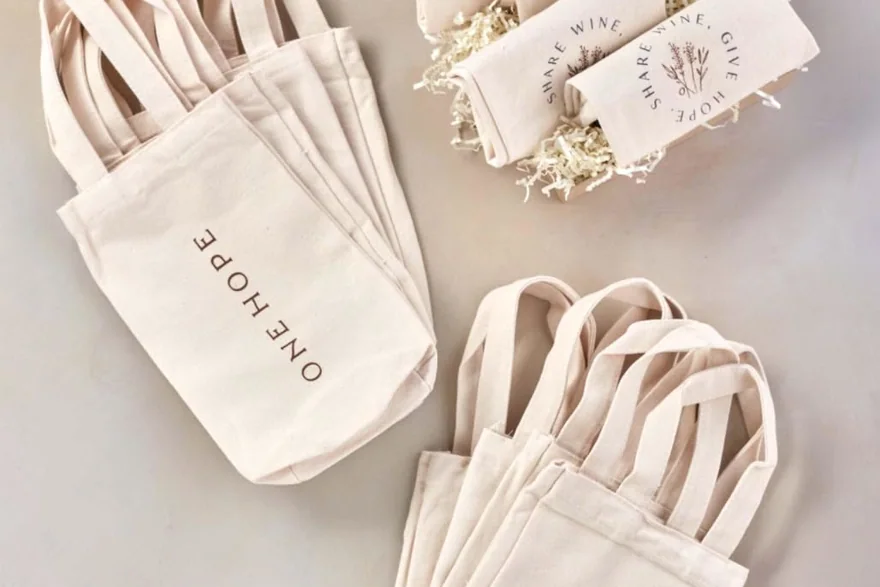
A corporate gift cosmetic bag programme is not one gift. It is two audiences sharing a purchase order. Employees receive the bag repeatedly, carry it daily, and judge the company by how well it holds up in month nine. Clients receive it once, judge the company by how it looks in the first ten seconds, and are unlikely to report a broken zipper. Those two failure modes pull the specification in different directions, and the most common sourcing error is buying one bag and hoping it satisfies both.
Employee-tier bags are specified for durability and restraint: a 420D or 600D polyester shell, a wipe-clean lining, a #5 nylon coil zipper with a moulded puller, and branding small enough that a commuter is comfortable pulling it out of a work bag. Client-tier bags are specified for finish: a smoother hand feel, a structured base that stands on a desk, a lining colour matched to the brand palette, and a closure that opens quietly. Because the minimum is 500 pieces per style and colourway, a two-tier programme is two production runs rather than one run split by decoration.
The category is large enough that the gifting decision sits inside a real market. Toiletry bags draw roughly 74,810 weekly Amazon searches according to ASINSIGHT 2026.07, and the phrase travel bag for toiletries draws about 110,000 monthly searches, which tells a gift buyer that recipients already own the format. Typical unit price bands run $0.45 to $12.00 on Alibaba as of 2026.10, and typical marketplace minimums run 100 to 1,000 pieces against a programme minimum of 500 pieces per style and colourway.
Four decisions determine the outcome. Which audience each tier serves. How much of the annual gifting budget lands on the bag rather than the contents. How visible the logo is permitted to be. And how many working days sit between the approval date and the hand-out date. Fabric, colour, closure and packaging all follow from those four.
Gift buyers also decide early whether the bag is the gift or the container for the gift. A bag specified as the gift carries a higher unit budget and a better closure, because it has to stand alone on a desk. A bag specified as packaging for a grooming kit or a skincare mini set can sit lower in the price band, because the contents carry the perceived value. Mixing the two roles inside one order is where gifting budgets quietly inflate.
Budget tiers, recipient segmentation and what each tier buys
Segmentation starts with a headcount rather than a catalogue. A company with 1,200 employees gifting once a year and 150 named clients gifting twice a year has two different volume curves, and volume determines which constructions are realistic. The staff tier clears the 500-piece minimum comfortably and can amortise a custom-dyed colourway across a full run. The client tier, at roughly 300 pieces a year, either shares a colourway with the staff tier or sits at the minimum and pays for the privilege.
Budget is best set as an illustrative landed-cost range per recipient per year and then tested against the calendar. As an illustrative planning range derived from stated assumptions, and explicitly not a measured result or a quoted price: a 1,200-person staff programme at an illustrative $2.60 to $4.20 landed per unit implies an annual bag line of roughly $3,120 to $5,040; a 300-piece annual client programme at an illustrative $6.50 to $9.00 per unit implies roughly $1,950 to $2,700. Buyers should replace these figures with their own freight, duty and decoration quotes; the arithmetic is a planning device, not a price list.
Where the money goes matters more than the total. On a soft bag the four controllable cost drivers are shell fabric weight, lining construction, closure hardware and decoration colour count. A move from 300D to 600D shell fabric adds grams and cost but extends service life well past a year of commuting. A move from a plain printed lining to a wipe-clean laminated lining costs more per unit and is the single specification change most recipients notice in the first week, because it is the difference between a bag that survives a leaked serum and one that does not.
Recognition tiers behave differently from calendar tiers. A five-year-service gift goes once to a small group, so the unit budget can be high and the bag can carry a name and a date. A holiday gift goes annually to everyone, so the unit budget has to survive repetition and the design should shift slightly year to year, otherwise a shelf of three identical bags starts to look like a storage problem rather than a collection.
| Recipient tier | Recipients per 1,000 staff | Illustrative unit planning range | Specification emphasis | Decoration approach |
|---|---|---|---|---|
| All-staff welcome kit | One per new hire | $2.40 - $3.60 | 420D shell, wipe-clean lining, #5 coil zipper | Small tone-on-tone print |
| Annual holiday gift | 1,000 | $2.60 - $4.20 | 600D shell, structured base, hangtag | One-colour screen print plus woven label |
| Service recognition | 40 - 70 | $6.00 - $8.50 | Canvas or PU shell, metal puller | Embossed patch plus embroidered initials |
| Client and executive | 30 - 150 | $6.50 - $9.00 | Structured case, matched lining, quiet hardware | Debossed logo, no exterior wordmark |
| Conference VIP | 50 - 200 | $3.20 - $5.40 | 210D ripstop, flat-pack for freight | Full-colour heat transfer |
- Spend on the closure and the lining before spending on capacity; a bag that opens badly is discarded regardless of how much it holds.
- Hold the staff colourway constant across cycles and vary the decoration, so a leftover balance stays usable next year.
- Order to the 500-piece minimum per style and colourway rather than to the exact headcount; the surplus is the buffer for mid-year hires.
- Ask for decoration defects to be listed as a separate class in the AQL 2.5 inspection report under ISO 2859-1.
- Compare two specifications on landed cost per unit at the destination, not on unit price at the port.
Freight is the part of the budget most often forgotten. On FOB Xiamen terms the buyer controls the main carriage, so a 500-piece order that fits into eight cartons behaves very differently from a 3,000-piece order that needs consolidation. Carton count rather than piece count is what the freight line responds to, and a flat-packed soft bag can cut carton volume materially against a structured case. That saving often exceeds the unit-price difference between two otherwise comparable bags.
Working backwards from a fixed event date
A gifting programme fails on the calendar more often than on the specification. A hand-out date is immovable: a holiday party, an annual sales kick-off and a client appreciation week all happen on the day they happen. Procurement therefore runs backwards from that date, and each stage has a duration that does not compress. Sampling takes 6-10 working days, complex constructions take 12-15 working days, and bulk production runs 35-50 days after sample approval.
Then come the stages a buyer controls and the ones a buyer does not. Artwork approval, internal legal review of logo usage and purchase-order raising are internal, and in a large organisation they can take two to four weeks on their own. Ocean transit from FOB Xiamen and customs clearance are external, and transit windows vary by port pair and by season. A realistic buffer between goods arriving at the destination and the hand-out date is ten to fifteen working days, because somebody has to unpack, check, repack and distribute.
As an illustrative planning timeline derived from stated assumptions, and not a measured result: for a hand-out on 10 December, goods should be in hand by roughly 20 November. Allowing an illustrative 25-35 days of ocean transit and clearance puts the ship date around 15-25 October. Counting back 35-50 days of bulk production puts the bulk start around 26 August to 10 September, and counting back 6-10 working days of sampling plus artwork approval puts the first sample request in the last week of July.
Two calendar hazards sit inside that window. Production slows or stops around the National Day period in early October and around Chinese New Year in January or February, and any programme whose bulk window overlaps either needs the window extended rather than the pace increased. Buyers who cannot move the hand-out date should move the sample request earlier, because compressing the bulk window is the one option that reliably produces either a decoration compromise or an air-freight bill.
| Milestone | Illustrative days before hand-out | Owner | Common failure mode |
|---|---|---|---|
| First sample request | 95 - 115 | Gift buyer | Logo usage approval not yet cleared |
| Sample approval in writing | 80 - 95 | Brand owner | Approval given verbally, then revised |
| Bulk production window | 35 - 50 after approval | Programme coordinator | Artwork revision after bulk start |
| Inspection to AQL 2.5 | 5 - 8 | Inspection team | Decoration defects not classified separately |
| Ocean transit and clearance | 25 - 35 | Freight forwarder | Port congestion in peak season |
| Receipt, unpack and repack | 10 - 15 | Office or warehouse | No space allocated for 8-40 cartons |
A programme that compresses the bulk window to save a week usually pays for it twice, once in air freight and once in a decoration compromise. The cheaper protection is to move the sample request two weeks earlier and leave the production window intact.
Inventory after the event is a planning line, not an afterthought. A staff programme ordered to the next round number above headcount leaves a balance that covers mid-year hires and replaces damaged units; a client programme ordered to the exact name list leaves nothing when a new account opens in week two. Because the minimum is 500 pieces per style and colourway, the difference between ordering 500 and ordering 620 is usually small on unit price and large on flexibility, and that decision belongs in the plan rather than in the follow-up email.
Multi-site companies should also decide where the goods land before the freight booking is made. Splitting one shipment across four offices multiplies handling cost and the chance of a carton going astray; consolidating to one distribution point and re-shipping domestically is usually simpler when the total sits under about fifteen cartons. The decision changes the delivery address on the booking, so it has to be made while the booking is still open.
Compliance, decoration and inspection for corporate gifts
An employee gift handed out inside the European Union is still an article placed on that market, and the buyer who places it there carries the documentation burden. REACH covers substances of very high concern in articles, so a buyer should hold a written declaration naming the position for the shell fabric, the lining, the coating and the decoration ink rather than a generic statement of compliance. The current obligation is published by ECHA at Understanding REACH, and it is worth reading before the specification is frozen.
Finished-textile certification is the second document. OEKO-TEX Standard 100 tests for harmful substances at the finished-article level, which covers the print paste and the zipper tape as well as the shell fabric, and it is the label most European recipients recognise. The scope is set out at OEKO-TEX Standard 100. A certificate belongs in the purchase-order file with the correct article scope and a validity date that has not expired, because a certificate issued for a different fabric construction does not cover the bag being shipped.
In the United States, the lead and phthalate limits in the CPSIA are written for children's products, so a general-use promotional bag is outside that scope; many corporate buyers still request a CPSIA-style declaration because the same bag ends up in a household with children, and the request costs very little. The statutory text is published by the CPSC at the Consumer Product Safety Improvement Act. Where the bag is filled with cosmetics, the contents sit under a separate cosmetics regime and the filler's documentation governs; the bag itself remains a textile article.
Decoration is where the two tiers finally diverge. Employees want a bag worth carrying, which in practice means less branding: a 40 mm mark near the base, a tone-on-tone print on a matching ground, or an embroidered monogram on a service-award piece. Clients tolerate more branding if the execution is quiet: a debossed logo on a PU patch, an engraved metal puller, or a lining print only visible when the bag is open. Zipper and hardware vocabulary is standardised under ASTM D2053, which gives both sides a common language for tape, slider and stop.
| Decoration method | Best for | Colour limit | Durability in service | Effect on sampling lead time |
|---|---|---|---|---|
| Screen print | Flat polyester panels | 1-4 spot colours | Good; cracks under heavy creasing | Within the standard 6-10 working days |
| Heat transfer | Full-colour marks and gradients | Unlimited | Fair; can lift if the lining is hot-pressed | Within the standard window |
| Embroidery | Canvas and 600D shells | Up to 12 thread colours | Excellent; stiffens the panel | Adds roughly 2-4 working days |
| Debossed PU patch | Client and executive tiers | Single tone | Excellent; ages with the bag | 12-15 working days, complex |
| Woven label | Every tier, as a secondary mark | Up to 8 colours | Excellent | Within the standard window |
| Engraved metal puller | Executive-tier hardware | Single tone | Excellent | 12-15 working days, complex |
- A REACH declaration naming the SVHC position for shell, lining, coating and ink.
- A current OEKO-TEX Standard 100 certificate whose article scope matches the bag actually being shipped.
- A CPSIA-style lead and phthalate declaration where the buyer's own internal policy requires one.
- A signed physical swatch or Pantone reference for shell, lining, print and hardware.
- Decoration defect definitions agreed in writing before the AQL 2.5 inspection under ISO 2859-1.
Inspection closes the loop. A corporate gift is inspected as a finished decorated article, not as a blank bag, which means print registration, embroidery density, patch alignment and colour shift against the approved swatch all sit inside the defect definitions. Under AQL 2.5 per ISO 2859-1, the sampling plan and the acceptable number of minor defects scale with lot size; buyers who want a tighter appearance standard on a client-tier bag should specify a lower acceptable number in the purchase order rather than expecting a re-sort at the destination. The sampling procedure is described at ISO 2859-1.
The B2B Customisation View
Every programme for cosmetic bags begins with a written brief: target retail price, filling volume, closure type, print method and the compliance market the goods will be sold in.
Commercial parameters stay fixed across the range: MOQ 500 pieces per style and colourway, prototype turnaround 6–10 working days (extended to 12–15 for multi-panel or moulded builds), bulk lead time 35–50 days from approved sample, AQL 2.5 inspection to ISO 2859-1, FOB Xiamen, T/T 30 deposit and 70 against bill of lading.
Working as a sourcing partner rather than a single-line vendor means QUANZHOU JUNYUAN BAGS can move cosmetic bags between construction types — woven, coated, leather-look — without restarting the compliance conversation.
Which Brand Types Benefit Most
The gifting channel rewards buyers who plan further ahead than their competitors and who know their recipient list precisely. Five buyer types get the most out of a structured cosmetic bag programme, and each one optimises something different.
- HR and people teams building onboarding welcome kits. These buyers need one bag that works for every new hire regardless of role, so a neutral colourway, a wipe-clean lining and a small mark outperform a bold design. Order to the annual hire forecast plus a buffer, and hold the colourway for two years so the balance stays usable.
- Corporate marketing and sales teams running client and executive gifting. Here the finish is the message, so the budget moves to a structured base, a matched lining and quiet hardware. Volumes are smaller and sit closer to the 500-piece minimum, so consolidating two client events into one colourway is usually the difference between an economic run and an expensive one.
- Retailers running loyalty-tier and VIP gifting. These buyers already have a palette and a brand standard, so the critical work is colour matching and decoration restraint. A bag that matches the store's packaging reads as part of the programme; a bag with a large exterior wordmark reads as a giveaway and rarely reaches a handbag.
- E-commerce sellers inserting VIP gifts into subscription or high-value orders. These programmes need a flat-packed bag that survives case packing and looks presentable straight out of the carton, because the unboxing moment is the whole point. Carton count and per-order weight drive the economics more than unit price does.
- Start-ups and scale-ups marking a launch, a funding round or a first client milestone. Volumes are modest and dates are fixed, so the risk is calendar rather than specification. These buyers benefit most from locking the artwork early and accepting one of two proven constructions instead of developing something new against an immovable date.
Frequently Asked Questions
What unit budget should a 500-piece employee welcome kit bag carry?
For an all-staff welcome kit, most programmes plan inside an illustrative range of $2.40 to $3.60 landed per unit, which buys a 420D polyester shell, a wipe-clean lining, a #5 coil zipper and a one-colour mark. That range is illustrative, derived from stated assumptions and not a measured result or a quoted price. Spend the top of it on the lining if the bag will carry liquids, and on the shell if it will be packed weekly.
How many cosmetic bags should a company order per 100 employees each year?
Order 108 to 115 per 100 employees. The headcount covers the named recipients and the additional 8 to 15 per cent covers mid-year hires, replacements for damaged units and the occasional bag for a visitor or a new office. Because the minimum is 500 pieces per style and colourway, a company of 500 staff ordering 540 units is close to the minimum anyway, and the extra units cost very little on a per-unit basis.
When should a corporate gift order be placed for a December hand-out date?
As an illustrative planning timeline derived from stated assumptions, place the first sample request in the last week of July for a 10 December hand-out. That allows 6-10 working days for sampling, 35-50 days for bulk after approval, an illustrative 25-35 days for ocean transit and clearance, and 10-15 working days for receipt, unpacking and distribution. Programmes adding embroidery or a debossed patch should extend the sampling stage by 2-5 working days.
Does CPSIA apply to a promotional cosmetic bag given to adult employees?
The lead and phthalate limits in the CPSIA are written for children's products, so a bag marketed and used as a general-purpose adult gift falls outside that scope. In practice many corporate buyers request a CPSIA-style declaration anyway, because the bag may end up in a household with children and the request costs nothing. Buyers read the statute and then set their own internal policy from it.
What documentation should a buyer hold before releasing a gifting order for the EU?
Three documents at minimum: a REACH declaration naming the substance-of-very-high-concern position for the shell, lining, coating and decoration ink; a current OEKO-TEX Standard 100 certificate whose article scope actually matches the bag; and a colour reference in Pantone or a signed physical swatch. Where the gift is filled, hold the filler's cosmetics documentation separately. A certificate with the wrong scope is the most common gap.
How is a client-tier bag specified differently from an employee-tier bag?
Client tiers put the budget into finish: a structured base that stands on a desk, a lining colour matched to the brand palette, quiet hardware and a closure that opens without noise. Employee tiers put the budget into survival: a heavier shell, a wipe-clean lining and a zipper that takes daily commuting. Both tiers share the same 500-piece minimum per style and colourway, so a two-tier programme runs as two production orders.
Can each bag carry an individual recipient name?
Yes, but the method sets both the cost and the timing. Embroidery handles names well on canvas and 600D shells and adds roughly 2-4 working days to sampling. Heat-transfer vinyl suits short name lists on flat panels. A debossed PU patch suits an executive tier and moves sampling into the 12-15 working day complex window. The name list should be final at sample approval, because a file revised after bulk start cannot be corrected.
What is the smallest personalised quantity inside a 500-piece order?
The minimum applies to the style and colourway, not to each name, so a 500-piece order can carry 500 different names where the decoration method supports variable data. Heat transfer and embroidery both do. Buyers usually split the difference: 500 units in one colourway with a shared logo, plus a subset of 40 to 80 units carrying names or initials for a recognition tier.
How should decoration defects be handled in an AQL 2.5 inspection?
Decoration deserves its own defect class in the inspection report. Print registration, embroidery density, patch alignment and colour shift against the approved swatch are appearance defects that a general inspection can score too generously. Buyers should list the decoration defect definitions in the purchase order and, for a client-tier bag where the finish is the point, specify a lower acceptable number of minor defects. ISO 2859-1 sets the sampling procedure; the buyer sets the tolerance.
Why does zipper choice matter more on a client gift than on an employee gift?
A client opens the bag a few times and forms a judgement from the sound and the resistance of the first pull, so a metal puller and a dyed-to-match tape earn their cost on that tier. An employee opens it hundreds of times and forms a judgement from whether it still closes in month nine, so cycle life matters more than finish. Both tiers should specify a boxed bottom stop; the difference is where the remaining budget goes.
What packaging keeps a corporate gift bag presentable after ocean freight?
Individually sleeved units, a rigid inner carton with a stated carton count, and either a folded tissue wrap or a hangtag applied at origin rather than at destination. Structured cases should be nested to protect the base, while soft bags can be flat-packed to cut carton volume. Buyers packing contents themselves should ask for bags to arrive unfolded, because creases from bulk packing are the most common complaint on receipt.
How does a buyer avoid the obvious-logo problem on employee gifts?
Reduce the mark and improve the object. A 40 mm mark near the base, a tone-on-tone print on a matching ground, or a brand colour pulled through the lining and the puller reads as designed rather than as promotional. Employees also respond to a bag that solves a problem: a hanging hook, a wipe-clean lining, a structured base. The logo stays on the bag; the reason to carry it is the bag itself.
What happens to the surplus once the gifting date has passed?
Plan for it before ordering. A staff programme ordered at 108 to 115 units per 100 employees leaves a balance covering mid-year hires and replacements for a year, provided the colourway is held constant across cycles. A client programme ordered to the exact name list leaves nothing when a new account opens. Some buyers hold one colourway for two or three years specifically so that a leftover balance stays usable.
Can a gifting bag be matched to an existing brand Pantone exactly?
A close match is realistic; an exact match depends on the substrate. Dyed polyester shells colour-match well to a Pantone reference with a lab dip and usually one correction round. PU-coated shells, printed linings and metal hardware each read differently and are matched to a physical approved swatch instead. Buyers should approve one signed swatch per element and treat that swatch as the reference during inspection.
Should the bag be the gift or the packaging for the gift?
Decide before specifying, because the answer sets the unit budget. A bag specified as the gift needs a better closure, a structured base and a lining worth opening, and lands in the upper half of the $0.45 to $12.00 unit band. A bag specified as packaging for a grooming or skincare kit can sit lower, because the contents carry the perceived value. Mixing the two roles in one order inflates the budget fastest.
People Also Ask
Are cosmetic bags a good corporate gift?
They work because the format is already in use. Toiletry bags draw roughly 74,810 weekly Amazon searches and the travel-toiletries phrase about 110,000 monthly searches, so recipients do not need to be taught what to do with one. The risk is that quality is visible daily: a bag carried every day is inspected every day, and a zipper that snags in week two says more about the giver than a card does.
How much do custom cosmetic bags cost for corporate gifting?
Typical unit price bands run $0.45 to $12.00 on Alibaba as of 2026.10. An all-staff programme commonly plans in an illustrative $2.40 to $4.20 landed per unit and a client tier at an illustrative $6.50 to $9.00. Those are illustrative planning ranges derived from stated assumptions, not measured results or quoted prices. Landed cost moves with fabric weight, lining, closure, decoration colour count and carton volume.
How far in advance should corporate gifts be ordered?
Work backwards from the hand-out date: 6-10 working days for sampling, 35-50 days for bulk after approval, an illustrative 25-35 days for ocean transit and clearance, and 10-15 working days for receipt and distribution. That is roughly 90 to 115 days in total, more if embroidery, a debossed patch or a holiday shutdown falls inside the window. Buyers should treat the sample approval date, not the enquiry date, as the start of the clock.
What should go inside a corporate gift cosmetic bag?
Contents should match how the bag will be used. For a commuting employee, travel-size toiletries, a dental kit and a stain-remover wipe suit the format. For a client, a skincare mini set or a grooming kit reads better, and the contents then carry the perceived value while the bag carries the brand. Any cosmetics placed inside sit under a separate regulatory regime, so hold the filler's documentation apart from the bag's textile documentation.
Request a Sample or a Written Quotation
Send the silhouette, dimensions, material preference and logo artwork, and the programme team will return a written quotation with MOQ, sampling window, bulk lead time and inspection standard.
Email: [email protected] · WhatsApp: +86 177 5002 0688